Direkte Antwort: bottle printing usually rubs off because the decoration system failed at one of four stages: the liquid ink did not wet the surface; the dried film did not anchor to the bottle or its coating; the ink did not fully cure or crosslink; or the cured film was not resistant to the product, alcohol, hand oils or abrasion it later encountered. Alcohol wiping is especially severe because it can soften or swell the film while the cloth mechanically removes it.
Do not solve every failure by “curing longer” or adding a clear coat. First identify which layer separated and whether the trigger was chemical exposure, friction or both. Then correct the substrate cleanliness, pretreatment, ink/primer match, mixing and pot life, film build, cure window or package-contact design responsible for that failure. Finally, repeat a written test on production-equivalent bottles after the specified conditioning period and with the actual formula.
This guide is for cosmetic brands, packaging engineers, quality teams, decorators and contract fillers. It covers screen and pad-printed decoration on plastic, bare glass and coated glass. Supplier-specific technical data sheets and validated package/formula tests take precedence over generic values.
What does cosmetic packaging ink adhesion actually mean?
“The ink sticks” is not one event. A durable decoration has to complete four jobs. First, liquid ink must wet the actual surface rather than bead or retract. Second, the ink must develop interfacial adhesion to that surface through mechanical, polar and chemical interactions appropriate to the system. Third, the ink film must dry or cure into a cohesive network. Fourth, the finished network must survive the package’s service environment.
Useful model: wet the surface → anchor to the surface → complete cure → resist real use.
A bottle can pass the first three stages and still fail when fragrance alcohol, sanitizer, oil, surfactant, sunscreen, repeated hand contact or carton scuffing attacks the film.
Adhesion is the strength of the ink-to-substrate interface. Cohesion is the strength within the ink film or within a coating layer. These are different. If tape removes a clean ink flake and leaves the lacquer intact, suspect the ink/lacquer interface. If the ink and lacquer leave together and clear glass is visible, the ink may be strongly attached to a weak coating; the failed interface is lower in the stack. If pigment smears onto a cloth without a clean peel edge, incomplete drying, incomplete crosslinking or solvent attack may be more plausible than simple interfacial adhesion.
That distinction is the foundation of useful troubleshooting. Increasing surface treatment cannot repair a lacquer-to-glass failure. More oven time cannot make a chemically incompatible binder withstand a solvent indefinitely. A hard clear coat cannot reliably rescue a base ink that never anchored to the surface.
Why does bottle printing come off when exposed to alcohol?
Alcohol can penetrate an ink film, reduce interactions between polymer chains, extract soluble components or swell a binder. The softened film then loses hardness, cohesion or interfacial strength. A wiping cloth adds shear, so a wet-rub test is not merely a chemical-resistance test; it is chemical exposure plus abrasion. The same decoration may tolerate a brief static drop but fail rapidly when the wetted area is rubbed.
Das Wort alcohol is not a complete test condition. Ethanol and isopropyl alcohol are different materials, concentration changes solvent strength, water content can alter the interaction, and commercial formulas contain fragrance oils, surfactants and other ingredients. Contact time, evaporation rate, cloth type, applied load and the number of passes all affect the result. “Passed 100 alcohol rubs” is therefore not comparable unless both parties used the same written method.
- Incomplete cure or crosslinking: residual solvent, incorrect hardener ratio, expired pot life, inadequate UV dose or insufficient time/temperature leaves a film more vulnerable to attack.
- Wrong ink chemistry: the film can be fully cured and still be unsuitable for the alcohol concentration, oil blend or surfactant system in use.
- Attack on an intermediate coating: the print may remain bonded to a spray color, soft-touch lacquer or metallized layer while that layer softens or releases from the bottle.
- Ingress at an edge or defect: pinholes, thin coverage, sharp edges or scratches let liquid reach a weak interface and initiate lifting.
Test the marketed formula, not just laboratory alcohol. A perfume leak, toner spill and 70% isopropyl-alcohol wipe create different exposures. Formula compatibility can also change the bottle, pump and coating, so include decoration in the same Protokoll zur Verträglichkeitsprüfung von Kosmetikverpackungen rather than treating printing as an isolated artwork check.
Why does printing wear off from friction even without alcohol?
Dry abrasion progressively removes material from the ink surface or concentrates stress at an edge. Common sources include bottles touching each other in bulk trays, pump collars rotating against shoulder decoration, guide rails on a filling line, corrugated dividers, caps packed loosely with decorated bottles, repeated hand contact and a rigid carton insert that bears on one raised feature.
A result can be acceptable in a tape test yet poor in a rub test. Tape primarily challenges separation from the surface; abrasion challenges wear resistance, film toughness and local geometry. Thin lines on a smooth cylindrical panel may survive while a dense print across a shoulder scuffs because the shoulder is a contact point and printing/cure are less uniform there. Bottles that flex under grip also subject a brittle ink film to tensile strain.
Look at the pattern. Uniform dulling suggests surface wear. Directional streaks suggest a repeated sliding contact. Damage on one side of every bottle often maps to a conveyor guide or carton wall. Chipping at a print edge can point to a thick or brittle film. Cracks that open only when a squeeze bottle is flexed suggest a flexibility mismatch, even if the ink remains well attached between cracks.
Besides alcohol, what else should printed packaging survive?
Alcohol is only one possible challenge. The correct exposure list comes from the marketed formula, filling and cleaning process, distribution route, bathroom or salon environment, and reasonably foreseeable consumer handling. A decoration can pass an ethanol wipe and still fail after oil, surfactant, sunscreen, fragrance concentrate, condensation or repeated carton contact.
| Exposure | Possible failure | How to reproduce the risk |
|---|---|---|
| Finished formula and leakage | Softening, staining, swelling, edge lift or coating release caused by the complete ingredient mixture | Use production formula on the finished decorated package; include realistic dwell, wipe and leak-path conditions |
| Fragrance oils, essential oils and emollients | Binder or lacquer softening, staining and slow interfacial attack | Test the actual blend and concentration; do not substitute one generic oil |
| Surfactants, acids, alkalis and cleaners | Loss of gloss, color transfer, hydrolysis or attack on an intermediate coating | Define concentration, contact time, temperature and whether wiping follows exposure |
| Water, humidity and condensation | Temporary whitening, reduced intercoat adhesion, blocking or slower cure in moisture-sensitive systems | Condition complete packs at justified temperature/humidity and inspect both wet and after recovery |
| Heat, cold, UV and thermal cycling | Embrittlement, color change, loss of gloss, differential expansion or cracking during bottle flex | Age decorated production samples under route- and market-relevant conditions, then repeat adhesion and rub tests |
| Hands, filling lines and distribution | Oil/sunscreen transfer plus abrasion, guide-rail scuffing, bottle-to-bottle wear and carton imprint | Run filled line trials and final pack-out simulation; map damage direction and contact points |
Do not assemble an indiscriminate list of aggressive chemicals and call it qualification. Rank exposures by probability and consequence, then write methods that reproduce them. For example, a perfume bottle needs attention at the crimp and leak path; a shampoo bottle needs wet-hand, surfactant and bathroom-humidity exposure; a salon bottle may also face repeated sanitizer contact. This risk-based approach produces more useful evidence than a single severe solvent test with no link to actual use.
First diagnostic step: locate the failed interface
Use magnification, an untested control, the material transferred to the cloth or tape, and the exposed surface color to determine where separation occurred. Record the bottle lot, cavity or mold position, decoration batch, ink batch, shift, line and cure conditions before experimenting. Otherwise a useful failure can become an untraceable anecdote.
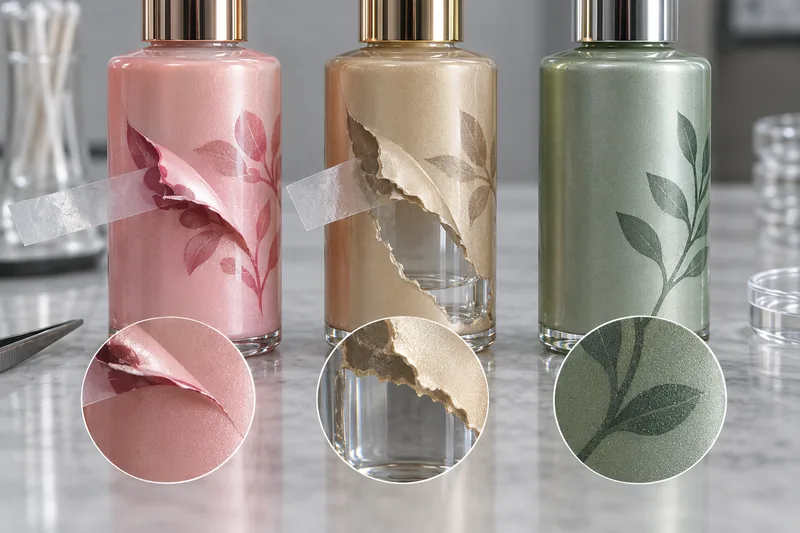
| Was du beobachtest | Likely failure location | Erste Überprüfungen |
|---|---|---|
| Ink transfers; substrate or lacquer stays intact | Within ink or at ink/top-surface interface | Cure, mixing, contamination, treatment, ink compatibility |
| Ink and colored coating leave together; clear glass/plastic is exposed | Coating/substrate interface | Coating pretreatment, bake, contamination and chemical resistance |
| Ink splits; some remains on bottle and some on tape | Cohesive failure within ink | Film build, cure, hardener ratio, solvent attack, brittleness |
| Only the top color separates from an underprint | Between ink layers | Intercoat window, contamination, cure sequence and ink-series compatibility |
How the substrate changes the adhesion problem
There is no “best ink for cosmetic bottles” independent of the surface. Resin grade, additives, recycled content, molding conditions and surface finish can change printability within the same nominal material. Always approve the actual production construction.
PE and PP: low surface energy and flexible walls
Untreated polyethylene and polypropylene are difficult for many inks to wet. Controlled flame, corona or plasma treatment can oxidize the outermost surface and improve wetting and compatibility. LyondellBasell’s technical guidance for polyethylene containers emphasizes that treatment settings, line speed, storage delay and surface contamination all matter. A dyne test is useful as a process screen, but it is not proof of adhesion and one target cannot be applied universally to every resin and ink.
Flexible bottles create a second requirement: the cured film must tolerate squeeze and recovery. A hard film can pass on a rigid plaque yet crack on the finished bottle. When selecting Kosmetikflaschen aus Kunststoff, qualify the molded surface, decoration and expected flex as one system.
PET and PETG: cleaner wetting does not remove the need to test
PET and PETG may print more readily with a compatible ink, but mold-release residues, dust, antistatic agents, recycled-content changes, surface treatments and aggressive solvents can still create failures. A transparent bottle also makes visual defects more obvious. Solvent selection must consider the possibility of haze, stress cracking or damage to a color coating as well as the printed film.
Bare glass, spray-coated glass and frosted glass
Glass is high-energy but not automatically clean or printable. Oils, silicone, graphite from forming operations, dust and moisture can interfere. Two-component glass inks may require a precise ink-to-hardener ratio and controlled cure. Technical sheets from established ink makers such as Marabu also require preliminary trials and clean surfaces; their published cure conditions are system-specific, not universal factory recipes.
On spray-coated glass, the lacquer—not the glass—is the ink substrate. The lacquer must be compatible with the ink and bonded to the glass. Ask a cosmetic glass packaging supplier to state the complete decoration stack and to retain production samples by bottle, coating and print lot.
A controlled factory workflow for durable bottle printing
The broad Siebdruckverfahren für Flaschen covers artwork, screens, setup and production in detail. For adhesion troubleshooting, focus on the variables below and connect each one to a record that can be reviewed after a failure.
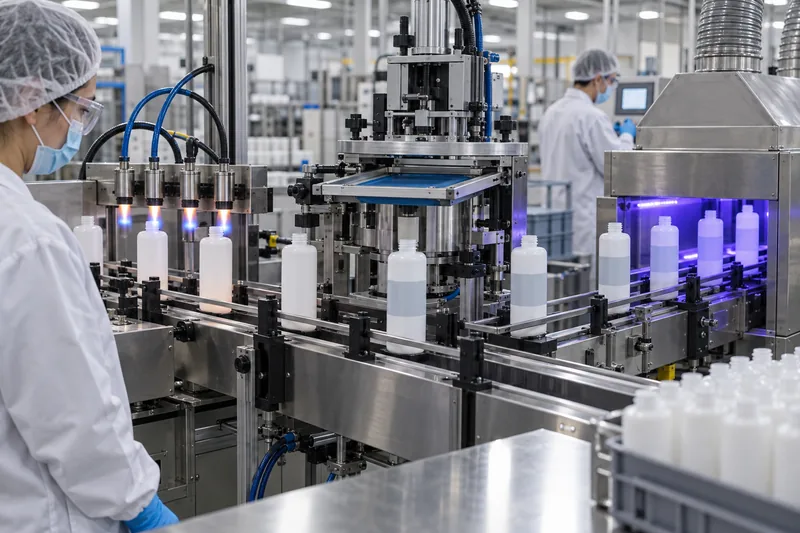
- Approve the construction and risk specification: identify resin grade or glass/coating stack, color, additives, artwork, filled formula, leak paths and use environment. A change from virgin to PCR resin, or from one clear coat to another, is a qualification change.
- Qualify production-equivalent samples: trial the actual molded bottle, every critical color and the intended decoration sequence. Flat plaques and laboratory-prepared “golden samples” do not represent bottle curvature, flex or coating variation.
- Control incoming and pre-print cleanliness: verify the correct bottle/coating lot and control dust, condensation, mold release, silicone, hand oils and cleaning-agent residue. Use clean handling and a defined maximum delay before printing.
- Apply validated pretreatment: define flame, corona, plasma or primer settings for the bottle geometry. Record equipment output and line speed. Surface-energy checks can monitor the window, but actual adhesion testing remains necessary.
- Mix the approved ink system: identify ink series, shade and batch; weigh hardener/catalyst and reducer to the approved ratio; record mixing time and discard time. Do not extend pot life or blend old two-component ink into a new batch unless the ink manufacturer expressly validates the practice.
- Lock the print window: control screen mesh, stencil, squeegee, viscosity, bottle fixture, print speed, registration and number of passes. Excess film can trap solvent or cure unevenly; too little can reduce opacity and wear life.
- Verify cure rather than trusting a setpoint: for thermal or air-cured systems, control time, bottle-surface temperature, airflow and conditioning. For UV systems, monitor irradiance/energy, spectrum, lamp condition, distance and line speed. Conveyor temperature alone does not prove bottle exposure or cure.
- Hold for the valid conditioning period: “dry to touch” is not the same as final chemical resistance. Some systems continue to develop properties for days. Use the named ink’s technical data sheet and define the earliest valid release-test time.
- Release with complementary tests: inspect appearance and registration, then run the agreed tape, dry-rub, alcohol/formula and flex or pack-contact tests. Sample the beginning, middle and end of the run and any meaningful bottle/coating lots.
- Retain evidence and control changes: keep batch records, test results, photographs and retained decorated samples. Require reapproval when the bottle resin/coating, ink, hardener, printer, treatment or cure route changes.
Environment matters when the selected system says it matters. Temperature affects ink viscosity, evaporation and reaction rate; high humidity or condensation can interfere with moisture-sensitive hardeners or surface cleanliness; dust can create pinholes and weak spots. Record actual conditions and follow the chosen ink supplier’s limits rather than copying a temperature or humidity figure from an unrelated ink. For example, one current Marabu two-component glass-ink sheet warns against curing below 15°C and against high humidity for several hours after printing, while a Nazdar container-ink page states that its named system reaches final properties after 5–7 days. Those are product-specific examples, not universal factory settings.
Which tests measure ink adhesion and durability?
No single test answers every question. Build a compact test matrix based on the intended failure mechanisms. The general Prüfplan für Kosmetikflaschen should then connect decoration checks to leakage, compatibility, distribution and line trials.
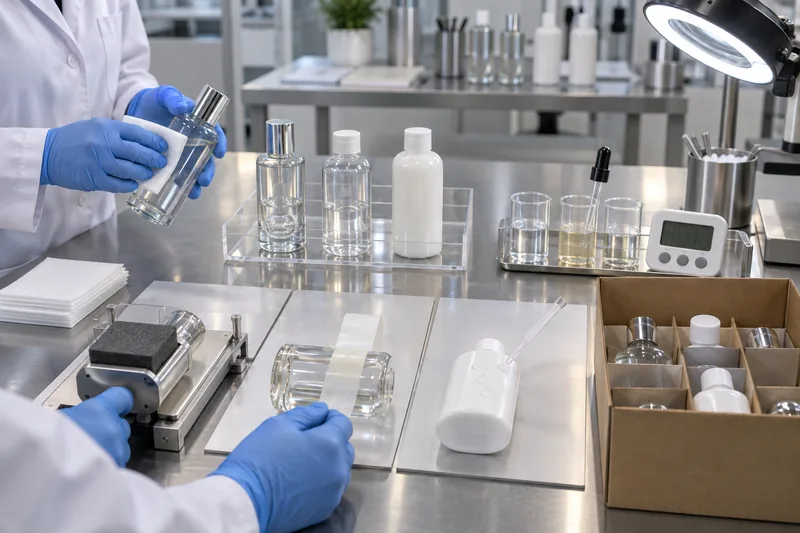
| Test | What it challenges | Was er nicht belegt | Use in a bottle plan |
|---|---|---|---|
| Tape pull, no cut | Gross attachment of print to curved surface | Chemical or abrasion resistance | Fast production screen when tape and method are controlled |
| Cross-cut/tape | Resistance to separation around controlled cuts | Absolute adhesion strength; suitability on every curve/texture | Use only where geometry and film system make the method applicable |
| Dry rub/abrasion | Wear, scuffing and transfer under friction | Resistance to formula or solvent | Match contact material, load and movement to handling/distribution risk |
| Alcohol/formula wet rub | Combined chemical attack and wiping | The separate contribution of chemistry versus abrasion | Useful field simulation when every variable is written |
| Spot or immersion exposure | Chemical resistance over a defined contact time | Abrasion or repeated handling | Compare controls after actual formula, components or challenge liquids |
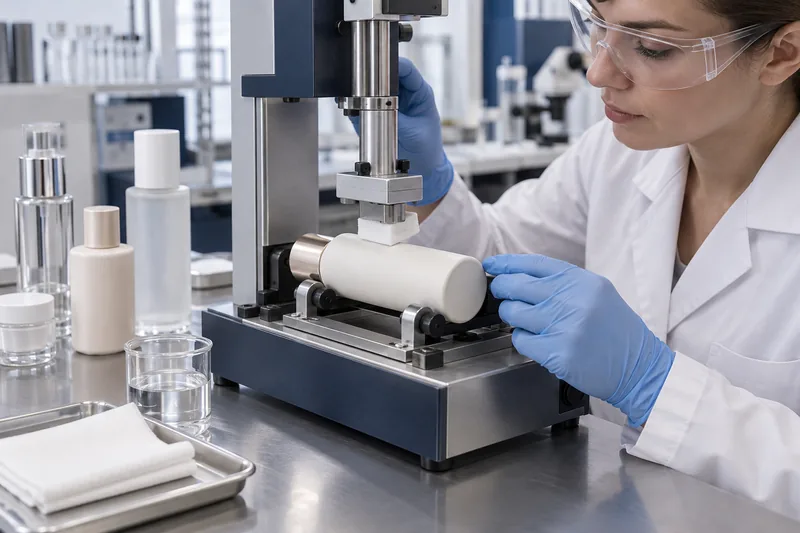
| Pack/line simulation | Real contact points, vibration, guides, dividers and filling handling | All shelf-life chemistry | Confirms whether lab tests represent the real package route |
Use standards accurately, not decoratively
ASTM D3359 and ISO 2409 are often cited for tape/cross-cut assessment, but neither should be presented as an absolute adhesion-strength measurement. ASTM D3359 notes that its methods indicate minimum adhesion and that operator, tape, angle, rate, temperature and humidity can influence results; its primary scope is coatings on metallic substrates. ISO 2409 describes an empirical cross-cut classification and also states that it is not a measurement of adhesion. Curved bottles and small printed characters may require an agreed adaptation or a different method.
ASTM D5264 uses a reciprocating rub tester to assess abrasion resistance of printed packaging and related materials, especially flat specimens. It can inform a bottle method, but curved geometry and contact pressure must be defined. ASTM D5402 addresses solvent rubs for organic coatings that change chemically during cure, yet it does not prescribe one solvent, cycle count or expected result and warns that solvent resistance alone does not prove full cure. ISO 2836 covers the resistance of prints to various agents, while ISO 2812-1 covers coating resistance to liquids by immersion. Choose the document that matches the question and construction.
How to write a reproducible alcohol and rub specification
A useful specification allows a supplier, brand laboratory and third-party inspector to reproduce the same challenge. Replace “alcohol resistant” or “rub 100 times” with the following controlled fields:
- Sample identity: finished bottle, substrate/coating/ink construction, color, production lot and whether filled or empty.
- Konditionierung: time after printing, temperature/humidity if controlled, and any heat aging or formula exposure before testing.
- Challenge liquid: chemical identity, concentration, supplier/grade, or the exact marketed formula; define whether the cloth stays saturated.
- Contact material: cloth, felt, cotton pad or abrasion surface, with size and replacement frequency.
- Mechanical variables: load or force, stroke length, speed and location. Define whether one cycle is one pass or one forward-and-back double rub.
- Exposure: cycle count or contact time, including dwell periods and when observations are made.
- Annahme: permitted color transfer, gloss change, smear, edge lift, exposed substrate, legibility change and coating damage. Add reference photos or a control standard.
- Bemusterung: units per lot, locations tested per unit, destructive-test disposition and rule for retest or rejection.
Set acceptance criteria from actual product risk. An alcohol-rich fragrance bottle that may leak around a crimp requires a different challenge from a rinse-off shampoo bottle. Critical instructions, legally required information and traceability codes need special protection. In the EU, Article 19 of the Cosmetics Regulation requires specified container and packaging information in indelible, easily legible and visible lettering. In the United States, FDA rules require mandatory information to be prominent and conspicuous; that wording is not identical, so confirm market-specific labeling with regulatory counsel.
Use three acceptance levels instead of one vague “pass”
A practical drawing or quality agreement can distinguish critical, funktionell und zur Kosmetik outcomes. Loss of required warnings, ingredient information, batch identification or directions can be critical even when only a small area is affected. Loss that makes the brand or product identity unreadable is a functional failure. A slight, agreed gloss change that leaves color, edges and legibility intact may be cosmetic—if the approved sample and viewing conditions permit it. This hierarchy prevents a supplier from averaging serious text loss into a general visual score.
Define inspection timing too. Test pre-production samples before signing the decoration approval, first-off pieces at line start, periodic production samples after the valid conditioning window, and retained units after relevant aging. Sample across the beginning, middle and end of the run and across cavities or coating lots where traceability allows. A single “golden sample” made under laboratory attention cannot demonstrate that the production window is controlled.
If a numerical scale is used, pair it with photographs. State whether ratings are assigned immediately after exposure or after a recovery period, because some films temporarily soften or whiten. Record both the rating and the failure mode—transfer, smear, peeling, fading, gloss loss, cracking or coating lift—so trend data points to a mechanism instead of becoming a row of unexplained numbers.
How to protect printed words and logos correctly
Use a hierarchy of controls. Protection begins with a stable interface and correctly cured film; barriers and pack design come after that.
- Engineer the base system: approve the exact bottle/coating, ink series, primer if needed, pretreatment and cure route using production-equivalent samples.
- Keep print away from predictable attack: avoid a fragrance leak path below the crimp, a pump collar contact ring, squeeze crease, conveyor guide or carton pressure point when artwork can be repositioned.
- Add a compatible barrier only after validation: a clear coat can improve wear or chemical resistance, but it introduces new interfaces, gloss/color changes and cure requirements. It cannot make poor base adhesion sound.
- Protect during transport: use clean trays, sleeves, partitions or surface-safe interleaves that prevent decorated areas from rubbing each other. Confirm that packaging materials do not block, imprint or transfer additives.
- Choose another decoration when exposure demands it: a pressure-sensitive label with qualified face stock/adhesive/overlaminate, a shrink sleeve, in-mold decoration, protected hot stamp, etched/laser mark or decoration under a transparent outer wall may suit some designs better. Each alternative needs its own compatibility and legibility assessment.
Cosmetic packaging ink adhesion troubleshooting matrix
| Fehlermuster | High-value hypotheses | Verification and correction |
|---|---|---|
| Print peels immediately with tape | Contamination; inadequate/decayed treatment; incompatible ink; wrong top surface | Compare cleaned and untreated controls; verify resin/coating and treatment record; run ink-supplier trial on actual bottles |
| Passes initially, fails after alcohol | Incomplete cure; wrong hardener/ratio; chemical incompatibility; coating softened | Check mix/pot-life/cure data; compare aged controls; inspect failed layer; challenge fully cured candidate inks with actual formula |
| Only one color fails | Color-specific pigment/additive, opacity-driven thickness, mixing or cure difference | Compare batch records, film build and cure by color; requalify that exact shade instead of approving “the ink series” broadly |
| Only one bottle lot or cavity fails | Resin/additive variation, mold release, treatment shadow, contamination or geometry | Map failures by mold/cavity/lot; test surface condition; audit handling and treatment access |
| Fails at shoulder, seam or recessed panel | Nonuniform print/cure/treatment; local flex; contact point | Map equipment exposure and pack contact; adjust artwork zone, fixture, print path or curing geometry |
| Cracks when bottle is squeezed | Film too brittle/thick; ink not designed for flexible substrate; overcure | Run flex after full cure and aging; confirm flexible-substrate ink and controlled film build |
| Passes lab tests, scuffs in shipment | Test does not reproduce carton contact, vibration, dust or load | Recreate contact stack; inspect damage direction; change dividers/interleaves and add distribution simulation |
| Ink and lacquer detach together | Coating-to-bottle failure, not merely print adhesion | Quarantine the coated-bottle lot; audit coating preparation/bake/chemistry; do not solve by changing only the ink |
What should you do when a production lot fails?
- Stop and segregate: identify printed, unprinted, packed and shipped quantities. Protect retained controls and do not continue rubbing samples informally.
- Confirm the method: verify the failure is reproducible with the written test and a known-good control. Check conditioning time and sample identity.
- Locate the failure plane: document close photographs and what transferred. Compare dry tape, dry rub and static chemical exposure to separate mechanisms.
- Review traceability: bottle/coating/ink/hardener lots, ratios, timestamps, pot life, operator, treatment settings, cure settings and environmental records.
- Run one-variable trials: use approved technical support from the ink and substrate/coating suppliers. Change one controlled variable at a time and retest after the valid cure window.
- Approve rework before mass action: stripping, solvent wiping, overprinting or clear coating may haze, craze, distort, contaminate or weaken the package. Validate appearance, dimensions, compatibility, odor and functional performance on a pilot lot.
- Close the system gap: update drawings, specifications, control plans, golden samples and change-control rules so the root cause cannot silently return.
Do not accept a supplier’s “we increased the oven temperature” as closure by itself. Ask for the failure mechanism, evidence from production-equivalent samples, the revised control limit and the record that will prove compliance on future lots. If a package layer, ink series, resin, coating, hardener, printing plant or curing route changes, define whether brand approval and compatibility revalidation are required before production.
Buyer’s ink-adhesion approval checklist
- Identify the bottle resin or glass construction and every coating/primer layer under the print.
- Provide the actual formula, likely leak paths, cleaning exposure and target markets under controlled confidentiality.
- Approve each decoration color and finish on production-equivalent bottles, not only a flat plaque.
- Define pretreatment, ink system, auxiliaries, cure and minimum conditioning time as controlled parameters.
- Use complementary tape, dry-rub, wet-rub/formula and pack/line tests with written pass criteria.
- Require traceability by bottle/coating/ink lot and retain approved and production samples.
- Protect critical information and ensure market-specific labeling remains legible through intended use.
- Require prior approval for resin, coating, ink, hardener, printer, treatment or cure-process changes.
For a custom project, send Boyu the bottle material, surface finish, artwork, formula category, target market and durability risks. Our team can align decoration trials with the bottle construction and help define production samples for approval. Discuss your cosmetic bottle decoration requirements before the bulk-printing window is locked.
Häufig gestellte Fragen
Is 70% alcohol always the correct bottle-print test?
No. It may be a useful challenge for some products or cleaning scenarios, but it is not a universal specification. Select the actual exposure risk and define alcohol type, concentration, cloth, saturation, load, stroke, cycles, conditioning and pass criteria. Also test the marketed formula where leakage or consumer contact is plausible.
Does a high dyne reading guarantee good ink adhesion?
No. Surface energy affects wetting, but adhesion also depends on contamination, surface chemistry, ink compatibility, film build and cure. Dyne pens and solutions are sensitive to technique, contamination and age. Use them to monitor a validated process, then confirm with adhesion and service-resistance tests.
Will a clear coat stop the logo from rubbing off?
It may improve abrasion or chemical resistance if the clear coat is compatible and fully cured, but it creates another layer and cannot reliably repair weak ink-to-substrate adhesion. Validate appearance, intercoat adhesion, formula resistance and cure on the exact package.
Why does only one printed color peel?
Colors within one ink family can differ in pigment loading, additives, opacity, film thickness and cure response. The failing color may also have been mixed or printed separately. Qualify each critical production shade and examine its batch, mix, film build and cure record.
Can printing that already peels be repaired?
Sometimes, but only after a controlled pilot. Removing ink can attack plastic or a spray coating; overprinting may not bond to the failed layer; and a topcoat can hide rather than correct the cause. Quarantine the lot, identify the interface, validate the proposed rework and repeat appearance, compatibility and function checks.
Need decoration that survives the real formula and supply chain?
Send the exact bottle construction, artwork, formula category and target exposure. Boyu Packaging can coordinate production-equivalent decoration samples and an agreed approval plan before bulk production.
Quellen und technische Referenzen
Standards define methods and limitations; ink technical sheets apply only to the named systems. Accessed October 5, 2026.
- ASTM D3359-23 — Measuring Adhesion by Tape Test
- ISO 2409:2020 — Paints and varnishes: cross-cut test
- ASTM D5264-98(2019) — Abrasion Resistance of Printed Materials by the Sutherland Rub Tester
- ASTM D5402-19(2024) — Solvent Rubs for Assessing Solvent Resistance of Organic Coatings
- ISO 2836:2021 — Resistance of prints to various agents
- ISO 2812-1:2017 — Determination of resistance to liquids: immersion
- LyondellBasell — Adhering Labels and Inks to Plastic Containers
- Marabu — Glass Ink GL Technical Data Sheet
- Nazdar — 5100 Series Container Screen Ink
- Nazdar — Making Ink Stick
- Sun Chemical — Ink Troubleshooting: Adhesion
- Enercon — Using Dyne Solutions and Pens to Measure Surface Energy
- Regulation (EC) No 1223/2009 on Cosmetic Products, Article 19
- U.S. FDA — Cosmetics Labeling Regulations
 English
  Español de Argentina
  Русский
  Italiano
  日本語
日本語  한국어
한국어  العربية
  Français
  Deutsch