Airless Pump Bottles Explained (Complete Guide)
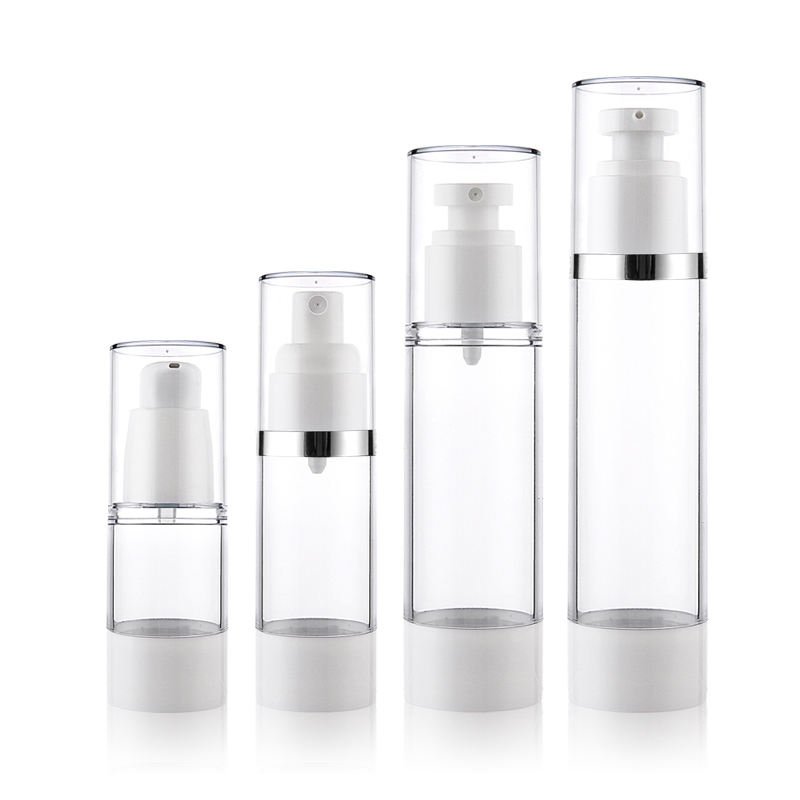
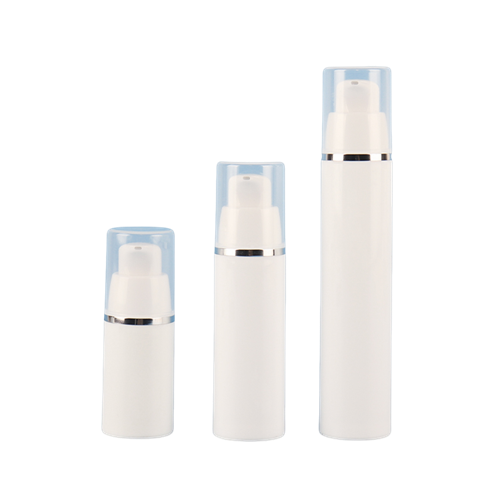
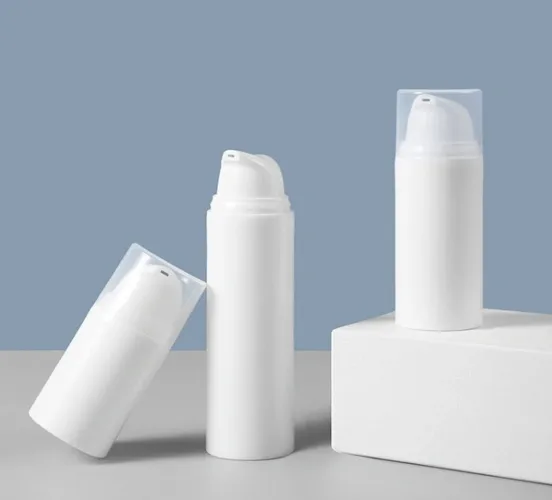
Airless pump bottles are widely used in luxury skincare, foundation, serum, and pharmaceutical packaging because they protect formulas from air exposure. Unlike normal pump bottles, they do not use a dip tube. Instead, they rely on a vacuum system to push product upward.
This guide explains:
- How airless bottles work
- Internal structure & key parts
- Manufacturing process
- Materials comparison
- Factory production flow
- Common failures & troubleshooting
- Cost breakdown
- Buyer FAQs
1. How Airless Pump Bottles Work (Simple Principle)
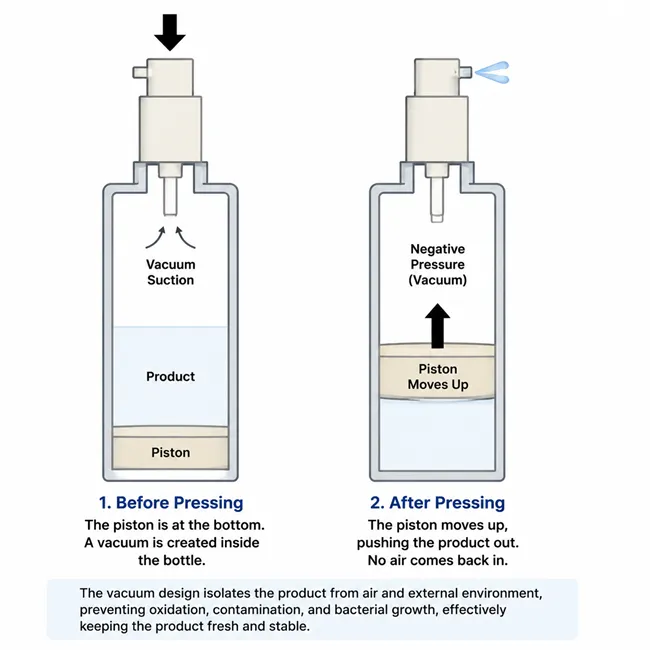
Airless pump bottles use a vacuum piston system.
Working process:
- You press the pump
- Air inside is not allowed to enter
- A vacuum is created
- The piston rises upward
- Product is pushed out without air contamination
👉 No air comes back into the bottle = “Airless system”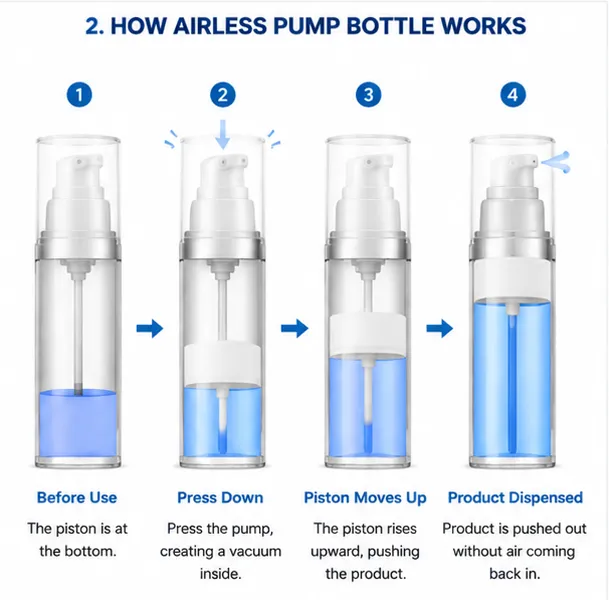 2. Core Structure & Components
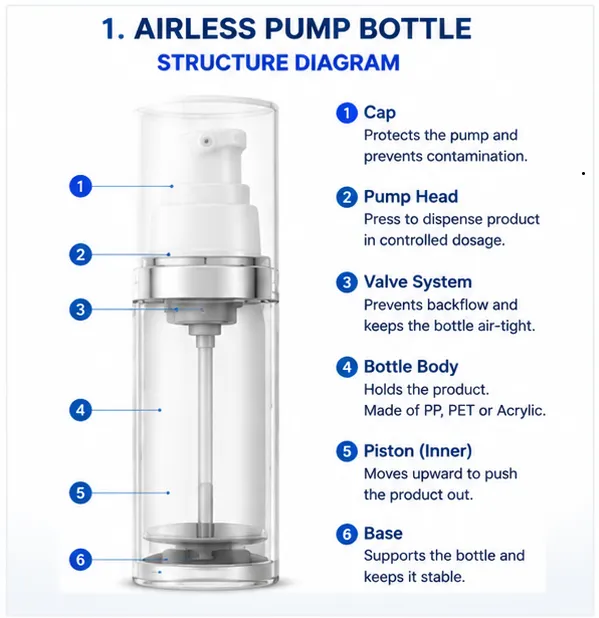
An airless bottle is made of 6 main parts:
1. Bottle Body
- Stores product
- Usually PET, PP, or acrylic
2. Inner Piston (Key part)
- Moves upward when pumping
- Pushes product upward
3. Pump Head
- Dispenses product
- Controls dosage
4. Nozzle / Valve System
- Prevents backflow
- Controls smooth output
5. Spring System (in some designs)
- Helps pump reset
6. Cap / Cover
- Protects pump
- Prevents contamination
3. What Each Part Does (and What Happens If It Breaks)
| Part | Function | If It Breaks |
|---|---|---|
| Piston | Pushes product upward | Product cannot rise |
| Pump head | Dispensing control | No output or leaking |
| Valve | Prevents air return | Product backflow / contamination |
| Bottle body | Holds product | Leakage or deformation |
| Spring | Pump reset force | Weak pumping / stuck pump |
| Cap | Protection | Dust contamination |
👉 Most failures come from pump head or valve system issues
4. Types of Airless Pump Bottles
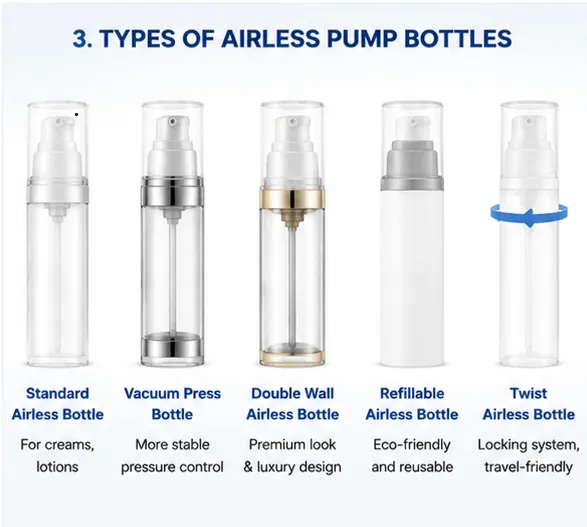
1. Standard Airless Bottle
- Basic piston system
- Used for creams & lotions
2. Vacuum Press Bottle
- More stable pressure control
- Better for serums
3. Double Wall Airless Bottle
- Premium cosmetic packaging
- Luxury skincare brands
4. Refillable Airless Bottle
- Sustainable design
- Popular in eco beauty brands
5. Twist Airless Bottle
- Locking system
- Travel-friendly
5. Main Materials (Comparison)
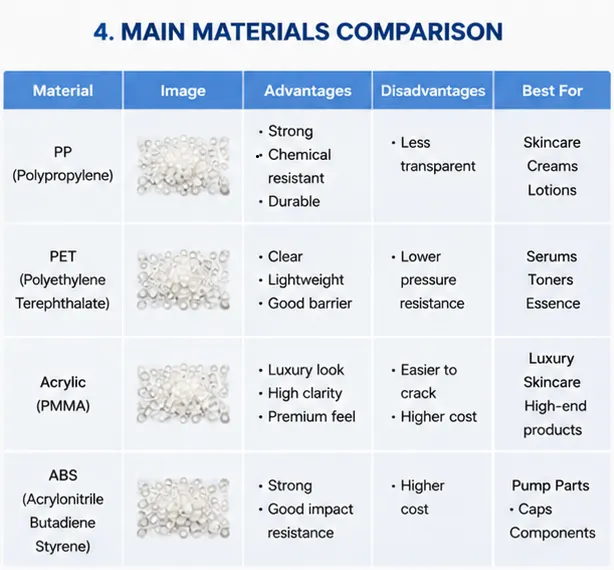
| Material | Advantages | Disadvantages |
|---|---|---|
| PP (Polypropylene) | Strong, chemical resistant | Less transparent |
| PET | Clear, premium look | Lower pressure resistance |
| Acrylic | Luxury appearance | Easier to crack |
| ABS (pump parts) | Strong structure | Higher cost |
👉 Best choice:
- Skincare → PP / PET
- Luxury brands → Acrylic + PP combination
6. Airless Bottle Manufacturing Process
Step 1: Raw Material Preparation
- PP pellets / PET resin
- Additives for strength & color
Step 2: Injection Molding
- Bottle body molded
- Pump components produced
Step 3: Assembly Line
- Piston inserted
- Pump system assembled
Step 4: Vacuum Testing
- Ensure airless function works
Step 5: Printing & Decoration
- Silk screen printing
- Hot stamping
- UV coating
Step 6: Final QC
- Leakage test
- Pump cycle test
- Drop test
Step 7: Packaging
- Export cartons
- Foam protection
7. Required Machines in Factory
- Injection molding machine
- Automatic assembly line
- Vacuum testing machine
- Printing machine (silk screen / UV)
- Leak testing equipment
- Packaging line
8. Production Cost Breakdown (Industry Range)
| Component | Cost Level |
|---|---|
| Bottle body | Low–medium |
| Pump system | Medium–high |
| Decoration | Medium–high |
| Assembly | Low |
| Packaging | Low |
👉 Total cost depends on:
- Material type
- Decoration level
- Pump quality
- MOQ size
9. Common Problems in Airless Bottles
Problem 1: Pump not working
- Air leakage inside system
- Poor piston alignment
Problem 2: Product not coming out
- Piston stuck at bottom
- Vacuum failure
Problem 3: Leakage
- Poor sealing ring
- Low-quality valve
Problem 4: Uneven dispensing
- Weak spring system
- Poor pump design
10. Target Users & Market Position
Main buyers:
- Skincare brands
- Cosmetic OEM brands
- Luxury beauty companies
- Pharmaceutical skincare products
- Eco-friendly beauty brands
Product positioning:
- Mid-to-high-end cosmetic packaging
- Strong focus on product protection
11. Buyer-Friendly Explanation (Simple Version)
Airless bottles are like a “sealed elevator system”:
- Product moves upward
- Air never enters inside
- Formula stays fresh longer
👉 That’s why luxury skincare brands prefer it.
12. Frequently Asked Questions
Q1: Why use airless bottles instead of normal pumps?
Because they prevent oxidation and keep ingredients stable longer.
Q2: Can airless bottles work upside down?
Yes, because there is no dip tube system.
Q3: Are airless bottles recyclable?
Yes, most PP and PET versions are recyclable.
Q4: What products are NOT suitable?
Very thick balms or solid creams may block the pump.
Q5: What is the lifespan of an airless pump?
Usually 3,000–10,000 pump cycles depending on quality.
Summary
Airless pump bottles are a high-performance cosmetic packaging system that:
- Protects formulas
- Improves user experience
- Extends product shelf life
- Fits premium skincare branding
 English
  Español de Argentina
  Русский
  Italiano
  日本語
日本語  한국어
한국어  العربية
  Français
  Deutsch