Foam Pump Bottles: Structure, Working Principle and Manufacturing Guide
A foam pump bottle is more than a plastic bottle fitted with a special pump. The pump is a small mechanical mixing system that combines a liquid formula with air and pushes the mixture through a fine mesh to create foam.
For cosmetic and personal care brands, the quality of the pump matters as much as the bottle itself. A good bottle may look attractive on a retail shelf, but if the pump produces watery bubbles, becomes stuck after several uses, or leaks during shipping, consumers usually blame the entire product.
As a cosmetic packaging manufacturer, Boyu Packaging develops foam pump bottle solutions for facial cleansers, hand wash, baby care, body care and other liquid formulations. This guide explains the bottle from a manufacturer’s point of view: how the pump works, which components are critical, what can go wrong, and how foam bottles are actually produced.
What Is a Foam Pump Bottle?
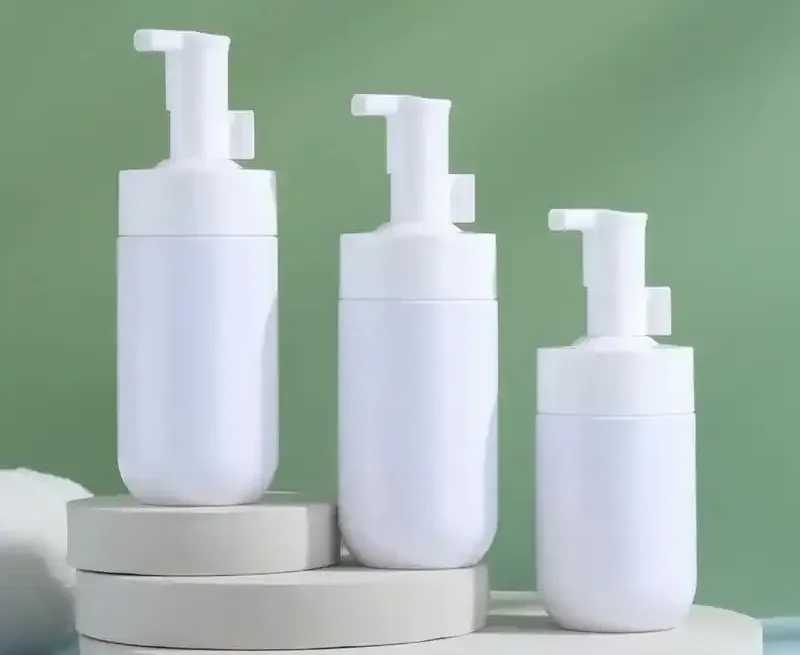
A foam pump bottle is a dispensing package that turns a suitable liquid formula into foam during dispensing.
The bottle itself does not normally contain ready-made foam. Inside the container is a liquid formulation. When the consumer presses the pump, the dispensing system draws both liquid and air into the pump chamber. These two streams mix before passing through a mesh screen.
The result is a soft foam or mousse.
This makes foam pumps useful for products where brands want:
- A lighter application feel
- Controlled dispensing
- Less direct liquid waste
- Easy spreading
- A more convenient washing experience
- A visible difference from a standard lotion pump
How Does a Foam Pump Bottle Work?
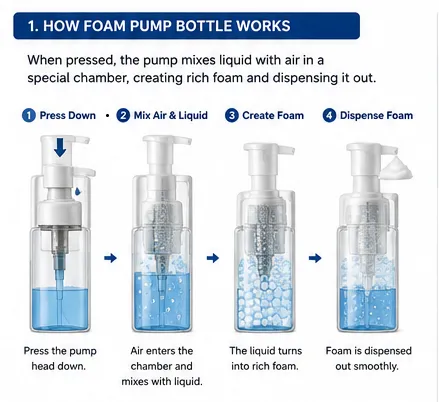
The working principle can be divided into five simple stages.
Step 1: The Consumer Presses the Pump
Pressing the actuator moves the internal pump mechanism downward.
This action changes the pressure inside the pump chamber.
Step 2: Liquid Is Drawn from the Bottle
The dip tube carries the liquid formulation from the bottom of the bottle into the liquid chamber.
A valve helps control the direction of flow.
Step 3: Air Enters the Air Chamber
At the same time, the pump draws in a measured volume of air.
A foam pump therefore handles two media: liquid and air.
This is one of the main differences between a foam pump and a standard lotion pump.
Step 4: Air and Liquid Are Mixed
The two streams meet inside the mixing chamber.
The pump structure controls the approximate air-to-liquid mixing behaviour. Formula viscosity and surfactant system also affect the final result.
Step 5: The Mixture Passes Through the Mesh
The mixed liquid and air pass through one or more fine mesh screens.
The mesh breaks large bubbles into smaller bubbles and creates a more uniform foam.
The finished foam then exits through the nozzle.
In simple terms: liquid + controlled air + mechanical mixing + mesh = foam.
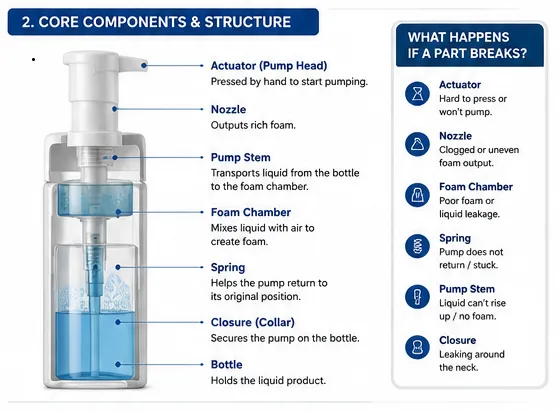
Core Components of a Foam Pump Bottle
A foam pump system contains more components than many buyers expect.
| Component | Main Function | Possible Problem If Damaged |
|---|---|---|
| Actuator | The part pressed by the user | Difficult pressing or no dispensing |
| Nozzle | Directs foam out of the pump | Poor foam shape or side leakage |
| Air Chamber | Controls incoming air | Wet or watery foam |
| Liquid Chamber | Draws and meters formula | Unstable dosage |
| Mixing Chamber | Combines liquid and air | Large, uneven bubbles |
| Mesh Screen | Refines the foam | Poor foam or pump blockage |
| Valve | Controls liquid flow direction | Backflow or loss of prime |
| Spring | Returns the actuator | Pump stays down or rebounds slowly |
| Dip Tube | Draws liquid from the bottle | Product remains at the bottom |
| Gasket / Seal | Prevents leakage | Leakage during use or shipping |
| Closure | Connects pump and bottle | Loose pump or neck leakage |
| Bottle Body | Holds the formula | Deformation, cracking or leakage |
What Happens When a Foam Pump Component Fails?
The Pump Produces Watery Foam
This is often related to the air and liquid mixing system.
Possible causes include:
- Insufficient air intake
- Formula viscosity is too high
- Incorrect surfactant system
- Damaged air chamber
- Mesh contamination
Changing the bottle alone will not normally solve this problem.
The Pump Does Not Dispense
First, check whether the pump has been primed.
A new foam pump may require several presses before liquid reaches the chamber.
If it still does not work, possible reasons include:
- Dip tube blockage
- Valve failure
- Air leakage
- Incorrect pump assembly
- Formula too viscous
The Pump Head Stays Down
The return spring or internal actuator structure may be damaged.
Product residue can also dry around the moving parts and restrict movement.
The Bottle Leaks Around the Neck
Common reasons include:
- Incorrect neck finish
- Pump and bottle thread mismatch
- Damaged gasket
- Insufficient tightening torque
- Bottle neck dimensional variation
For OEM projects, we recommend testing the bottle, pump and formula as one complete packaging system.
The Pump Creates Large Bubbles
Large bubbles usually indicate poor foam refinement.
The mesh structure, air ratio and formulation should all be checked.
A pump that works well with hand wash may not create the same foam with an amino acid facial cleanser.
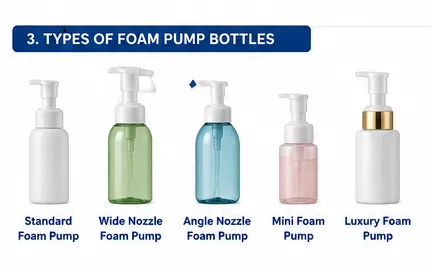
Main Types of Foam Pump Bottles
Standard Hand Foam Pump Bottle
This is the most common structure.
Typical capacities include 250ml, 300ml and 500ml.
Best for:
- Foaming hand wash
- Household soap
- Body wash
The main advantage is cost control and mature pump availability.
Facial Cleanser Foam Pump Bottle
These bottles are commonly used for amino acid cleansers and mousse face wash.
Typical capacities:
- 100ml
- 120ml
- 150ml
- 200ml
Brands usually pay more attention to foam density, smooth pump actuation and the appearance of the bottle.
Mousse Pump Bottle
A mousse pump is designed to create rich, soft foam.
It is commonly selected for:
- Facial mousse
- Hair mousse formulas
- Body cleansing mousse
- Special cosmetic treatments
The formula must be tested before production.
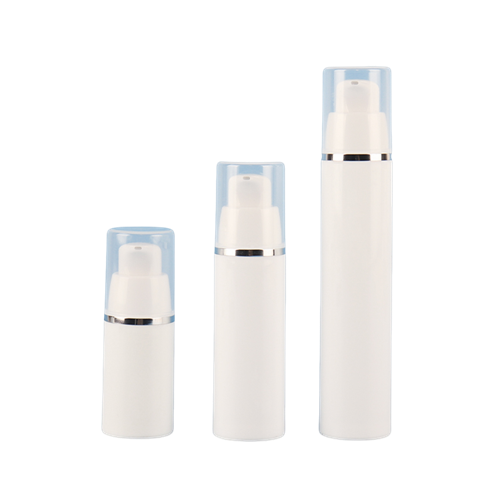
Mini Foam Pump Bottle
Typical sizes range from 30ml to 100ml.
These bottles work well for:
- Travel sets
- Hotel amenities
- Trial products
- Promotional skincare kits
Small foam pumps require careful structural design because the pump takes up a relatively large part of the package.
Large-Capacity Foam Pump Bottle
Typical capacities include 500ml, 750ml and 1,000ml.
Suitable for:
- Family-size hand wash
- Salon products
- Spa products
- Professional personal care
A larger bottle needs better wall strength and base stability.
Refillable Foam Pump Bottle
Refillable packaging is increasingly considered by brands developing repeat-purchase systems.
The pump may be reused while the bottle or inner container is refilled.
The main challenge is maintaining pump cleanliness and foam performance over repeated use.
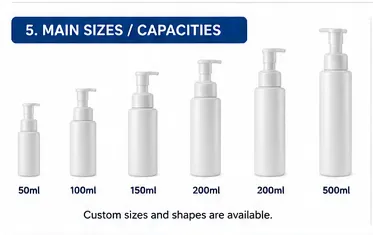
Popular Foam Pump Bottle Sizes
| Capacity | Typical Application | Market Position |
|---|---|---|
| 30–50ml | Samples and travel sets | Trial / Travel |
| 80–100ml | Travel cleanser | Compact Skincare |
| 120–150ml | Facial cleanser | Standard Retail |
| 200ml | Face and body cleansing | Personal Care |
| 250–300ml | Hand wash | Mainstream |
| 400–500ml | Family-size cleanser | Home / Family |
| 750–1000ml | Salon and professional use | Bulk / Professional |
For a facial cleanser, 120ml–200ml is often a practical starting range.
For hand wash, 250ml–500ml remains more common.
Capacity alone should not determine bottle size. Pump height, shoulder shape, wall thickness and bottle weight all affect the final dimensions.
Main Materials Used for Foam Pump Bottles
PE / HDPE
PE is widely used for personal care bottles.
Advantages
- Good impact resistance
- Lightweight
- Cost-effective
- Suitable for blow molding
- Good chemical resistance
- Recyclable options available
Disadvantages
- Lower transparency
- Softer appearance than PET
- Not always suitable for a high-gloss luxury look
Best for: hand wash, baby wash and everyday personal care.
PET
PET is popular when the brand wants a clear or highly polished bottle.
Advantages
- Good transparency
- Attractive retail appearance
- Good dimensional stability
- Wide decoration possibilities
Disadvantages
- Less squeezable than PE
- Formula compatibility still requires testing
- Clear bottles expose the formula to light
Best for: facial cleansers and premium personal care.
PP
PP is especially important in foam pump components.
Advantages
- Good chemical resistance
- Lightweight
- Durable
- Suitable for injection molding
- Widely used in pump structures
Disadvantages
- Lower transparency
- Standard PP can look less luxurious without decoration
Best for: pump heads, closures and internal components.
PCTG
PCTG is used when appearance is a priority.
Advantages
- High clarity
- Premium visual effect
- Good impact performance
- Suitable for luxury cosmetic packaging
Disadvantages
- Higher material cost
- Higher overall packaging price
Best for: premium skincare and high-value cleansing products.
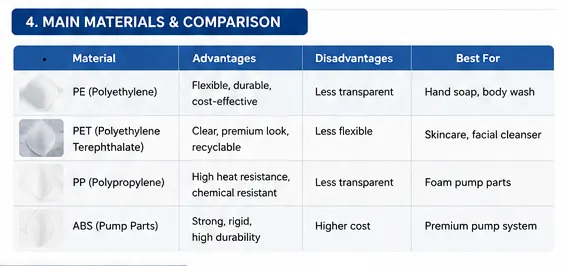
Material Comparison
| Material | Clarity | Durability | Cost | Typical Use |
|---|---|---|---|---|
| PE | Low | High | Low | Personal care |
| HDPE | Low | Very High | Low–Medium | Hand wash |
| PET | High | High | Medium | Facial cleanser |
| PP | Low–Medium | High | Low–Medium | Pump components |
| PCTG | Very High | High | High | Premium skincare |
There is no single “best material.”
The correct material depends on the formula, target price, brand positioning and required visual effect.
How a Foam Pump Bottle Factory Produces the Packaging
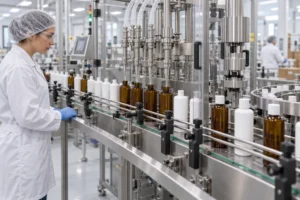
From a manufacturer’s perspective, production is divided into bottle manufacturing, pump component manufacturing, assembly, decoration and inspection.
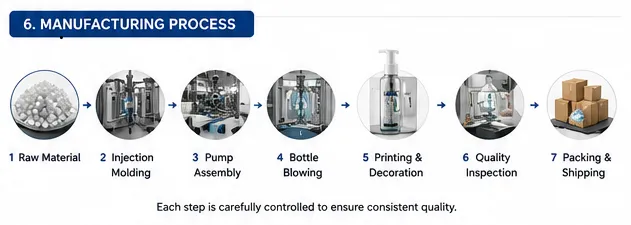
1. Raw Material Preparation
Common raw materials include:
- PE resin
- HDPE resin
- PET resin
- PP resin
- PCTG resin
- Masterbatch
- Color additives
- Metal springs
- Gaskets and sealing components
The factory checks material batches before molding.
For custom colours, masterbatch is adjusted according to the approved colour standard or Pantone reference.
2. Bottle Production
PE and HDPE bottles are generally produced through extrusion blow molding.
PET bottles may use injection stretch blow molding or related bottle production systems.
The machine forms the bottle according to the mold cavity.
Important production controls include:
- Bottle weight
- Wall distribution
- Neck dimensions
- Bottle height
- Base stability
- Appearance
A bottle with uneven wall distribution may deform during transportation.
3. Pump Component Injection Molding
Foam pump components are mainly produced using injection molding machines.
Different molds produce:
- Actuators
- Closures
- Pump chambers
- Valve components
- Internal housings
One foam pump can contain many individual plastic components.
This is why pump quality is closely related to mold precision and assembly control.
4. Mesh and Internal Component Assembly
The foam mesh, valve, spring and internal pump components are assembled.
Automatic assembly equipment is preferred for large-volume orders.
Manual inspection may still be used at selected quality-control stages.
5. Pump Assembly
The pump components are fitted together in a controlled sequence.
Incorrect component orientation can cause:
- No foam
- Leakage
- Poor pump return
- Unstable output
For this reason, assembly-line control is critical.
6. Bottle Decoration
After bottle production, the brand may select:
- Silk screen printing
- Hot stamping
- UV printing
- Label application
- Spray coating
- Matte finishing
- Soft-touch coating
- Custom colour molding
Decoration cost depends heavily on the number of colours and production process.
7. Compatibility and Functional Testing
Before mass production, the manufacturer should recommend formula testing.
Typical checks include:
- Foam quality
- Pump output
- Priming performance
- Leakage
- Pump return
- Formula compatibility
A pump test with water cannot fully represent the performance of the customer’s real formula.
8. Final Quality Inspection
The QC team may inspect:
- Bottle dimensions
- Bottle weight
- Colour consistency
- Printing position
- Pump function
- Leakage
- Assembly
- Appearance
Export orders may also require carton and pallet checks.
What Machines Are Required to Manufacture Foam Pump Bottles?
A professional production system may use:
| Machine | Purpose |
|---|---|
| Extrusion Blow Molding Machine | PE / HDPE bottle production |
| Injection Molding Machine | Pump and closure components |
| PET Blow Molding Machine | PET bottle production |
| Automatic Pump Assembly Machine | Foam pump assembly |
| Silk Screen Printing Machine | Logo and text printing |
| Hot Stamping Machine | Metallic decoration |
| UV Printing Equipment | Digital decoration |
| Leak Testing Machine | Sealing inspection |
| Pump Testing Equipment | Output and function testing |
| Air Compressor | Supports production equipment |
| Automatic Packing Equipment | Final packing |
Not every packaging supplier owns every machine.
Some manufacturers specialize in bottles, while others specialize in pumps. A packaging integrator may coordinate bottle production, pump matching, decoration and QC under one project.
For buyers, the important question is not simply, “Do you own every machine?”
A better question is:
“Who controls the specifications, compatibility testing, assembly quality and final inspection?”
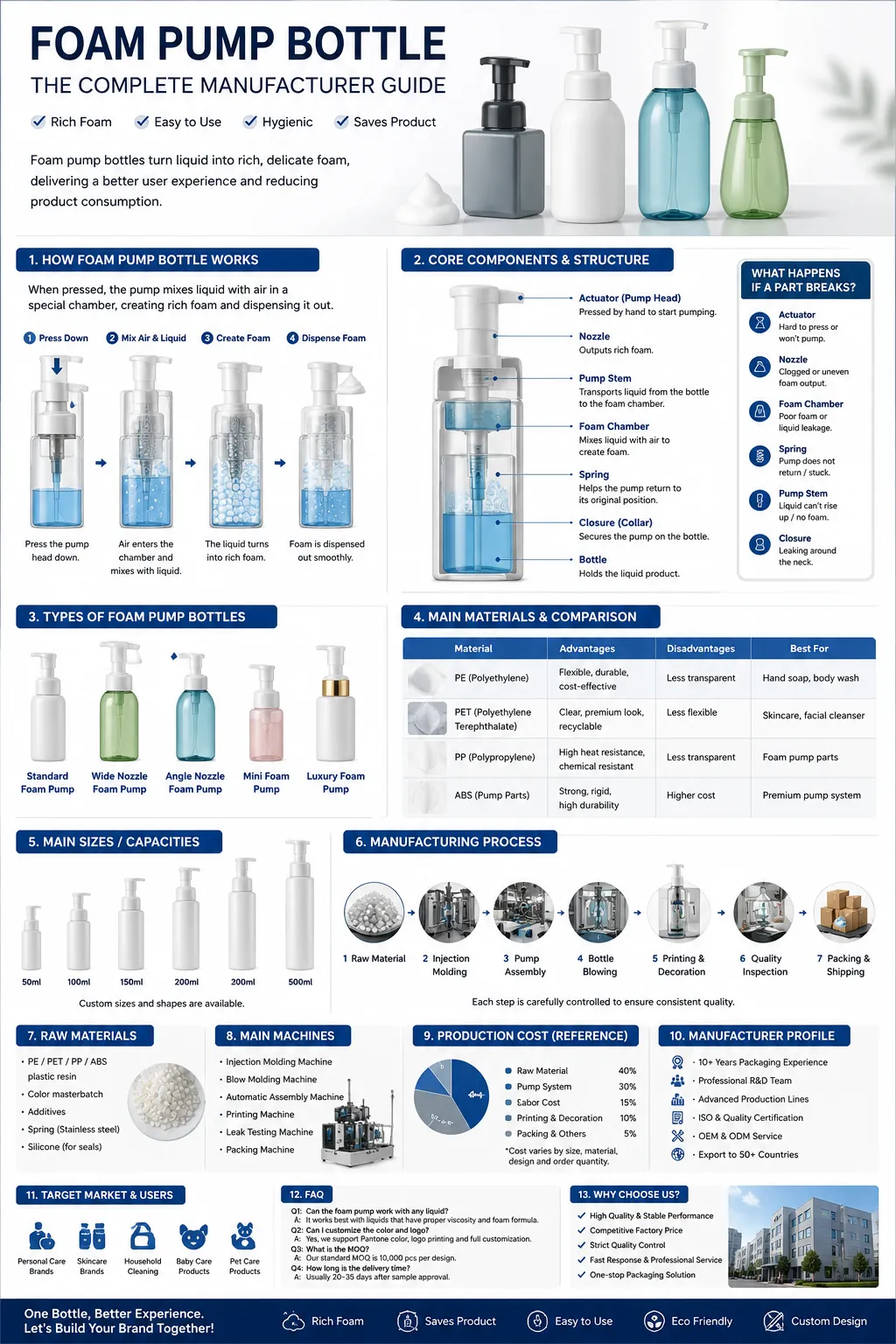
How Much Does a Foam Pump Bottle Cost to Produce?
There is no fixed production cost for every foam pump bottle.
For standard wholesale projects, the unit cost is mainly influenced by:
- Bottle material
- Bottle weight
- Pump structure
- Pump output
- Capacity
- Custom colour
- Printing
- Surface finishing
- Order quantity
- Packaging method
A simple standard bottle costs less than a PCTG bottle with a custom pump and premium decoration.
Indicative Cost Structure
| Cost Area | Typical Cost Impact |
|---|---|
| Bottle Body | Medium |
| Foam Pump | Medium–High |
| Raw Material | Medium |
| Decoration | Low–High |
| Assembly | Low–Medium |
| QC | Low |
| Export Packing | Low–Medium |
| Custom Mold | High initial investment |
For many projects, the foam pump is one of the most technically important and higher-cost components.
A rough factory-level packaging price can vary from below USD 0.30 for very simple, high-volume configurations to above USD 1.50 per set for more complex or premium structures. This is only an indicative industry range, not a quotation.
Luxury PCTG designs, special pumps, low quantities or complex decoration can cost more.
Does a Custom Foam Pump Bottle Need a New Mold?
Not always.
If an existing bottle and pump meet the brand’s requirements, the manufacturer can customize:
- Bottle colour
- Pump colour
- Logo
- Printing
- Hot stamping
- Label
- Surface finish
This is usually the faster and more economical route.
A new mold may be required when the buyer needs:
- A unique bottle shape
- A special neck structure
- A proprietary pump design
- Embossed or debossed branding
- A custom locking mechanism
- A completely new capacity or proportion
For new brands, we usually recommend reviewing existing molds before investing in custom tooling.
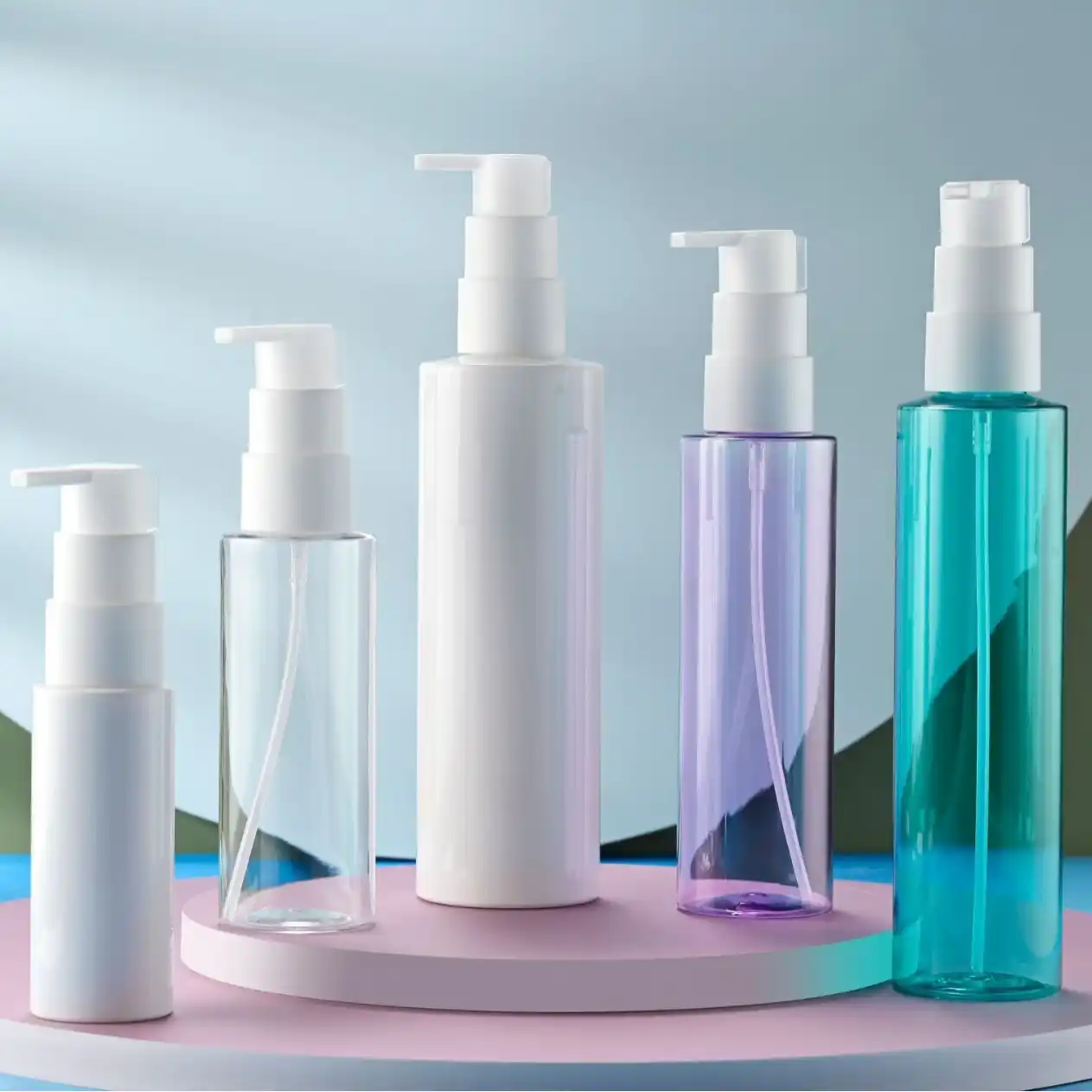
Who Should Buy Foam Pump Bottles?
Foam packaging is particularly suitable for:
Skincare brands developing amino acid cleansers or facial mousse.
Personal care brands producing foaming hand wash and body cleansers.
Baby care companies looking for gentle and easy-to-dispense packaging.
Hotel and travel brands developing compact cleansing products.
Private-label manufacturers that need stable, scalable packaging for multiple formulas.
Premium beauty brands can use PCTG, custom colours and advanced decoration to move the foam bottle into a higher market position.
What Should Buyers Test Before Ordering?
Do not approve a foam bottle based only on photographs.
Request samples and test the actual formula.
Pay attention to:
- How many presses are required for initial priming?
- Is the foam dense or watery?
- Does each press produce a similar amount?
- Does the pump return smoothly?
- Does product dry around the nozzle?
- Does the pump clog after several days?
- Is there leakage after lying horizontally?
- Does the bottle deform?
- Does the formula affect the plastic?
For a serious OEM project, formula compatibility is part of packaging development—not an optional final check.
Frequently Asked Questions About Foam Pump Bottles
What is the difference between a foam pump and a lotion pump?
A lotion pump mainly dispenses the formula in its original liquid or cream form. A foam pump mixes a suitable liquid with air and passes it through a mesh to create foam.
Can I put normal liquid soap in a foam pump bottle?
Not every liquid soap will work correctly. Thick formulas may produce poor foam or block the pump. The formula should be designed or diluted appropriately for a foam dispensing system.
Why is my foam pump producing watery bubbles?
Check formula viscosity, surfactants, air intake and the internal mesh. The pump may also be damaged or incompatible with the formula.
What is the most popular foam bottle capacity?
For facial cleansers, 120ml–200ml is common. For hand wash, 250ml–500ml is widely used.
Are foam pump bottles leak-proof?
A properly matched bottle and pump should provide good sealing performance. However, leakage testing should be completed with the final bottle, pump and formula.
Can foam pump bottles be reused?
Some bottles can be refilled, but the pump should be cleaned carefully. Dried product or contamination can affect foam quality.
Are foam pump bottles recyclable?
PE, HDPE, PET and PP are commonly recyclable materials, but recyclability depends on local recycling systems and the use of mixed materials, springs, coatings and labels.
Can the foam pump colour be customized?
Yes. Pump and bottle colours can generally be customized based on a Pantone reference, subject to MOQ.
What is the normal MOQ for a custom foam pump bottle?
For Boyu Packaging custom colour and decoration projects, a typical MOQ is 10,000 pieces per SKU. Existing stock products may have different requirements.
How long does production take?
Custom samples generally require around 7–15 working days, depending on decoration. Mass production commonly takes 30–45 days after sample and artwork approval. New mold projects require additional development time.
Choosing a Foam Pump Bottle Manufacturer
A foam bottle supplier should not be evaluated only by unit price.
Ask the manufacturer about the pump structure, formula testing, foam output, neck compatibility and leakage inspection.
For a simple hand wash project, a mature standard bottle can keep costs under control. For an amino acid facial cleanser or premium skincare product, pump performance deserves more attention than saving a few cents on the packaging.
At Boyu Packaging in Hangzhou, China, our role is to help cosmetic and personal care brands match the bottle, foam pump and decoration with the intended product positioning. Existing packaging can shorten development time, while OEM and mold development are available for projects requiring a more distinctive structure.
The right foam pump bottle should look good on the shelf. More importantly, it should still produce stable foam after the consumer has pressed it hundreds of times.
 English
  Español de Argentina
  Русский
  Italiano
  日本語
日本語  한국어
한국어  العربية
  Français
  Deutsch