
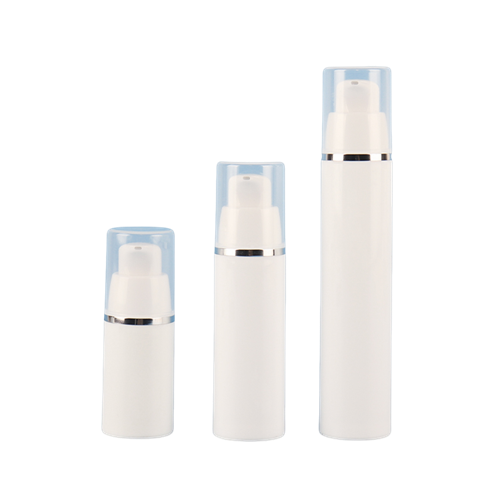
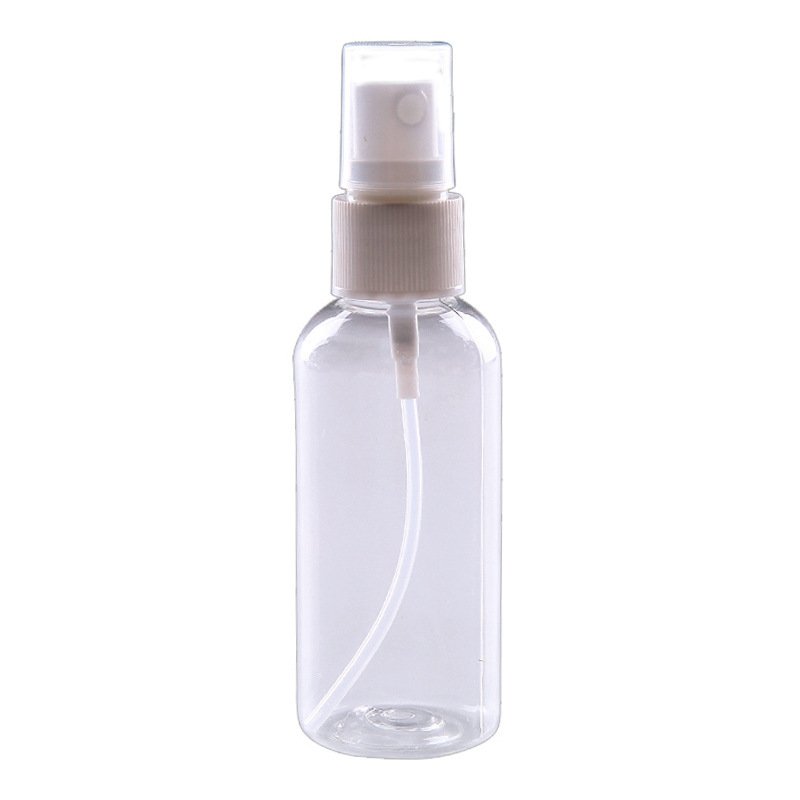
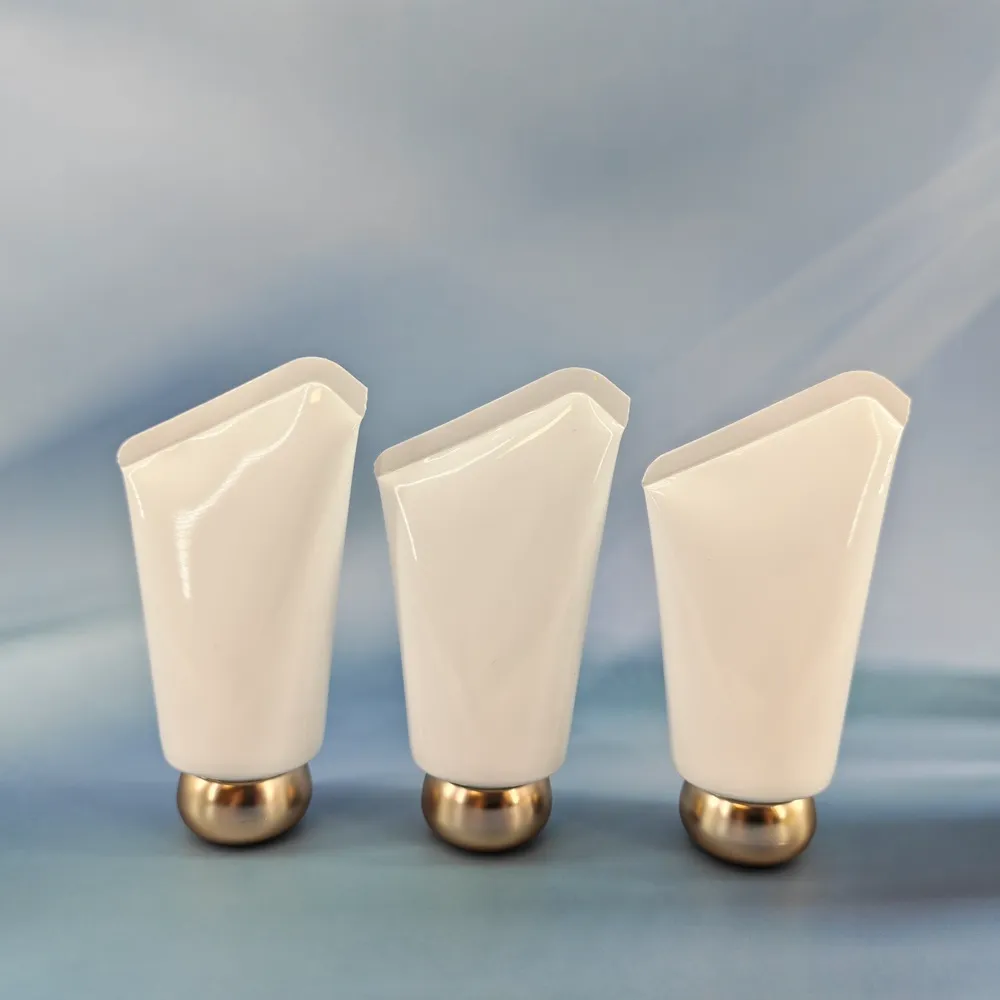
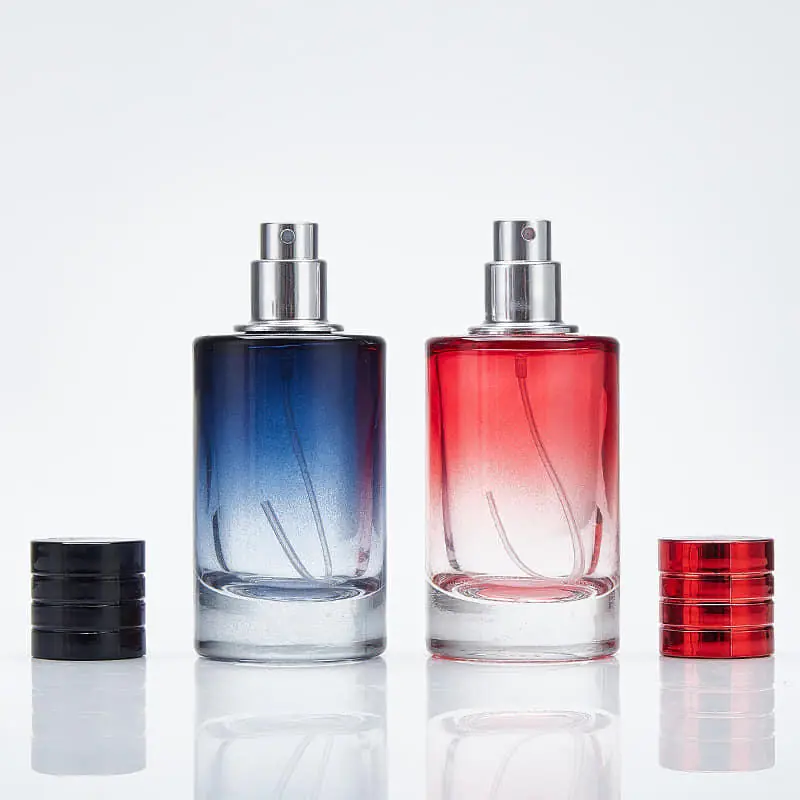
Direct answer: the three core retail perfume sizes are 30 mL (marketed as 1 fl oz), 50 mL (1.7 fl oz) and 100 mL (3.4 fl oz). Their exact US conversions are 1.014, 1.691 and 3.381 US fl oz. At a measured pump dose of 0.10 mL per full stroke, they provide about 300, 500 and 1,000 theoretical sprays.
Spray count is not fixed by bottle capacity. Commercial fragrance pumps are available in different doses, including 70, 100 and 130 microlitres per actuation, so a 100 mL bottle could theoretically yield about 1,429, 1,000 or 769 full sprays. Use the chart below for comparison, then test the actual filled pack before making a consumer claim.
This guide is for fragrance shoppers, brand teams and packaging buyers who need to compare nominal capacity, real-world use, physical bottle size and packaging material without treating them as the same measurement.
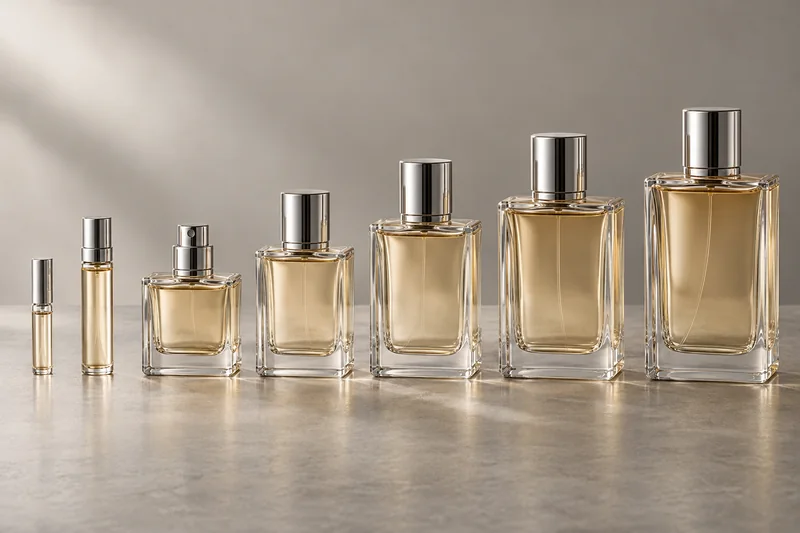
Perfume bottle sizes chart: mL, US fl oz and spray counts
The ounce column below uses US fluid ounces, not weight ounces and not Imperial fluid ounces. Spray figures are mathematical estimates: bottle volume ÷ dose per stroke. They do not deduct priming strokes, incomplete actuations, evaporation, leakage or product that remains in the bottle.
Capacity and typical format
| Nominal size | Exact US fl oz | Typical role |
|---|---|---|
| 1.5 mL | 0.051 | Spray sample |
| 2 mL | 0.068 | Discovery vial |
| 5 mL | 0.169 | Mini sample |
| 7.5 mL | 0.254 | Purse spray |
| 10 mL | 0.338 | Travel atomizer |
| 15 mL | 0.507 | Large travel size |
| 30 mL | 1.014 | Entry retail |
| 50 mL | 1.691 | Core retail / gift |
| 75 mL | 2.536 | Generous mid-size |
| 100 mL | 3.381 | Full size |
| 125 mL | 4.227 | Extended size |
| 200 mL | 6.763 | Jumbo / refill |
Theoretical spray counts by tested pump dose
| Size | 0.07 mL | 0.10 mL | 0.13 mL |
|---|---|---|---|
| 1.5 mL | 21 | 15 | 12 |
| 2 mL | 29 | 20 | 15 |
| 5 mL | 71 | 50 | 38 |
| 7.5 mL | 107 | 75 | 58 |
| 10 mL | 143 | 100 | 77 |
| 15 mL | 214 | 150 | 115 |
| 30 mL | 429 | 300 | 231 |
| 50 mL | 714 | 500 | 385 |
| 75 mL | 1,071 | 750 | 577 |
| 100 mL | 1,429 | 1,000 | 769 |
| 125 mL | 1,786 | 1,250 | 962 |
| 200 mL | 2,857 | 2,000 | 1,538 |
What 1 oz, 1.7 oz and 3.4 oz mean on perfume bottles
1 fl oz is the 30 mL commercial size
One US fluid ounce equals 29.5735 mL, while the standard commercial bottle is usually called 30 mL. Therefore “1 fl oz / 30 mL” is a practical dual declaration, not a statement that the two figures are mathematically identical to every decimal place. At 0.10 mL per spray, 30 mL represents about 300 full actuations before real-world losses.
1.7 fl oz is the 50 mL commercial size
Multiplying 1.7 by 29.5735 gives 50.275 mL; conversely, 50 mL equals 1.6907 US fl oz. This is the middle size in many fragrance collections: large enough for regular use, but less expensive and easier to finish than 100 mL. It is often a sensible “hero” SKU for gifting and first full-bottle purchases.
3.4 fl oz is the 100 mL commercial size
Multiplying 3.4 by the US factor gives 100.550 mL; 100 mL equals 3.381 US fl oz. The familiar 3.4 fl oz wording is therefore a rounded commercial pairing. A 100 mL bottle offers the lowest unit cost in many retail ranges, but only creates value when the user will finish it and the package protects the fragrance throughout its service life.
How to convert perfume capacity and calculate spray count
mL and US fluid-ounce formulas
- US fl oz to mL: fluid ounces × 29.5735295625
- mL to US fl oz: millilitres ÷ 29.5735295625
- Imperial fl oz to mL: fluid ounces × 28.4130625
Use fluid ounces for liquid volume. A plain weight ounce is a mass unit and cannot be converted to mL without the formula’s density. For other sizes and units, use Boyu’s ounce conversion calculators rather than rounding repeatedly from an already rounded label value.
Spray-count formula
Theoretical sprays = usable liquid volume in mL ÷ measured output per full actuation in mL. For example, 50 mL ÷ 0.10 mL equals 500 theoretical sprays. If the same pump package actually averages 0.13 mL, the theoretical count falls to about 385.
A more defensible production estimate uses the average of multiple controlled strokes after priming. Collect or weigh a defined number of full actuations, calculate output per stroke, repeat across several filled packs and report the test conditions. Boyu’s 30 mL spray-count calculator and test method provides a narrower worked example.
How long will a bottle last?
Days of use = estimated usable sprays ÷ full sprays used per day. At 0.10 mL per spray and four sprays per day, the theoretical durations are 75 days for 30 mL, 125 days for 50 mL and 250 days for 100 mL. Wearing several fragrances in rotation extends calendar life; reapplying or using a higher-dose pump shortens it. This is a usage estimate, not a fragrance-performance claim.
Capacity is not the same as physical bottle dimensions
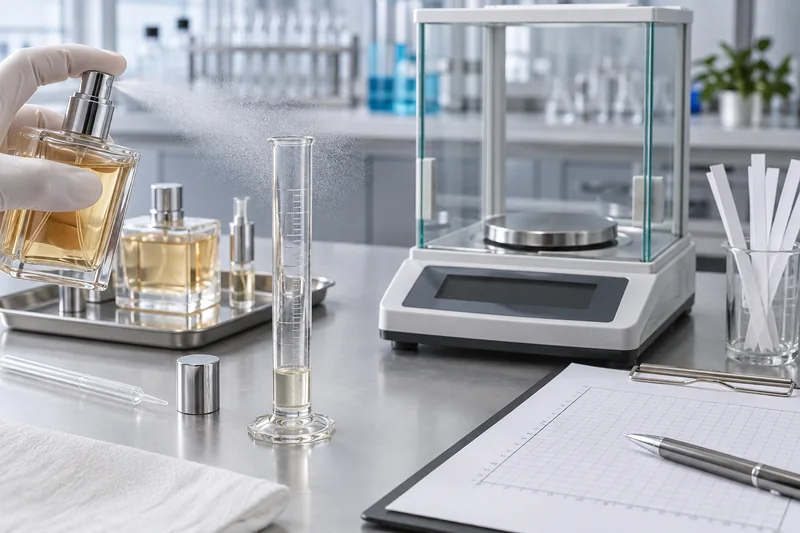
There is no universal height, width or diameter for a 30, 50 or 100 mL perfume bottle. A low rectangular flacon, a tall cylinder and a thick-base square bottle can hold the same nominal volume while occupying very different shelf and carton envelopes. Glass distribution, shoulder shape, base thickness, cap height and pump construction all change the exterior.
The dimensions a buyer should request
- Nominal fill and brimful capacity: the labelled fill is not the capacity to the rim. Pump displacement and headspace must be accommodated.
- Glass-only envelope: body height, maximum width/depth or diameter, base contact area and relevant corner radii.
- Assembled envelope: total height and maximum width with pump, collar and cap installed.
- Neck finish: the controlled crimp, snap or thread geometry—not only a nominal diameter.
- Mass and distribution: empty bottle weight plus defined wall, heel and base measurements where technically important.
- Decoration and label panels: usable print area, curvature, seam position and artwork datum.
For a compact-format example, see the 10 mL bottle dimension guide. For procurement, always use the selected model’s current technical drawing and a measured production-intent sample; a marketplace photograph is not a dimension specification.
Which perfume bottle capacity should you choose?
| Format | Best when |
|---|---|
| 1–5 mL | The user needs several proper wears before committing |
| 7.5–15 mL | Portability and repeat application matter |
| 30 mL / 1 oz | The scent is new, seasonal or part of a rotation |
| 50 mL / 1.7 oz | Regular use is likely but 100 mL is excessive |
| 75–100 mL | The fragrance is a confirmed favourite or daily signature |
| 125–200 mL+ | Use is frequent or the pack is an intentional refill |
| Format | Brand role | Key trade-off |
|---|---|---|
| 1–5 mL | Sampling / discovery | High pack cost per mL; little decoration area |
| 7.5–15 mL | Travel / paid trial | Refill and leak control are critical |
| 30 mL | Entry full size | Higher price per mL than a large bottle |
| 50 mL | Core / hero SKU | Balance premium presence and pack weight |
| 75–100 mL | Value / full size | Higher outlay, shelf space and shipping mass |
| 125–200 mL+ | Jumbo / refill | Validate handling and long service life |
A larger bottle is not automatically the best value. Compare total price, likely wear frequency, pump output, storage conditions and the chance that tastes will change. A lower cost per mL only becomes a saving when the product is actually used.
Does bottle material change the size or conversion?
Material does not change the mathematical conversion: 50 mL is the same liquid volume in glass, PET or a lined metal travel atomizer. Material can change empty-pack weight, wall thickness, exterior dimensions, break resistance, light exposure, decoration choices, shipping load and compatibility risk.
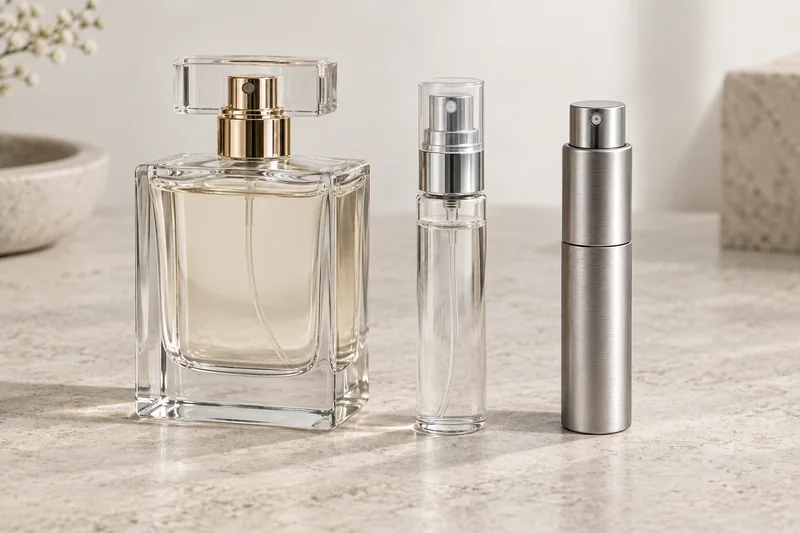
Glass is widely used for retail fragrance because it is virtually inert and impermeable, provides visual depth and supports frosting, coating, printing and heavy-base designs. The disadvantages are breakage risk and shipping mass. A thick base makes a bottle look substantial but can make a 50 mL pack externally similar to a taller-capacity design; weight alone does not prove structural quality.
PET: lightweight portability
PET can suit travel sprays, body mists and price-sensitive formats where lower weight and impact resistance matter. It should not be selected by resin name alone. Validate the actual fragrance against the bottle, pump, gasket, dip tube, decoration and storage conditions, because alcohol level, fragrance oils, colourants and contact time vary.
Aluminium and metal-bodied atomizers
A metal travel atomizer often uses an aluminium outer shell around an internal reservoir rather than allowing the fragrance to contact decorative metal directly. The shell improves opacity and protects the reservoir, but the internal container, seals and refill valve determine compatibility and leakage performance. Ask for a component cross-section and contact-material list.
How a fragrance brand should plan a size range
A coherent size architecture is more useful than offering every capacity. Start with the customer journey, then confirm filling, tooling and component feasibility.
- Define the trial step. Choose a 1.5–2 mL spray sample or a paid 5–10 mL mini. For sourcing decisions, compare wholesale mini perfume bottle formats by fill method, pump and pack-out—not capacity alone.
- Select one commercial core. A 50 mL hero size can simplify forecasting; a 30 mL core may suit niche collections or higher-priced formulas.
- Add a value anchor only when demand supports it. A 100 mL bottle increases product, glass, freight, carton and inventory exposure. Model the complete delivered cost.
- Coordinate the family. Keep cap proportion, decoration, label area and spray character consistent while allowing each capacity to use its own validated mold and dip tube.
- Freeze a specification per SKU. Do not assume a pump, cap or carton approved for 50 mL automatically fits the 30 or 100 mL version.
Travel limits and label cautions
Carry-on and checked baggage
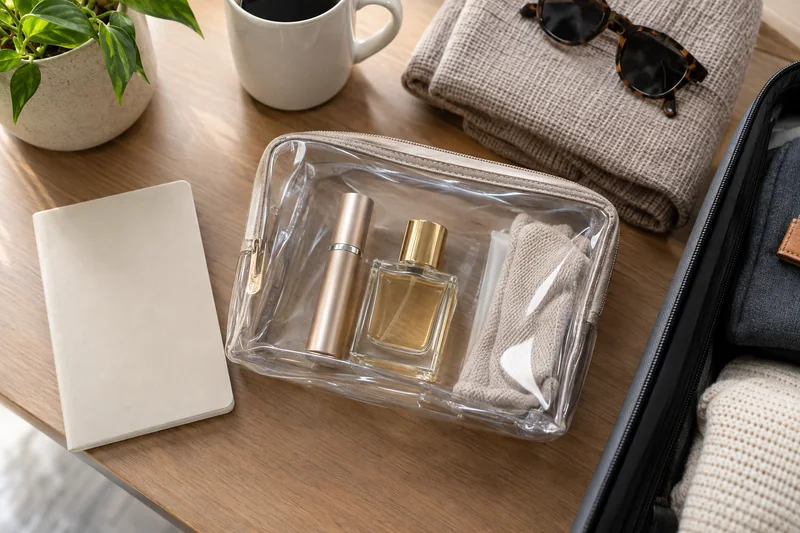
For US airport screening, TSA’s 3-1-1 rule limits carry-on liquids to containers of 3.4 ounces or less, placed in one quart-size clear bag per passenger. A partly filled 125 mL bottle does not become a 100 mL container. A standard 100 mL bottle sits at the familiar upper limit, but a 10–30 mL atomizer is easier to pack and exposes less fragrance if a closure leaks. See Boyu’s perfume-specific TSA 3-1-1 guide for the detailed travel workflow.
FAA PackSafe guidance also limits medicinal and toiletry articles in checked baggage: each container must not exceed 500 mL, and the aggregate per person must not exceed 2 L or 2 kg; release devices must be protected from accidental activation. Rules can differ by country, airport and airline, so verify the actual itinerary.
Nominal capacity is not an artwork shortcut
In the United States, FDA guidance says a liquid cosmetic’s net quantity is stated in fluid measure and must accurately disclose the contents; metric volume may also be stated. In the EU, Article 19 of Regulation (EC) No 1223/2009 requires nominal content at packaging by weight or volume, subject to specified exceptions such as certain packs below 5 mL, free samples and single-use packs.
Do not copy “3.4 fl oz” onto artwork merely because the selected bottle is marketed as 100 mL. Confirm the intended fill, applicable market rules, rounding, principal display panel and legal review. Also distinguish nominal fill, brimful capacity and usable dispensed volume in the specification.
Perfume bottle RFQ and approval checklist
Before comparing quotations, send each supplier the same controlled brief. Boyu’s custom perfume bottle specification checklist covers the complete packaging system; at minimum, a size-focused RFQ should include:
- nominal fill in mL and target markets for the label;
- quantity by capacity, design, colour and decoration version;
- maximum assembled height, width/depth or diameter and target empty-pack mass;
- existing-mold or custom-mold route, with current bottle drawing;
- brimful capacity, headspace and pump displacement assumptions;
- pump fixation, dose per actuation, spray pattern and priming requirement;
- cap construction, retention, alignment and accidental-actuation protection;
- formula-contact materials and filled-pack compatibility plan;
- decoration, artwork area, colour standard and durability checks;
- inspection plan, approved reference samples, export packing and delivery term.
When appearance is still open, compare the available glass perfume bottle collection, then request the exact drawing and samples for the shortlisted model. Never price-match a heavy thick-base flacon against a lightweight standard bottle as if capacity were the only difference.
Common mistakes to avoid
- Calling every ounce a fluid ounce. Weight ounces measure mass; fluid ounces measure volume.
- Publishing one spray count as guaranteed. Dose, priming, actuation quality and residual product change the usable count.
- Inferring dimensions from capacity. Cartons, inserts and filling-line guides require the selected model’s drawing and assembled samples.
- Assuming glass makes the whole pack compatible. The gasket, dip tube, pump, coating and print can fail even when the glass body is suitable.
- Using brimful capacity as net fill. A closure inserted into an overfilled bottle can displace liquid and compromise sealing.
- Choosing the largest size only for cost per mL. Inventory, freight, shelf space and the customer’s actual wear pattern matter.
Perfume bottle size FAQs
What are the most common perfume bottle sizes?
Samples commonly use 1–5 mL, travel sprays 7.5–15 mL, and core retail bottles 30, 50 and 100 mL. Capacity availability depends on the selected bottle family, pump and mold.
How many sprays are in 100 mL of perfume?
The theoretical count is about 1,429 at 0.07 mL per stroke, 1,000 at 0.10 mL and 769 at 0.13 mL. The actual usable count requires measurement of the filled pack and allowance for priming and residual product.
How big is a 1.7 oz perfume bottle?
It is the nominal 50 mL format, but it has no universal external dimensions. Shape, wall and base thickness, pump, collar and cap determine the assembled height, width and weight.
Is 30, 50 or 100 mL the best perfume size?
Choose 30 mL for a new or rotational scent, 50 mL for balanced regular use, and 100 mL for a confirmed signature fragrance. Brands should also account for target price, packaging mass, inventory and fill-line compatibility.
Does a glass bottle hold more than a plastic bottle of the same mL?
No. Equal nominal mL values describe equal liquid volume. The material and design can make the exterior larger or heavier and can change brimful capacity, protection and compatibility, so compare controlled drawings and samples.
Sources
- NIST Guide to the SI, Appendix B.8: fluid-ounce conversion factors.
- Aptar Beauty, Essencia fragrance pump product specifications.
- Aptar Beauty, Precious Sensea fragrance pump dose options.
- US FDA Cosmetics Labeling Guide.
- Regulation (EC) No 1223/2009 on cosmetic products, Article 19.
- US Transportation Security Administration, 3-1-1 Liquids Rule.
- US Federal Aviation Administration, PackSafe chart.
- FEVE, glass packaging inertness and impermeability.
 English
  Español de Argentina
  Русский
  Italiano
  日本語
日本語  한국어
한국어  العربية
  Français
  Deutsch