
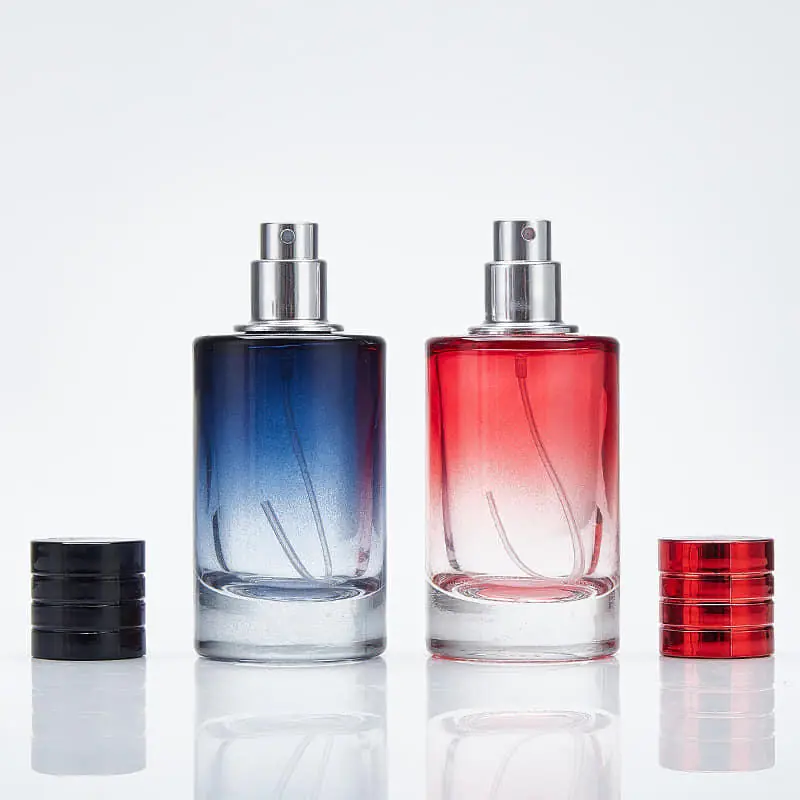
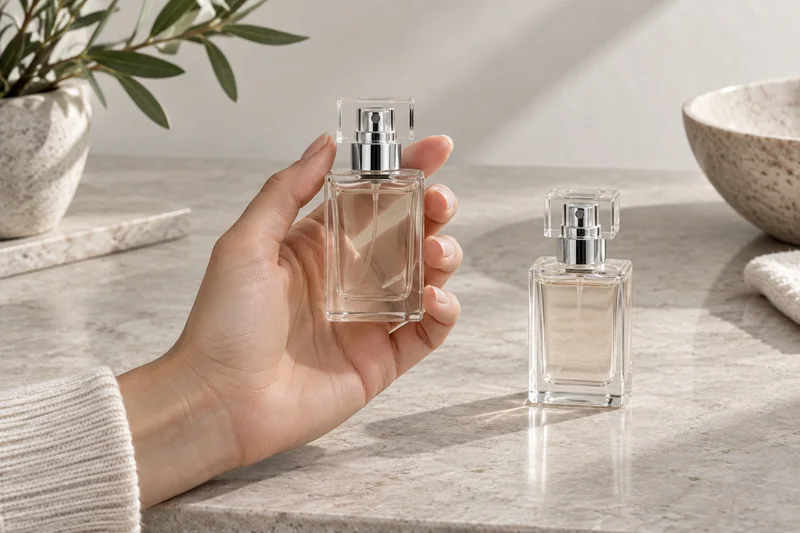
Direct answer: In perfume listings, 1 oz normally means 1 US fluid ounce. The exact conversion is 29.5735 mL, while the standard commercial perfume size is rounded and sold as 30 mL / 1.0 fl oz. It is a small full-size bottle—usually easy to hold in one hand—but there is no universal height or width because glass thickness, base weight, shape, pump and cap all change the exterior.
A 30 mL perfume provides about 300 theoretical sprays only when the atomizer meters 0.10 mL per full stroke. With documented fragrance-pump dose examples of 0.07, 0.10 and 0.13 mL, the mathematical range is roughly 429, 300 or 231 sprays. At four sprays per day, that is approximately 107, 75 or 58 days before allowing for priming and residual liquid.
This guide is for fragrance buyers and packaging teams who need to interpret a 1 oz listing accurately—not assume that capacity, bottle dimensions, filled weight and number of sprays are the same measurement.
How many mL is 1 oz of perfume?
One US fluid ounce equals exactly 29.5735295625 millilitres for conversion purposes. NIST’s consumer conversion table rounds this to 29.57 mL. Perfume brands commonly pair “1.0 fl oz” with a nominal 30 mL fill because 30 mL is the practical metric pack size and differs from one US fluid ounce by only about 0.43 mL.
| Label or calculation | Equivalent | What it means |
|---|---|---|
| 1 US fl oz | 29.5735 mL | Exact conversion basis |
| 30 mL | 1.0144 US fl oz | Common nominal perfume size |
| 1 Imperial fl oz | 28.4131 mL | Different UK/Imperial unit |
| 1 weight oz | 28.3495 g | Mass, not bottle capacity |
The correct conversion formulas
- US fl oz to mL: fluid ounces × 29.5735295625
- mL to US fl oz: millilitres ÷ 29.5735295625
- 1 oz commercial perfume check: 30 ÷ 29.5735295625 = 1.0144 US fl oz
Use Boyu’s ounce conversion tools when a specification mixes US fluid ounces, Imperial fluid ounces, millilitres, grams or pounds. The first question should always be whether “oz” describes liquid volume or weight.
How big is a 1 oz perfume bottle physically?
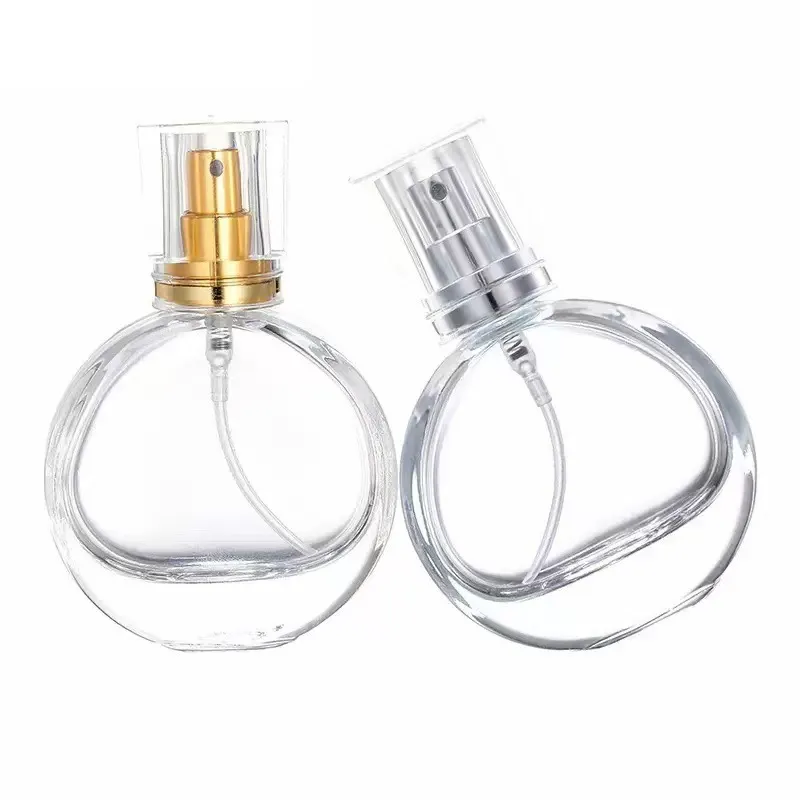
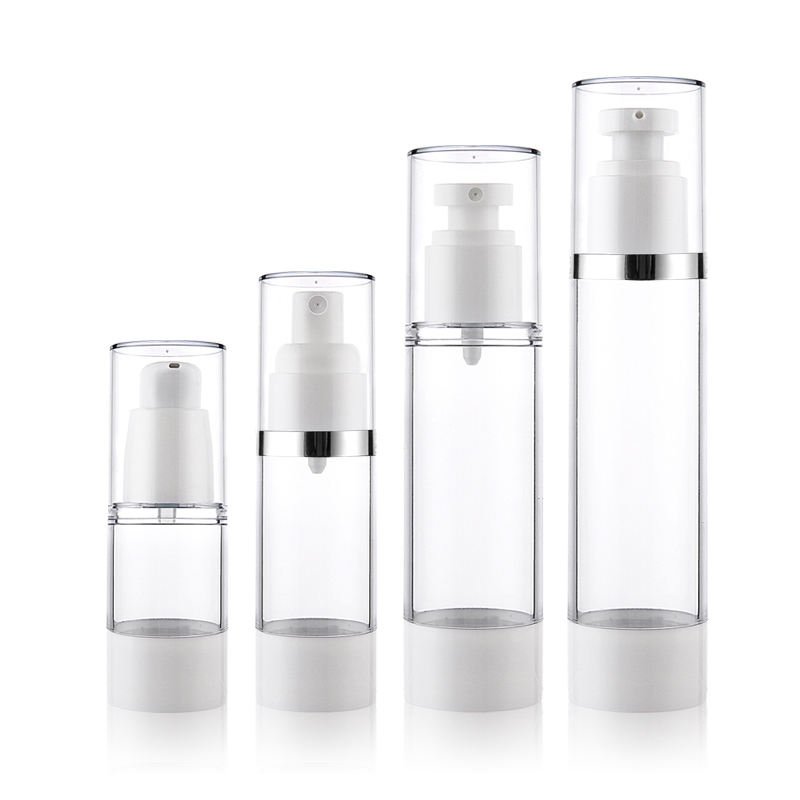
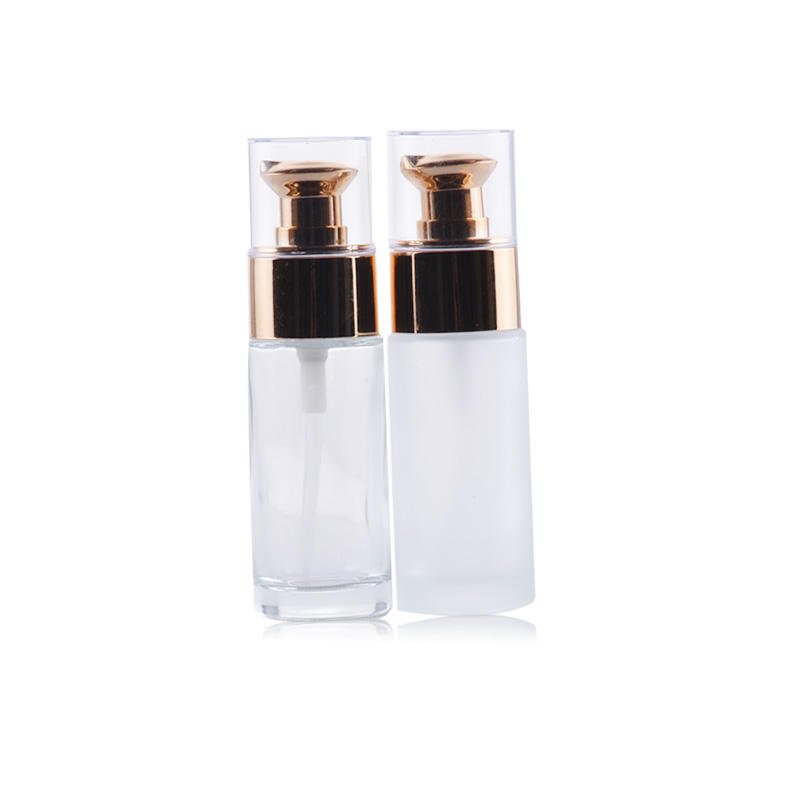
A 1 oz perfume bottle has no standard external dimensions. The 30 mL figure describes the nominal liquid fill, not the bottle’s height, width or depth. A tall cylinder, a flat rectangular flacon and a compact square bottle can all hold 30 mL while requiring different cartons, shelf space and protective inserts.
For early planning—not final tooling—a conventional 30 mL glass perfume bottle often has a body roughly 80–110 mm high and about 30–45 mm wide when round or compact-square. Flat decorative bottles can be much wider and shallower. One commercial flat 30 mL model, for example, is listed at approximately 88 × 73 × 23 mm before treating that one model as a category standard. Cap height can add materially to the assembled envelope.
For a visual comparison across retail formats, use Boyu’s 30 mL, 50 mL and 100 mL size-in-hand comparison. For an actual purchase order, replace all “typical” ranges with the chosen model’s current technical drawing and measured production-intent samples.
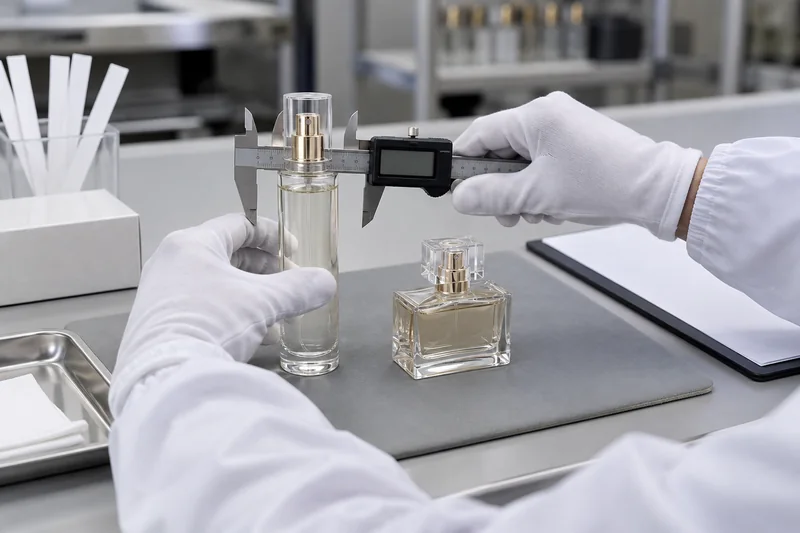
Dimensions worth checking before you buy
- Bottle-only envelope: body height, maximum width/depth or diameter and base contact area.
- Assembled envelope: total height and maximum width with pump, collar and cap fitted.
- Nominal versus brimful capacity: the recommended 30 mL fill needs headspace and room for pump displacement.
- Neck finish: controlled crimp, snap-on or thread geometry, not simply a casual neck-diameter measurement.
- Decoration area: printable panel, curvature, seam location and artwork datum.
- Carton and insert fit: clearance for decoration, cap removal, abrasion control and transit movement.
Why a 30 mL bottle may not look filled to the top
A nominal 30 mL perfume package normally needs more than 30 mL of internal capacity. The bottle must accommodate the intended liquid fill, the volume displaced by the pump components and a controlled headspace. Filling a bottle to the brim can interfere with closure application, create overflow during assembly and leave too little expansion margin during temperature changes.
Visual judgement is especially unreliable with a heavy-base flacon. Thick glass at the heel can make the internal cavity begin higher than the outer base, while curved shoulders change the apparent liquid line. An opaque coating may hide the fill level completely. The correct comparison is therefore the approved fill specification and net contents—not whether the liquid appears to occupy every visible millimetre of the bottle.
For package development, ask the supplier or filler to distinguish four values: nominal fill, target fill, brimful capacity and closure displacement. Approve a filled sample at the intended line, then use that same reference for filling setup, artwork placement and appearance inspection. If the filled level looks commercially unacceptable, change the bottle or fill specification deliberately; do not solve it by overfilling an unverified package.
How many sprays are in 1 oz of perfume?
About 300 sprays is a useful planning estimate, not a fixed bottle specification. It assumes a 30 mL fill and a metered output of 0.10 mL for every complete actuation. Aptar documents fragrance-pump options at 70, 100 and 130 microlitres per stroke, demonstrating why a single universal “sprays per mL” figure is not technically defensible.
| Pump dose | Theoretical sprays from 30 mL | At 4 sprays/day |
|---|---|---|
| 0.07 mL | About 429 | About 107 days |
| 0.10 mL | About 300 | About 75 days |
| 0.13 mL | About 231 | About 58 days |
Formula: theoretical spray count = usable liquid volume in mL ÷ measured output per full stroke in mL. The result should be rounded down for planning, then checked on actual filled packs. Priming strokes, incomplete presses, a tilted bottle, leakage, evaporation and liquid left below the dip-tube pickup reduce the number a user can obtain.
How to obtain a defensible spray estimate
- Prime the filled pump using the approved procedure; do not count priming strokes as consumer doses.
- Use complete, repeatable actuations with the bottle upright.
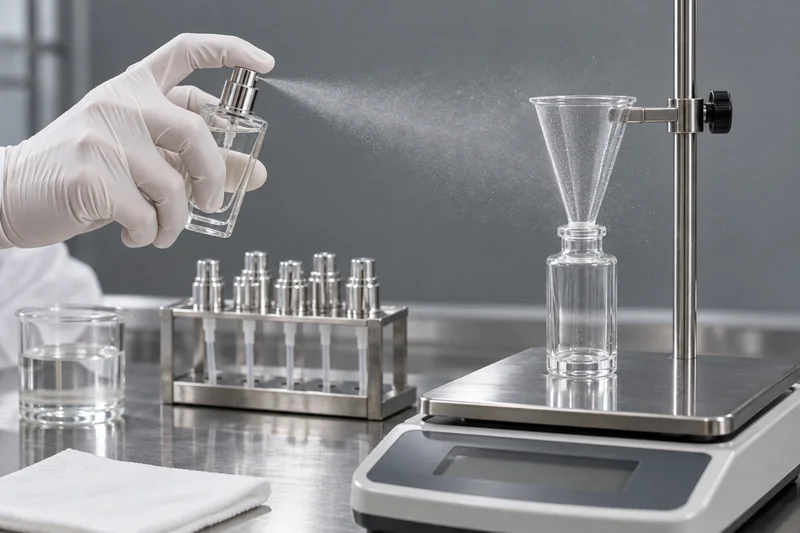
- Collect or weigh multiple strokes—not one—so scale resolution and actuation variation have less influence.
- If weighing, convert mass loss to volume using the actual formula density; do not assume 1 g equals 1 mL.
- Repeat across several assembled packs and record the pump model, formula, temperature and method.
Boyu’s 30 mL perfume spray calculator and measurement method provides the detailed calculator and a wider range of pump-output scenarios, so this page does not duplicate that tool.
How long does a 1 oz perfume last?
At the 300-spray planning benchmark, a 1 oz / 30 mL bottle lasts about 150 days at two sprays per day, 75 days at four, 50 days at six or 30 days at ten. These are usage calculations, not application recommendations. Fragrance strength, setting, climate, skin, reapplication and personal preference affect how many sprays someone chooses.
| Daily use | At 300 sprays | Practical reading |
|---|---|---|
| 2 sprays/day | 150 days | About 5 months |
| 4 sprays/day | 75 days | About 2.5 months |
| 6 sprays/day | 50 days | About 7 weeks |
| 10 sprays/day | 30 days | About 1 month |
Is 1 oz of perfume different from 1 oz of water, oil or lotion?
The volume conversion is not different: one US fluid ounce occupies 29.5735 mL whether the liquid is perfume, water, oil or another fluid. What changes is mass, flow behaviour, spray performance and package compatibility.
Volume versus mass
To convert a fluid volume into grams, density is required:
Mass in grams = 29.5735 mL × formula density in g/mL
For example, a hypothetical liquid with a density of 0.85 g/mL would have a formula mass of about 25.1 g per US fluid ounce. That is an arithmetic example, not a universal perfume density. Use the formula owner’s measured density at the stated temperature for filling, freight and pump-output calculations.
Why equal volumes can dispense differently
- Alcohol-based fragrance is usually paired with a fine-mist fragrance pump designed for low-volume atomisation.
- A water-based mist can use a different actuator and spray pattern even at the same bottle capacity.
- Oil-rich or viscous products may form larger droplets, prime slowly or require another pump design.
- Particles, high solids or incompatible seals can cause clogging, swelling, leakage or output drift.
Therefore, “1 oz” can define the same volume across products while producing very different package weights, spray counts and user experiences.
Does bottle material change how big 1 oz looks?
Material does not change the 29.5735 mL volume conversion, but it can change the exterior envelope and total pack weight. A heavy glass base, thick walls and decorative cap can make a 30 mL perfume look and feel more substantial than a lightweight 30 mL travel sprayer.
| Format | Why it may look different | Buyer check |
|---|---|---|
| Glass flacon | Wall and base distribution add mass and visual depth | Weight, base, dimensions, drop and compatibility tests |
| PET bottle | Lower component mass and different wall construction | Formula compatibility, permeation, stress and decoration |
| Metal-bodied atomizer | Outer shell may protect a separate internal reservoir | Contact-material list, refill valve and leak path |
Glass is widely used for perfume because it is virtually inert and impermeable as a material. That does not remove the need to test the complete package: the fragrance also contacts the pump, gasket and dip tube, while coatings, inks and adhesives face exterior exposure.
Is 1 oz a small perfume bottle?
One ounce is best described as a small full-size retail perfume. It is larger than a discovery vial or 5–10 mL travel spray, but smaller than the common 50 mL / 1.7 oz and 100 mL / 3.4 oz sizes. It often suits someone testing a new fragrance over many wears, carrying a compact bottle or rotating several scents.
- 10 mL / 0.34 fl oz: travel, sampling or purse spray.
- 30 mL / about 1 fl oz: small retail bottle, rotation or lower-commitment purchase.
- 50 mL / about 1.7 fl oz: mid-size regular-use format.
- 100 mL / about 3.4 fl oz: large full-size or signature-scent format.
When choosing between the endpoints, Boyu’s 1 oz versus 3.4 oz perfume bottle guide explains the capacity and packaging trade-offs in more depth. The larger bottle may reduce the price per mL, but it is only better value if the perfume will actually be used.
Can you take a 1 oz perfume on a plane?
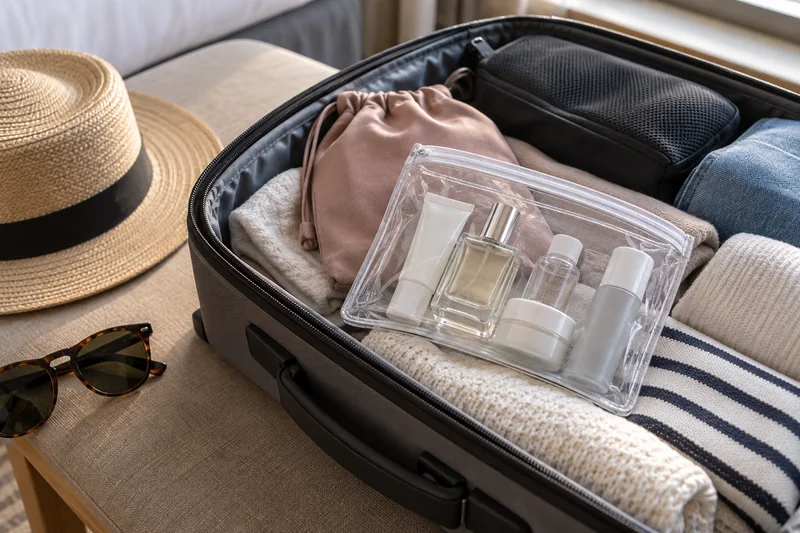
A 1 oz / 30 mL perfume bottle is below the standard per-container carry-on liquid limit used by both the US Transportation Security Administration and current European Union airport guidance. TSA states 3.4 oz / 100 mL or less per liquid container under its 3-1-1 rule; EU guidance likewise limits individual hand-luggage liquid containers to no more than 100 mL in a transparent resealable bag.
Capacity compliance does not prevent leakage or breakage. Keep the cap secure, place the bottle in the required liquids bag, protect glass from impact and verify the latest rules for the departure airport, connection, airline and destination. Boyu’s perfume 3-1-1 packing guide covers the travel workflow in detail.
What a brand should specify for a 1 oz perfume bottle
“30 mL glass perfume bottle” is not a complete RFQ. To compare quotations and samples fairly, issue one controlled specification that covers the filled package rather than the container alone.
- Capacity: nominal fill, brimful capacity, target fill level and permitted fill tolerance.
- Bottle: model code or drawing revision, material, weight, body dimensions, neck finish and critical cosmetic zones.
- Pump: fixation method, nominal dose per stroke, spray pattern, priming requirement, dip-tube specification and actuator/collar finish.
- Cap: assembled height, fit, pull-off or retention requirement and accidental-actuation protection.
- Decoration: artwork version, colour reference, print area, coating, curing and acceptance standard.
- Testing: formula compatibility, leakage, output, spray pattern, priming, residual volume, drop and transit checks appropriate to the project.
- Market: destination-country labelling, carton information and required documentation.
When the project reaches sourcing, compare Boyu’s glass perfume bottle options using the same controlled brief. Request current drawings and representative samples before freezing artwork, inserts or filling-line settings.
Frequently asked questions
Is 1 oz of perfume exactly 30 mL?
No. One US fluid ounce is 29.5735 mL. The perfume industry’s common 30 mL pack equals about 1.014 US fl oz and is commercially labelled as approximately 1.0 fl oz.
How tall is a 1 oz perfume bottle?
There is no universal height. Many conventional 30 mL glass bodies are roughly 80–110 mm tall, but flat, sculptural and heavy-base designs can fall outside that planning range. Confirm bottle-only and assembled dimensions from the selected model’s drawing.
Does every 1 oz perfume contain 300 sprays?
No. Three hundred is the theoretical result for 30 mL divided by 0.10 mL per full stroke. A 0.07 mL pump gives about 429 theoretical sprays, while a 0.13 mL pump gives about 231. Real usable counts are normally lower than pure arithmetic because of priming and residual liquid.
How many grams is 1 oz of perfume?
It cannot be determined from fluid ounces alone. Multiply 29.5735 mL by the formula’s measured density in g/mL to obtain formula mass. Then add the bottle, pump, cap, decoration and secondary packaging for filled or shipping weight.
Is 1 oz a good perfume size?
It is often a practical small full-size option for a new scent, a rotation or frequent travel. A larger size may cost less per mL, but the 30 mL format limits commitment, occupies less space and is easier to finish.
Sources
- NIST — Approximate Conversions from U.S. Customary Measures to Metric. Conversion reference for fluid ounces, millilitres, weight ounces and grams.
- Aptar Beauty — Essencia fragrance spray collection. Manufacturer documentation listing 70, 100 and 130 µL dose options.
- U.S. FDA — Cosmetics Labeling Guide. Official guidance distinguishing liquid measure from weight and explaining cosmetic net-content declarations.
- U.S. Transportation Security Administration — TSA Travel Tips. Current 3-1-1 liquid-rule summary.
- European Commission — Information for air travellers. Official guidance for 100 mL containers and one-litre resealable bags, including perfume.
- FEVE — Glass as a virtually inert and impermeable packaging material. Industry source used for the limited glass-material statement.
- The Parfumerie Store — Watch-style 30 mL atomizer specifications. Supplier-listed dimensions used only as a clearly identified single-model example, not as a category standard.
 English
  Español de Argentina
  Русский
  Italiano
  日本語
日本語  한국어
한국어  العربية
  Français
  Deutsch