


An empty paper coffee cup can cost only a few U.S. cents when bought by the case, but the product and order size matter. In a checked U.S. distributor example, a case of 1,000 plain 12 oz single-wall cups was $45.99, or $0.04599 per cup, before shipping and tax. A 500-cup case of 12 oz double-wall cups was $50.99, or $0.10198 per cup. These are specific listings, not a universal market range or a PaperBull quotation.
This guide explains the cost of empty disposable packaging, not the price of brewed coffee. For a cafe, distributor or office coffee program, compare the delivered cost of the cup, the required lid and any sleeve before choosing a supplier.
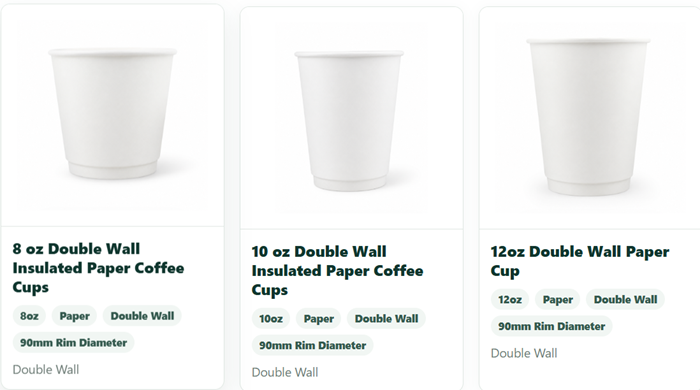
Paper Coffee Cup Prices Per Cup and Per Case
The following WebstaurantStore listings were checked on 18 November 2026. Prices are in USD at the displayed single-case purchase level. Shipping, tax and any other checkout charges are excluded. The final row includes both cups and lids, so its unit is one complete set.
| 12 oz stock product | Contents per case | Case price | Calculated unit cost |
| Plain white single-wall cup | 1,000 cups No lids |
$45.99 | $0.04599 per cup 4.599 cents |
| Plain white smooth double-wall cup | 500 cups No lids |
$50.99 | $0.10198 per cup 10.198 cents |
| Plain white single-wall cup and lid kit | 100 cups 100 lids |
$25.49 | $0.25490 per set 25.490 cents |
These examples compare different constructions and pack sizes from one U.S. distributor; they do not establish national averages, factory export prices or the separate price of a lid. Listings and discounts can change.
Read the Denominator Before the Price
A $45.99 case is not a $45.99 cup. Equally, a $50.99 carton is not necessarily better value than a $45.99 carton: here it contains half as many cups and a different construction. Divide each case price by its own quantity. For a kit, confirm whether the quantity counts complete sets or individual components.
What Changes the Cost of a Paper Coffee Cup
Size and construction
Compare the same nominal capacity first, then the wall structure, lining and agreed specification. An 8 oz cup, a 12 oz cup and a 16 oz cup are different purchasing items. A small cup is not automatically the cheapest once order volume, stock availability and delivery are included.
Single-wall, double-wall and ripple-wall products use different structures. Evaluate them against the intended beverage and handling conditions. If a single-wall cup needs a sleeve in your service, include that sleeve in its cost. Do not assume that every double-wall cup eliminates the need for one without checking the actual product in use.
Plain stock versus custom printing
Plain stock cups avoid ordering a unique design. Custom paper coffee cups add artwork approval and may involve setup, plates, printing or other production charges, depending on the supplier and process. Ask which costs are included in the unit quotation and which are separate. A stock coffee-pattern design is not the same as printing your own logo.
Confirm the artwork and production format with the custom printing team before comparing quotations. Keep the same cup specification, print coverage and quantity across suppliers. Do not assume that a repeat order has the same setup charges as a first order.
Quantity and delivery
A larger order may reduce the quoted unit price or spread a fixed setup fee across more cups. It also commits more cash and storage space. Ask for price breaks at quantities you can realistically use, rather than choosing a large minimum order only to obtain a lower headline price.
For overseas orders, specify the destination and ask where the seller’s delivery responsibility ends. A factory collection price and a delivered warehouse price cover different costs. Request a written breakdown of freight and any other charges you will have to arrange separately; do not add a charge again if the quotation already includes it.
Lids and other service components
Paper coffee cups with lids should be compared as a matched combination. Check the exact cup and lid codes rather than assuming that every lid fits the same ounce size. Count sleeves, carriers or stirrers only when your service actually uses them, and state whether the quotation includes them.
If the supplier proposes a different material or an environmental claim at a higher price, request the relevant product documentation. A higher price alone does not prove better performance or a verified environmental benefit.
Calculate the Delivered Cost Per Usable Set
Start with the quoted case price divided by the stated number of cups. For a complete takeaway serving, add the required lids and other components, then allocate the order charges once. Keep the calculation at full precision until you calculate the order total.
For example, the $45.99 single-wall case contains 1,000 cups. Dividing $45.99 by 1,000 gives $0.04599 per cup. Rounding that early to $0.05 and multiplying back would produce $50.00, overstating the case cost by $4.01.
A worked budget example
The figures below are hypothetical, not supplier prices. Assume an order provides 10,000 matched cup-and-lid sets and all of them are usable. No additional charges apply in this example.
| Budget item | Quantity or basis | Amount in USD |
| Empty cups | 10,000 at $0.06 | $600 |
| Matching lids | 10,000 at $0.03 | $300 |
| One-time print setup | One charge | $100 |
| Delivery | Whole order | $200 |
| Total | 10,000 usable sets | $1,200 |
| Delivered packaging cost | $1,200 divided by 10,000 | $0.12 per set |
In this example, the cup alone is six cents, while a delivered cup-and-lid set is twelve cents. It excludes the beverage, labor and any service components not listed. If some pieces cannot be used, divide the relevant total cost by the lower number of usable sets; do not invent a standard loss percentage.
Use the Calculation for Your Service
A cafe should cost the packaging combination it hands to customers, not just its cheapest cup SKU. For an office or hotel station where lids are optional, separate open-cup and takeaway usage rather than charging a lid to every serving.
For events, count actual cups used, including refills that require a new cup, rather than assuming one cup per guest. A distributor should also compare carton quantities, storage and onward delivery across the formats it stocks. These differences can change the purchasing decision even when two suppliers quote the same cup price.
Ask for a Comparable Bulk Quotation
When buying paper coffee cups in bulk, send the same purchasing brief to each supplier. Request the following details in writing before comparing the final price:
- Nominal capacity, cup code, dimensions, construction and intended beverage use.
- Quantity per size and design, pieces per carton and any order minimum.
- Plain stock or custom print, artwork requirements and separately charged setup.
- Approved lid code and quantities of lids, sleeves or other included components.
- Currency, price validity, destination and exactly what delivery charges include.
- Sample approval, production timing and the process for resolving nonconforming goods.
Approve representative samples before committing to a large order. Check cup-and-lid fit, the intended filling process and handling conditions. A low purchase price is less useful if the supplied packaging cannot perform the service you bought it for.
Frequently Asked Questions
How much does one paper coffee cup cost
In the checked 1,000-cup single-wall example, one empty cup works out to $0.04599 before shipping and tax. That is an allocation of the case price, not a promise that the seller will sell one cup at that price.
Does the price include a lid
Only when the listing or quotation says so. The 100-set example includes 100 cups and 100 lids. The two cup-only case examples do not include lids.
Are custom printed paper coffee cups more expensive
They can carry additional printing or setup costs. Compare a written quotation for the same cup, quantity and artwork; there is no verified universal markup that applies to every custom order.
Is buying wholesale always cheaper
Not necessarily in total. Compare the delivered cost per usable cup or set, then consider the cash, storage and likely consumption required by a larger order.
Request a Quote for Your Cup Specification
Review our custom coffee paper cups paper and send the cup size, construction, quantity, lid requirements, artwork and delivery destination. Ask us to separate the cup price, setup and delivery so you can compare the total against your service budget.
About the Author
Vincent Zheng is the Co-Founder and Sales Manager at PaperBull, with five years of packaging-industry experience. He works with bulk and wholesale buyers on packaging selection, cup-and-lid compatibility and custom printing.

 English
 Español de Argentina
 Русский
 Italiano
 日本語
 한국어
 العربية
 Français
 Deutsch