Glass Perfume Bottle Manufacturing Process: From Raw Materials to OEM Production
A premium fragrance bottle may look simple on a retail shelf, but producing it consistently requires control of glass chemistry, furnace conditions, mold design, forming, annealing, decoration and closure compatibility. For fragrance brands and packaging buyers, understanding the glass perfume bottle manufacturing process makes supplier discussions more precise and helps prevent expensive problems during filling and launch.
This guide follows the bottle from raw batch to undecorated “bare bottle,” then through secondary processing, assembly and OEM delivery. It also explains how to evaluate a manufacturer and how common defects should be prevented rather than merely sorted after production.
What Raw Materials Are Used in Perfume Bottle Glass?
Most commercial perfume bottles use soda-lime glass. The exact formulation belongs to the glassmaker, but the main batch materials commonly include:
- Silica sand: the primary glass-forming material.
- Soda ash: lowers the melting temperature and improves processability.
- Limestone and dolomite: contribute calcium and magnesium oxides that improve chemical durability and stability.
- Feldspar or alumina-bearing materials: help improve strength and resistance.
- Cullet: cleaned recycled glass that melts more readily and can reduce energy demand.
- Refining agents and colorants: used in controlled quantities to manage bubbles, clarity or glass color.
Raw-material purity matters. Iron contamination can add an unwanted green tint to clear flint glass, while foreign particles can create stones, inclusions or stress points. A qualified factory controls incoming materials, batch ratios, cullet cleanliness and traceability.
Clear, Extra-Flint and Colored Glass
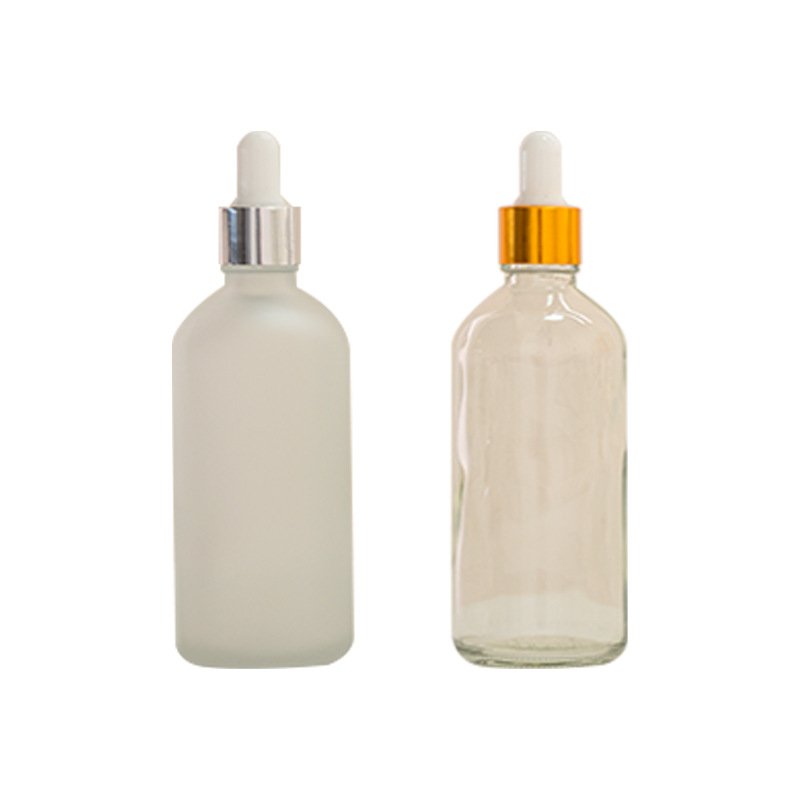
“Clear glass” is not one universal grade. Fragrance packaging may use standard flint, high-white or extra-clear glass depending on the target appearance and budget. Colored glass can be created in the furnace, but many perfume projects use external color coating because it offers broader color flexibility. Buyers should define an approved color standard and viewing conditions instead of relying on descriptions such as “crystal clear” or “luxury white.”
How a Bare Glass Perfume Bottle Is Produced
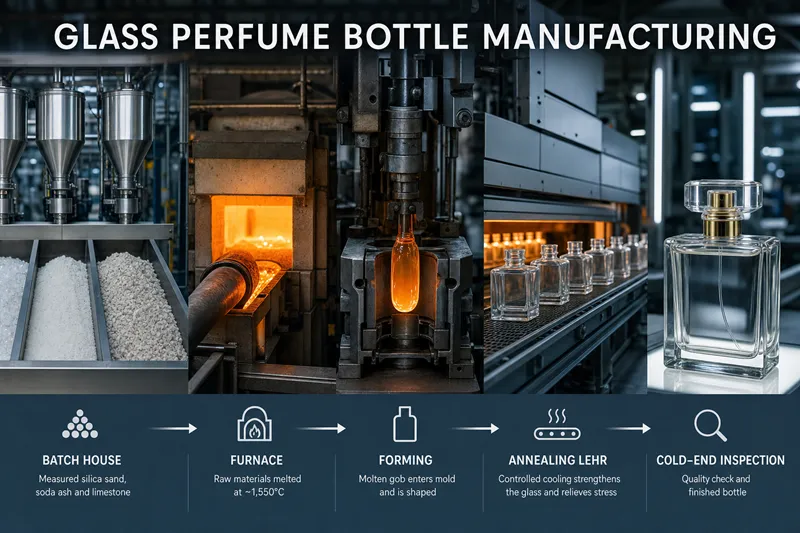
1. Batching, Melting and Refining
Measured raw materials are mixed and fed into a furnace. The batch melts into a homogeneous glass mass, while refining helps remove trapped gases and unmelted particles. The molten glass then passes through a forehearth, where temperature is conditioned before forming. Stable viscosity is essential: glass that is too hot or too cold can create uneven walls, poor definition, seams or dimensional variation.
2. Gob Cutting and Forming
A controlled portion of molten glass, called a gob, is cut and delivered into a blank mold. The machine creates a preliminary shape called a parison, which is transferred to the final mold and formed into the finished bottle geometry. Depending on the container and production setup, glass containers may use blow-and-blow or press-and-blow principles.
Gob weight, timing, mold temperature, air pressure and machine alignment all affect the result. The neck finish must be especially consistent because it determines how the spray pump, collar and sealing gasket will fit.
3. Hot-End Treatment and Annealing
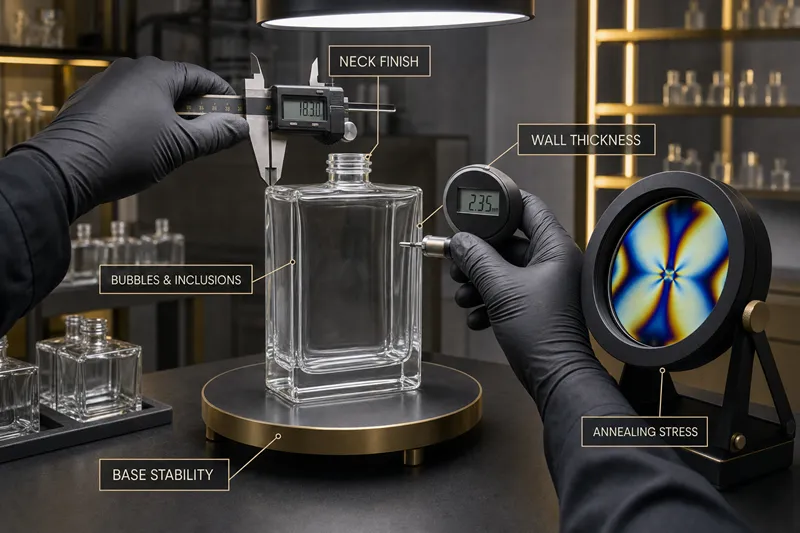
Freshly formed bottles contain thermal stress. They pass through an annealing lehr, where temperature is reduced along a controlled curve. Correct annealing relieves internal stress and reduces the risk of spontaneous cracking or breakage during decoration, filling and transportation. A hot-end or cold-end surface treatment may also be used to improve scratch resistance and line handling.
4. Cold-End Inspection and Bare-Bottle Release
After cooling, the undecorated bottle is inspected. Typical checks include overall dimensions, capacity, weight, verticality, base stability, neck finish, wall distribution, seams, bubbles, stones, cracks and cosmetic appearance. Automated inspection can screen repeatable defects, while trained visual inspection remains important for luxury bottles with complex curves and heavy bases.
The approved output at this stage is the bare glass bottle. It should be evaluated before decoration because coating or frosting can hide some glass defects and add new ones.
Secondary Processing and Decoration Options
Post-processing turns a standard glass container into recognizable fragrance packaging. The decoration route should be chosen according to the artwork, resistance requirements, target cost and expected production volume.
| Process | Visual Effect | Key Control Point |
|---|---|---|
| Frosting | Soft matte, translucent surface | Uniformity, masking and scratch control |
| Color coating | Solid, translucent, gradient or metallic color | Color tolerance, adhesion and curing |
| Screen printing | Opaque logos and precise spot colors | Registration, ink adhesion and curved surfaces |
| Hot stamping | Metallic gold, silver or colored foil | Pressure, temperature and surface flatness |
| Decal transfer | Fine multi-color graphics | Position, firing/curing and edge quality |
| Metallization | Reflective metal-like finish | Coverage, adhesion and fingerprint resistance |
| Laser or mechanical engraving | Permanent tactile mark | Depth, legibility and glass-stress risk |
Decoration Testing Before Mass Production
An attractive sample is not enough. The decorated bottle should be checked for adhesion, abrasion, alcohol or formula resistance, color consistency and compatibility with filling-line contact points. Test methods and acceptance criteria should be agreed for the actual decoration system. A multi-process design—such as frosting plus coating, printing and hot stamping—needs a defined sequence because each curing step can affect the next layer.
The OEM Glass Perfume Bottle Process
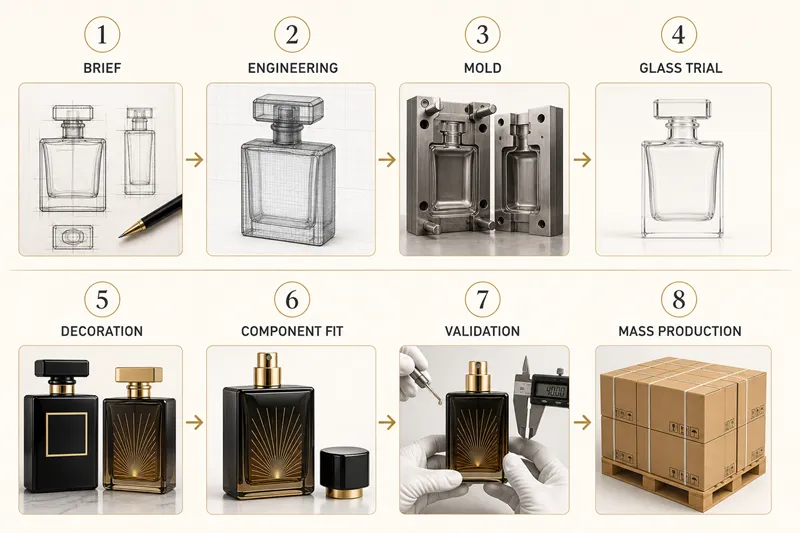
- Requirement brief: capacity, target dimensions, bottle weight, fill formula, closure, decoration, quantity forecast and target market.
- Stock or custom decision: select an existing bottle for speed and lower development risk, or develop an exclusive mold for brand differentiation.
- Engineering review: assess draft angles, wall distribution, base thickness, embossing, decoration area, neck specification and filling-line compatibility.
- 3D design and prototype: confirm proportions and component appearance before committing to production tooling.
- Mold development: produce and validate molds, including the neck ring and bottom plate where applicable.
- Glass trial and bare-bottle approval: approve dimensions, capacity, weight, appearance and critical fit points.
- Decoration sampling: establish signed color, artwork, gloss and placement standards.
- Component matching: test pump, collar, gasket, dip tube and cap with the actual bottle.
- Pilot and validation: complete leakage, actuation, transport and formula-compatibility checks appropriate to the project.
- Mass production and inspection: control the agreed critical-to-quality characteristics and release against approved samples.
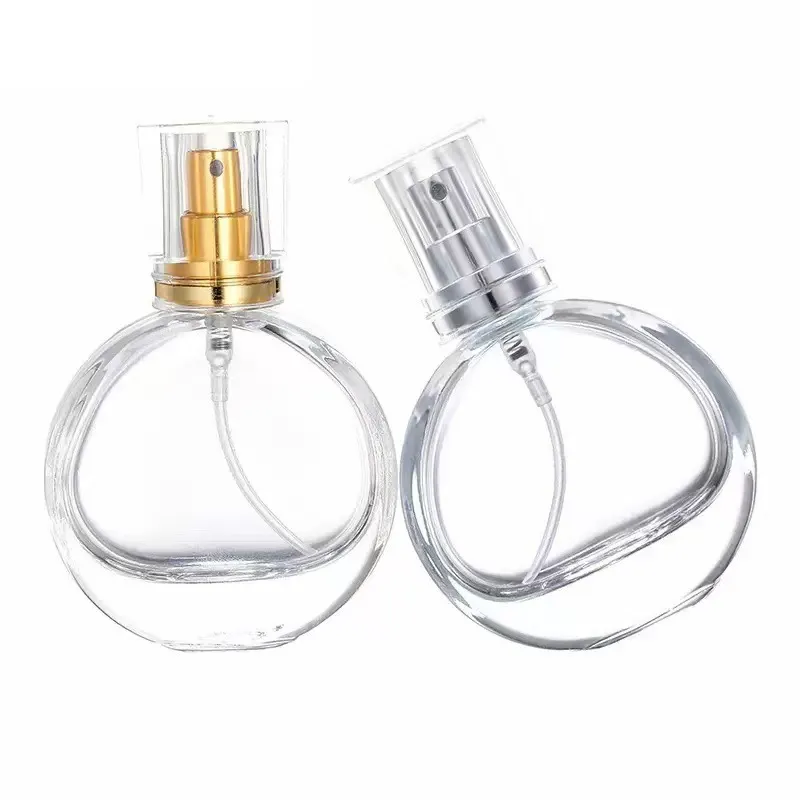
Boyu Packaging can help buyers coordinate the bottle with complete perfume packaging, including compatible pumps, collars and caps. Buyers comparing bottle formats can also browse the glass perfume bottle collection.
How to Choose a High-Quality Glass Perfume Bottle Factory
Do not judge a supplier only by polished product photographs. A capable manufacturing partner should be able to explain how it controls the process and what happens when results drift.
- Relevant manufacturing capability: verify whether the supplier forms glass, manages qualified partner furnaces, decorates in-house or coordinates multiple vendors.
- Engineering support: ask for dimensioned drawings, neck specifications, tolerance review and mold feasibility feedback.
- Documented quality standards: define defect classifications, sampling plan and acceptable limits before production.
- Decoration control: confirm color measurement, curing control, adhesion testing and signed master samples.
- Component integration: the supplier should evaluate the bottle, pump, collar, cap and dip tube as one dispensing system.
- Traceability and change control: batch records and approved-change procedures reduce surprises between repeat orders.
- Communication quality: useful suppliers identify risks early instead of agreeing to every request without engineering review.
For broader sourcing, the cosmetic glass packaging range shows how glass formats can be coordinated across fragrance and skincare lines.
Common Production Problems and Practical Solutions
| Problem | Likely Cause | Prevention / Correction |
|---|---|---|
| Bubbles or seeds | Batch contamination or insufficient refining | Control batch purity and furnace/refining conditions; define size and location limits |
| Stones or inclusions | Unmelted material or refractory contamination | Improve material screening, furnace maintenance and inspection |
| Uneven wall or heavy base | Gob, temperature or forming imbalance | Adjust gob delivery, mold temperature, timing and air pressure |
| Cracks or checks | Thermal stress, impact or mold condition | Verify annealing, handling and mold maintenance; use stress inspection |
| Unstable or tilted bottle | Base deformation or uneven glass distribution | Control mold cooling and base geometry; check verticality and rocking |
| Pump leakage | Neck variation, incorrect gasket or crimp setting | Control finish dimensions and validate the complete closure system |
| Coating peels or scratches | Poor cleaning, adhesion or curing | Improve surface preparation and curing; run adhesion and abrasion tests |
| Print misregistration | Fixture, artwork or bottle dimensional variation | Use controlled registration references and decoration tolerances |
Frequently Asked Questions
What is the difference between a stock bottle and a custom-mold bottle?
A stock bottle uses existing tooling and can usually reduce development work. A custom-mold bottle gives the brand greater control over silhouette, weight, embossing and decoration area, but requires engineering validation and tooling.
Why is annealing important for perfume bottles?
Annealing relieves internal stress created during forming and cooling. Poor stress control can lead to cracking during decoration, crimping, filling, transit or consumer use.
Can the same bottle use different spray pumps?
Only if the neck finish, gasket, crimp or screw interface, dip tube and dosage requirements are compatible. Every selected pump should be tested as part of the complete package.
Which decoration is best for a luxury perfume bottle?
There is no single best process. Frosting creates a soft tactile appearance, coating offers flexible color, screen printing gives strong spot graphics and hot stamping adds metallic accents. The best specification balances design intent, durability and production repeatability.
What information should a buyer send for an OEM quotation?
Send capacity, reference shape or drawing, estimated quantity, bottle and closure requirements, decoration artwork, color references, filling formula, target market, testing requirements and desired launch timing. Boyu should confirm project-specific MOQ, tooling, pricing and lead time after technical review.
Build a Production-Ready Perfume Bottle
Discuss Your Glass Perfume Bottle Project with Boyu Packaging
A successful OEM bottle starts with a clear technical brief and coordinated control of glass, decoration and dispensing components. Share your design, capacity, finish and closure requirements with Boyu Packaging for a project review. MOQ, tooling, testing plan and production schedule require Boyu confirmation.
 English
  Español de Argentina
  Русский
  Italiano
  日本語
日本語  한국어
한국어  العربية
  Français
  Deutsch