
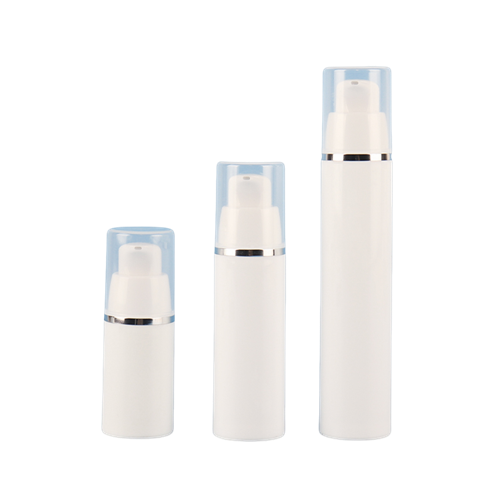
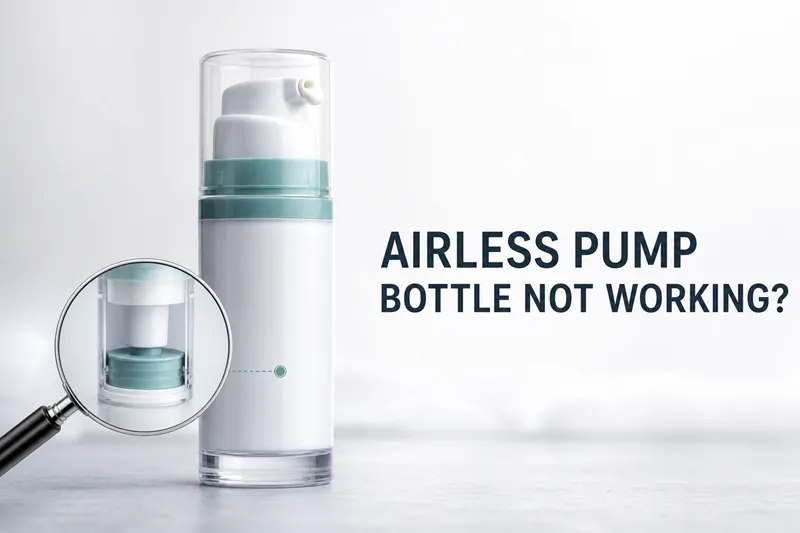
An airless pump bottle that stops dispensing is often not permanently broken. In many cases, the system has lost its seal, trapped an air pocket, or needs to be primed after filling or transit. The correct fix depends on whether the actuator moves, whether the internal piston rises, and whether the formula can pass through the pump.
Why Is My Airless Pump Bottle Not Working?
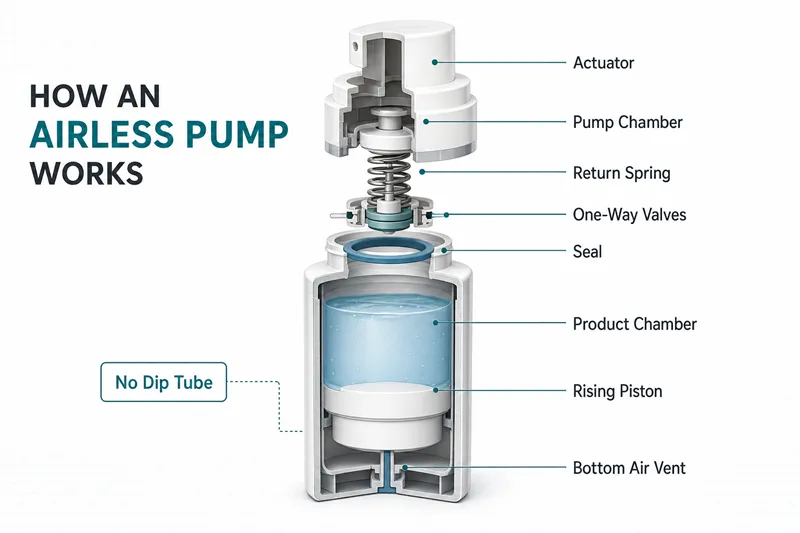
An airless package does not use the long dip tube found in an ordinary lotion bottle. Each pump stroke removes a measured amount of product and creates a pressure difference inside the container. Atmospheric pressure enters below the follower piston through a bottom vent, pushing the piston—and the formula above it—upward. If the system cannot maintain that pressure difference, dispensing stops.
Searchers usually describe the same symptom in different ways: “the pump presses but nothing comes out,” “the bottle worked once and stopped,” or “product remains but the pump feels empty.” The table below separates those symptoms so you can test the least invasive solution first.
| Symptom | Likely cause | What to do |
|---|---|---|
| New bottle, no output | Pump is not primed or piston stuck after transit | Tighten, tap gently, then make slow full strokes |
| Actuator moves with no resistance | Air leak, loose collar, damaged seal, or air pocket | Restore the seal and re-prime |
| Actuator is hard to press | Blocked outlet, dried product, or formula too viscous | Clean the external nozzle; do not force the pump |
| Weak or inconsistent dose | Incomplete strokes, entrained air, or poor formula compatibility | Prime, use full strokes, then run a compatibility test |
| Pump stays down | Return spring jammed, actuator misaligned, or product dried in mechanism | Stop forcing it; replace the matched pump assembly if serviceable |
How an Airless Pump Bottle Works
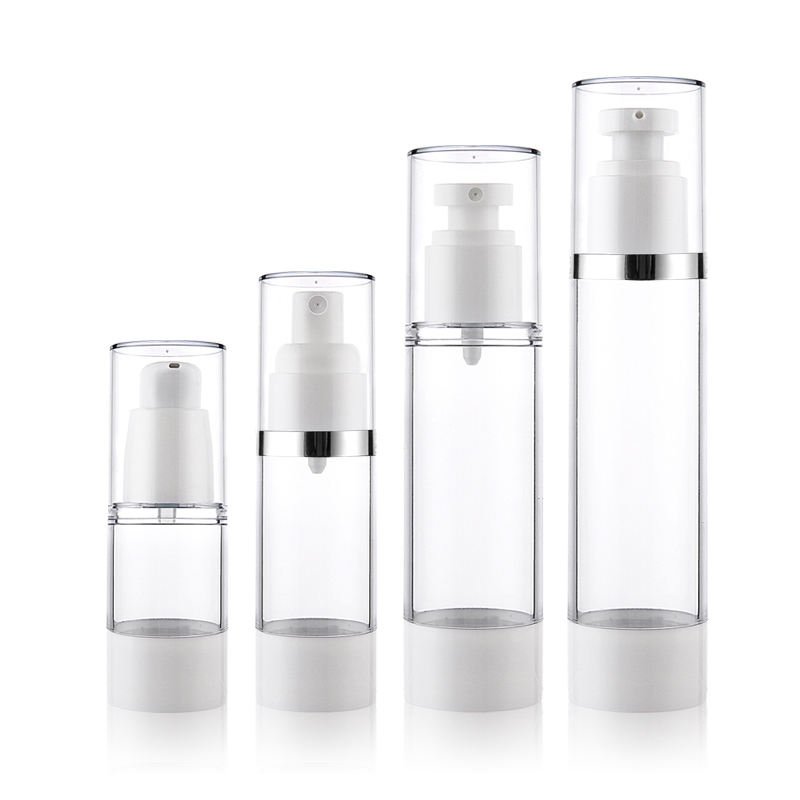
The main parts
- Actuator and outlet: the surface you press and the path through which the dose exits.
- Pump chamber and stem: create the displacement that draws in and expels product.
- Inlet and outlet valves: control one-way movement so the dose does not flow backward.
- Gasket and seals: maintain the closed pressure system.
- Follower piston: rises as product is removed, reducing headspace.
- Bottom vent: admits air below the piston—not into the formula chamber.
What does the spring do?
The spring returns the actuator and internal plunger to their starting position after each press. During the return stroke, the pump chamber expands and draws the next dose through the inlet valve. A spring that is corroded, deformed, displaced, or obstructed may leave the actuator down or produce an incomplete refill of the chamber.
In a well-designed cosmetic pump, the spring is normally isolated from direct formula contact or selected for the intended construction. End users should not open the spring chamber: the small components are difficult to reseal hygienically, and reassembly can change the pump output. For a brand or packaging buyer, the safer corrective action is usually to replace the complete matched pump rather than one internal spring.
Airless Bottle Quick Fix: Step-by-Step
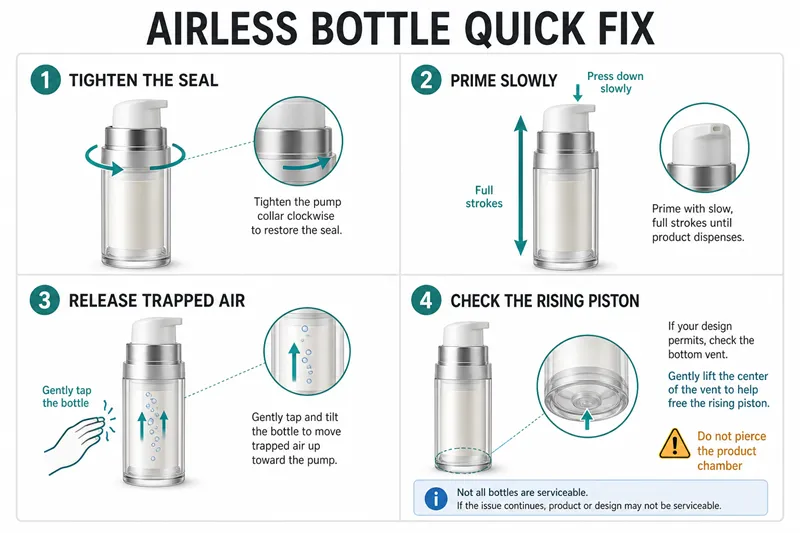
1. Check the lock and pump collar
Some actuators twist-lock. Rotate the head to the open position without loosening the collar below it. Confirm the closure is seated evenly and hand-tight. A small leak at the neck can prevent the vacuum from forming.
2. Prime with slow, complete strokes
Keep the bottle upright. Press the actuator to the bottom of its travel, allow it to return fully, and repeat 10–15 times. Rapid half-strokes move less air and can delay priming. A newly filled bottle may require more strokes because the pump chamber initially contains air.
3. Move a trapped air pocket
If the bottle was shipped on its side, gently tap the base against your palm and slowly rotate or tilt the package. The goal is to bring product into contact with the pump inlet, not to shake bubbles into the formula. Return it upright and prime again.
4. Inspect the nozzle and piston
Wipe dried product from the external outlet with a clean, damp cloth. Do not push a pin deep into the nozzle. If the bottle has an exposed service opening in the base, check whether the follower piston appears stuck. Only use the manufacturer’s recommended method; never puncture the product chamber. Many sealed airless systems are not designed for consumer disassembly.
5. Consider formula compatibility
A pump may work with a light serum but fail with a cream containing waxes, powders, fibers, or large suspended particles. High viscosity can slow chamber refill; a product that dries rapidly can block the outlet. Packaging approval should therefore be based on the final bulk formula, not water alone.
How to Replace a Broken Airless Pump Head
First determine whether the package is serviceable. Threaded pump assemblies can often be removed. Crimped, ultrasonically welded, and many snap-fit systems are intended to remain closed; forcing them apart can crack the bottle, contaminate the formula, or destroy the seal.
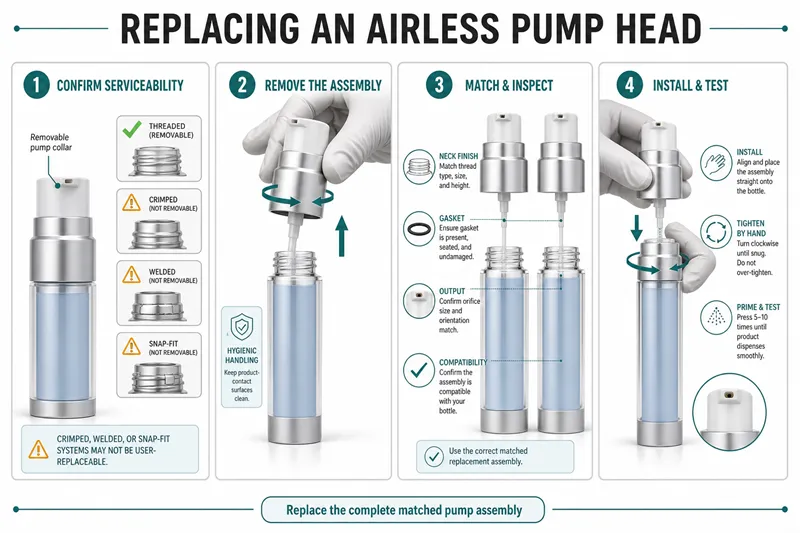
- Work clean. Wash and dry your hands, clean the exterior, and use clean gloves if the product will be retained.
- Identify the closure. Look for a threaded collar that can be turned independently. Stop if the closure is crimped, welded, or permanently snapped in place.
- Remove the complete assembly. Hold the bottle upright and unscrew the collar slowly. Do not pull the actuator off the internal stem or open the spring chamber.
- Protect the formula. Cover the bottle opening with a clean, compatible temporary cover. Avoid touching any product-contact surface.
- Match the replacement. Confirm neck finish, thread profile, gasket dimensions, pump output, inlet geometry, materials, and formula compatibility. A head that merely “looks the same” may not seal.
- Inspect the new pump. Check that the gasket is present, flat, clean, and undamaged. Verify that the actuator returns freely.
- Install by hand. Place the assembly squarely on the neck and tighten evenly until snug. Cross-threading and overtightening can both create leaks.
- Prime and test. Use slow complete strokes. Check output consistency, leakage around the collar, actuator return, and piston movement before returning the package to use.
Common Causes Brands Should Test Before Launch
- Seal integrity: neck, gasket, collar torque, and pump/bottle dimensional match.
- Viscosity through temperature range: a formula may thicken in cold storage or thin at elevated temperature.
- Priming and dose consistency: measure the first-to-dose stroke count and repeated output using filled packages.
- Transit orientation: vibration and side storage can move air within the system.
- Residue and drying: evaluate the nozzle after realistic pauses between uses.
- Material compatibility: check swelling, stress cracking, discoloration, odor transfer, and loss of seal.
For sourcing, compare the complete system rather than selecting the bottle, piston, and pump independently. Boyu Packaging’s airless pump bottle range can be reviewed alongside broader skincare packaging and plastic cosmetic bottle options. Final specifications, MOQ, testing plan, production timing, and customization should be confirmed with Boyu for the selected model and formula.
Frequently Asked Questions
Why does my airless pump bottle have no straw?
A true piston-style airless bottle normally draws product from the chamber above a rising follower piston, so it does not need a dip tube. The absence of a straw is not a missing part.
How many times should I pump to prime it?
Ten to fifteen slow, full strokes is a practical starting point. The number varies with pump chamber volume, fill level, formula viscosity, and how much air entered during filling or opening.
Can I refill an airless bottle?
Only if the specific design is sold as refillable or serviceable. Opening a sealed system can damage the vacuum path and introduces a hygiene risk. For commercial reuse programs, cleaning validation and component compatibility must be defined.
Can a thick cream work in an airless pump?
Often yes, but “thick” is not a sufficient specification. Rheology, particles, temperature behavior, pump inlet geometry, and output all matter. Test the final formula in the selected package.
When should I stop troubleshooting?
Stop if the actuator is cracked, the collar leaks, the spring does not return, the bottle is damaged, or the product may be contaminated. Consumers should contact the brand; brands should quarantine affected stock and investigate the component and formula lots.
Need an Airless Package That Matches Your Formula?
Share your target capacity, formula type, viscosity range, desired pump output, decoration, and market requirements. Boyu Packaging can recommend candidate systems for sampling and compatibility evaluation.
 English
  Español de Argentina
  Русский
  Italiano
  日本語
日本語  한국어
한국어  العربية
  Français
  Deutsch