
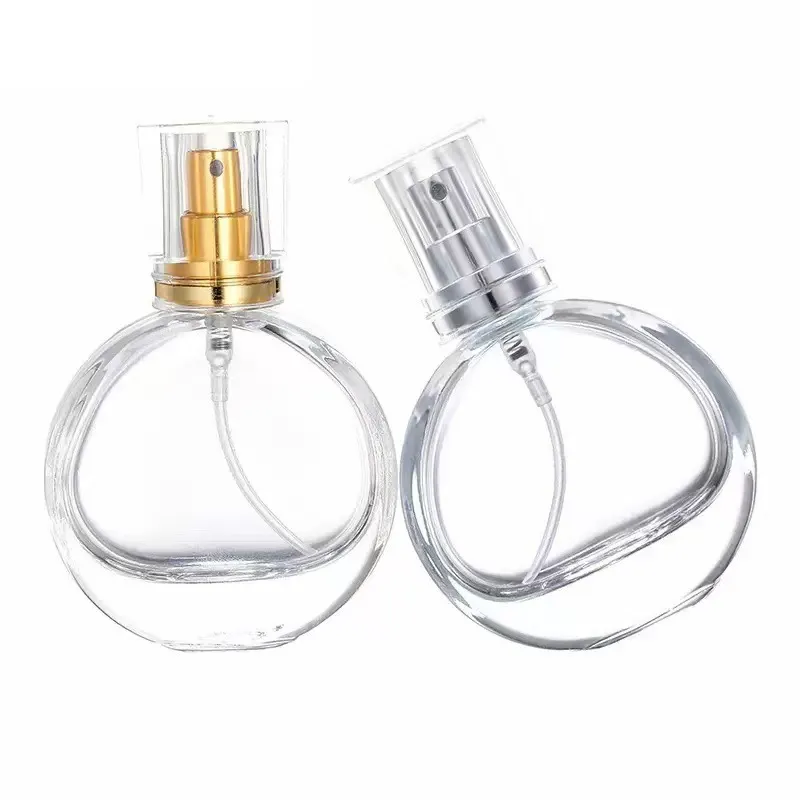

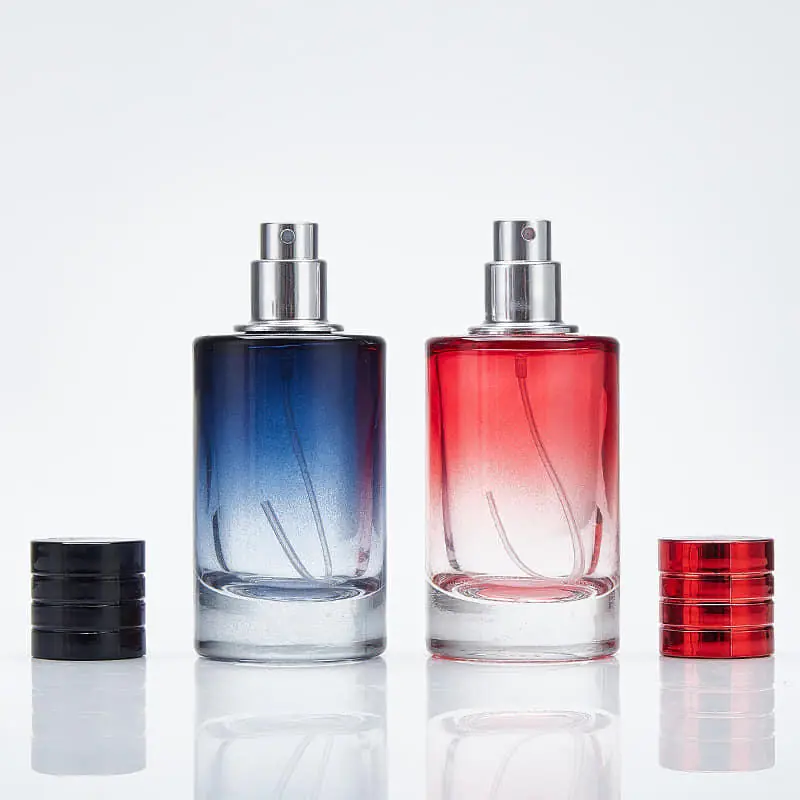
Direct answer: perfume bottle crimping is the permanent mechanical fastening of an atomizer pump to a glass crimp neck. A segmented crimping collet closes around the pump’s aluminium ferrule and forms it beneath the bottle’s neck bead while the gasket stays compressed against the sealing surface. A reliable closure depends on the complete system—bottle finish, pump, gasket, ferrule, dip tube, tooling and line setup. There is no universal air pressure or crimp-force value that is safe for every FEA bottle.

In this guide
How does perfume bottle crimping work?
The atomizer assembly normally contains an actuator, pump engine, gasket, ferrule and dip tube. Before crimping, the gasket sits between the pump cup and the bottle’s top sealing land. The filled bottle is centred below a collet, the pump is pressed fully onto the finish, and the collet’s segments close radially. The aluminium skirt yields plastically and curls or forms under the glass bead. When the tool opens, the deformed ferrule cannot move back over the bead without being cut or pried off.
The gasket—not the metal-to-glass contact—provides the primary liquid and vapour seal. The ferrule supplies retention and keeps the gasket compressed. This distinction explains why simply increasing pressure may make a leaking pack worse: over-crimping can wrinkle the ferrule, distort the pump cup, side-load the stem, damage the gasket or chip the glass while leaving the real leak path unresolved.
CETIE Guide No. 12 describes essential rules for tool crimping aluminium-ferrule pumps on FEA glass finishes. Its public scope specifically excludes rotating-head or rolling crimping. A supplier using a rolling head must therefore qualify that mechanism separately instead of claiming that one tool-crimping setup automatically applies.
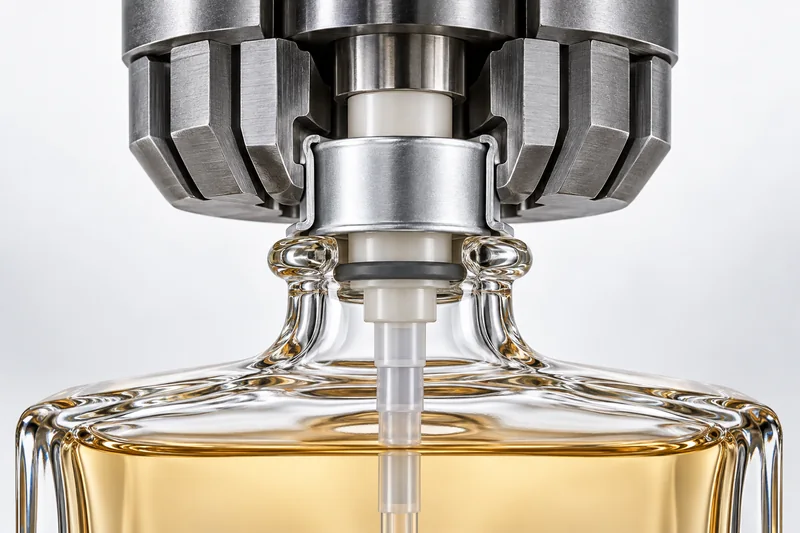
The crimp system: six parts that must fit together
| Part | What must be controlled |
|---|---|
| Glass neck finish | Top sealing surface, bead geometry, finish height, verticality, chips and mould variation. EN 14854 covers nominal FEA 11, 13, 15, 17, 18 and 20 families for moulded and tubular glass. |
| Pump cup and ferrule | The nominal neck family, ferrule material and thickness, skirt profile and pump-cup dimensions. EN 14849 identifies ferrule dimensions important to fastening; use the pump maker’s current drawing for production. |
| Gasket | Material, thickness, compression and chemical compatibility with alcohol, fragrance oils and colorants. Swelling, shrinkage or extraction can create a delayed leak even when the first inspection passes. |
| Pump engine | Dose, priming, spray pattern, actuator return and resistance to the actual formula. As product examples, Aptar lists 70, 100 and 130 µL options for one fragrance-pump family; Coster lists 60, 90 and 120 µL for another. These are product-family choices, not industry-wide defaults. |
| Dip tube | Length, cut style, curvature and fit in the pump. A tube that bottoms out can cock the pump; one that is too short leaves unusable fragrance. |
| Crimp tooling and support | Collet profile and condition, closing stroke, bottle centring, axial seating and base support. The tooling must match the selected pump and actual bottle—not merely the nominal FEA number. |
Important: “FEA 15” is not a complete approval
The nominal family helps identify compatible systems, but it does not replace dimensioned bottle and pump drawings, production gauges or physical trials. Do not substitute a 15/410 threaded pump for an FEA 15 crimp pump. Boyu’s bottle neck-finish compatibility guide explains the difference between crimp, screw and snap-on terminology.
Crimp neck, screw neck or snap-on: which is better?
| System | Strengths | Limitations | Best fit |
|---|---|---|---|
| FEA crimp | Established premium appearance; compact neck; secure permanent retention; mature high-speed equipment. | Requires tooling and setup control; difficult to disassemble; failed filled units need controlled disposition. | Conventional prestige fragrance and established filling lines. |
| Screw, including SNI | Can support refill, repair and component separation; no metal-forming crimp operation. | Needs controlled torque, thread and seal design; decorative collar still requires engineering. | Refillable concepts and brands prioritising separability. |
| Snap-on / crimpless | Fast assembly and no aluminium crimp deformation; available in dedicated proprietary systems. | Bottle finish, pump and applied vertical load must be validated as one system; not interchangeable with any random FEA pump. | Programs designed around a qualified snap system from the start. |
CETIE has published screw and snap-on perfume finishes in addition to conventional FEA designs, reflecting the industry’s movement toward refillability and component separation. The best closure is therefore the one that meets the product’s sealing, line-speed, appearance, refill and end-of-life requirements—not automatically the most familiar one.
Perfume bottle crimping process, step by step
1. Freeze the approved component combination
Approve the bottle drawing, neck-finish gauge, pump and gasket code, ferrule finish, actuator, dip-tube specification, collar, cap and tool reference. A metallic color change may involve a different ferrule coating or forming behaviour, so visual substitutions should not bypass line trials.
2. Inspect and condition incoming parts
Quarantine components until incoming inspection is complete. Check glass sealing surfaces for chips, cracks, distortion and contamination; sample finish dimensions and bottle verticality; confirm pump, gasket and tube codes; and keep parts clean, dry and protected from dust. Allow cold components to equilibrate before filling so condensation does not wet the sealing land.
3. Fill the released fragrance
The formula must be released under the manufacturer’s batch controls and filled to the validated target. Maintain the specified headspace and avoid wetting the neck. Fragrance on the sealing land can lubricate the gasket during assembly, trap contamination or obscure the true leak path. Fill accuracy is normally controlled by mass or calibrated volume with formula density accounted for.
4. Insert and seat the pump
Feed the dip tube without folding or scraping it. The pump cup must sit level and fully down on the bottle. If it rocks, sits high or springs back, stop and investigate tube interference, mouth variation, foreign material or the wrong pump—do not use the crimper to force a badly seated assembly into place.
5. Centre, support and crimp
Locate the bottle on a repeatable fixture and support its base or body according to the machine design. Apply the validated axial seating condition, then close the collet through the qualified stroke. All segments should move freely and form a uniform circumference. Air pressure is a machine input, not the product specification; tool geometry and actual closing stroke determine the metal profile.
6. Release and inspect the first-off pack
Check the pump is level, the aluminium has no severe wrinkles or splits, glass is undamaged, and the assembly meets the agreed crimp height, diameter or profile gauge. Confirm retention or rotation resistance with the documented method, then prime and spray the actual product. Approval should be recorded before continuous production begins.
7. Fit the collar and cap
A decorative collar hides the ferrule and creates the final premium appearance. It must not press the actuator, scrape the decoration or conceal a visibly defective crimp. Fit and removal forces for the overcap should be controlled so normal cap removal does not loosen the pump or pull off the collar.
What happens in a perfume bottle workshop?
Two factories are often confused. The glass-packaging factory melts raw materials, forms bottles, anneals them, inspects the cold end and may spray, frost, print or metallise the surface. The fragrance filling and assembly workshop receives those bottles, fills the perfume and installs the pump. Boyu’s detailed glass perfume bottle manufacturing process covers the first factory; the flow below focuses on the second.

- Receiving and quarantine: verify lot identity, count, protection, certificates and transport damage.
- Incoming inspection: sample critical bottle, pump, tube, gasket, collar and cap characteristics against approved specifications.
- Line clearance and cleaning: remove previous product and components; verify contact parts, guards, extraction and batch documents.
- Formula preparation and release: mature, chill or filter the fragrance if its manufacturing instruction requires it; confirm identity and quality before filling.
- Filling: dose released product while controlling fill mass, foaming, drips and neck cleanliness.
- Pump placement and crimping: insert the correct tube and pump, verify seating, crimp with approved change parts, then perform first-piece and interval checks.
- Finishing: fit decorative collar, actuator if separate, cap, label and batch code without scratching the bottle.
- Finished-pack release: inspect appearance, fill, crimp, leaks, spray and coding; review records and retained samples before distribution.
Perfume crimping machine types and process control
| Machine | Advantages | Main control risk |
|---|---|---|
| Hand or bench collet | Low investment; useful for samples, laboratories and small batches. | Operator centring, seating and cycle variation; needs a fixture and frequent checks. |
| Pneumatic semi-automatic | More repeatable motion while retaining flexible hand loading. | Wrong change parts, unregulated air, hand-seated pump variation and poor bottle support. |
| Automatic inline or rotary | Integrated filling, pump feeding, crimping and inspection at commercial speed. | Small feeder or centring errors can repeat rapidly; sensors, rejects, guarding, changeover and preventive maintenance are essential. |
| Rolling / rotating head | Alternative forming mechanism used on some machines. | Different process mechanics from segmented tool crimping; requires its own validated setup and acceptance profile. |
Why a universal crimping pressure is the wrong specification
Two machines can show the same air pressure while producing different closing force and ferrule geometry because cylinder area, leverage, head design and stroke differ. Even within one nominal FEA size, ferrule thickness, gasket, bottle finish and tool profile may change. The robust method is to qualify a window using approved components, then control measurable outputs: pump seating, crimp height/diameter/profile around the circumference, retention, glass condition, leak performance and spray function.
Record machine identity, tooling code, setup position or stroke, air pressure where relevant, component lot, operator, first-off results and inspection frequency. Air pressure remains useful as a process-monitoring parameter—but only after it has been correlated to acceptable finished packs.
How to inspect and test a crimped perfume bottle

| Stage | Useful controls | What it detects |
|---|---|---|
| Incoming glass | Finish gauges or dimensions, sealing-land visual inspection, verticality, crack/chip checks and cleanliness. | A bottle issue that cannot be corrected safely by machine pressure. |
| First-off crimp | Approved profile gauge or measured diameter/height at defined positions, uniformity, seating and glass inspection. | Wrong head, wrong setting, off-centre bottle, worn segments or component mismatch. |
| Retention | Documented rotation, pull or removal-force method with product-specific limits. | Loose ferrule and inadequate mechanical engagement. Destructive tests belong to a sampling plan. |
| Seal integrity | Validated side/inverted storage, mass-loss assessment, vacuum or pressure method where suitable, plus temperature and transport conditioning. | Liquid leakage, vapour loss and delayed gasket or formula interaction. |
| Dispensing function | Priming strokes, output mass, spray pattern, drool, actuator return and pickup near end of use. | Pump damage, side-loaded stem, tube interference, blockage or formula mismatch. |
ISO 8113 provides a method for testing a glass container’s resistance to external force along its vertical axis. It can inform packaging and line-development work, but it is not a finished perfume-pack crimp acceptance standard. Likewise, no single leak-test duration or vacuum level is correct for every bottle and formula. Build the plan around the actual distribution route, shelf life and failure risk. For the wider package program, see Boyu’s guide to tests required for cosmetic bottles.
Common perfume bottle crimping problems and solutions
| Symptom | Likely causes | Corrective path |
|---|---|---|
| Pump rotates or feels loose | Under-formed ferrule, wrong head, bottle/pump mismatch, incomplete seating or ferrule variation. | Quarantine the lot. Compare component and tool codes, measure the profile around the circumference and approve a corrected first-off. Do not raise pressure before identifying the mismatch. |
| Leak around the neck | Missing, damaged or incompatible gasket; wet/defective sealing land; off-centre, under- or over-crimped assembly. | Trace whether loss is liquid or vapour. Inspect the seal stack, neck and gasket; verify formula compatibility; then retest the complete pack after conditioning. |
| Wrinkled or uneven ferrule | Bottle off centre, dirty/worn segments, mismatched profile, uneven jaw travel or excessive closing. | Stop, clean and inspect the head; verify centring and bottle support; replace damaged change parts and restore the validated output profile. |
| Chipped or cracked glass | Excessive radial/axial load, misalignment, neck defect, unsuitable support, tool contact or pre-existing glass stress. | Stop the line and segregate affected units. Inspect glass finish and fracture location, tooling, support and alignment. Never continue by trial-and-error pressure increases. |
| Pump sits high or tilted | Dip tube bottoming or kinking, debris, uneven mouth, incorrect pump or poor insertion. | Check tube length and cut, pump seating before crimp, bottle verticality and finish geometry. Correct the cause before re-approving. |
| No spray, weak spray or sticky actuator | Unprimed or clogged pump, formula incompatibility, bent tube, side-loaded stem or pump damage during crimping. | Test an uncrimped control pump with the same formula, inspect tube and stem alignment, then separate pump performance from the crimp variable. |
| Collar or cap will not fit | Crimp outer diameter/height out of tolerance, collar mismatch or high pump seating. | Measure the finished stack against all three drawings—pump, collar and cap. Do not force the collar over a defective crimp. |
| Scratched paint or glass | Hard or contaminated guides, insufficient decoration cure, bottle-to-bottle contact or poor handling. | Map every contact point, clean or soften guides where appropriate, verify decoration cure and repeat line trials with production-finished bottles. |
A faster diagnostic order: follow the seal stack
- Confirm the exact bottle, pump, gasket, tube and tooling codes.
- Inspect the glass sealing surface and pump seating before evaluating machine pressure.
- Measure the crimp at several positions, not only one convenient point.
- Compare leaking and non-leaking samples from the same lots.
- Test the actual formula after relevant storage and transport conditioning.
- Change one controlled variable at a time and document the result.
Can a failed crimp be removed and reworked?
Not as an informal line-side repair. A crimp is intended to be permanent. Prying or cutting a ferrule can create glass chips and metal fragments, damage the neck, contaminate fragrance and expose workers to a flammable liquid. A failed filled unit should be quarantined and dispositioned by quality personnel.
If a manufacturer recovers product, it needs a validated decrimp or decanting procedure covering tools, containment, filtration where justified, traceability, contamination risk, formula stability, glass inspection and regulatory release. Otherwise the pack or product should be scrapped through the approved waste route. A consumer should never attempt to repair a crimped fragrance bottle with pliers or heat.
Safety and environmental conditions in the crimping area
Many ethanol-based fragrances can generate flammable vapours, but the applicable classification depends on the actual formula and safety data sheet. The workshop should assess the product, quantity, transfer method, ventilation and ignition sources. OSHA 29 CFR 1910.106 includes ventilation, vapour-control and bonding/grounding provisions for relevant flammable-liquid operations in the United States. In the EU, Directive 1999/92/EC requires employers to assess explosive-atmosphere risks, prevent ignition—including electrostatic discharge—and mitigate consequences.
Use equipment suitable for the classified area, capture spills, control static where required and provide compatible PPE. Temperature and humidity also affect formula density, condensation, component dimensions and decoration, but there is no universal room setpoint for crimping. Establish limits from the formula, equipment, component and safety requirements, then record them in the validated process.
What to send a perfume bottle or filling supplier
A useful RFQ lets suppliers evaluate a complete package rather than quote a bottle in isolation. Include:
- Bottle capacity, fill level, material, shape, decoration and target weight.
- Required finish system and the approved pump drawing or desired dose and spray performance.
- Formula type, alcohol level or relevant compatibility information under confidentiality.
- Dip tube, actuator, ferrule color, collar, cap and refill/disassembly requirements.
- Annual volume, order quantity, filling location, machine type and desired line speed.
- Target markets, transport route, shelf life and agreed leak, retention, spray and appearance tests.
- Golden samples, defect boundary samples, sampling plan, traceability and change-control expectations.
Before importing, request production samples assembled with the intended pump and test them on the actual filling line. The bottle maker should provide controlled neck-finish data and dimensional evidence; the pump supplier should confirm the matching ferrule, gasket and crimp-tool recommendation; the filler should demonstrate the qualified setup. Boyu’s guide to importing perfume bottles from China covers supplier qualification, samples, inspection and logistics in more detail.
Frequently asked questions
What is an FEA perfume bottle neck?
FEA is the common industry designation for standardized spray-glass neck-finish families. EN 14854 specifies nominal families including 11, 13, 15, 17, 18 and 20 mm. The number identifies a family, not every production dimension needed to approve a bottle and pump.
How tight should a perfume bottle crimp be?
Tight enough to meet the approved crimp profile, retention, leak and spray requirements without wrinkling the ferrule, distorting the pump or damaging glass. Specify measurable finished-pack results rather than copying another machine’s pressure setting.
Does crimping make a perfume bottle leakproof?
It can create an effective seal when every part is compatible and the process is controlled, but “crimped” alone is not proof of leak performance. The gasket, neck surface, formula, storage temperature and distribution stress all matter, so finished packs require validation.
Can an FEA crimp bottle be refillable?
A conventional crimp pump is not designed for routine consumer removal. Refillable products are better designed from the start around a qualified screw, snap-on or proprietary refill system that preserves sealing and tamper expectations.
Build the bottle, pump and crimp process as one package
Boyu Packaging can develop custom glass fragrance bottles and coordinate neck finish, pump, decoration and production testing for your target market and filling line. Send the formula type, capacity, finish, pump dose, decoration, order quantity and test requirements for a package-level review.
Sources
- CETIE, Guide No. 12 catalogue entry: crimping a pump on an FEA glass finish
- EN 14854:2021 preview, aerosol and spray glass-container neck finishes
- EN 14849:2005, glass aerosol-container ferrule dimensions
- CETIE neck-finish data sheets for crimp, screw, snap-on and crimpless systems
- Aptar Beauty, Essencia Classic fragrance-pump formats and doses
- Coster, perfumery pump product brochure
- ISO 8113:2004, resistance of glass containers to vertical load
- OSHA 29 CFR 1910.106, flammable liquids
- EU Directive 1999/92/EC, worker protection in potentially explosive atmospheres



 English
  Español de Argentina
  Русский
  Italiano
  日本語
日本語  한국어
한국어  العربية
  Français
  Deutsch