


Direct answer: A fine mist sprayer produces a stream when the liquid does not leave the actuator as a thin, rotating sheet that can break into droplets. The usual causes are residue or damage in the tiny orifice or swirl insert, an incorrect or displaced insert, insufficient pressure from a partial/slow stroke or weak pump, air in the supply path, and a formula whose viscosity, surface tension, particles or emulsified phases exceed that sprayer’s atomisation window. Diagnose the spray shape and use controlled cross-testing before changing either the formula or package.
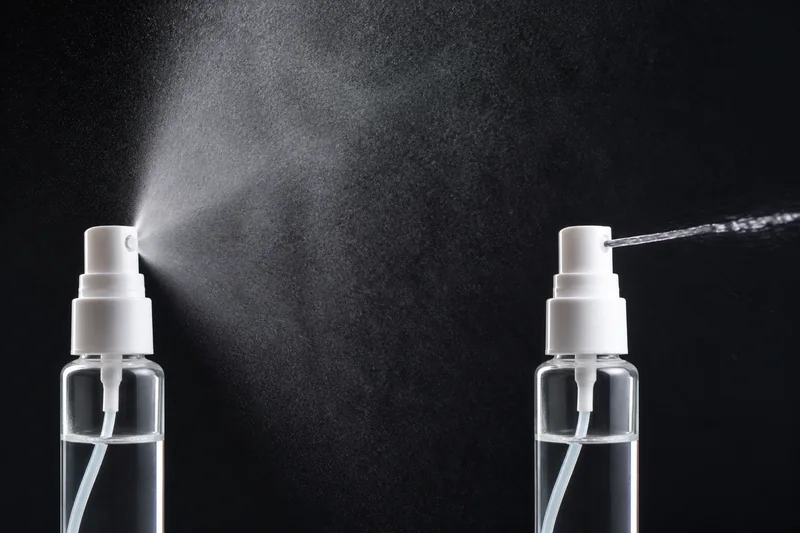
Diagnose the spray appearance before disassembly
| Observed output | Priority checks | What it suggests |
|---|---|---|
| Clean, narrow stream on every full stroke | Wrong/missing insert, damaged swirl geometry, formula outside the sprayer window | Little or no swirl-sheet formation |
| Stream angled to one side | Partial obstruction or orifice damage | Asymmetric flow at the outlet |
| Coarse droplets with a wet centre | Actuation speed, pressure recovery, viscosity, surface tension, output/insert match | Sheet forms but does not break up adequately |
| Good mist followed by sputtering | Dip-tube joint, prime, fill level, entrained air | Air interrupts continuous liquid supply |
| Only the first stroke after storage streams | Nozzle wetting, dried residue, prime retention and stroke completeness | Transient condition, not necessarily permanent hardware failure |
| Performance worsens over pack life | Residue deposition, compatibility ageing, particles, formula separation | Progressive fouling or material change |
Why a fine mist sprayer can turn into a jet
In a typical mechanical fine mist actuator, the pump pressurises a measured liquid volume and the actuator insert directs it through small tangential passages. The rotating flow emerges through the orifice as a thin conical sheet. Inertia stretches that sheet while surface tension tries to hold it together; disturbances grow into ligaments and then droplets. If swirl is lost, pressure is too low or cohesive/viscous forces dominate, the liquid remains a thick sheet or coherent jet.
ASTM D4041/D4041M-05(2025) states that spray pattern varies with both actuator design and the nature of the liquid; different liquids need not produce the same pattern with the same actuator. Research on liquid-sheet breakup likewise identifies nozzle geometry, pressure/inertia, viscosity and surface tension as coupled variables. This is why “the pump works with water” does not qualify it for a toner, setting spray or fragrance.
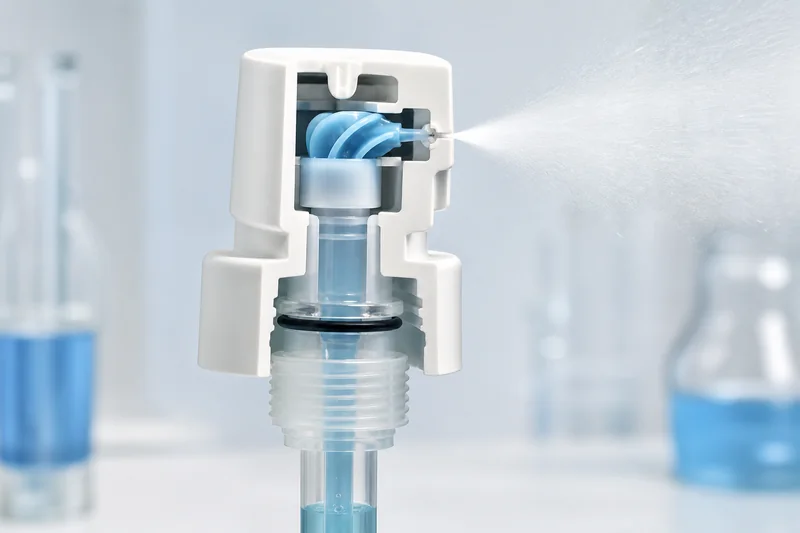
Blocked or contaminated swirl passages
Dried product, crystallised salts, polymer deposits, pigments or foreign matter can narrow a tangential channel or the orifice. A one-sided blockage commonly produces a deflected jet or uneven pattern. In development, inspect the actuator microscopically and compare a fresh actuator on the same filled bottle. For a marketed cosmetic, follow the brand’s cleaning directions; pushing a pin into the orifice can permanently change geometry.
Damaged, missing or mismatched actuator insert
An insert may be malformed, displaced during assembly or paired with the wrong pump output. The actuator, insert, pump engine and formula form one atomising system; substituting an actuator that fits mechanically does not prove equivalent spray performance.
Insufficient pressure or incomplete actuation
A hesitant partial stroke may not deliver the velocity needed for sheet breakup. Compare controlled full strokes at a consistent rate. If all users or an actuation rig show the same defect, assess pump output, pre-compression design where applicable, spring return, leakage and chamber refill rather than blaming technique.
Air entering the liquid path
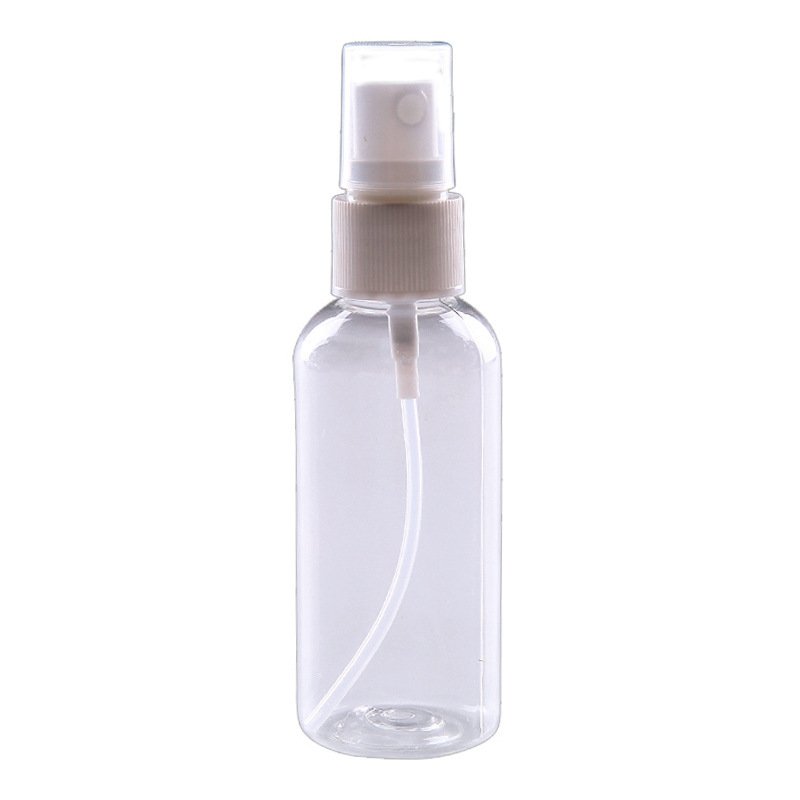
A loose dip tube, inadequate immersion, poor prime retention or aerated fill can cause sputter and alternating stream/mist. Check bubbles in a transparent diagnostic pack and validate the dip-tube length and inlet position if that supporting article is live.
Higher viscosity generally resists deformation and can produce larger droplets, a narrower cone or a stream at a given nozzle and pressure. Yet viscosity alone cannot predict performance. Dynamic surface tension during the millisecond-scale formation of new surface, density, viscoelasticity, suspended solids, emulsion droplets, dissolved polymers, alcohol content and temperature can all change atomisation.
- Structured or shear-thinning formulas: measure properties under spray-relevant shear where possible; a low-shear viscosity result may misrepresent passage flow.
- Surfactant systems: equilibrium surface tension may not describe the rapidly created liquid sheet. Dynamic behaviour can differ.
- Particles or phase inhomogeneity: even when they pass through the orifice, they can disturb swirl or accumulate over repeated cycles.
- Temperature: it alters viscosity and sometimes phase behaviour, so a pack may mist warm and stream cold.
- Formula ageing: evaporation, precipitation, separation or interaction with wetted materials can make a formerly acceptable system fail.
Do not dilute or reformulate a finished product as a casual packaging fix. Screen a sprayer designed for the actual formula, or change the formula through controlled stability, safety and performance review.
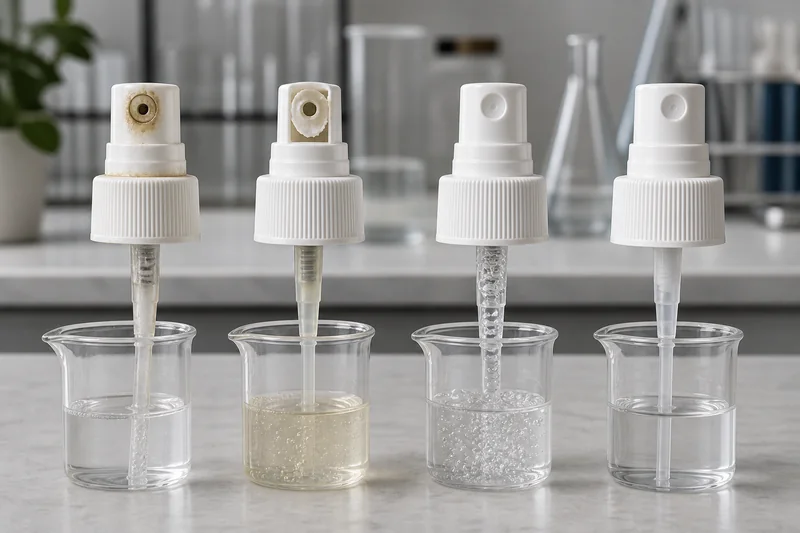
Use a four-cell cross-test to isolate the root cause
| Test cell | Purpose | Interpretation |
|---|---|---|
| Suspect sprayer + production formula | Reproduce the failure | Establishes the baseline only |
| Fresh sprayer, same specification + production formula | Check individual hardware damage/fouling | If restored, investigate the suspect actuator or pump |
| Suspect sprayer + supplier reference liquid | Screen hardware under defined conditions | If still streaming, hardware/assembly becomes more likely |
| Fresh sprayer + production formula | Test system-level compatibility | If it streams while the reference liquid mists, formula–sprayer mismatch becomes more likely |
Use multiple representative units and control temperature, fill, prime, stroke rate, distance and orientation. A single swap cannot establish lot capability. Also note that water or a reference liquid is diagnostic, not a substitute for finished-formula approval.
How to validate spray quality for production

- Define the desired pattern for the use case: cone shape, coverage, centre wetness, droplet character, output and consumer feel. “Fine mist” alone is not an acceptance specification.
- Use production-intent spray bottles and fine mist sprayers, finished formula and representative component/formula lots.
- Condition samples at agreed temperatures and orientations; record prime strokes and exclude them from steady-state results unless first-use performance is being assessed.
- Spray at a fixed perpendicular distance onto suitable collection media. Evaluate pattern dimensions, symmetry, voids, heavy centre and streamers. ASTM D4041 provides a comparative spray-pattern method.
- Measure mass output per full stroke and observe repeated strokes, slow/fast user strokes and full actuator return.
- Repeat through pack life and after compatibility/storage conditioning. Inspect for clogging, material change, leakage and altered spray.
- Use instrumental droplet-size measurement only when the product requirement justifies it; visual pattern and mass output do not independently define the full droplet-size distribution.
Frequently asked questions
Can I unclog a fine mist sprayer with a needle?
No for qualification or production use. A needle can enlarge or deform the precision orifice and permanently change the spray. Follow validated cleaning instructions or replace the actuator for diagnosis.
Why does it mist with water but stream with my formula?
The pump is moving liquid, but the production formula’s viscosity, surface tension, rheology, particles or phase structure does not atomise within the same hardware window. Test alternative inserts/pumps with the finished formula.
Can slow pressing cause a stream?
Yes, if the slower stroke produces insufficient pressure and outlet velocity. However, packaging intended for consumers should be evaluated across realistic actuation behaviour, not only under an ideal laboratory stroke.
Does a smaller orifice always create a finer mist?
No. Orifice size works with swirl geometry, pump pressure/output and liquid properties. Making the orifice smaller may increase restriction or clogging without achieving the intended spray.
When should the whole sprayer be changed?
Change the hardware specification when fresh, correctly assembled samples repeatedly fail with the stable finished formula across intended temperatures and user strokes, or when compatibility ageing causes unacceptable drift. Confirm the replacement through full pack testing.
Sources
- ASTM D4041/D4041M-05(2025), Spray Patterns of Manually Operated Pump Dispensers
- Physical Review X, What Determines the Drop Size in Sprays?
- Energy, Experimental investigation of surface tension and viscosity on hollow-cone spray atomisation
- Silgan Dispensing, Personal Care Product Portfolio—fine mist spray pattern options


 English
  Español de Argentina
  Русский
  Italiano
  日本語
日本語  한국어
한국어  العربية
  Français
  Deutsch