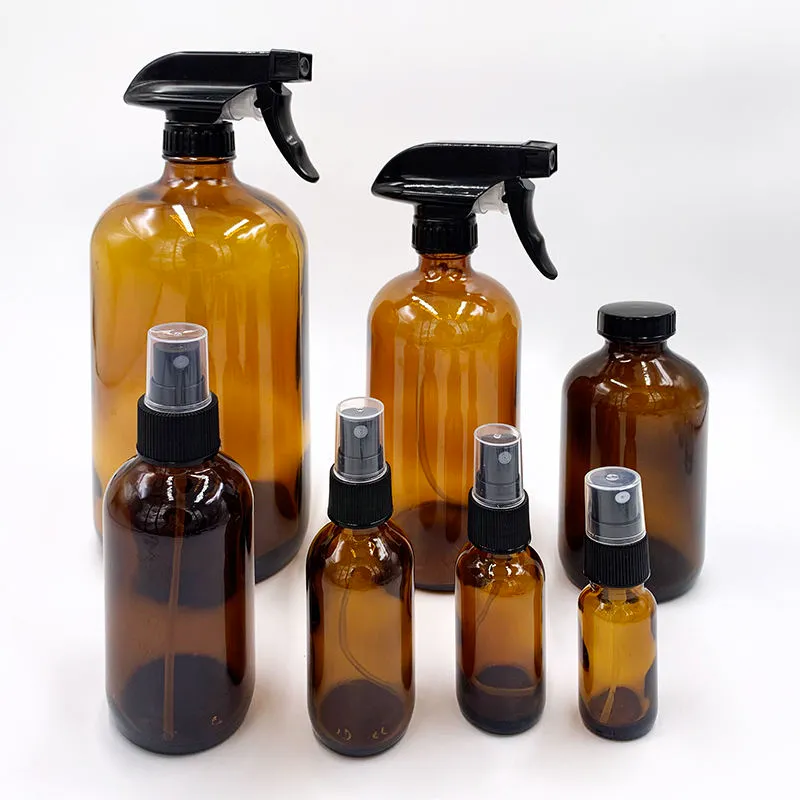
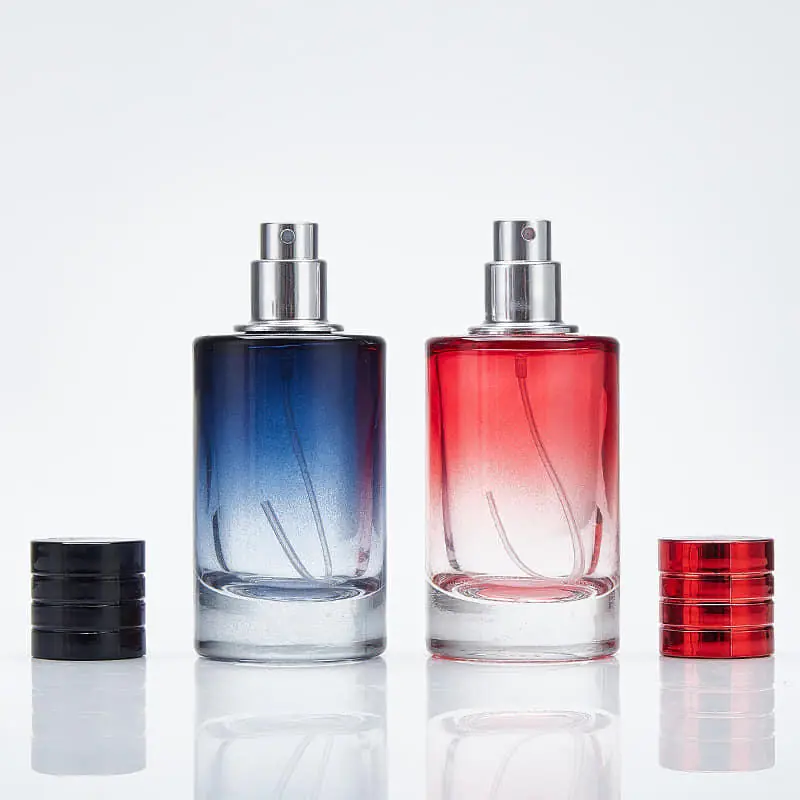
Direct answer: 16 avoirdupois ounces (oz) = 453.59237 grams (g). That is exactly 1 pound. The calculation is 16 × 28.349523125.
However, 16 US fluid ounces (fl oz) is a volume, not a weight. It equals 473.176 mL. Its weight in grams depends on the product’s density: a 16 US fl oz fill weighs about 473.18 g only when density is 1.000 g/mL. Bottle material does not change this conversion, but the formula, temperature, entrained air, package tare and chosen fill line all affect real filling and shipping calculations.
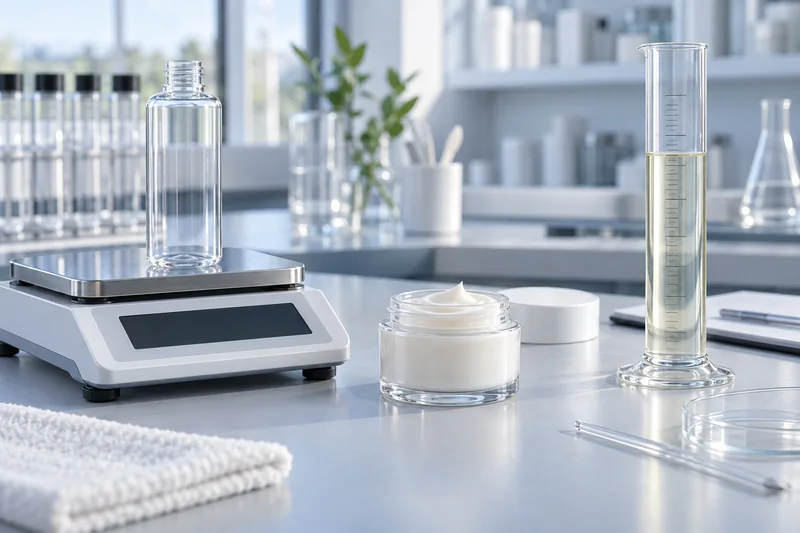
What is 16 ounces in grams or millilitres?
The answer depends on what the word “ounces” means. This is the decision point most quick converters omit.
| Starting unit | What it measures | Exact or practical answer | When used |
|---|---|---|---|
| 16 oz (avoirdupois) | Mass | 453.59237 g = 1 lb | Creams, balms, scrubs, powders, bath salts, product or shipping weight |
| 16 US fl oz | Volume | 473.176 mL | US liquid fills such as shampoo, toner, body wash and lotion where fluid measure is used |
| 16 Imperial fl oz | Volume | 454.609 mL | Older or specifically Imperial specifications; not interchangeable with US fl oz |
Ounces, grams and millilitres calculator
This calculator can start with weight ounces, US fluid ounces, Imperial fluid ounces, grams or millilitres. Enter the measured density of the finished product whenever the conversion crosses between mass and volume.
Packaging conversion calculator
Planning estimate only: 1.000 g/mL is a water-like placeholder, not a universal cosmetic density. Use a batch-specific density measured at a stated temperature. The displayed answer does not include bottle, pump, cap, label or carton weight.
JavaScript is off. For 16 weight oz, use 16 × 28.349523125 = 453.59237 g. For 16 US fl oz, use 16 × 29.5735295625 = 473.176 mL, then multiply by density to estimate grams.
The correct conversion formulas
Weight ounces to grams
For 16 oz: 16 × 28.349523125 = 453.59237 g. Use 453.59 g for ordinary planning or 454 g when whole-gram precision is sufficient. Do not claim more decimal places than the scale and process can support.
US fluid ounces to millilitres
For 16 US fl oz: 16 × 29.5735295625 = 473.176473 mL. In commercial packaging this is commonly rounded to 473 mL for calculation, but the approved legal declaration and target fill should follow the market, product and measurement-control plan.
Fluid ounces to grams
For a US unit, use 29.5735295625 mL per fl oz. Example: a finished lotion with measured density 1.05 g/mL filled to 16 US fl oz has an estimated product mass of 16 × 29.5735295625 × 1.05 = 496.84 g. That is product mass only—not the filled pack’s gross weight.
Grams to millilitres
A 453.592 g fill occupies 453.592 mL at 1.000 g/mL, about 431.99 mL at 1.05 g/mL and about 503.99 mL at 0.90 g/mL. This is why a 16 oz net-weight product cannot be assigned a bottle volume responsibly without density data and headspace requirements.
Does the liquid or cosmetic formula change the answer?
It changes a fluid-ounce-to-gram conversion, but not an ounce-to-gram mass conversion. Sixteen weight ounces is always 453.59237 g. Sixteen US fluid ounces is always 473.176 mL. The grams contained in that volume change with density.
Density is mass per unit volume, usually expressed as g/mL for cosmetics. Water near room temperature is close to 1 g/mL. Ethanol is less dense—NIST reports 0.78937 g/cm³ at 20°C for pure ethanol—while emulsions or salt-rich formulas may be higher than water. Those facts are useful for understanding direction, but they are not substitutes for measuring the actual finished formula. Oils, surfactants, silicones, suspended solids, dissolved salts and ethanol level can all shift density.

| Illustrative density | Mass of 16 US fl oz / 473.176 mL | What the number means |
|---|---|---|
| 0.80 g/mL | 378.54 g | A low-density calculation scenario |
| 0.85 g/mL | 402.20 g | A low-density calculation scenario |
| 0.90 g/mL | 425.86 g | A below-water calculation scenario |
| 1.00 g/mL | 473.18 g | A water-like calculation scenario |
| 1.05 g/mL | 496.84 g | An above-water calculation scenario |
| 1.10 g/mL | 520.49 g | A higher-density calculation scenario |
These are arithmetic examples, not recommended densities for product categories. Two shampoos or lotions can have different densities, and density can change after reformulation. Measure the production formula after aeration has settled, record the test temperature and use a calibrated method.
Does bottle material change ounces to grams?
No. Glass, PET, HDPE, PP and aluminium do not change the conversion between product ounces, grams or millilitres. They change the empty package weight (tare), barrier performance, rigidity, breakage risk, compatibility, decoration options and shipping weight.
A 473.176 mL fill at 1.00 g/mL contains the same 473.176 g of product whether it is placed in glass or plastic. But the filled glass pack can be much heavier than the filled PET or HDPE pack because the container itself weighs more. Keep these quantities separate:
- Net content: product only.
- Tare: empty bottle plus the packaging components included in the weighing method.
- Gross unit weight: net product + bottle + pump/closure + label and any components weighed together.
- Shipping weight: filled units + cartons + dividers + pallets or other transport materials.
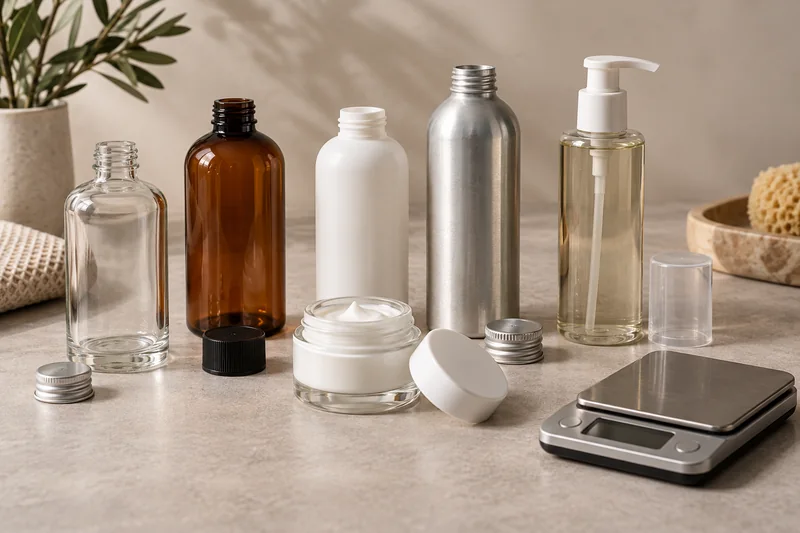
Common ounce conversions for cosmetic packaging
Weight ounces to grams
| Weight ounces | Grams | Common packaging context |
|---|---|---|
| 0.1 oz | 2.835 g | Sample or concentrated solid format |
| 0.17 oz | 4.819 g | Approximately a 5 g sample by weight |
| 0.25 oz | 7.087 g | Small balm or eye product |
| 0.5 oz | 14.175 g | Small cream or balm |
| 1 oz | 28.350 g | Facial cream, mask or treatment |
| 1.7 oz | 48.194 g | Often paired commercially with a nominal 50 g pack, but not exact |
| 2 oz | 56.699 g | Cream, scrub or travel solid |
| 3.4 oz | 96.388 g | Close to, but not exactly, 100 g |
| 4 oz | 113.398 g | Jar, scrub, balm or powder |
| 8 oz | 226.796 g | Body cream, scrub or salon size |
| 12 oz | 340.194 g | Large jar or treatment |
| 16 oz | 453.592 g | One pound net weight |
US fluid ounces to millilitres
| US fluid ounces | Millilitres | Practical note |
|---|---|---|
| 0.17 fl oz | 5.028 mL | Small fragrance, serum or sample |
| 0.34 fl oz | 10.056 mL | Travel or treatment size |
| 0.5 fl oz | 14.787 mL | Often marketed alongside 15 mL, but not exact |
| 1 fl oz | 29.574 mL | Often marketed alongside 30 mL, but not exact |
| 1.7 fl oz | 50.275 mL | Close to 50 mL; common face-care size |
| 2 fl oz | 59.147 mL | Often paired with 60 mL |
| 3.4 fl oz | 100.552 mL | Close to 100 mL |
| 4 fl oz | 118.294 mL | Often paired with 120 mL |
| 8 fl oz | 236.588 mL | Often paired with 240 or 250 mL |
| 12 fl oz | 354.882 mL | Medium-to-large hair or body product |
| 16 fl oz | 473.176 mL | Common US family-size fill |
A 500 mL bottle is not exactly 16 US fl oz. Five hundred millilitres equals about 16.907 US fl oz. This 26.824 mL difference matters for label declarations, target fill, headspace, carton weight and the number of units that can be filled from a bulk batch.
How packaging engineers use the conversion
A conversion is only the first step. Container selection and line setup need a controlled chain from declared net content to target fill and pack-out weight.
- Confirm the declaration basis. Is the product sold by weight or volume in the destination market? Record the exact unit system.
- Measure finished-product density. Use a documented method, calibrated equipment and stated temperature. Repeat if the formula changes.
- Translate the declared quantity into the other control unit. A line may fill volumetrically but verify by weight, or vice versa. Density connects the two.
- Select nominal and brimful capacity deliberately. Bottle “capacity” can mean nominal fill, overflow/brimful capacity or a catalogue family name. The closure and dip tube also displace volume.
- Allow functional headspace. Do not solve an undersized bottle by filling to the lip. Headspace must account for closure insertion, temperature change, handling and the product’s behaviour.
- Establish tare distribution. Weigh multiple bottle, pump, cap and label sets; one empty pack is not a reliable production average.
- Run filling trials. Check product temperature, foam, trapped air, drip/stringing, fill repeatability, net-content compliance and appearance after settling.
- Validate the complete pack. Test leakage, torque or crimp, pump output, compatibility, transport and storage with the actual formula and decorated components.
For package-system verification, use Boyu’s guides to cosmetic packaging compatibility testing and cosmetic bottle leak testing. For adjacent unit problems, the cosmetic packaging conversion calculator hub keeps mass, volume and density tools together.
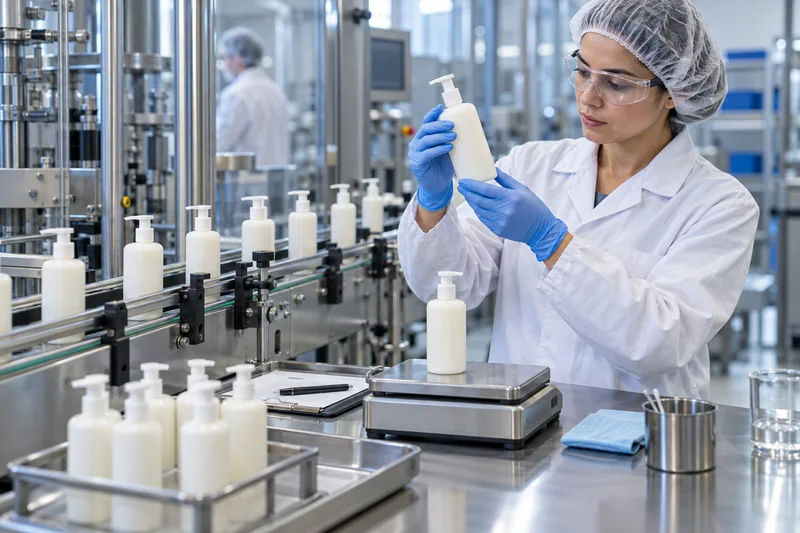
Worked cosmetic packaging example
A US body-lotion project calls for 16 US fl oz. The finished lotion’s validated density at the agreed test temperature is 1.04 g/mL.
- Nominal volume: 16 × 29.5735295625 = 473.176 mL.
- Calculated product mass: 473.176 × 1.04 = 492.104 g.
- If the agreed packaging tare is 46.0 g, expected filled unit gross weight is approximately 538.1 g before any outer carton.
- If a master carton holds 24 units, product plus primary-pack mass is approximately 12.91 kg; dividers, carton and pallet materials must still be added.
This is a planning illustration, not a fill tolerance or legal compliance rule. Actual target fill must account for equipment variation, measurement uncertainty, sampling plan and applicable net-content law. A factory should not simply set the machine to 492.1 g and assume every pack complies.
Net-content and market labelling cautions
In the United States, FDA cosmetics guidance says net contents are generally stated by fluid measure for liquids and by weight for solids, semisolids and viscous products, subject to customary trade practice. FDA also states that liquid volume is determined at 68°F (20°C). The detailed rules sit in 21 CFR 701.13, and packaged-goods requirements may also involve federal and state weights-and-measures rules.
In the European Union, Article 19 of Regulation (EC) No 1223/2009 requires nominal content at the time of packaging, given by weight or volume, except for specified small packages, free samples and single-application packs. ISO 22715 provides cosmetics packaging and labelling requirements, but the applicable legal market rules remain controlling.
Nine conversion mistakes to avoid
- Treating oz and fl oz as the same unit. One is mass; the other is volume.
- Assuming every liquid has density 1.000 g/mL. That silently turns an estimate into a wrong specification.
- Confusing US and Imperial fluid ounces. Sixteen US fl oz is about 473.18 mL; 16 Imperial fl oz is about 454.61 mL.
- Calling 500 mL exactly 16 fl oz. The sizes are commercially close but mathematically different.
- Including the bottle in net content. Product net mass excludes packaging tare.
- Using brimful capacity as target fill. A working package needs headspace and closure allowance.
- Using viscosity instead of density. Thick and heavy per mL are different properties.
- Ignoring temperature and air. Density and apparent volume can shift; foamed product can cause unstable readings.
- Overstating precision. A formula with six decimals does not make an uncalibrated line or low-resolution scale precise.
Frequently asked questions
Is 16 ounces exactly 454 grams?
No. Sixteen avoirdupois ounces is exactly 453.59237 g, commonly rounded to 453.59 g or 454 g. The rounded value is useful, but it is not the exact conversion.
Is 16 oz the same as 500 mL?
No. Sixteen US fl oz is approximately 473.176 mL. Five hundred millilitres is approximately 16.907 US fl oz. Sixteen weight oz cannot be converted to mL without the product’s density.
How many grams is 16 fl oz of water?
At exactly 1.000 g/mL, 16 US fl oz would be 473.176 g. Real water density varies slightly with temperature, so precision work should use the density at the stated temperature rather than assuming exactly 1.000.
How many grams is 16 fl oz of lotion?
There is no universal answer. Multiply 473.176 mL by the measured density of the lotion. At 1.05 g/mL the estimate is 496.84 g; at 0.95 g/mL it is 449.52 g. Test the actual finished formula.
Does a glass bottle make 16 oz heavier than a plastic bottle?
The product’s net 16 oz does not change, but the gross filled pack usually does. Glass commonly has a higher tare than a comparable plastic bottle. Weigh product and packaging separately for net-content and logistics calculations.
What bottle size should I choose for a 16 fl oz cosmetic?
Do not choose from nominal label alone. Start with 473.176 mL product volume, then assess headspace, closure displacement, brimful capacity, formula expansion, filling process and appearance. A nominal 500 mL bottle may be a candidate, but the actual drawing and filled trial must confirm fit.
Can I use ingredient density from an online table?
Only for an early estimate. A finished formula is a mixture, and its density may differ from any major ingredient. Approve packaging and fill settings using measured finished-product density at a documented temperature.
Need to turn a 16 oz brief into a production-ready pack?
Send Boyu Packaging the market, product form, declared fill, measured density, target annual quantity and preferred bottle/closure. We can help compare nominal and brimful capacity, package tare, pump or cap fit, decoration and validation needs. Contact Boyu Packaging for a project-specific review.
Sources
- NIST, approximate conversions from US customary measures to metric — ounce-to-gram and US-fluid-ounce-to-millilitre reference factors.
- NIST Handbook 44, Appendix C: General Tables of Units of Measurement — conversion tables and unit definitions.
- NIST glossary, density — density definition and water reference.
- NIST, selected values of properties of chemical compounds — ethanol density reference at 20°C.
- US FDA, Cosmetics Labeling Guide — net-content basis, customary units and 20°C liquid-volume guidance.
- 21 CFR § 701.13, declaration of net quantity of contents — US cosmetics net-quantity regulation.
- NIST Handbook 130, current edition — US weights-and-measures laws and regulations reference.
- Regulation (EC) No 1223/2009 on cosmetic products, Article 19 — EU nominal-content labelling requirement.
- ISO 22715:2006, Cosmetics—Packaging and labelling — international cosmetics packaging and labelling standard.
 English
  Español de Argentina
  Русский
  Italiano
  日本語
日本語  한국어
한국어  العربية
  Français
  Deutsch