
Direct answer: The most useful cosmetic bottle leak testing methods are inverted or side storage, vacuum immersion/bubble observation, pressure or vacuum decay, gravimetric mass-loss testing, and filled-pack distribution simulation. They are not interchangeable. Use a visual method to locate gross leaks, a validated quantitative method to measure the smallest commercially important leak, and filled-formula ageing plus transport challenges to reveal failures that develop over time.
No universal test pressure, duration, sample size, or allowable leak rate applies to every cosmetic bottle. The correct protocol depends on the bottle, closure, formula, headspace, leak path, shelf life, market and shipping route.
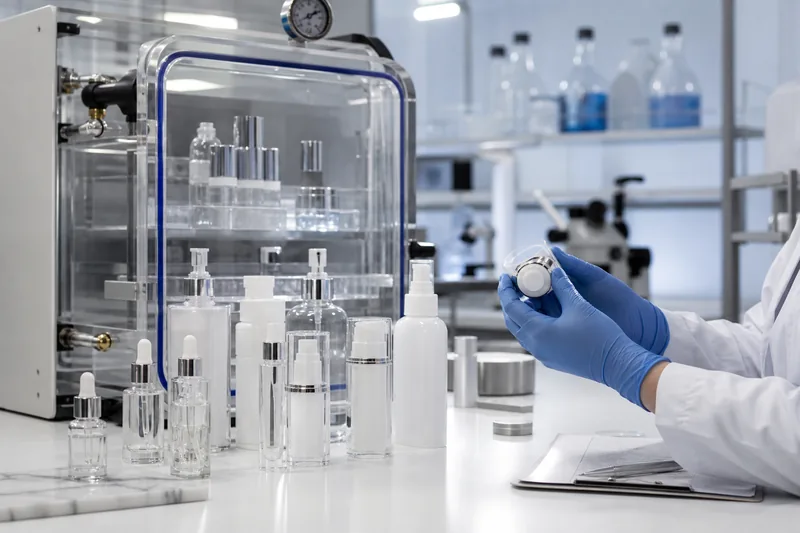
What does cosmetic bottle leak testing actually prove?
A leak test answers a defined question under defined conditions. It may show that liquid escapes, gas crosses the package boundary, a closure fails under differential pressure, or filled bottles survive a distribution sequence without visible leakage. Passing one test does not prove that a package is “leak-proof” under every condition.
The US FDA does not publish a prescribed test list for each cosmetic. It places responsibility for product safety on the manufacturer or distributor. That makes a documented, risk-based protocol more defensible than copying a convenient test from another product category.
Define the failure that matters first. A watery toner may visibly wet a closure quickly. A viscous cream can plug a small channel yet still permit gas exchange. An airless pack may lose prime without leaving a puddle. A volatile or alcohol-rich formula may show mass loss before a wet spot becomes obvious.
Cosmetic bottle leak testing methods compared
| Method | Best use | Output | Main limitation |
|---|---|---|---|
| Inverted/side storage | Low-cost filled-formula screening and stability intervals | Visible wetting, staining, mass change, torque or function change | Slow; sensitivity depends on formula, orientation, time and inspection |
| Vacuum immersion/bubble | Locating gross leak paths in rigid empty packs | Bubble stream and pressure at first observed leakage | Destructive/wetting; observation-dependent; test liquid may affect some packs |
| Vacuum decay | Repeatable non-destructive testing of compatible rigid or semi-rigid systems | Pressure rise/vacuum loss versus time | Requires a fitted chamber, validated controls and compensation for package/product behavior |
| Pressure decay | Empty component or assembled system testing when it can be safely pressurized | Pressure loss over a defined stabilization and test period | Fixtures can create false leakage; pressurization may not represent the real leak direction |
| Mass loss | Volatile formulas, long storage and filled-pack comparison | Change in mass after controlled conditioning | Cannot locate the path; evaporation and balance/environmental variation must be controlled |
| Dye or tracer liquid | Confirming a suspected channel or studying interfaces | Visible tracer ingress/egress | Destructive, subjective and chemistry-dependent; small paths may be missed |
| Tracer gas/mass extraction | High-sensitivity investigations or high-value applications | Quantitative gas flow or tracer response | Specialised equipment and product-specific validation; often more than routine cosmetics need |
| Distribution plus inspection | Validating the final filled pack-out | Leaks, closure movement and damage after realistic hazards | Finds system failure but may not isolate the root cause |
Inverted and side-storage testing
Fill production-intent bottles, apply closures at a controlled setting, clean the exterior, record initial mass and place samples upright, inverted and on their sides. Use a compatible absorbent indicator so small leaks are visible. Inspect at planned intervals for wetting, mass change, closure back-off, deformation and dispensing performance.
This method is particularly valuable during compatibility/stability work because the formula remains in contact with the liner, gasket, pump or valve. Water is suitable for setup and gross screening, but it cannot represent a formula’s viscosity, surface tension, volatility or chemical interaction.
Vacuum immersion and bubble observation
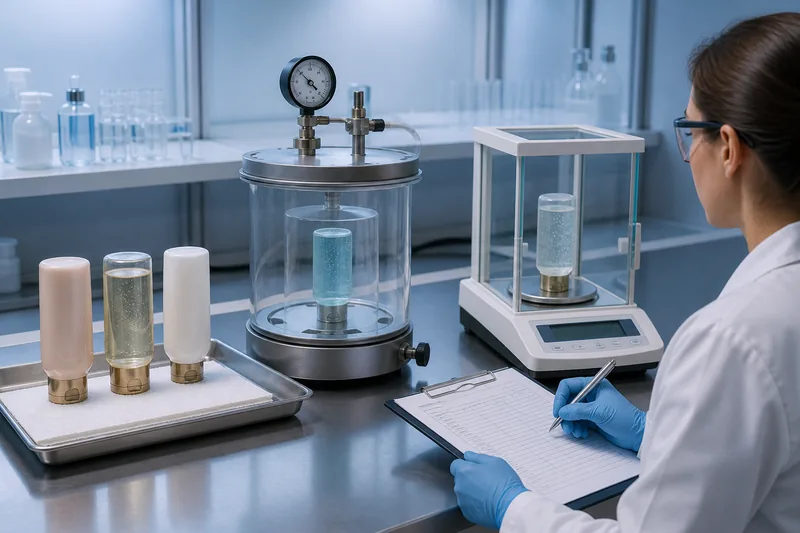
In a typical rigid-container test, the closed package is submerged and external pressure is reduced. Gas inside expands; a continuing stream of bubbles can reveal a leak and its location. ASTM D4991 covers empty rigid containers under differential pressure and notes an approximate upper differential of 95 kPa (13.8 psi) for the method. That limit is part of the standard’s scope—not a default cosmetic-bottle acceptance pressure.
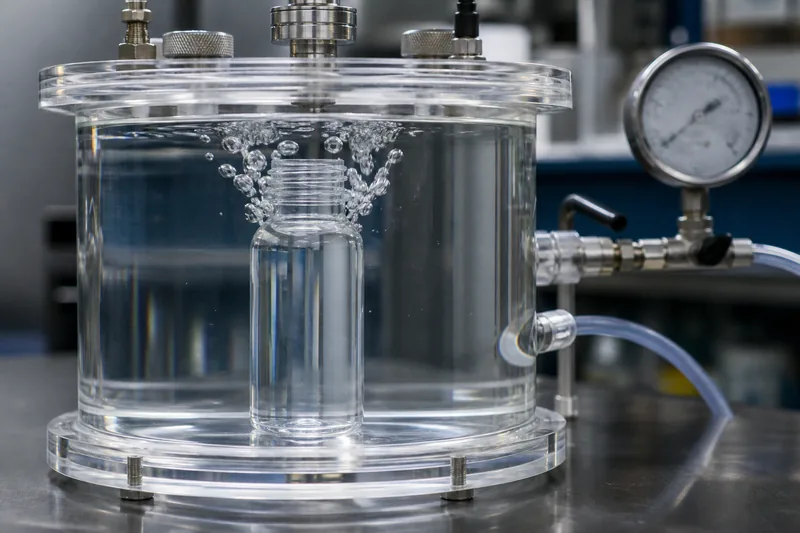
Differentiate trapped air released from threads from a repeatable stream originating at one point. Establish vacuum ramp, hold time, immersion depth and observation rules. ASTM D3078 is frequently cited online, but its scope is flexible packaging containing headspace gas; it is not the obvious default standard for a rigid cosmetic bottle.
Vacuum decay and pressure decay
Decay methods infer leakage from pressure change after stabilization. Vacuum decay places the package in a sealed evacuated chamber; ASTM F2338 describes non-destructive detection across several package types. Pressure decay commonly introduces pressure into an empty package or test circuit and measures its decline.
These methods can support objective limits and production automation, but equipment sensitivity is not the same as validated package sensitivity. Demonstrate performance with known-good controls and calibrated artificial leaks or other justified positive controls. Account for chamber volume, flexible-panel movement, temperature, volatile product, headspace and fixture leakage.
Gravimetric mass-loss testing
Weigh cleaned filled packs on a suitable balance, condition them in controlled environments and calculate change against time and controls. Report both absolute change and a normalised metric meaningful to the product, while separating true package loss from residue, handling and measurement uncertainty.
Mass loss is slow but commercially relevant for volatile products and shelf-life studies. It does not identify whether loss occurred through the neck seal, pump, bottle wall or permeation, so combine it with targeted inspection or a second method.
Tracer gas and mass extraction
Tracer-gas methods can locate or quantify very small gas paths, while mass extraction measures gas flow from a package under vacuum. ASTM F2391 addresses helium tracer gas, and ASTM F3287 covers non-destructive mass extraction for nonporous rigid and semi-rigid packages. These technologies are useful where sensitivity, automation or high product value justifies them; they should not be presented as mandatory for ordinary cosmetics.
How to build a defensible leak test protocol
- Define the failure mode. Specify liquid loss, gas ingress, loss of prime, closure back-off or staining—not simply “leakage”.
- Set the use conditions. Include fill, headspace, orientation, storage climate, consumer handling and distribution route.
- Choose method and sensitivity. The method must reliably detect the smallest defect that creates unacceptable risk or commercial loss.
- Control assembly. Record component lots, cavities, liners, dip tubes, fill temperature and closure application settings.
- Establish controls. Use known-good units, blanks and justified positive controls. Blind samples when visual judgement is involved.
- Predefine acceptance. State sample size, conditioning, equipment, calibration, numerical limit, visual failure rules and retest policy before seeing results.
- Challenge then retest. Repeat the relevant measurement after ageing, thermal cycling, vibration, drop or low-pressure exposure.
Diagnosing where and why a bottle leaks
Mark the bottle, closure and pump orientation before testing. If leakage appears, record its first location rather than wiping the sample immediately. Inspect the neck sealing land, thread engagement, liner compression, gasket position, pump crimp or screw closure, actuator channel, bottle seam, gate and stress-whitened areas.
Measure removal torque before and after conditioning. Swap one component at a time with a known-good counterpart: suspect closure on reference bottle, then reference closure on suspect bottle. This simple cross-over isolates whether the primary contributor follows the bottle, closure or assembly process. For a broader failure tree, consult Boyu’s guide to common causes of cosmetic bottle leakage.
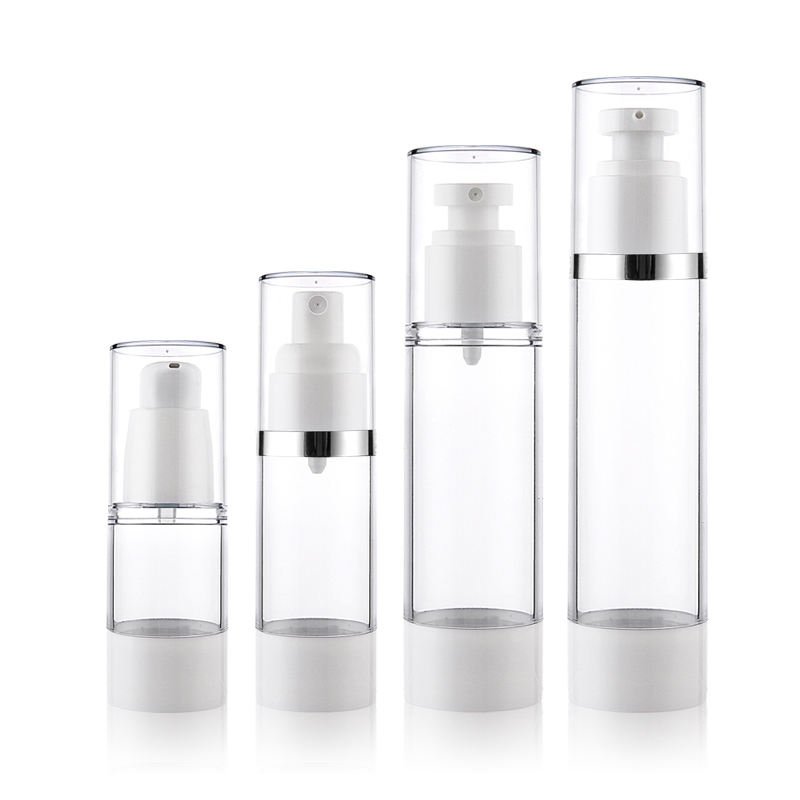
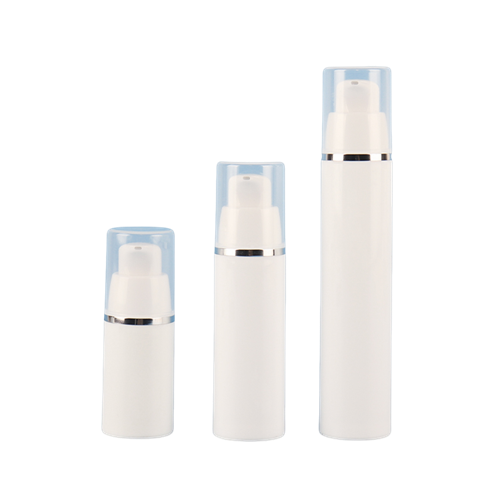
Formula-related failures can emerge only after time. Oils, alcohol, surfactants, acids, fragrances and solvents may change elastomers, plastics, adhesives or coatings. Test the final formula in the final decorated package. An airless pump bottle also requires functional checks such as priming, piston travel and evacuation; a dry exterior does not prove correct dispensing.
Development, production and shipping need different evidence
Development testing compares designs and establishes limits. Include samples from relevant mould cavities and more than one production lot where feasible. Incoming and in-process QC uses faster checks proven to correlate with qualification results. Filled-pack validation confirms that formula, filling line, capping settings, decoration and final shipper work together.
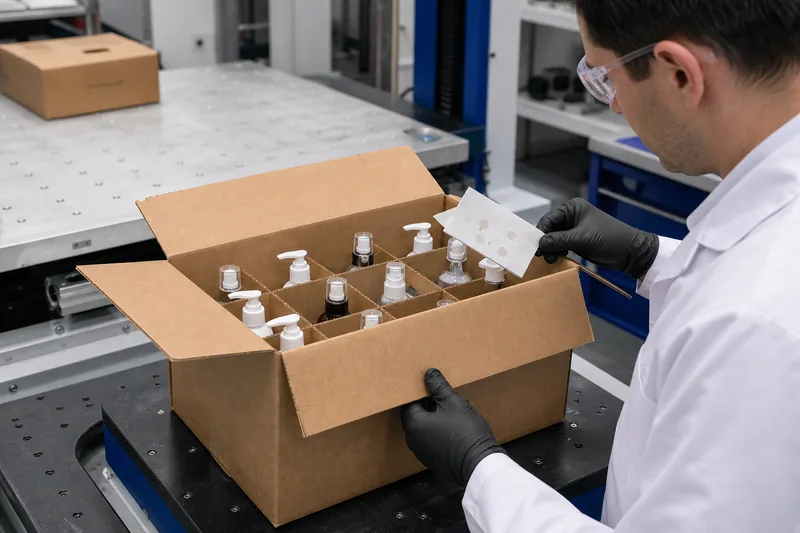
Distribution protocols may include vibration, impact, compression and low-pressure exposure according to the real route. Test saleable units in production-intent cartons and partitions, then repeat leak, torque and function checks. When comparing cosmetic glass packaging with plastic bottles, remember that glass raises impact and fragment risks while plastics can panel, creep or stress crack; the seal interface remains critical in both.
Common leak-testing mistakes
- Testing only empty components and assuming the filled formula will behave identically.
- Calling a package leak-proof without stating method, sensitivity or conditions.
- Using one arbitrary vacuum level for every bottle, including deformable packs.
- Ignoring trapped air, product vaporisation, fixture leakage or flexible-panel movement.
- Testing hand-tightened samples without recording assembly torque.
- Using only passing production samples and no positive controls.
- Applying a standard outside its stated package scope.
- Passing a pre-shipment test but failing to inspect again after distribution simulation.
Frequently asked questions
What is the best cosmetic bottle leak test?
There is no single best method. For many programmes, use inverted filled-formula storage for realism, a validated vacuum/pressure method for objective detection, and post-distribution inspection for shipping performance.
Is vacuum testing better than pressure testing?
Neither is inherently better. Select the pressure direction and fixture that reproduce the relevant leak path without deforming or modifying the package. Validate detection using known defects and controls.
Can cosmetic bottles be leak-tested with water?
Water is useful for setup and gross leak screening, but it cannot establish compatibility or predict every formula’s flow and evaporation. Final approval should include the commercial formula or a justified worst-case surrogate.
How long should an inverted leak test run?
No universal duration applies. Set intervals from the shelf-life and shipping risk, include immediate and longer observations, and continue formula-package stability for the justified programme duration. A convenient 24-hour screen is not full shelf-life evidence.
How many bottles should be tested?
Base sample size on failure severity, method variability, cavity count, lot variation and desired confidence. Design qualification and routine lot acceptance usually need different sampling plans; document the rationale rather than choosing a universal number.
Sources
- US FDA — Product Testing of Cosmetics
- ASTM D4991-25 — Leakage Testing of Empty Rigid Containers by Vacuum Method
- ASTM F2338 — Nondestructive Detection of Leaks by Vacuum Decay
- ASTM D3078 — Leaks in Flexible Packaging by Bubble Emission
- ASTM F2391 — Package and Seal Integrity Using Helium
- ASTM F3287 — Nondestructive Leak Detection by Mass Extraction
- PDA Journal study — Vacuum decay compared with dye ingress

 English
  Español de Argentina
  Русский
  Italiano
  日本語
日本語  한국어
한국어  العربية
  Français
  Deutsch