
Dispensing specification guide
Choose pump output by dividing the product’s intended amount per use by the number of full strokes consumers should make. Then verify that target gravimetrically with the finished formula in the production-intent bottle and pump. Serum usually needs a smaller, more controllable dose than body lotion, but there is no universal “correct” millilitre value: application area, formula density and rheology, actuator travel, consumer behaviour, priming, and end-of-pack performance all change the result.
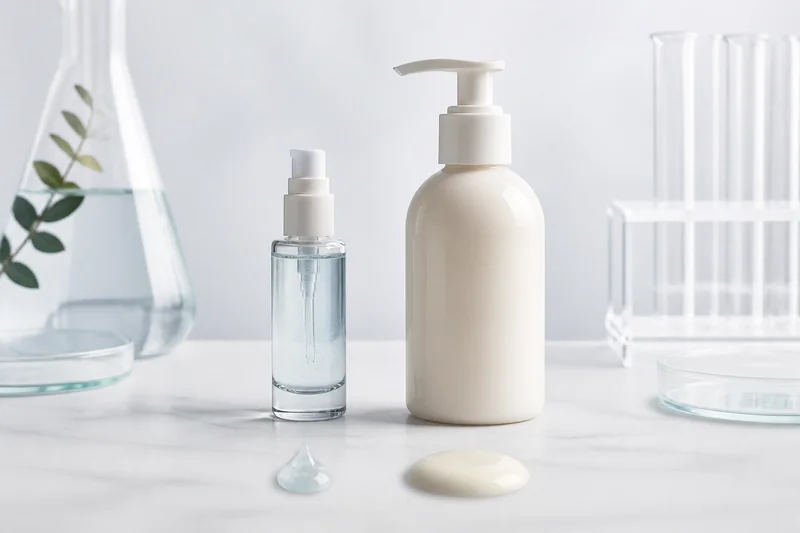
The pump-output decision in one table
| Decision | Serum | Lotion | What to approve |
|---|---|---|---|
| Intended dose | Usually a small facial or targeted-area portion | Often a larger face, hand, or body portion | A dose stated in grams per use, based on product directions and user testing |
| Preferred interaction | One controlled full stroke is often easiest to repeat | One or more comfortable full strokes may suit the covered area | Full-stroke behaviour; do not rely on consumers reproducing half-strokes |
| Pump family | Treatment pump, small-output airless pump, or other precision dispenser | Lotion pump or higher-output airless system | Complete pump–bottle–formula system, not a pump component in isolation |
| Critical risks | Over-dispensing, jetting, stringing, poor control | Slow delivery, excessive pressing force, incomplete recovery, residue | Mean output, variation, prime, rebound, drip/stringing, evacuation |
Commercial catalogues illustrate how broad the hardware window can be. Silgan, for example, lists pump solutions in the 0.100–0.200 mL range, a 0.25 mL airless pump-on-tube, and other beauty pumps around 0.45 mL. These are examples of available mechanisms—not category standards and not proof that the same outputs will work with your formula.
How to calculate a sensible starting output
Start in mass because product-development teams can weigh a dose directly and because millilitres and grams are not interchangeable unless density is known. If a supplier specifies volume, convert it using the finished formula’s measured density:
Worked example
Suppose consumer testing establishes an intended facial-serum portion of 0.36 g and the desired instruction is two full pumps. The engineering target is 0.18 g per stroke. If the formula density is 1.03 g/mL, the approximate volumetric target is 0.175 mL per stroke (0.18 ÷ 1.03). That figure is a screening target; the final specification should be based on measured filled-pack performance and an agreed tolerance.
How serum and lotion requirements differ
For serum, prioritise control and repeatability
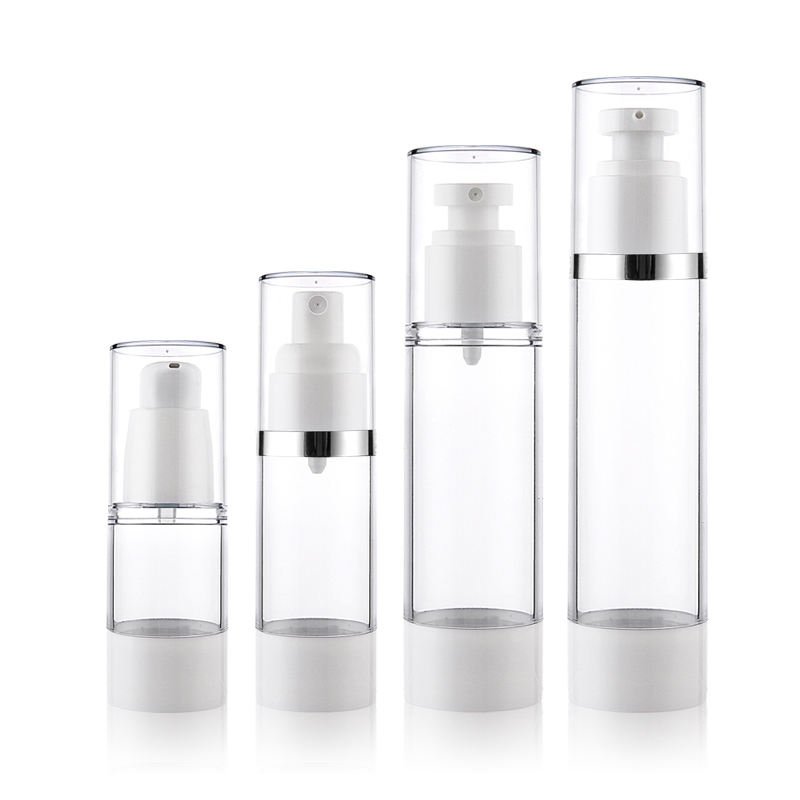
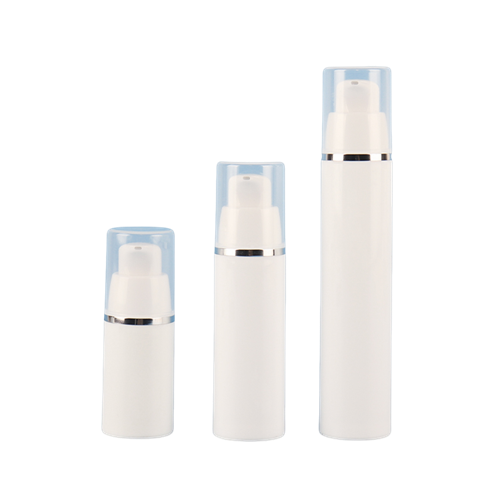
A facial serum is normally applied over a smaller area and may have a premium cost per gram. Too much output can create waste, pilling under later layers, or an unexpectedly short pack life. Evaluate whether one full stroke gives adequate control, whether the nozzle places product cleanly on a fingertip, and whether a low-viscosity serum spurts or drips after actuation. A small airless pump bottle can be a useful candidate when formula protection and controlled dispensing are priorities, but it still requires compatibility and output testing.
For lotion, match output to application area
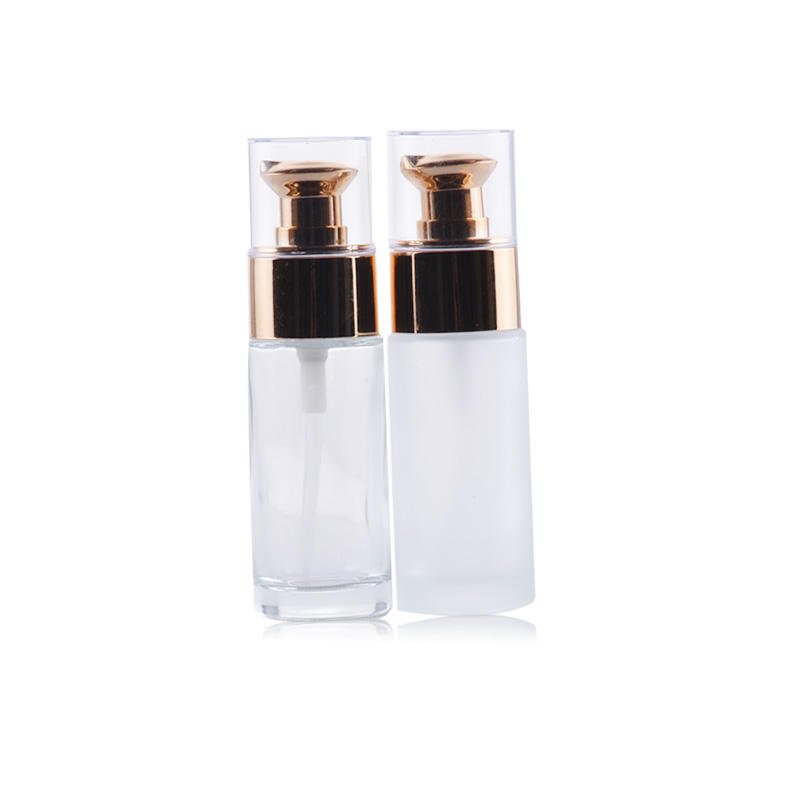
Facial lotion, hand lotion, and body lotion should not automatically share one pump specification. A low-output pump may make a body product frustrating because the user must press repeatedly; an oversized dose may be wasteful for a facial moisturiser. Test how many complete, comfortable presses cover the intended area. Boyu’s lotion bottle range provides starting formats for face and body products, but the actuator, engine, dip tube, closure, and bottle must be qualified as one system.
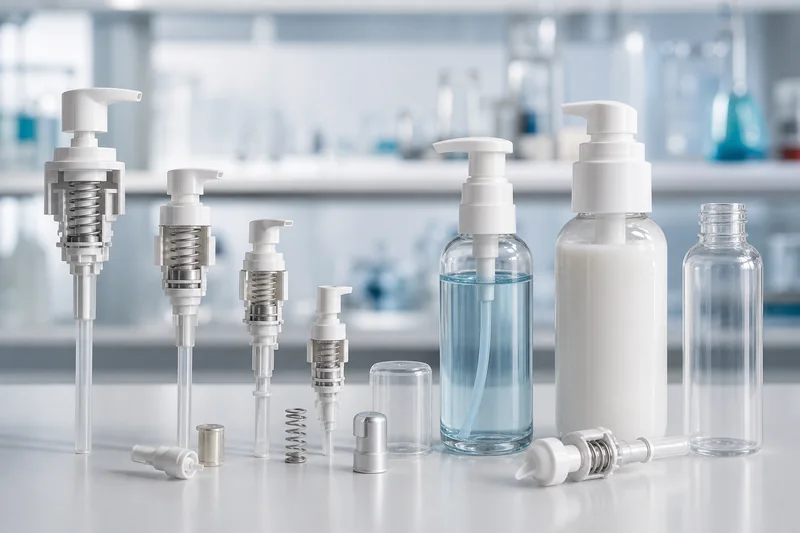
Why nominal pump output is not the delivered dose
A supplier’s output is a useful component specification, but it may have been measured with a reference liquid under defined conditions. Your finished formula can behave differently. Assess at least:
- Density: the same chamber volume produces different mass doses for formulas with different densities.
- Rheology: viscosity at one shear rate is not a complete description. Shear thinning, yield stress, thixotropic recovery, and stringing affect fill and discharge.
- Temperature: cold storage can increase resistance; heat may lower viscosity and encourage dripping. Test relevant market and transport conditions.
- Air and particulates: entrained air can create inconsistent strokes, while beads, powders, or fibres may obstruct narrow passages.
- Pack geometry: dip-tube length and cut, bottle shoulder, venting, headspace, piston movement in airless packs, and closure seal all matter.
- Use mechanics: press speed, complete versus partial travel, time allowed for spring recovery, bottle angle, and repeated rapid strokes change delivery.
Viscosity is therefore a compatibility screen, not an output selector by itself. Two formulas with the same headline viscosity can dispense differently if their flow curves, surface tension, or recovery differ.
How to measure pump output with the finished formula
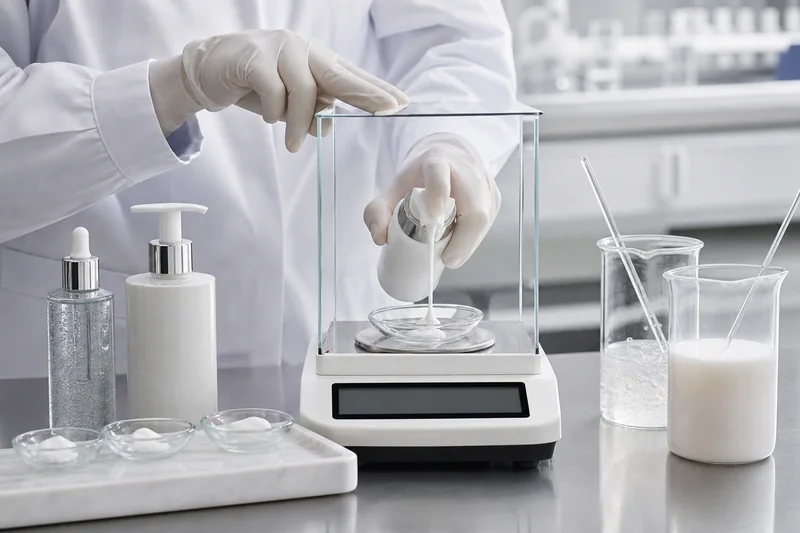
- Condition samples. Record formula batch, component lots, fill level, assembly settings, conditioning time, and temperature.
- Prime separately. Use complete strokes until flow is continuous. Record prime count; do not silently include irregular prime strokes in the steady-state mean.
- Weigh repeated full strokes. Tare a suitable vessel, dispense at a controlled natural rate, and weigh the collected product. Dividing a multi-stroke mass by the stroke count reduces balance-resolution error.
- Repeat across units. Test multiple pumps from representative lots. Define the sample plan and acceptance limits from risk, process capability, supplier agreement, and quality procedures—not from an arbitrary online number.
- Test pack life. Measure early, middle, and late life, including near-empty performance. Record air shots, incomplete return, drips, stringing, clogging, and residual product.
- Challenge conditions. Repeat after relevant hot/cold conditioning, storage orientation, vibration or transport simulation, and compatibility ageing.
Report more than an average
For each unit, report mean mass per full stroke, minimum and maximum, standard deviation or coefficient of variation, prime strokes, actuation feel, and failure observations. An average can look perfect while individual pumps under- or over-deliver. Agree whether limits apply to unit means, individual strokes, lot means, or all three.
| Checkpoint | Why it matters | Suggested record |
|---|---|---|
| Prime | Determines first-use friction and product lost before delivery | Strokes to continuous discharge; first usable dose |
| Steady state | Confirms normal-use dose | Mass/stroke distribution at controlled full travel |
| Rapid repeat | Reveals incomplete chamber refill | Output decay and recovery time |
| Near empty | Shows whether claimed pack life is realistic | Output decline, air shots, residual mass, evacuation percentage |
| Aged pack | Finds formula/material or mechanical drift | Baseline versus aged output and functional observations |
ASTM D4336 describes methods for determining the output per actuation of mechanical pump dispensers and references priming before measurement. Use the current purchased standard and your quality system to define the formal method; do not treat a supplier web page as a substitute for the standard.
Seven costly pump-output mistakes
- Specifying only “0.2 mL” without tolerance, test medium, temperature, stroke method, or life stage.
- Testing water when the product is a structured serum or emulsion.
- Confusing mL with g and ignoring density.
- Approving one golden sample instead of representative component lots.
- Assuming users will make identical partial strokes.
- Checking output only immediately after filling, not after ageing or near empty.
- Choosing the pump before validating dose instructions with users.

A practical approval specification
Ask the supplier and filler to agree on:
- Target mass per full stroke and allowable limits
- Finished formula or agreed representative test medium
- Conditioning temperature and time
- Priming definition and excluded strokes
- Actuation rate, full travel, recovery interval, and bottle orientation
- Sample plan and treatment of individual versus average results
- Early-, mid-, and late-life checkpoints
- Maximum prime count, residual product, and acceptable functional defects
- Requalification triggers after formula, pump, bottle, or assembly changes
ISO 22715 covers cosmetic packaging and labelling, but it does not supply a universal lotion- or serum-pump dose. Output remains a product-specific engineering and quality decision. For broader pack selection, review Boyu’s skincare packaging options and compare dispensing systems before tooling or decoration approval.
Frequently asked questions
What is a typical serum-pump output?
Low-output commercial pumps exist around 0.1–0.2 mL per stroke, but that is a hardware reference window, not a universal serum requirement. Calculate from the intended mass dose and validate with the actual formula.
What is a typical lotion-pump output?
Lotion pumps cover a much wider range because facial lotion and body lotion serve different areas. Select the number of comfortable full strokes first, then screen pumps that deliver the required mass. Request the exact supplier drawing and test conditions.
Should output be specified in mL or grams?
Either can be used if the method is defined, but grams per stroke are convenient for gravimetric QC. Convert using the measured formula density and state the temperature.
Can a half-pump provide a smaller dose?
It may, but partial travel is generally less repeatable across users and mechanisms. If dose consistency matters, design the nominal full stroke around the intended interaction and verify real user behaviour.
Does an airless bottle guarantee accurate output?
No. Airless systems can support controlled dispensing and reduce air re-entry, but chamber fill, piston movement, formula behaviour, actuation, and component tolerances still require testing.
How many doses will a bottle provide?
For an estimate, divide net fill mass by measured average mass per usable stroke. Then account for priming and residual product. A 30 g fill at 0.20 g per stable stroke suggests 150 stable-stroke equivalents before those losses—not a guaranteed 150 consumer doses.
Send Boyu Packaging your formula type, density and rheology data, intended dose, pack size, application area, and target number of full strokes. The team can help shortlist production-intent samples for compatibility and output testing.
Sources
- ASTM D4336 — Standard Test Methods for Determination of the Output Per Actuation of a Mechanical Pump Dispenser
- ISO 22715:2006 — Cosmetics — Packaging and labelling
- Silgan Dispensing — Global Product Portfolio (pump output-range example)
- Silgan Dispensing — ERA Airless Pump-on-Tube, 0.25 mL output example
- Silgan Dispensing — Beauty Global Product Portfolio (0.45 mL output example)

 English
  Español de Argentina
  Русский
  Italiano
  日本語
日本語  한국어
한국어  العربية
  Français
  Deutsch