


Direct answer: Choose a spout pouch manufacturer only after it proves five things for your exact product: a traceable legal and production identity; a controlled film–spout–cap specification; compatibility with the contents, filling line and thermal process; repeatable seal and leak performance; and destination-market documentation. Treat certificates, samples and low prices as evidence to investigate—not as substitutes for a filled-product pilot. Qualify the packaging as one system, then compare surviving suppliers on accepted landed cost, MOQ, capacity and service.
This guide is for brand owners, importers, contract packers and procurement teams buying custom spouted pouches for food, beverage, pet care, beauty refills or household liquids. Regulatory examples are practical sourcing guidance, not legal advice.
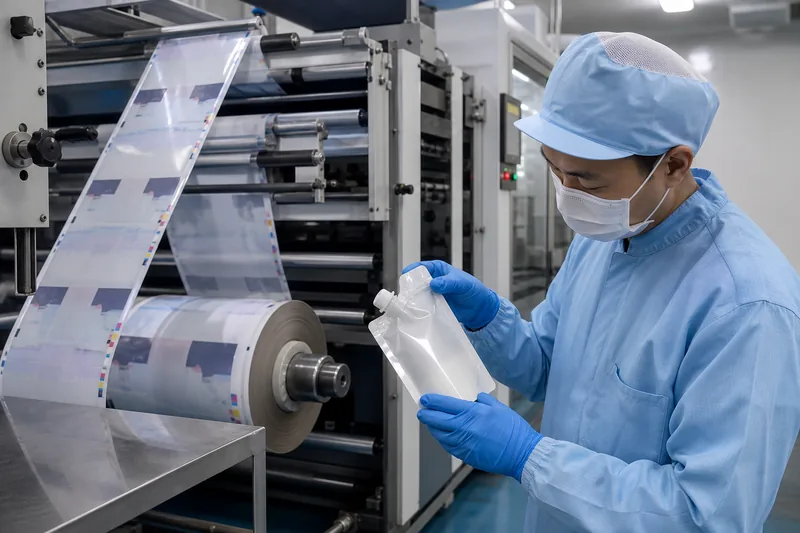
Use five pass/fail gates before comparing prices
A polished sample can be hand-made under ideal conditions. A certificate can cover only one site or a limited activity. Neither proves that thousands of pouches will survive your product, filler and distribution route. Start with five non-negotiable gates; score commercial preferences only after every gate passes.
Legal entity, site and scope
Controlled BOM and drawings
Product, process and market
Seals, spout and distribution
Traceability and change control
Gate 1: verify who manufactures what
Match the quotation, business license, bank beneficiary, factory address, audit report and certificate holder. Ask which steps are performed at that site: film extrusion, printing, lamination, curing, slitting, pouch making, spout molding, spout insertion and laboratory testing. Outsourcing is not automatically a problem, but undisclosed outsourcing breaks traceability and makes root-cause work harder.
Gate 2: lock an exact, revision-controlled specification
“PET/PE pouch, food grade” is not a specification. The controlled bill of materials should identify each film layer or resin family, nominal thickness, adhesive and cure requirement, printed side, food-contact layer, spout and cap resin, fitment drawing, cap/tamper feature, pouch drawing, seal geometry and agreed tolerances. State that no resin, film, adhesive, ink, fitment, subcontractor or process site may change without written approval and, where relevant, revalidation.
Gate 3: prove compatibility with actual use
Give the supplier the product chemistry, viscosity at a stated temperature, particle size, fill temperature, hot-fill or retort schedule, storage conditions, intended shelf life and destination market. Food-contact authorizations are tied to substances and intended conditions of use; in the United States, for example, an effective food contact notification may be specific to the named manufacturer and use limitations.[1] A generic “FDA material” statement is therefore incomplete.
Gate 4: validate pouch-body, weld and closure integrity
The critical leak path is often the transition from flexible film to the rigid fitment. Require evidence from production-representative pouches, not only flat-film data. Test the body seals, gusset intersections, spout flange weld, cap torque/tamper band and the complete filled package after conditioning, thermal processing and simulated distribution.
Gate 5: demonstrate repeatability
Ask for lot coding, incoming-material records, in-process checks, retained samples, nonconformance handling and corrective-action examples. ISO 9001 is useful evidence of a quality-management system, but ISO itself states that it does not certify products and does not guarantee 100% product conformity.[2] Product-specific controls and results still decide acceptance.
Score qualified manufacturers on 100 points
Use the same evidence window for every candidate. Score what the supplier proves, not what its website says. A sensible shortlist threshold is your company’s decision; the more important control is that a high commercial score can never override a failed gate.
| Area | Weight | Evidence worth points | Weak evidence |
|---|---|---|---|
| Legal identity and quality system | 10 | Current registry record; certificate matched to legal name, site, scope, issuer and validity; recent audit and corrective-action closure | Logo wall, cropped certificate or sales-company name only |
| Relevant application engineering | 15 | Documented projects with comparable chemistry, fill/thermal process, size and distribution; risk-based structure rationale | A list of industries without use conditions |
| Material and compliance control | 15 | Full construction, declarations, supplier traceability, migration support and written change control | “Food grade,” “BPA-free” or “FDA approved” with no use basis |
| Printing, lamination and pouch converting | 15 | Equipment and process capability, curing controls, inspection, repeat-order color method, spout-weld parameter records | Perfect photographs with no process records |
| Fitment and filling-line competence | 15 | Dimensioned drawings, resin and tolerances, rail/fixture compatibility, torque window and production-line trial support | Spout diameter stated without flange/thread drawings |
| Laboratory and validation evidence | 15 | Calibrated equipment, traceable reports, named methods, conditioning, sample sizes, results and agreed limits | “Pass” certificates without data or conditions |
| Repeatability and change control | 5 | Lot traceability, retained samples, capability trends, deviation approval and CAPA records | Final visual inspection only |
| Commercial clarity | 5 | Cost breakdown, MOQ by SKU, tooling ownership, overrun limits, warranty/remedy and payment milestones in writing | Single unit price with exclusions hidden |
| Logistics and service | 5 | Dated production plan, export documents, packing specification, escalation contacts and continuity plan | “Fast delivery” or “24/7 service” slogans |
For a safety-sensitive baby-food, retort or chemical application, redistribute weight toward application engineering, compliance and validation. For a short-life promotional product, printing flexibility and MOQ can carry more weight—but the five gates remain.
Specify the pouch as a complete packaging system
The supplier cannot engineer a reliable pouch from capacity and artwork alone. Package performance comes from the interaction among seven elements: product, laminate, fitment, cap, weld, filling/closing process and distribution. Changing one element can invalidate the rest.
Product and process come first
State pH, water/fat/alcohol or solvent content, surfactants, aroma or active ingredients, particle size, viscosity and temperature. Then define whether the pouch is filled cold, warm, hot, aseptically or before retort. “Hot-fill capable” and “retortable” are not interchangeable: both require a qualified laminate, adhesive, sealant and fitment, but retort adds a validated pressure-and-temperature process after sealing.
| Application | Engineering priority | What the supplier must prove | Common failure |
|---|---|---|---|
| Ambient water-based beverage | Aroma/oxygen target, clean pouring, tamper evidence | Barrier under stated conditions, closure hygiene and line compatibility | Choosing barrier by pouch thickness alone |
| Oil, sauce or acidic condiment | Chemical resistance, seal-through-contamination behavior, oxygen/light protection | Product-contact and filled-pack aging with the actual formula | Swelling, flavour pickup, delamination or weak seals |
| Hot-filled product | Hot tack, fitment geometry and cooling profile | Trials at the maximum fill temperature and worst-case dwell/handling | Distortion or leakage while the seal is still hot |
| Retorted food or pet food | Thermal/pressure resistance and process validation | Exact retort schedule, post-process seal/fitment integrity and shelf-life program | Cap or flange deformation, flex cracks, delamination |
| Frozen product | Low-temperature impact, flex crack and drop performance | Conditioned drop and distribution tests at realistic minimum temperature | A pouch that passes warm tests but cracks when frozen |
| Beauty or personal-care refill | Surfactant/oil/alcohol compatibility, controlled pouring and consumer squeeze | Formula aging, leakage after repeated use and closure cleanliness | Stress cracking, fragrance loss or messy dispensing |
| Detergent or industrial liquid | Chemical permeation, environmental stress cracking, warning/closure needs | Use-specific compatibility and transport classification | Assuming a food pouch is automatically suitable for chemicals |
Define performance, not a fashionable laminate
PET, oriented nylon, foil, metallised film, EVOH, PE and CPP can serve different structural, barrier and sealing functions. A thick pouch is not necessarily a high-barrier or retort pouch. Ask for oxygen transmission rate (OTR), water-vapour transmission rate (WVTR), test temperature/humidity, test method and the complete structure used to obtain the values. ASTM lists D3985 for oxygen transmission and F1249 for water-vapour transmission among its primary barrier-packaging methods.[3]
For recyclability, “mono-material” is also not a complete answer. CEFLEX recommends mono-PE or mono-PP where possible and advises matching spouts, closures and valves to the primary pack material, while still accounting for adhesives, inks, barrier layers, size and sorting behavior.[4] Local collection and recycling infrastructure determine whether a technically compatible design is actually recycled.
Specify the fitment by drawing and function
The word “16 mm spout” may refer to the flow bore, thread, neck or another catalogue dimension. Require a dimensioned fitment drawing, resin grade/family, flange geometry, sealing surface, cap thread, tamper-band design and tolerances. Select flow bore from viscosity, particles, desired pour rate, user strength and the filler—not from a universal size chart. If the filler handles pre-spouted pouches on rails or clamps, share its machine model, rail profile, pitch and gripping dimensions before tooling.
Validate capacity and usability with real fill
Finished width × height × gusset is more useful than a nominal “500 mL pouch,” because product density, headspace, seal width, spout displacement and standability change usable volume. Fill a dimensional sample with the actual product; check filling clearance, cap application, shelf footprint, pallet orientation, pour control and evacuation. A corner spout can aid pouring, while a center spout may suit specific filling equipment and symmetrical presentation. Neither is universally superior.

Audit the processes that create—and prevent—failure
A full spout-pouch workflow can include prepress, printing, lamination, adhesive curing, inspection, slitting, pouch forming, spout insertion/welding, final inspection and packing. Equipment maker and converter documentation show that these are distinct operations with different controls.[5] Ask to follow one lot from raw film and fitment receipt to packed cartons.
Printing: approve a measurable color process
Digital printing usually reduces setup burden for prototypes and multiple low-volume SKUs. Gravure or flexographic printing can be economical and repeatable at scale but may require cylinders or plates and larger economic runs. Define the approved color reference, lighting/measurement condition, barcode verification, registration tolerance, acceptable splice rules and ownership/storage of cylinders or plates. Do not approve only a screen PDF and expect it to predict production color.
Lamination and curing: verify the process window
Confirm adhesive system, target coat weight, mix and application control, curing time/temperature, solvent or residual-control method and bond-strength checks. The required cure can affect both lead time and chemical/thermal resistance; rushing material into pouch making may create latent odor, bond or delamination risks. For food-contact work in the EU, GMP rules require documented quality assurance, quality control and records for materials including inks and adhesives.[6]
Spout welding: demand parameter records and destructive checks
Ask how the machine controls and records temperature, pressure, dwell time, fixture alignment and cooling, and how operators react to drift. Check flange placement, wrinkles, channels and thinning where rigid and flexible materials meet. FDA guidance for retort pouches identifies seal-bar temperature, pressure, dwell time and smooth, uncontaminated sealing surfaces as critical; it also recommends validating settings through burst testing.[7]
Ask for these eight records during an audit
- One completed batch traveller linking raw films, adhesive, ink, fitments and caps to finished cartons.
- Calibration status for seal, leak, torque, thickness, dimensional and barrier-test equipment.
- The approved master specification and its revision history.
- Incoming inspection and supplier-approval records for film, ink, adhesive and fitments.
- Printing, lamination/curing and spout-welding parameter records from a comparable job.
- A nonconformance and corrective-action example with effectiveness verification.
- Retained-sample policy and traceability challenge or recall-test record.
- Subcontractor list and written change-control procedure.
Build a test plan with methods, conditions and acceptance limits
A standard test method tells the laboratory how to measure; it rarely tells your business what result is acceptable for every product. The buyer and supplier must agree the sample stage, conditioning, method revision, equipment settings, specimen orientation, sample size, acceptance limit and reaction plan. Record both the measured value and the failure mode.
| Risk | Useful method or evaluation | What it answers | Important boundary |
|---|---|---|---|
| Body- and fitment-seal strength | ASTM F88/F88M or agreed equivalent; fitment pull/peel method developed for the design | Force and failure mode when a seal strip is separated | F88 measures the tested seal strip; it does not alone prove a leak-free whole pouch |
| Gross leaks | ASTM D3078 for flexible packs with headspace; ASTM F2096 where applicable | Visible bubble emission or gross defect under a defined pressure differential | D3078 warns that small leaks may escape detection and product can plug a defect[8] |
| Burst and creep | ASTM F1140/F1140M or a validated equivalent | Failure tendency under rising pressure or a set pressure over time | ASTM notes that burst does not necessarily correlate with F88 seal strength; control all test parameters[9] |
| Closure security | Application-specific opening/closing torque, tamper-band engagement, removal/pull and leak tests | Whether the cap remains secure, opens as intended and reseals | Condition after filling, hot-fill/retort if used, aging and distribution—not only at assembly |
| Barrier | OTR/WVTR on the proposed laminate; light barrier if relevant | Rate of oxygen or moisture transmission under stated conditions | Flat-film values do not include seal, spout, closure or flex-crack contribution |
| Product compatibility | Real-time and justified accelerated aging with the actual formulation | Swelling, stress cracking, odor/taste change, migration, delamination, loss and visual change | Accelerated aging must be correlated or justified; heat can create failure modes absent at normal storage |
| Line performance | Pilot filling/capping run at realistic speed and worst-case conditions | Feeding, gripping, filling accuracy, contamination, capping, jams and rejects | A hand-filled sample does not predict automated line performance |
| Distribution | Temperature-conditioned drop, compression, vibration/transport simulation and pallet trial | Whether the sales unit and shipping pack survive the intended route | Use actual fill mass, headspace, case count, orientation and distribution severity |
| Lot acceptance | ISO 2859-1:2026 attribute sampling plus agreed critical/major/minor defect classes | How many units to inspect and when to accept or reject a lot | AQL is a sampling-plan index, not permission to ship known defects; life-safety defects may require zero-tolerance controls[10] |
Keep a “golden sample” only as a visual and dimensional reference. The controlling documents should be the signed specification, drawings, approved artwork, material declarations, test plan and acceptance limits. Samples age; controlled specifications can be revised and audited.
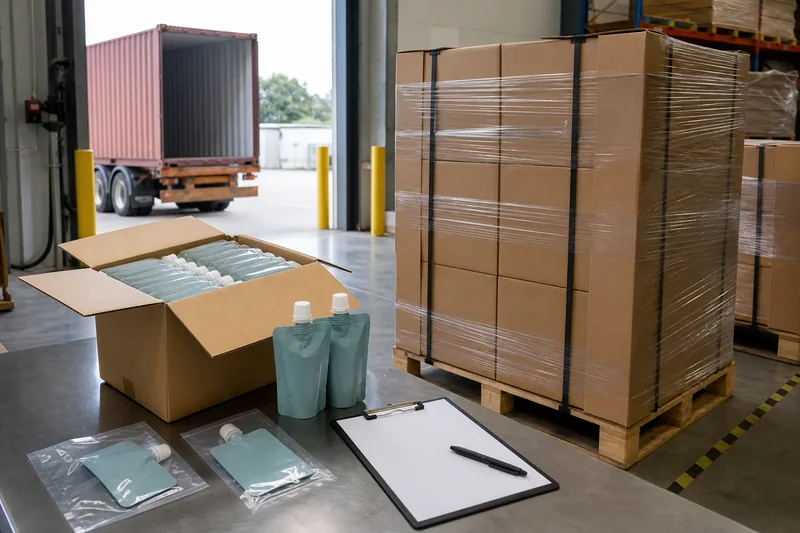
Choose a manufacturer that supports your destination market
The packaging converter can supply evidence, but the brand owner, packer or importer usually retains responsibility for the finished product placed on the market. Tell candidates the destination countries at RFQ stage; “export quality” has no defined legal meaning.
| Market | What matters for supplier selection | Buyer request |
|---|---|---|
| United States | Each food-contact substance in the finished article needs an applicable legal basis for the specified food type, temperature and contact time. An FCN can be manufacturer- and use-specific; FDA does not issue a blanket “FDA-certified pouch factory” status.[1] | Complete composition under confidentiality, letters of guaranty, cited 21 CFR/FCN or other basis, limitations and migration/supporting evidence. For low-acid or acidified thermally processed foods, involve the processor’s competent process authority. |
| European Union / EEA | Framework Regulation (EC) 1935/2004, GMP Regulation (EC) 2023/2006 and, for applicable plastic layers/articles, Regulation (EU) 10/2011 govern safety, traceability, manufacturing and migration/documentation.[11] PPWR 2025/40 generally applies from 12 August 2026 with later phased design, labeling and recyclability obligations.[12] | Declaration of Compliance where required, full supporting-document chain, migration conditions matching the intended food/use, GMP evidence, traceability and an exact-material recyclability review—not a generic mono-PE claim. |
| Great Britain / Northern Ireland | Food-contact and packaging rules must be checked for the relevant UK jurisdiction; Northern Ireland can follow EU rules in areas governed by the applicable arrangements. Government guidance requires packaging that does not contaminate food.[13] | A jurisdiction-specific compliance statement and current regulatory review rather than assuming an EU declaration automatically resolves every UK obligation. |
| Canada | Food businesses are responsible for safe, suitable packaging. CFIA lists supplier/manufacturer letters of guarantee and Health Canada letters of no objection among evidence options; premarket review is required for infant-formula packaging and certain novel processes.[14] | Use-specific Letter of Guarantee and supporting data; Health Canada LONO where required. Importers should integrate packaging hazards and supplier controls into the preventive control plan. |
| Australia / New Zealand | FSANZ states that food businesses must ensure food in contact with packaging is safe; in Australia, packaging must be fit for intended use and unlikely to contaminate food.[15] | Composition, migration/compatibility rationale and evidence tied to intended product and process, plus local labeling and stewardship checks. |
| Other markets | GCC, Japan, South Korea, Latin America and other jurisdictions have their own food-contact, labeling, recycling, chemical and importer requirements. | A written compliance matrix from a qualified local adviser. Do not accept “FDA and EU compliant” as a passport to every country. |
BRCGS Packaging Materials Issue 7 can strengthen a food or consumer-products supplier audit because the scheme addresses quality assurance, legal compliance and authenticity at a site.[16] It is still a site/system credential. Check the legal name, address, product category, exclusions, grade, audit date, certificate validity and certification body; then review product-specific evidence.
Do not let sustainability language outrun the specification
Ask “recyclable where, through which collection stream, under which design protocol, and for this exact printed structure and fitment?” CEFLEX’s design-check tool explicitly says that a guideline assessment is not a recyclability certification and does not account for every country’s collection, sorting, recycling or EPR system.[17] For EU sales, document PPWR roles and phased dates with counsel or an EPR specialist; for other markets, verify local claim and labeling rules.
Match the supplier model to your company and product
| Buyer type | Best-fit manufacturer profile | Priority questions | Watch-out |
|---|---|---|---|
| Startup / market test | Digital-print capability, stock fitments and willingness to support a production-representative pilot | MOQ per artwork, setup charges, digital-to-gravure transition and contract-filler compatibility | A low-MOQ decorative sample that uses a different material or process from scale production |
| Scaling DTC or retail brand | Repeatable multi-SKU color, reliable schedules, inventory planning and documented lot control | Capacity reservation, reorder variance, safety stock, artwork control and retailer test support | Optimizing unit price while ignoring launch timing and accepted yield |
| Contract packer / co-manufacturer | Strong fitment drawings, filling-line trials and technical response | Machine interface, rail/clamp dimensions, cap torque, contamination tolerance, line speed and rejects | Allowing the brand and converter to approve a pouch without the filler |
| Food, baby-food or pet-food brand | Relevant food-contact documentation, hygienic controls, barrier capability and validated hot-fill/retort experience when applicable | Comparable process evidence, migration basis, traceability, seal-integrity program and recall system | Accepting “retort pouch” as a catalogue property without exact process validation |
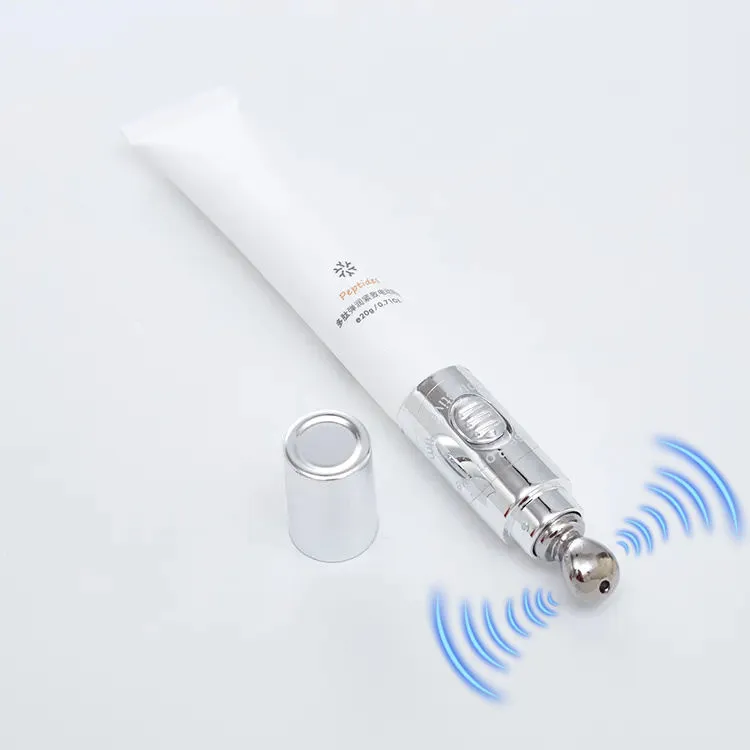
| Beauty / personal-care refill brand | Formula-compatibility support, premium print, controlled pour and closure testing | Surfactant, fragrance, oil/alcohol compatibility; repeated opening; leak after drop; consumer evacuation | Choosing a pouch only because it uses less resin by weight. A custom cosmetic tube or shampoo bottle may perform better for precise dosing or shower use. |
| Household / industrial chemical buyer | Chemical-resistance engineering, appropriate closure/security options and dangerous-goods competence where relevant | Exact formulation, permeation, stress cracking, exposure, transport classification, warnings and spill response | Using food-contact evidence as proof of chemical compatibility |
| Distributor / private-label portfolio | Mixed-SKU planning, artwork/version control, market-specific documentation and responsive claims handling | SKU consolidation, cylinder ownership, forecast bands, traceability and territory support | One construction silently reused across incompatible customer products |
Geography is a service variable, not a quality ranking. A nearby converter can offer faster engineering visits, shorter replenishment and simpler claims. A Chinese converter can be attractive for integrated print/lamination/converting and export economics. The correct choice is the factory that passes the same technical gates at the lowest risk-adjusted, accepted landed cost.
Kanzopack review: a qualified recommendation, not a blank check
Supplier case studyEvidence checked 2 Sep 2026
Kanzopack is the trade name used by Kaizheng Packaging Technology (Guangdong) Co., Ltd. A public company-data record drawing from China’s national enterprise database lists the legal entity as established on 13 April 2020 with CNY 10 million registered capital and a business scope that includes plastic-product manufacturing, packaging sales, packaging/decoration printing and food-plastic packaging production.[18] Buyers should recheck the Unified Social Credit Code and current status in China’s official National Enterprise Credit Information Publicity System before contracting.[19]
Main products and stated market
Kanzopack’s website lists spout pouches, stand-up pouches, flat-bottom and side-gusset bags, coffee bags, vacuum bags, sachets, bag-in-box formats and rollstock. Its spout-pouch page advertises center and corner positions, multiple closure styles, 8.55–33 mm diameter options, multilayer and mono-PE constructions, and uses ranging from beverages and condiments to cosmetics, detergents and lubricants.[20] These are supplier-published capabilities; each must be confirmed on an exact drawing and construction.
The company says it serves the Americas, Europe/EMEA, Asia-Pacific and Africa. Independent event directories list Kaizheng Packaging at Seoul Food 2024, RosUpack 2024 and iPackCon, which corroborates international market outreach but not shipment volume, customer satisfaction or application performance.[21]
Potential advantages
- Clear public starting points: the MOQ page states 1,000 pieces for digitally printed spout pouches and 10,000 for gravure, reducing early ambiguity.[22]
- Broad flexible-packaging scope: the site presents printing, lamination, slitting, pouch conversion and spout insertion, which could simplify accountability if an audit confirms that these steps are in-house.
- Multiple application and material options: conventional barrier laminates and mono-PE options allow comparative development rather than forcing one structure.
- Published quality-system claims: Kanzopack states BRCGS Packaging Materials Issue 7 Grade B and ISO 9001:2015 certificates valid to 2027, plus traceability and corrective-action procedures.[23] If verified, these would be relevant system evidence.
- Export support: it states FOB, CIF, CFR and EXW shipment support through Shenzhen and Guangzhou and a process from artwork review to samples and documentation.
Limitations and questions to resolve
- The SGS assessment shown is out of date: Kanzopack’s page gives a validity period of July 2025 to July 2026. As of this article’s 2 September 2026 research date, request the renewed assessment and close-out evidence.
- Certificates were not independently verified in this review: request complete BRCGS and ISO certificates, including number, holder, site, scope, grade, issue/expiry dates and certification body, then verify them with the issuing directory/body.
- Company age needs clarification: the current legal entity is recorded as formed in 2020, while the website refers to factory heritage since 1988. Ask for the predecessor relationship, asset/site continuity and which entity owns the equipment and employs production staff.
- “FDA approved” is overly broad wording: FDA authorizes food-contact substances and intended uses through specific legal routes; it does not grant a blanket approval to every pouch made by a supplier. Demand the basis for the exact materials and conditions of use.
- Lead-time language varies: the about page says a typical four-to-six-week production cycle after sample approval and sampling from about 15 days, while the homepage refers to delivery within 30 days. Obtain a dated critical-path schedule for your SKU, construction, print route and fitment.
- Recyclability must be demonstrated: mono-PE construction can improve compatibility, but printed film, adhesives, barrier layers, spout/cap and local collection still matter. Request the exact composition and market-specific assessment.
- Warranty language needs contract terms: the site mentions a one-year guarantee or remaking defects. Define defect classes, notice period, evidence, quarantine, freight, rework/replacement and consequential-cost limits in the purchase agreement.
Who Kanzopack may suit
Kanzopack is reasonable to include in an RFQ for buyers needing custom printed flexible pouches at the company’s stated digital or gravure scale, especially when several pouch formats and export coordination are useful. It is not yet a risk-free recommendation for a retort, infant-food, aggressive-chemical or high-speed filling application: those projects require renewed third-party evidence, exact compliance files, a factory/process audit and a filled-product pilot. Very small buyers needing fewer than the stated 1,000 digital units, or buyers needing turnkey filling rather than empty packaging, should confirm another operating model.
How to source spout pouches from China without losing control
- Freeze the use case before supplier search. Create a one-page brief covering contents, process, filler, market, shelf life, volume, annual demand and critical risks. If these inputs are unknown, budget for a joint development phase rather than asking for a final unit quote.
- Build a longlist by relevant process—not catalogue breadth. Look for converters with comparable pouch size, film construction, fitment and thermal/filling process. A factory good at coffee bags is not automatically qualified for retort baby-food pouches.
- Verify the contracting identity. Search the exact Chinese legal name or Unified Social Credit Code in the official GSXT registry. Match it to the business license, factory site, certificates, bank account and export documents. If a trading company contracts, document the manufacturing site and responsibility split.
- Issue one controlled RFQ to every candidate. Require candidates to identify exceptions and assumptions rather than silently substituting. Compare line items on the same Incoterm, destination, construction, quantity and test scope.
- Review documents before buying custom tooling. Check certificates, audit reports, proposed BOM, technical datasheets, food-contact declarations, sample reports and subcontracting. Confirm cylinder/plate, mold and artwork ownership, storage and transfer rights.
- Use staged samples. Separate an unprinted size mock-up, color proof, laboratory prototype, machine-made pre-production sample and filled line-trial unit. Record what each stage can and cannot approve. A digitally printed mock-up cannot approve gravure color, lamination cure or production spout welding.
- Audit the factory and the exact process route. Audit remotely only when risk permits. For critical applications, use an independent on-site auditor and witness material traceability, spout-weld controls, testing and a comparable production job.
- Run a production-representative pilot. Fill and close it on the intended equipment; execute the maximum thermal process, shelf/compatibility study and conditioned distribution sequence; then repeat leak, torque and integrity checks.
- Turn approvals into a quality agreement. Attach the signed specification, drawings, artwork, test plan, defect classification, sampling plan, change-control clause, traceability, retained samples, complaint investigation and remedies to the purchase contract.
- Inspect before balance/payment release or shipment. Verify quantity, packaging, identity, dimensions, print, functional samples, test records and shipping marks against the contract. Keep sealed reference samples from the inspected lot and verify the saved inspection result.
Contract details buyers often miss
- Named Incoterm and place: write, for example, “FOB Yantian, Incoterms 2020,” not simply “FOB China.” ICC’s rules allocate tasks, costs and risk by named term and point.[24]
- Overrun/underrun: set an allowable percentage by SKU and whether the buyer must pay for excess. Printed flexible packaging often has process scrap and run-length constraints.
- Tooling and cylinders: state who owns them, usable life, storage period, remake responsibility, destruction/return and whether another factory may use them.
- Material change: require written approval before any layer, resin, additive, adhesive, ink, spout, cap, supplier, plant or process change. Define which changes trigger document renewal and revalidation.
- Defect remedies: distinguish replacement value from sorting, disposal, airfreight, filling loss, recall and downstream damage. Negotiate what is commercially realistic before an incident.
- Language precedence: if bilingual contracts/specifications are used, state which version controls and ensure technical terms match.
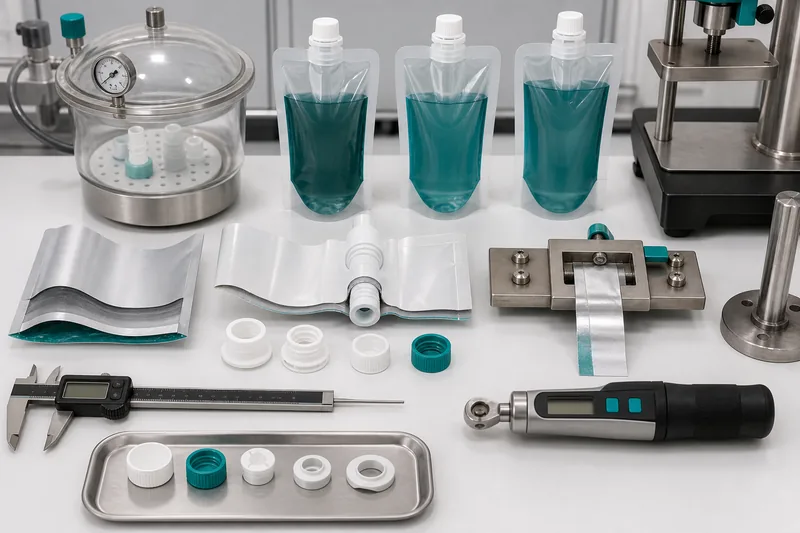
Compare accepted landed cost, not the quoted pouch price
The lowest ex-factory price can become the highest-cost option after plates/cylinders, testing, rejects, emergency freight and line downtime. Calculate cost on units that are accepted and fillable.
Keep filling losses and downtime visible even if finance books them outside packaging cost. A small change in spout alignment or pouch coefficient of friction can cost more on a high-speed line than a fraction-of-a-cent purchase saving.
What actually sets MOQ
MOQ is normally constrained by the largest economic minimum among the print route, film/lamination run, fitment purchase, pouch-converting setup and SKU allocation—not by one universal factory number.
Ask whether the quote is per design, size, structure or total order. Digital printing may reduce artwork-specific MOQ but can carry a higher unit cost or different appearance. Gravure usually spreads cylinder cost over a larger run. For each route, compare color capability, material availability, repeat-order consistency, lead time and transition plan—not just quantity.
Build lead time from the critical path
Request calendar dates for each milestone and define when the clock begins. “30 days” can mean production after deposit and artwork approval, not delivery to your warehouse. Add time for a failed trial, revised artwork, document correction and customs inspection.
Copy this spout pouch RFQ checklist
1. Product and use
- Product name/category and confidential formula or risk-relevant composition under NDA
- pH; water, oil/fat, alcohol/solvent, surfactant and active content
- Viscosity in mPa·s/cP at a stated temperature; maximum particle/fiber size
- Sensitivities to oxygen, moisture, light and aroma loss or scalping
- Target shelf life; storage and transport temperature/humidity range
- Single use or repeated opening; target user, dosing/pour behavior and evacuation requirement
2. Filling and processing
- Filler model, pouch handling/rail or clamp dimensions and target line speed
- Fill through open top or through spout; cap applied by supplier or filler
- Minimum/normal/maximum fill temperature, fill weight/volume and headspace
- Hot-fill, pasteurisation, aseptic or retort time–temperature–pressure profile
- Closing torque target, seal contamination risk, cooling and post-fill handling
3. Package specification
- Finished width, height, bottom/side gusset and dimensional tolerances
- Nominal and brimful capacity using actual product; fill line and headspace
- Center/corner spout, dimensioned fitment and cap drawings, resin, color and tamper feature
- Performance targets for OTR, WVTR, light, puncture, flex crack and seal—not a guessed laminate alone
- Print process, number of colors, finish, color reference/tolerance, barcode grade and artwork versions
- Carton quantity, dividers/liners, pallet pattern, moisture protection and shipping marks
4. Quality, compliance and commercial data
- Destination countries and product category; requested declarations and supporting evidence
- Test methods, conditioning, sample sizes, acceptance limits and test stage
- Critical/major/minor defects and ISO 2859-1:2026 plan or another agreed inspection scheme
- Quantity per size/design, annual forecast, reorder cadence and launch date
- Quote currency, named Incoterm/place/version, validity and every setup/tooling/testing charge
- Sample stages, production schedule, payment milestones, overrun/underrun and remedies
- Factory site, outsourced operations, change control, traceability and audit rights
Frequently asked questions
Who is the best spout pouch manufacturer?
There is no universal best manufacturer. The best supplier is the one that passes all five gates for your specific formula, fill/thermal process, filling line, distribution route and market, then offers the strongest risk-adjusted accepted landed cost. Kanzopack is a reasonable candidate for a comparative RFQ, but its documents and production-representative samples still need verification.
What is a typical custom spout pouch MOQ?
MOQ varies by print route, structure, pouch size, fitment and number of artworks. Kanzopack publicly states 1,000 pieces for digitally printed and 10,000 pieces for gravure-printed spout pouches, but those are supplier-reported reference figures, not a market standard. Reconfirm quantity per SKU and all setup charges in a dated quotation.
How long does custom spout pouch production take?
Separate development from repeat production. A first order includes specification, artwork, tooling or cylinders, film/fitment procurement, printing, lamination cure, pouch making, testing and freight. Kanzopack reports roughly 15 days from concept to sample and four to six weeks for production after sample approval, but its pages use different delivery wording. Ask for a project schedule with dates and assumptions.
Which material is best for a spout pouch?
The best structure is the thinnest qualified construction that protects the product, seals through the real process, survives distribution, meets market rules and supports the intended end-of-life route. Clear PET/PE, nylon-containing, foil/metallised, EVOH and mono-PE/PP structures solve different problems. Do not select by material name or total thickness without product and process validation.
Is a mono-PE spout pouch recyclable?
Potentially, but not automatically. Verify the percentage and compatibility of every layer, adhesive, barrier, ink, label, spout and cap against a recognized design guide and the destination’s collection/sorting/recycling system. “Mono-PE” is a construction description; it is not proof that the finished printed pouch will be collected or recycled in every market.
How should I choose spout size?
Choose by actual bore dimension, viscosity at use temperature, largest particles, desired pour/dose, consumer force and filling-line interface. Test at worst-case cold/high-viscosity conditions and check dribble, glugging, cap cleanliness and evacuation. Share the filler’s drawings; a catalogue “diameter” alone can refer to different features.
How do manufacturers prevent spout pouch leaks?
They control compatible film and fitment resins, flange geometry, spout alignment, weld temperature/pressure/dwell, seal cleanliness, cap torque and cooling, then verify production lots. The buyer should validate the filled pouch after thermal processing, aging, drop, compression and transport simulation because pre-fill leak testing alone cannot reproduce every failure mode.
Should I avoid a trading company?
Not necessarily. A competent trading or supply-chain partner can consolidate components and manage export service. The risk is hidden responsibility. Identify every manufacturing site, require the same specification/change control, audit rights and traceability, and make the contracting party responsible for nonconformance. If you need broader cosmetic-packaging context, review Boyu Packaging’s company and process overview.
Sources
Requirements and supplier information were checked on 2 September 2026. External links below use nofollow. Standards are named for scoping; obtain the current licensed edition before writing a test procedure.
- U.S. FDA — Determining the regulatory status of components of a food-contact material; and Inventory of effective Food Contact Substance Notifications.
- ISO — ISO 9001 explained; see also the ISO/IAF expected-outcomes guidance.
- ASTM International Committee F02 — Primary barrier packaging fact sheet.
- CEFLEX D4ACE — Design choices for flexible packaging.
- Karlville — Pouches and flexible-packaging machinery workflow; and Totani ST-30 spout-inserter specifications.
- EUR-Lex — Regulation (EC) No 2023/2006, good manufacturing practice for food-contact materials.
- U.S. FDA — Guide to inspections of low-acid canned food manufacturers, Part 3.
- ASTM D3078 — Determination of leaks in flexible packaging by bubble emission.
- ASTM F1140/F1140M — Internal pressurization failure resistance of unrestrained packages; and ASTM F88/F88M — Seal strength of flexible barrier materials.
- ISO 2859-1:2026 — Sampling schemes indexed by acceptance quality limit.
- EUR-Lex — Regulation (EU) No 10/2011 on plastic food-contact materials; and Regulation (EC) No 1935/2004.
- European Commission — PPWR rules begin phased application; and Regulation (EU) 2025/40.
- UK Government — Food labeling and packaging overview.
- Canadian Food Inspection Agency — Construction and packaging materials guidance; and CFIA — Importing food to Canada step by step.
- Food Standards Australia New Zealand — Chemicals in food packaging.
- BRCGS — Packaging Materials Issue 7 overview.
- CEFLEX D4ACE — Flexible-packaging design check and its limitations.
- CNVerify — Kaizheng Packaging Technology (Guangdong) Co., Ltd. company record. Secondary mirror; verify current data in GSXT.
- China National Enterprise Credit Information Publicity System (GSXT).
- Kanzopack — Spout pouch product page. Supplier self-report.
- Seoul Food & Hotel 2024 exhibitor guide; RosUpack 2024 directory; and iPackCon recommended-supplier directory.
- Kanzopack — Minimum order quantity page. Supplier self-report.
- Kanzopack — About, certifications, capabilities and markets. Supplier self-report.
- International Chamber of Commerce — Incoterms 2020 wall chart.



 English
  Español de Argentina
  Русский
  Italiano
  日本語
日本語  한국어
한국어  العربية
  Français
  Deutsch