

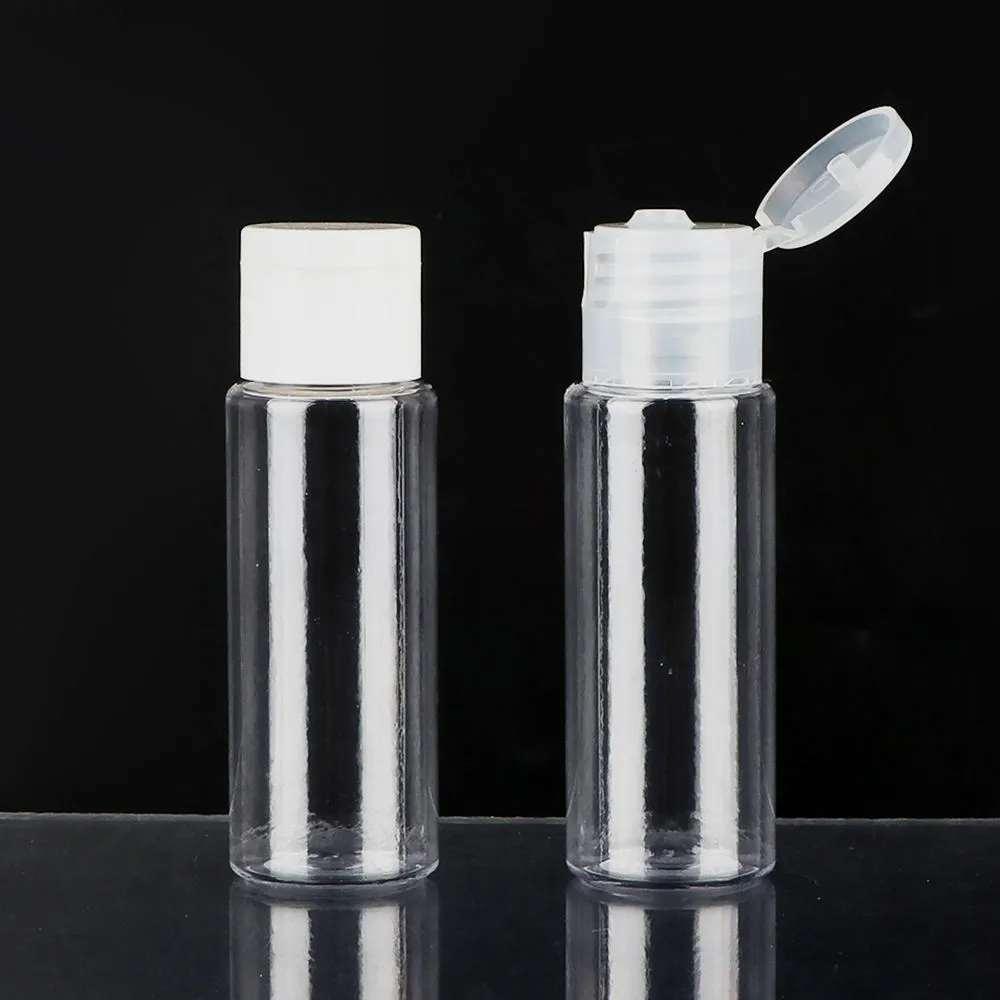
Quick answer: to fix a spray bottle pump that is not working, first unlock the nozzle, keep the dip tube submerged, seat the closure correctly and use complete strokes to restore prime. If it still will not spray, diagnose the symptom: no resistance usually points to an intake air leak or lost prime; firm resistance with no output points to a blocked outlet; air-only output points to the dip tube; and a slow or stuck return points to residue, piston friction or a failed spring.
Start by unlocking the nozzle, keeping the tube submerged, tightening the closure normally and making full strokes. Rinse only if the product label and sprayer supplier say that water cleaning is safe. Replace the complete spray head when plastic is cracked, a seal or valve is deformed, the spring will not return, or a correctly fitted head still cannot prime.
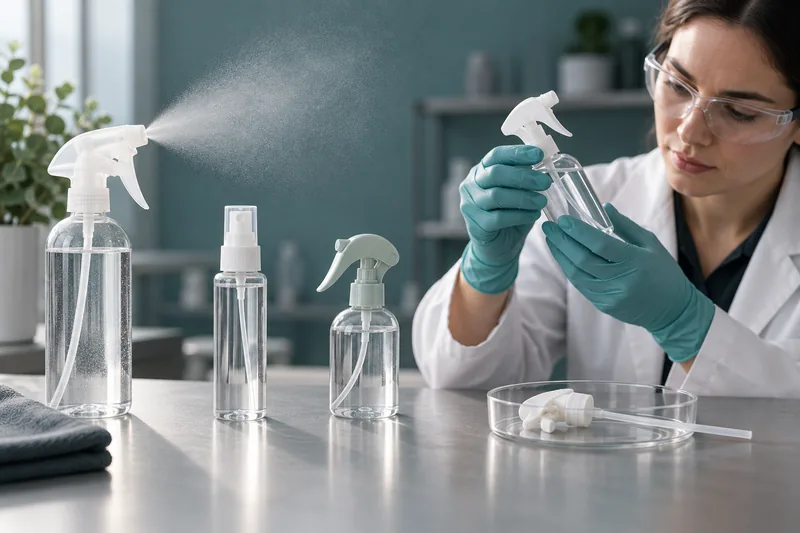 Diagnosis begins with the symptom: no output, air only, poor pattern, leakage and a stuck trigger point to different parts of the liquid path.
What Should You Check in the First 60 Seconds?
- Identify the package. This guide covers non-pressurised trigger and finger-operated pumps. It does not cover aerosol cans.
- Read the product label. Do not dismantle, transfer or rinse a pesticide, disinfectant, solvent or other hazardous product unless its instructions permit it.
- Open the nozzle fully. Adjustable trigger nozzles may have OFF, SPRAY, STREAM or FOAM positions; fine-mist pumps may have a twist lock or a clip.
- Hold the bottle upright. Make sure the liquid covers the bottom end of the dip tube.
- Seat the closure. Tighten it until the gasket is compressed normally. Do not force crossed threads or overtighten a plastic neck.
- Use complete strokes. Pull or press to the end of travel, let the actuator return fully, and repeat until liquid reaches the chamber. There is no universal stroke count.
- Watch and feel. Air bubbles near the tube joint, liquid at the neck, a trigger with no resistance, or a slow return immediately narrows the fault.
Safety boundary: never puncture, heat or try to open a pressurised aerosol can. Never mix bleach or disinfectants with other cleaners to “flush” a sprayer. Keep pesticides in their original labelled containers and follow the label for storage, use and disposal.
Quick Diagnosis: Match the Symptom to the Most Likely Fault
| What you observe | Most likely causes | Best first check | Replace when |
|---|---|---|---|
| No spray and no resistance | Lost prime, air leak, detached tube, inlet valve held open | Check the tube joint, liquid level and closure seal; then use full strokes | The tube and closure fit correctly but the chamber never draws liquid |
| Trigger is firm but nothing exits | Closed nozzle, blocked outlet, dried product, outlet valve stuck | Confirm the open position; inspect the orifice without inserting a pin | The clean outlet remains blocked or the actuator is physically damaged |
| Air only or sputtering | Tube end exposed, tube crack, loose tube joint, low fill or air entering at the seal | Submerge the tube and look for bubbles or a wet tube connection | A tube is cracked or the intake connection will not seal |
| Weak dribble or intermittent output | Partial clog, incomplete strokes, poor venting, thick product or worn piston seal | Let the trigger return fully; inspect for residue and bottle collapse | Output remains weak with a compatible clean test liquid |
| Stream instead of mist | Wrong nozzle setting, residue or damage in the spinner/orifice, inadequate pressure, formula mismatch | Check the setting and use the dedicated fine-mist stream diagnosis | The spinner insert or orifice is damaged, missing or unsuitable |
| Trigger stays down or returns slowly | Crystallised residue, piston friction, deformed trigger or failed return spring | Stop forcing it; inspect for residue and broken plastic | The spring, hinge or piston remains slow after permitted cleaning |
| Leaks at the bottle neck | Loose or crossed closure, damaged gasket, wrong thread finish, bottle-neck defect | Remove, inspect and reinstall squarely | The gasket or threads are damaged, or the finish does not match |
| Works only at one angle | Short, curled or poorly oriented dip tube; low product level; standard sprayer used upside down | Inspect where the tube end sits in the assembled bottle | The tube cannot be corrected or the use case requires an upside-down system |
How Does a Manual Spray Bottle Work?
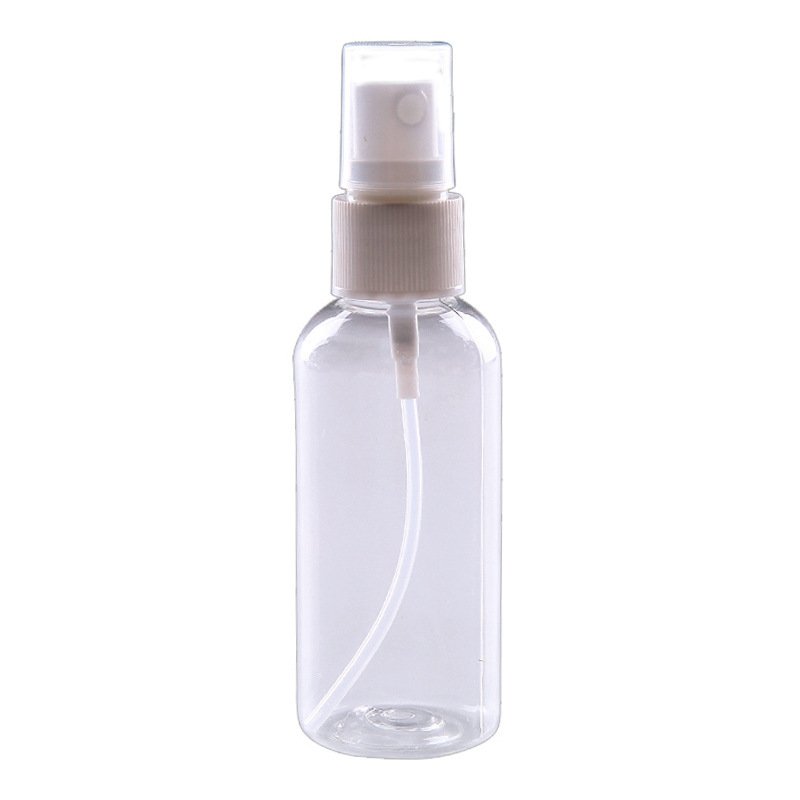
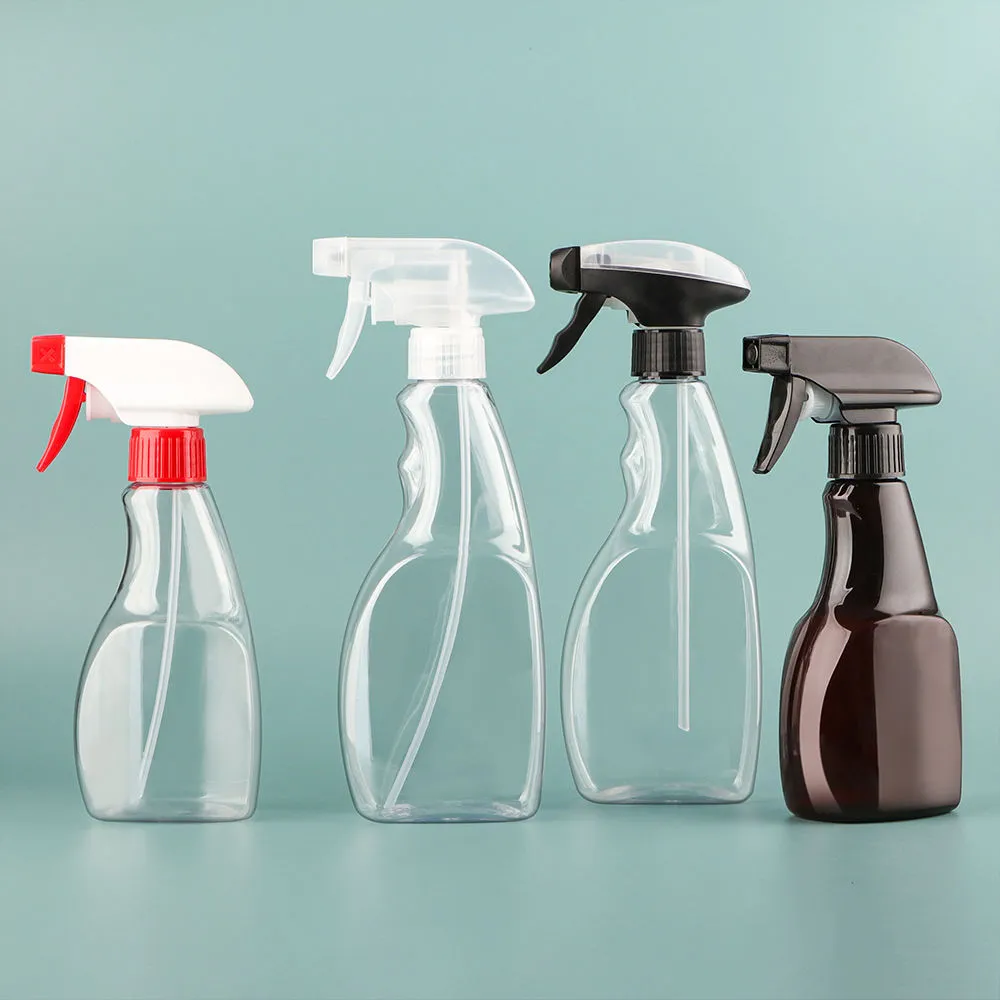
A trigger sprayer is a small reciprocating pump. Pulling the trigger moves a piston into a chamber and reduces the chamber volume. Pressure closes the inlet check valve, opens the outlet valve and pushes liquid through the discharge passage. The nozzle or spinner then converts that pressurised flow into a stream, foam or spray pattern.
Releasing the trigger lets the return spring move the piston back. The chamber volume increases, pressure falls, the outlet closes and the inlet valve opens. Liquid rises through the dip tube and refills the chamber. A vent admits air to replace dispensed product so a rigid bottle does not progressively pull a vacuum.
The two one-way valves are the key. If either valve cannot seal, pressure is lost in the wrong direction. If either cannot open, liquid cannot enter or leave. That is why a bottle can appear intact while its sprayer no longer primes.
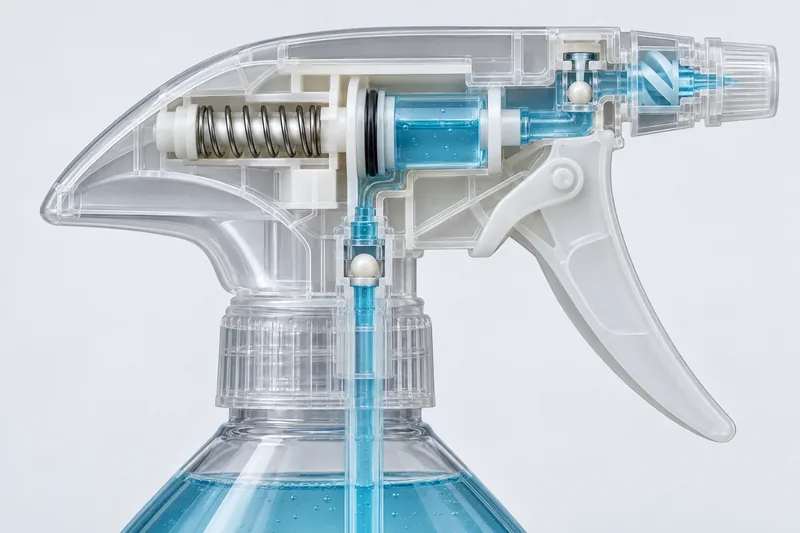 A conventional trigger sprayer alternates between a suction stroke that fills the chamber and a pressure stroke that sends liquid through the nozzle.
Why Spray Bottles Stop Working: Nine Common Causes
1. The nozzle is closed, between settings or obstructed by a shipping lock
Many apparent failures are operating-state problems. An adjustable barrel can stop between SPRAY and STREAM, a fine-mist actuator can remain twist-locked, and a trigger can retain a transport clip. Return the control to its marked open position without forcing it. If the nozzle turns freely but the pattern does not change, its internal insert may be displaced or damaged.
2. The pump has lost prime
A dry new sprayer, a bottle stored for a long time or a system that has admitted air may need several complete cycles before product reaches the chamber. Keep the tube submerged, pull fully and allow full return between strokes. Rapid half-strokes can move the piston without giving the chamber enough time to refill, especially with a long tube or a viscous product.
3. The dip tube is detached, cracked, blocked or the wrong length
A pump that moves air but never liquid usually has an intake problem. The tube may have fallen off the stem, split near the connection, sealed against the bottle base, curled above the liquid or been cut too short. Inspect it in the assembled orientation. A long tube is not automatically better: excessive length can kink, while a square-cut tube pressed flat against the base can restrict intake. For production measurement, use Boyu’s guide to calculating dip-tube length.
4. Dried product or particles are blocking the liquid path
Salts, minerals, polymers, waxes, powders, shimmer and dried surfactant can obstruct the dip-tube filter, check-valve seat, spinner or tiny orifice. A partial obstruction commonly produces a crooked jet, coarse droplets or declining output before it stops completely. Do not push a needle or drill into the orifice: enlarging or deforming it changes flow and atomisation permanently.
5. The formula is outside the sprayer’s operating window
A sprayer that works with water can still fail with the marketed product. Higher viscosity slows chamber refill and increases the pressure needed at the nozzle. Suspended solids can bridge small passages. Solvents, fragrance oils, oxidisers and high or low pH products may swell elastomers, embrittle plastics or corrode a wetted metal spring. Water is therefore a diagnostic reference, not proof that the package is compatible.
6. The closure, gasket or piston seal admits air
The pump must create a pressure difference. A cracked gasket, misthreaded closure, incompatible bottle finish, loose dip-tube joint or worn piston seal lets air take the easier path. Neck diameter alone is insufficient: for example, 28-400 and 28-410 identify different thread finishes and should not be treated as interchangeable without drawing and fit confirmation.
7. The bottle cannot vent correctly
If a rigid bottle pulls inward, output weakens after several strokes and briefly recovers when the closure is loosened, investigate the vent path. A vent may be blocked by residue, covered by an incompatible gasket or prevented from operating by the wrong closure-to-neck relationship. Do not solve a leak by blindly adding a vent hole; venting and transport sealing must be engineered together.
8. A valve, piston, spring or trigger has mechanically failed
A trigger that feels loose may no longer drive the piston. A slow-return trigger may have a failed spring or excessive seal friction. A deformed check valve may leak backward on every stroke. Consumer sprayer engines are normally assembled as compact units; once an internal valve, piston cup, spring or moulded hinge is damaged, replacing the complete head is more reliable than attempting to rebuild it.
9. Storage changed either the product or the sprayer
Cold can raise viscosity or cause crystallisation; heat can accelerate evaporation, seal swelling, stress relaxation and formula-package interaction. Long nozzle-down storage can also keep the orifice wet and encourage leakage or deposits. Return the product only to the labelled use temperature, inspect it for separation or crystals and never heat a chemical container to force it to spray.
How to Fix a Spray Bottle Pump That Is Not Working
Use the least invasive step that matches the symptom. The following method is appropriate only for a non-pressurised package whose label and product chemistry allow opening and water contact.
- Protect the work area. Use any gloves, eye protection and ventilation required by the product label. Keep the original label with the product.
- Unlock and prime. Open the nozzle, hold the bottle upright and use slow, complete strokes. Stop if the closure leaks or the trigger binds.
- Remove the head squarely. Do not squeeze the trigger while pointing it toward your face. Inspect the gasket, threads and underside for cracks, swelling or residue.
- Inspect the intake. Confirm that the dip tube is attached, clear, uncracked and positioned near the lowest usable point without sealing against the base.
- Flush only when permitted. For a compatible water-based, nonhazardous product, place the dip tube in clean warm—not boiling—water and pump into a sink or waste container as appropriate. Follow the label for disposal. Do not introduce vinegar, bleach, ammonia, alcohol or solvent as a generic cleaner.
- Clean external residue gently. Soak only removable, water-compatible parts and use a soft brush. Do not insert metal into the nozzle or lever apart a sealed pump body.
- Reassemble and verify. Refit the gasket correctly, engage threads squarely and tighten normally. Prime again and check output, pattern, trigger return and neck leakage.
- Replace if the fault remains. Persistent no-prime, leakage, mechanical binding or an altered pattern after cleaning indicates damage or specification mismatch.
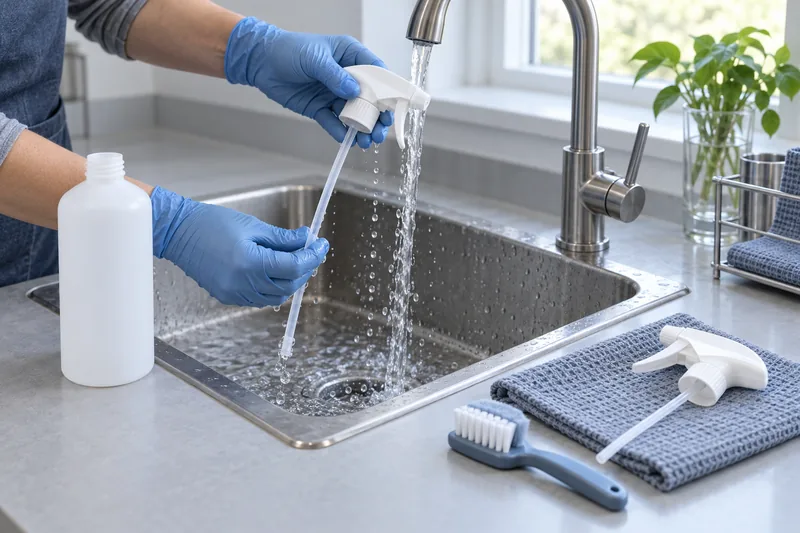 Rinsing is a conditional repair step for compatible, nonhazardous water-based products—not a universal instruction for chemicals, aerosols or contamination-sensitive formulas.
Cosmetic hygiene note: if a personal-care product smells, looks or feels different, or the package has been contaminated during repair, do not return it to normal use. Cleaning a sprayer does not restore a compromised formula or preservative system.
Should You Repair the Sprayer or Replace the Whole Head?
| Condition | Repair is reasonable | Replacement is safer or more reliable |
|---|---|---|
| Nozzle locked or pump dry | Unlock, orient correctly and prime | If the lock is broken or actuator will not move |
| Visible water-soluble residue | Label permits opening and water flushing | Unknown, hazardous, solvent-based or contamination-sensitive contents |
| Dip tube detached | Tube and stem are undamaged and make a secure fit | Tube is split, hardened, swollen or repeatedly falls off |
| Trigger or finger pad sticks | External dried product is the only cause | Cracked hinge, distorted piston or failed return spring |
| Neck leak | Closure was loose or crossed and seals after correct refitting | Damaged gasket, neck, threads or incompatible finish |
| Poor output with finished formula | A removable clog is confirmed | Clean head works with water but not product; respecify the dispenser |
How to Choose the Correct Replacement Spray Head
A head that screws on is not necessarily a functional replacement. Match the complete interface and duty:
- Exact neck finish: confirm nominal diameter, thread style, thread starts, neck height and sealing surface from the bottle drawing or a verified sample.
- Gasket and sealing method: match material, thickness and seat geometry to the bottle and formula.
- Dip-tube outside diameter and length: it must grip the stem, reach the usable heel and remain open rather than curling or sealing against the base.
- Output per stroke: choose a dose that delivers useful coverage without hand fatigue, runoff or excessive product use.
- Nozzle function: mist, stream, adjustable spray/stream, foam and shut-off designs are not equivalent.
- Formula contact materials: review body resin, valve and piston materials, gasket, dip tube and any wetted spring against the real formulation.
- Venting and bottle stiffness: confirm that the head vents as required without leaking during storage or shipment.
- Use orientation and safety: standard, upside-down, shipper, ratchet, tamper-evident and child-resistant configurations solve different requirements.
Manufacturer portfolios illustrate why these details matter: trigger heads may be offered in more than one 28 mm finish, several output levels and different spray/stream/foam or safety configurations. Compatibility still has to be demonstrated on the final bottle with the final product.
Correct Use: How to Keep a Spray Bottle Working Longer
- Turn the nozzle fully to the intended setting; do not operate it halfway between positions.
- Use full, deliberate strokes and let the trigger or actuator return completely.
- Keep a conventional bottle upright unless it is designed for upside-down or 360-degree spraying.
- Wipe product from the nozzle after use, especially for salty, sugary, polymer-rich or particle-containing formulas.
- Store the bottle as the label directs, normally with the nozzle closed and away from incompatible heat, freezing or direct sun.
- Do not dilute, combine or transfer products merely to make them spray. Dilution can change safety, efficacy and preservation.
- Do not refill a container whose label says not to reuse or refill. Never put a hazardous product into a food or beverage bottle.
- Replace the closure if it cracks, leaks, binds or produces an uncontrolled pattern.
For Brands and Buyers: Diagnose a Complaint Before Changing the Sprayer
One failed bottle and a repeated market complaint require different responses. Preserve the returned unit, its batch code and storage history before cleaning it; otherwise the most useful evidence can be destroyed.
| Failure pattern | Investigate first | Decision-useful comparison |
|---|---|---|
| One used bottle, others normal | Damage, residue, tube detachment, consumer storage | Returned unit versus retained sample from the same lot |
| Many bottles fail at first use | Assembly, closure torque, dip-tube fit, component lot, shipping lock | Incoming components versus approved golden sample |
| Failures rise after weeks or months | Formula compatibility, evaporation, crystallisation, seal change, corrosion | Aged filled package versus time-zero control |
| Sprayer works with water, not product | Viscosity, particles, surface behaviour and chemical compatibility | Actual formula across approved candidate sprayers |
| Only one orientation fails | Tube length, tube set, fill level, bottle geometry | Full, half-full and near-empty use-position tests |
A release specification should define more than “sprays normally.” Record maximum priming strokes, output per stroke and variation, pattern at a fixed distance, actuation and return, leakage, usable evacuation, orientation, and pass/fail conditions after compatibility ageing and distribution simulation. Test the filled bottle, gasket, closure, sprayer and decoration as one system. Boyu’s cosmetic packaging compatibility guide explains how to structure that programme.
ASTM maintains separate practices for the number of strokes to prime a mechanical pump dispenser, output per stroke and spray-pattern comparison. These methods help standardise how samples are compared; they do not supply a universal acceptance limit for every formula or package. The brand still has to define limits that reflect the intended dose, pattern, use life and market complaint risk.
 Replacement approval should verify the bottle finish, seal, tube fit, output and pattern with the actual formula—not only whether the closure screws on.
Frequently Asked Questions
Why does my spray bottle pump air but no liquid?
The intake is drawing air. Check that the dip tube is attached, uncracked, clear and submerged; then inspect the tube joint, closure gasket and piston seal. If these fit correctly but the chamber never fills, the inlet check valve or piston seal is probably no longer serviceable.
How do I unclog a spray bottle nozzle?
First follow the product label. For a nonhazardous water-based product whose supplier permits rinsing, pump clean warm water through the head and use a soft brush on removable parts. Do not insert a pin into the orifice or mix cleaning chemicals. Replace the head if the pattern stays distorted.
Why does the trigger have no resistance?
The pump may be dry, the tube may be detached or leaking, or the trigger may no longer engage the piston. Prime it with the tube submerged and inspect the connection. A broken hinge, driver or piston requires a complete new head.
Can I replace only the nozzle?
Only if the manufacturer designed it as a separately replaceable part and the exact insert is available. Nozzle geometry is matched to the pump and output. For ordinary consumer heads, replacing the complete sprayer is usually more dependable.
If it sprays water, does that prove the sprayer is good?
No. It shows that the basic liquid path can operate with water. The finished formula may have different viscosity, particles, solvents or chemical interactions, so it must pass functional and compatibility testing in the final package.
How long should a spray head last?
There is no honest universal number. Life depends on the sprayer design, formula, stroke rate, storage, environment and acceptance criterion. Brands should set an endurance target based on expected consumer use and verify it with the real filled package.
Choose a Spray System That Works Beyond the Water Test
For a new personal-care or cosmetic package, share the bottle drawing, formula characteristics, target dose and spray pattern, use orientation, market and test plan. Boyu Packaging can review relevant spray bottle options and coordinate samples for filled-package validation. Final performance must be approved with your actual formula.
Sources
- US Patent US6641003B1: Low-cost trigger sprayer with double valve element — conventional pump chamber, dip tube, inlet/outlet check valves, piston and trigger cycle.
- Canyon Europe: CHS-3A industrial trigger sprayer — manufacturer description of the liquid path, ball valve, cylinder, second valve, spinner and configurable closures/tubes.
- Aptar: TSP full-plastic trigger spray pump — examples of finish, output, nozzle and compatibility-oriented design choices.
- US Centers for Disease Control and Prevention: Cleaning and disinfecting with bleach — chemical-mixing and handling precautions.
- US Environmental Protection Agency: Storing pesticides safely — original-container and label guidance.
- US Environmental Protection Agency: Label Review Manual — pressurised aerosol container handling and no-puncture direction.
- ASTM D3890-18(2025): Number of Strokes to Prime a Mechanical Pump Dispenser — a standardised practice for comparing pump priming.
- ASTM D4336-18(2025): Output Per Stroke of a Mechanical Pump Dispenser — a standardised output-measurement practice.
- ASTM D4041/D4041M-05(2025): Spray Patterns of Mechanical Pump Dispensers — comparative spray-pattern practice and formula/actuator context.


 English
  Español de Argentina
  Русский
  Italiano
  日本語
日本語  한국어
한국어  العربية
  Français
  Deutsch