The best packaging for vitamin C serum is usually an opaque, low-air-return dispensing system that has passed compatibility and stability testing with the finished formula. For a water-based L-ascorbic acid serum, a well-designed airless pump is often the strongest starting point because it limits repeated air exchange and user contact. Dark amber or black glass can provide excellent light protection and a premium feel, but a conventional dropper repeatedly opens the pack and increases headspace during use. There is no universally “best” bottle independent of the formula.
This guide is written for skincare brands and packaging buyers. It explains how material, bottle design, capacity, dispensing system, decoration, filling conditions, and consumer behavior work together. It is not a formula-stability certificate: the final package must be tested with the actual serum.
Why Vitamin C Serum Needs Protective Packaging
Vitamin C is not one single formulation. Pure L-ascorbic acid is generally more oxidation-sensitive in aqueous systems than many derivatives, while oil-soluble or encapsulated forms behave differently. Formula pH, water activity, chelators, antioxidants, dissolved oxygen, manufacturing process, temperature, light and headspace all influence stability.
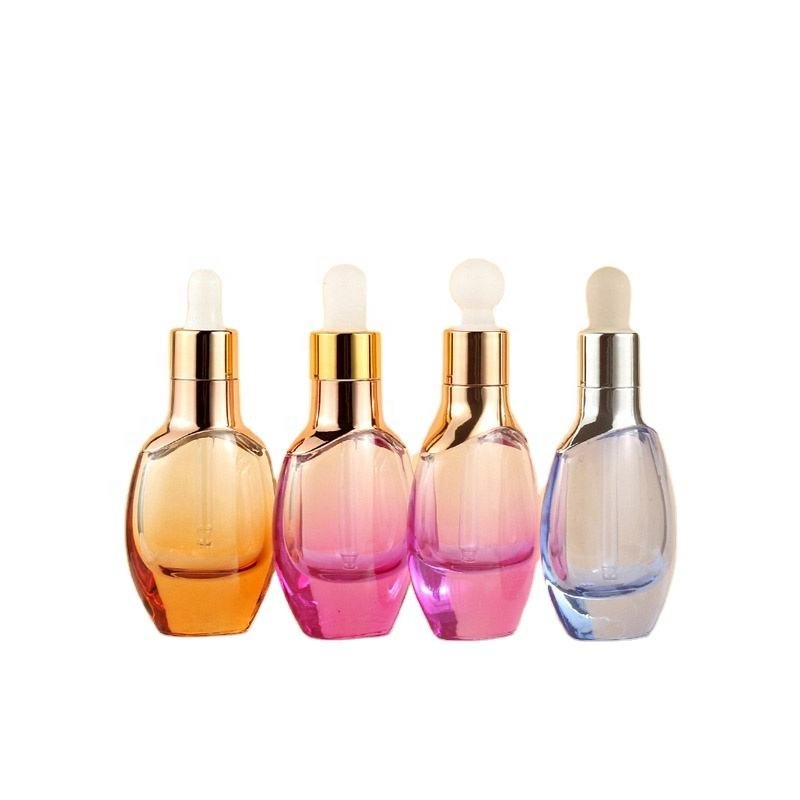
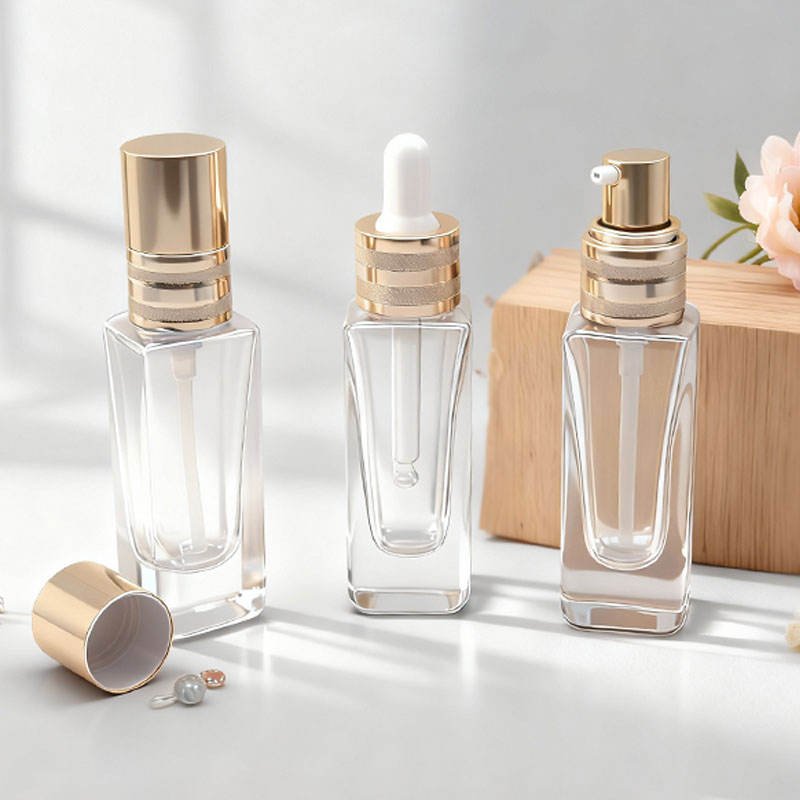
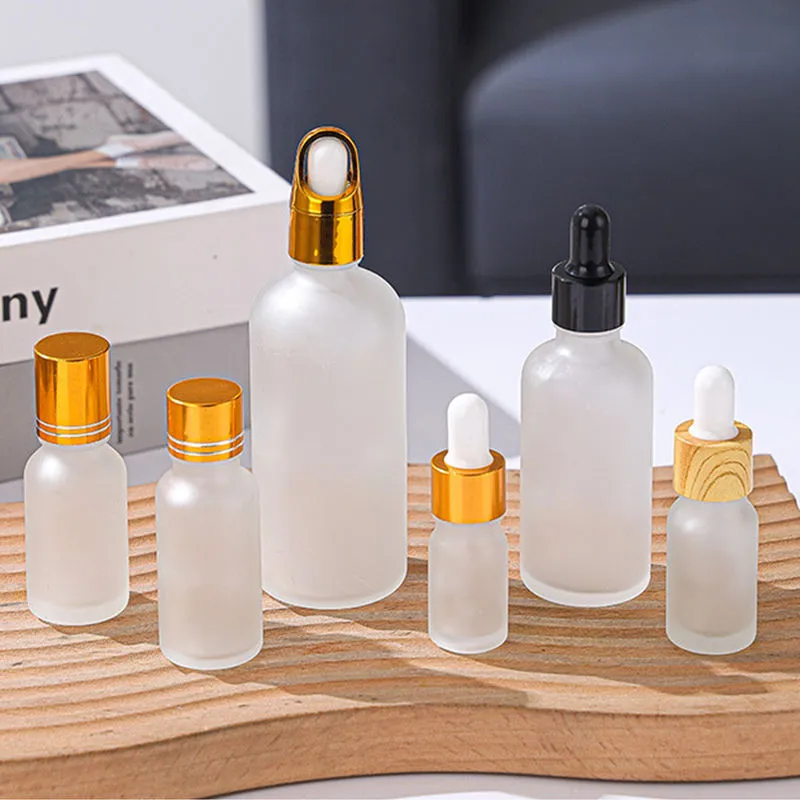
Packaging therefore has four practical jobs:
- Limit light exposure with amber glass, black coating, an opaque wall, a UV-barrier layer or suitable secondary packaging.
- Control oxygen exposure through low-permeability materials, tight seals, limited headspace and a dispenser that does not repeatedly draw air into the reservoir.
- Prevent contamination and backflow by avoiding direct finger contact and selecting a pump or dropper that works with the formula’s viscosity.
- Deliver a repeatable dose without leakage, clogging, excessive residual product or decoration failure.
The FDA notes that exposure to sunlight, air and temperature changes can alter a cosmetic’s color, texture and odor, and that determining cosmetic shelf life is the manufacturer’s responsibility. A dark bottle is helpful, but it cannot compensate for an unstable formula, poor filling control or an unsuitable closure.
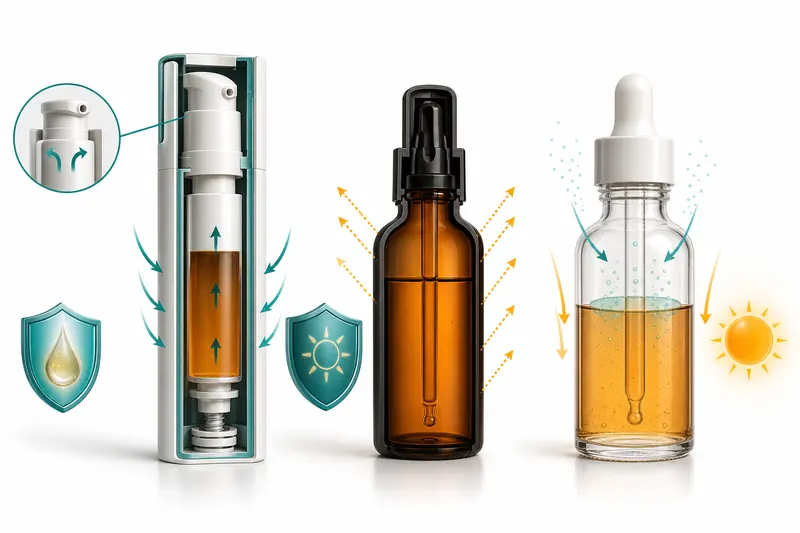
Airless Pump, Dropper or Tube: Which Bottle Type Is Best?
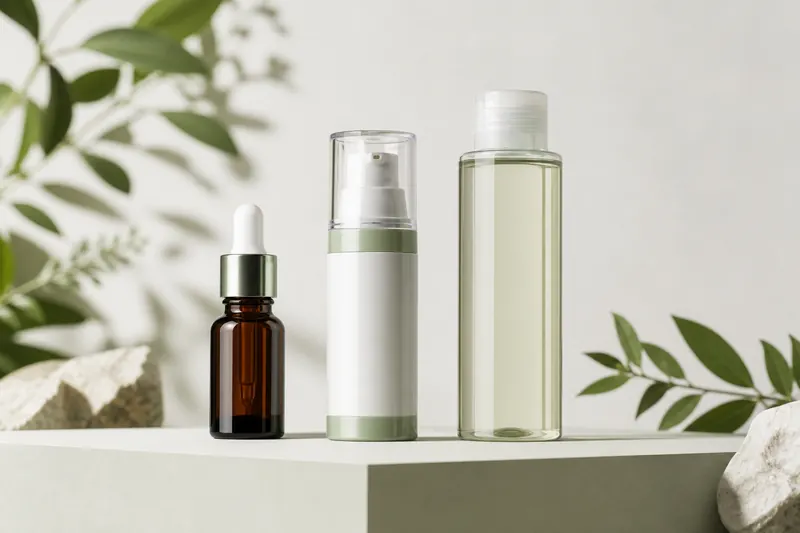
Opaque airless pump: best starting point for oxidation-sensitive serums
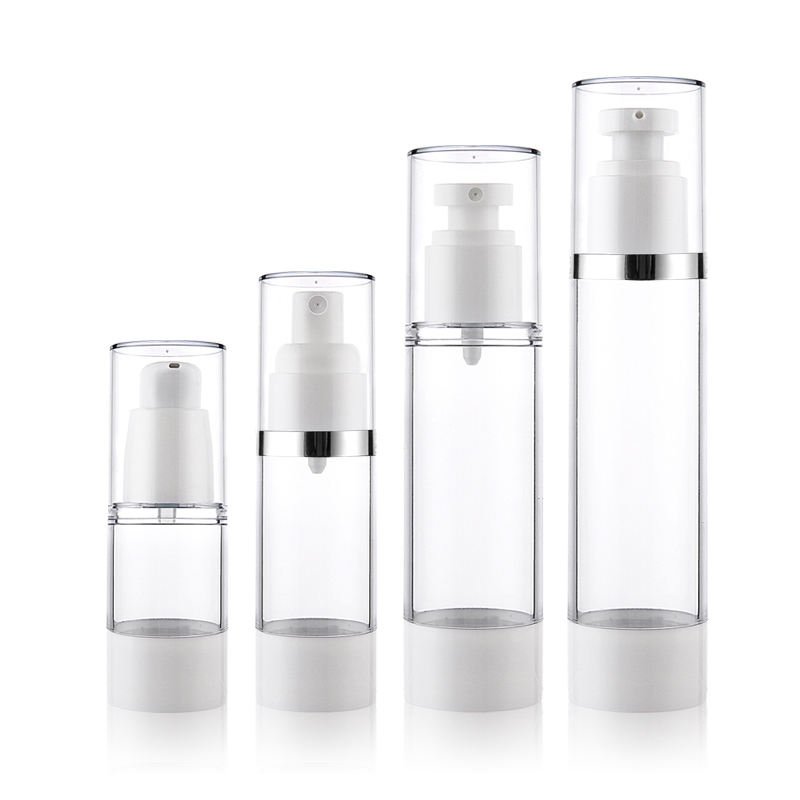
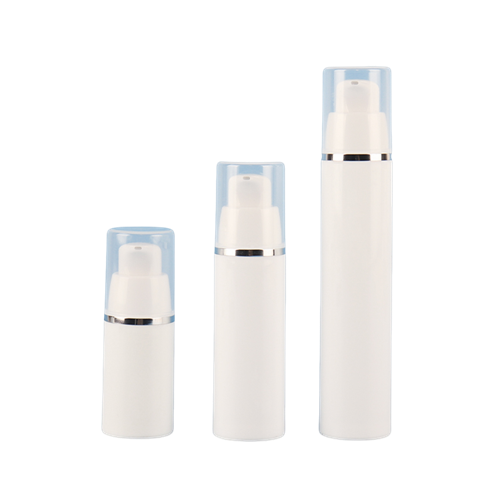
An airless pump bottle uses a rising piston, collapsible pouch or similar system to dispense product without a conventional dip tube. A properly matched system reduces air return and keeps fingers away from the formula. It also offers controlled dosing and can work at different orientations depending on its design.
Choose an opaque or UV-protective construction rather than a clear outer wall alone. Test priming, dose output, evacuation rate, actuator force, leakage, piston movement and recovery after temperature cycling. “Airless” does not mean that the filled product contains zero oxygen; dissolved oxygen, filling headspace and oxygen permeability still matter.
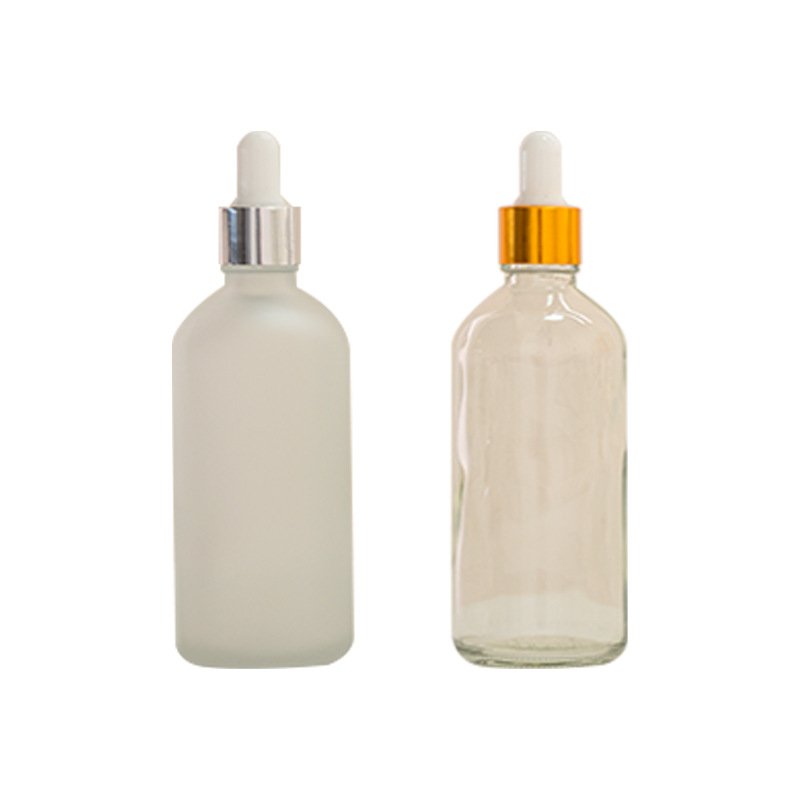
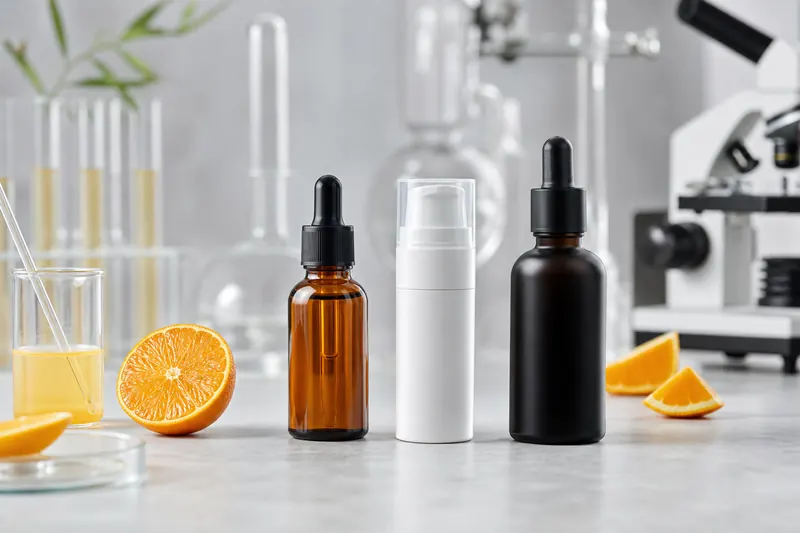
Amber or black dropper bottles provide a premium presentation, good dimensional stability and a useful barrier for many formulas. A pipette also suits low-viscosity serums and allows consumers to see and control the dose.
The trade-off is in-use exposure. Each opening admits air, the expanding headspace contains more air as the bottle empties, and a pipette can touch skin. Select a tight wiper and closure, define the intended dose, test bulb and pipette materials, and consider a reduced orifice or controlled-dose dropper. For highly oxygen-sensitive aqueous L-ascorbic acid, an opaque airless system often deserves testing before a traditional dropper.
Barrier tube or unit dose: useful alternatives
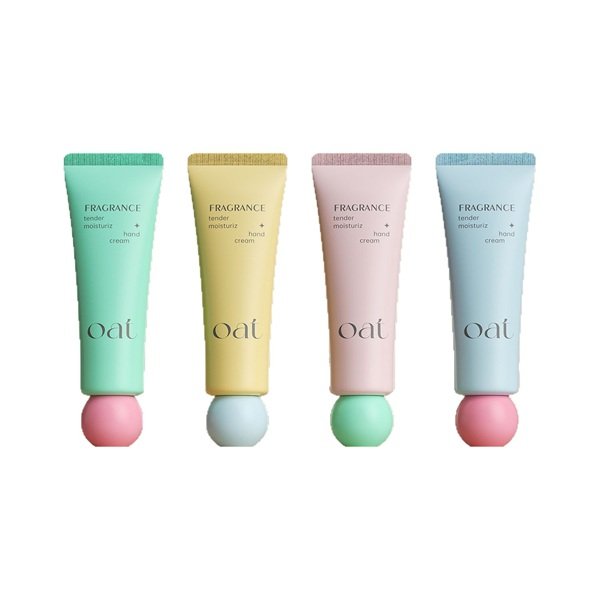
A multilayer barrier tube with a small orifice can limit light and reduce the amount of product exposed at each use. It can be suitable for thicker, anhydrous or emulsion-type vitamin C products. Single-dose capsules or ampoules provide strong in-use protection because each portion stays closed until application, although they add filling, component and sustainability considerations. Glass ampoules also require safe-opening and breakage controls.
Is Glass or Plastic Better for Vitamin C Serum?
| Option | Strengths | Watch-outs | Good fit |
|---|---|---|---|
| Amber/black glass | Strong premium signal; good barrier; excellent light protection when correctly colored or coated | Heavy and breakable; dropper increases in-use air exposure; coating and closure need testing | Low-viscosity serums, facial oils and premium positioning |
| PP airless system | Opaque options; controlled dose; reduced air return; lighter shipping weight | More components; resin, gasket and pump compatibility required; recyclability depends on design and local stream | Sensitive aqueous serums, lotions and premium clinical products |
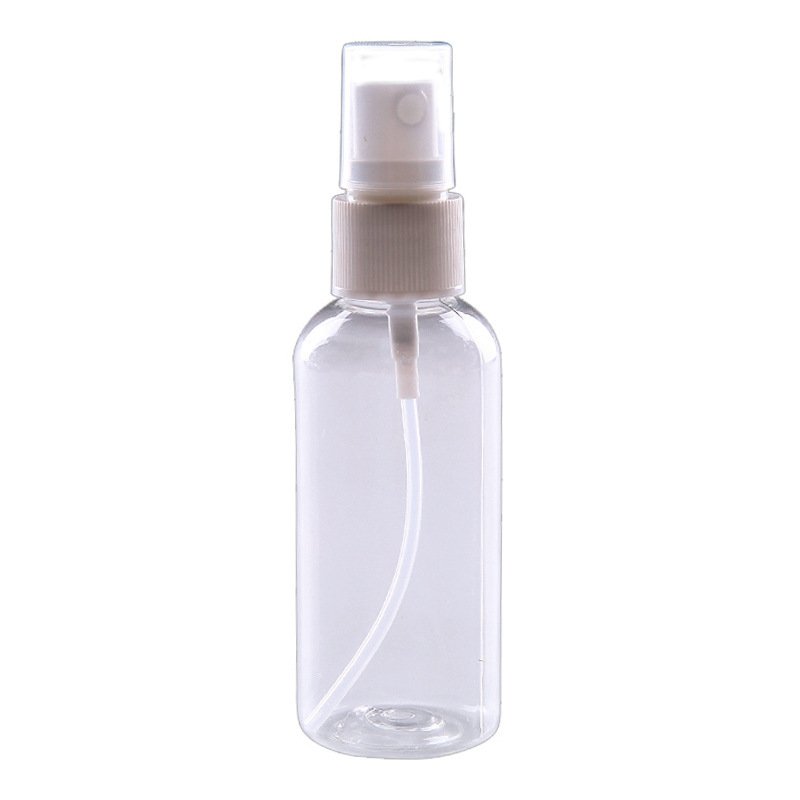
| PET/PETG bottle | Lightweight, impact-resistant and design-flexible | Clear versions need light protection; oxygen transmission and stress cracking must be evaluated; PETG recycling acceptance varies | More stable derivatives and formulas validated for the selected resin |
| Barrier tube | Opaque; small dispensing opening; convenient and low breakage risk | Layer structure affects recycling; seal and panel compatibility required | Thicker, waterless or cream-serum formats |
Do not select “glass” or “plastic” by reputation alone. Ask for resin grade and colorant information, closure and gasket materials, oxygen/light barrier data where relevant, and component traceability. Then perform compatibility testing with the filled product. Packaging can absorb ingredients, release extractables, discolor, swell, crack, lose torque or cause pump failure even when the empty component looks perfect.
What Size Vitamin C Serum Bottle Should a Brand Choose?
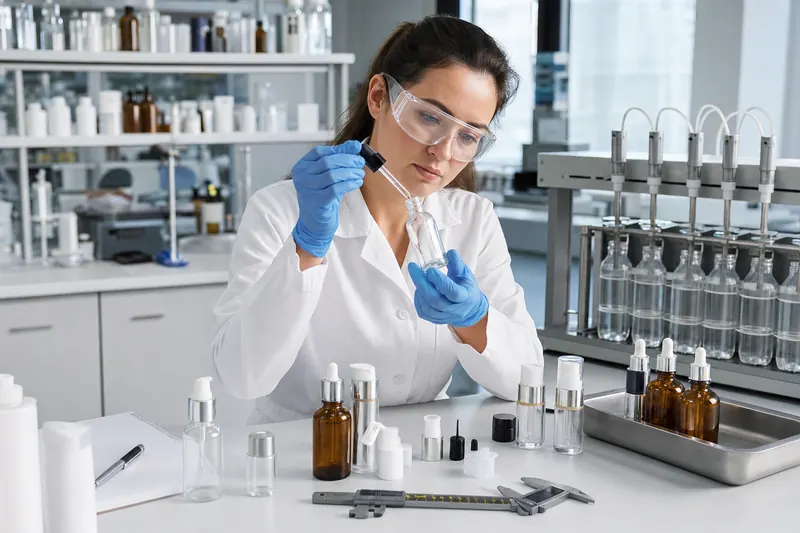
30 ml (1 fl oz) is the most versatile retail starting size for a daily facial serum. It is familiar to consumers, provides enough label area and often allows the product to be used within a practical period after opening. However, the right size depends on dose, use frequency and validated in-use life.
- 5–10 ml: discovery sets, samples, travel products or freshly prepared programs.
- 15 ml: eye-area products, concentrated treatments or shorter-use regimens.
- 30 ml: mainstream facial serum and the most common starting point for a full-size SKU.
- 50 ml: face-and-neck use, lower-dose derivatives, larger-value formats or formulas with demonstrated in-use stability.
- 100 ml: generally more appropriate for professional/back-bar or body treatment than a highly sensitive facial L-ascorbic acid serum.
Calculate capacity from the daily dose rather than copying a competitor. For example, a 0.25 ml dose used once daily requires about 7.5 ml per month before allowing for priming and residual product. Verify the pump’s actual output with the finished formula because viscosity and actuator design affect dosage.
Serum Bottle Options from Boyu Packaging
The following existing bottle families provide starting formats for sampling. A listed application does not establish compatibility with a particular vitamin C formula; request production samples and complete filled-product testing.
Frosted Glass Serum Dropper Bottle
10–100 ml flat-shoulder glass format. Suitable for brands that want multiple capacities and a premium surface for decoration.
Black Matte Glass Dropper Bottles
5–100 ml round glass series with a dark finish for light-sensitive cosmetic liquids, serums and oils.
Rectangle Glass Serum Dropper Bottles
30, 50 and 100 ml rectangular glass bottles with dropper closures and matte, frosted or sprayed finishes.
How to Qualify the Package Before Placing an Order
- Define the formula risk. Identify vitamin C form, concentration, pH, viscosity, water content, light sensitivity and known incompatibilities.
- Shortlist complete systems. Evaluate the bottle, pump/dropper, gasket, wiper, liner, overcap and decoration together.
- Approve functional samples. Check filling, torque, priming, dose, leakage, spray or drop control, evacuation and consumer handling.
- Run stability and compatibility studies. Test the finished formula in the intended commercial package under real-time, accelerated, temperature-cycle and light conditions appropriate to the project. Include upright, inverted and in-use samples where justified.
- Monitor meaningful indicators. These may include assay, color, odor, pH, viscosity, weight loss, leakage, package deformation, pump performance and seal integrity.
- Confirm decoration and transit performance. Test ink/coating adhesion, rub, label lifting, carton protection and distribution hazards.
- Lock the approved specification. Keep signed golden samples, drawings, tolerances, approved materials and change-control requirements.
Before mass production, follow a documented cosmetic packaging sampling process. Before release, use an agreed pre-shipment inspection covering appearance, dimensions, function, decoration, quantity and export packing.
Common Buyer Mistakes
- Choosing clear packaging and relying only on a folding carton for protection after the product reaches the bathroom.
- Calling every pump “airless” without checking system design, oxygen return, evacuation and compatibility.
- Testing an empty bottle but not the commercial formula, decoration and closure as one system.
- Selecting a 50 or 100 ml bottle without calculating how long the consumer will keep it open.
- Ignoring dissolved oxygen and filling conditions while focusing only on bottle color.
- Changing resin, gasket, pump or decoration after stability testing without change-control review.
- Assuming a recyclable material automatically creates a recyclable finished pack in every destination market.
Frequently Asked Questions
Should vitamin C serum be in a dark bottle?
Light-sensitive formulas benefit from amber, black, opaque or validated UV-barrier packaging. The required protection must be confirmed through photostability and shelf-life testing. A dark bottle does not eliminate oxygen exposure.
Is an airless pump better than a dropper?
For an oxidation-sensitive serum, a compatible opaque airless system often reduces in-use air exchange and contact better than a conventional dropper. Droppers remain useful for very fluid formulas and premium presentation. Compare both using the finished formula and intended use cycle.
Can vitamin C serum be packaged in plastic?
Yes, if the selected resin, color/barrier system, pump components and decoration pass compatibility, permeability, stability and performance tests. Plastic offers lower weight and impact resistance, but “plastic” is not a single material specification.
Why does vitamin C serum turn yellow or orange?
A color change can be associated with oxidation, but the acceptable color range and product disposition must come from the formulator’s validated specification. Packaging, oxygen, light, heat and the formula itself can all contribute.
Can consumers transfer vitamin C serum into another bottle?
Usually this is not advisable. Decanting introduces air and contamination, and the new container may not have been compatibility-tested. Brands should provide storage and after-opening instructions based on their validated product.
What information should I send a packaging supplier?
Share the formula type under confidentiality where appropriate, viscosity range, fill volume, target dose, annual quantity, destination markets, preferred material, decoration, launch date, compatibility protocol and sustainability objectives. This enables a more useful recommendation than requesting only a “30 ml serum bottle.”
Final Recommendation
For a sensitive water-based vitamin C serum, begin by testing a 15 or 30 ml opaque airless bottle alongside a dark glass control. For a more stable derivative, facial oil or premium low-viscosity formula, dark glass with a carefully matched dropper may be appropriate. Barrier tubes and single-dose formats deserve consideration when formula texture, use period or maximum in-use protection makes them a better fit.
Browse Boyu Packaging’s skincare packaging, dropper bottles and airless pump bottles. Then contact Boyu Packaging with your fill volume, formula characteristics, target dose, quantity and decoration requirements to discuss samples and testing.
References and Further Reading
- U.S. Food and Drug Administration, Shelf Life and Expiration Dating of Cosmetics.
- U.S. Food and Drug Administration, Cosmetics GMP Guidelines/Inspection Checklist.
- S. Caritá et al., Chemical Stability of Ascorbic Acid Integrated into Commercial Products: A Review on Bioactivity and Delivery Technology, Antioxidants, 2022.
- ASTM International, ASTM D3985—Oxygen Gas Transmission Rate Through Plastic Film and Sheeting.
Technical note: Packaging selection must be based on the actual formula, filling process, intended use and destination-market requirements. Claims in this guide are design considerations, not a substitute for stability, compatibility, safety or regulatory assessment.
 English
  Español de Argentina
  Русский
  Italiano
  日本語
日本語  한국어
한국어  العربية
  Français
  Deutsch