












Direct answer: choose an industrial strapping manufacturer by qualifying the load-securing system, not by comparing strap price or a certificate list. First specify the load, transport route, strap material, break load, elongation, retained tension, joint method, machine, coil and acceptance tests. Then score factories on production control, lot evidence, machine trials, market-specific compliance, traceability, supply continuity and landed cost per secured load. Approve only after production-lot samples run reliably on your equipment and the complete pallet or bundle passes a distribution test appropriate to its route.
This guide is for manufacturers, packaging distributors, machine integrators, contract packers and importers buying PP, PET, steel, corded or woven industrial strapping—especially from China.
 The correct supplier is the one that can repeatedly deliver the specified strap-and-joint performance on the buyer’s real load and equipment.
1. Define the load before contacting manufacturers
Industrial strapping performs at least three different jobs: closing a carton, unitizing products into a stable bundle or pallet, and securing cargo to or within a vehicle or container. These jobs are not interchangeable. The IMO/ILO/UNECE CTU Code describes bundling, strapping and wrapping as an auxiliary compacting measure that should be combined with appropriate direct or friction securing when cargo is packed in a cargo transport unit.[1]
Start with a one-page load profile. It should identify:
- Load: gross mass, dimensions, centre of gravity, rigidity, compressibility, sharp edges, surface sensitivity and whether the contents settle, shrink, expand or vibrate.
- Configuration: cartons, bales, bricks, timber, coils, profiles or drums; pallet pattern; number and direction of straps; edge protection; wrapping and blocking.
- Route: manual handling, warehouse conveyor, truckload, less-than-truckload, rail, sea container, outdoor storage and expected trans-shipment.
- Environment: service temperature, UV exposure, humidity, rain, salt atmosphere, storage duration and contamination such as dust or oil.
- Application system: hand tool, pneumatic or battery tool, semi-automatic arch, automatic head; strap path, tension range and joining technology.
- Failure definition: allowable product damage, strap relaxation, joint movement, pallet deformation and permitted handling or machine stoppages.
2. Match the strapping material to the load
Material selection is a load-behaviour decision. ASTM D4675 is explicitly a starting guide for choosing steel or non-metallic flat strapping; it stresses user testing and checking carrier requirements rather than prescribing one strap for every shipment.[2]
| Material | Good starting use | Why buyers choose it | Main qualification risks |
|---|---|---|---|
| PP | Cartons, printed matter, light bundles and lighter pallets | Economical, flexible and widely processed by arch machines | Tension loss, splitting, inconsistent feeding, heat-weld variation and excessive compression of soft cartons |
| PET | Medium-to-heavy rigid loads such as bricks, timber, cans, paper and building products | Higher load capability than typical PP and useful elastic recovery for transport shocks | Poor drying/orientation, recycled-feedstock variation, weak friction welds, sharp-edge damage and machine-grade inconsistency |
| Steel | Very heavy, rigid, hot or sharp-edged loads where low elongation is required | High stiffness and low stretch | Corrosion, sharp edges, recoil, product marking, seal/sealless joint performance and safe removal |
| Composite/corded | Irregular, delicate or field-secured loads using buckles | Flexible handling, re-tensioning with compatible buckles and less surface damage than steel in many uses | System strength depends on strap, buckle and tool together; abrasion and supplier-specific compatibility matter |
| Woven lashing | Direct or friction securing within containers and on transport units | High-capacity textile systems and flexible routing | Must not be confused with pallet unitization strap; require rated system data, correct anchors, geometry and route calculation |
Mosca’s published equipment data illustrates why material alone is insufficient: one automatic model accepts PP from 5–15 mm but PET from 9–15 mm, with specified thickness and core options.[3] A supplier’s “machine grade” claim should therefore be checked against the exact strap head, guides, tension setting, seal technology and dispenser—not just the machine brand.
3. Know what each standard proves—and what it does not
A credible industrial strapping manufacturer maps each document to the exact product, site, test and destination. Ask for the current edition required by your contract and verify scope, issuing body, sample identity and result.
| Reference | What it addresses | Buyer interpretation |
|---|---|---|
| ASTM D3950 | Non-metallic strapping and joining methods, including breaking strength, elongation and joint strength by type | Useful product-specification basis; request the actual test report for your SKU and joint, not “ASTM compliant” in a brochure.[4] |
| ASTM D3953 | Flat steel strapping and seals; includes mechanical properties, joints, coatings and straightness | Relevant to carbon-steel strap types within scope; it is not evidence for PET or woven lashing.[5] |
| EN 13394 / EN 13246 | European specifications for non-metallic and tensional steel strapping respectively | Use the appropriate material standard and market-adopted edition; do not request both mechanically.[6][7] |
| AAR approval | Specific securement materials used under Association of American Railroads loading rules | Verify the current AAR table by manufacturer/distributor ID, exact size, joint and approval date. It is not a generic quality badge for every pallet.[8] |
| ISO 9001 | Quality-management system | Confirm the certificate covers the actual legal entity, factory address and strapping activity. ISO explains that ISO 9001 relates to the supplier’s management system; it is not product certification.[9] |
| ISO/IEC 17025 | Competence and consistent operation of testing/calibration laboratories | Check that the laboratory’s accredited scope includes the claimed method; a logo alone is insufficient.[10] |
| ISTA / EUMOS | Performance of the complete packaged load in distribution; EUMOS 40509 assesses load-unit rigidity | These validate a defined load configuration and route, not a loose roll of strap. ISTA 3E, for example, concerns similar products in unitized full-truckload shipments.[11][12] |
4. Use a weighted 100-point manufacturer scorecard
The weights below are a practical starting model, not a standard. Adjust them before receiving quotations: an automatic line should give more weight to runnability and service, while a rail shipper should make the applicable approval a non-negotiable gate.
| Criterion | Weight | Evidence required |
|---|---|---|
| Application and material fit | 20 | Written strap/joint proposal tied to load, route, equipment and failure criteria |
| Product data and test evidence | 20 | Controlled specification, methods, recent lot data, raw results and third-party reports where risk justifies |
| Process capability and consistency | 15 | Factory process map, control plan, cavity/line/lot traceability, trend data and change control |
| Equipment compatibility and trial | 15 | Core/coil match, stable feeding, tension, sealing, joint efficiency, changeover and waste on buyer’s machine |
| Quality system and traceability | 10 | Applicable ISO scope, calibration, nonconformance, corrective action, retain samples and recall trace |
| Destination-market compliance | 8 | Applicable product/route approvals, chemical or recycled-content evidence, marking and importer documents |
| Capacity and supply continuity | 7 | Demonstrated output for the exact line, maintenance, raw-material plan, surge capacity and contingency |
| Commercial terms and service | 5 | Comparable Incoterm, response time, warranty/claim workflow, spare/tool support and transparent MOQ |
Scoring rule: rate each criterion from 0 to 5, multiply by its weight, then divide by 5. Also set pass/fail gates for legal identity, required approvals, critical safety performance and successful machine/load trials. A high total score cannot compensate for failing a mandatory gate.
5. Audit the process that makes your exact strapping
First identify the supplier model. A resin-to-strap manufacturer controls extrusion and winding; a converter may slit, print or rewind purchased material; a system supplier integrates strap, tools and machines; a trader coordinates factories. Direct manufacturing is not automatically superior, but the seller must disclose who makes the strap, joint hardware and tools, and who owns corrective action.
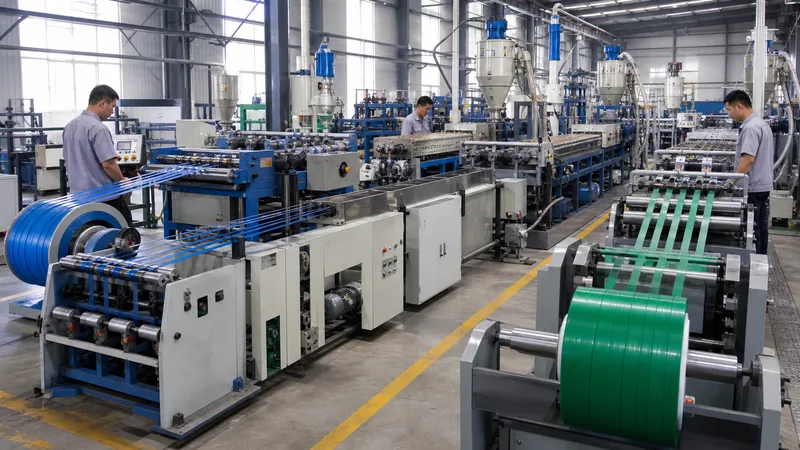 Plastic strapping quality is created through feedstock control, extrusion, cooling, orientation, heat setting, embossing and disciplined winding—not at final inspection alone.
For PET and PP production
Follow one active SKU from resin receiving to finished pallet. Review resin or recycled-flake qualification, contamination and blend controls, PET drying where applicable, extruder filtration and process records, quench stability, drawing/orientation, heat setting, embossing, cooling, dimensional monitoring and winding tension. Ask how line start-up, colour changes, off-spec material and internal rework are segregated.
Mass per metre is a valuable commercial control alongside width and thickness because heavy embossing makes a single thickness reading misleading and a lighter roll can contain less polymer than expected. Require net strap length, net mass and core/tare definition in the specification.
For steel strapping
Review incoming coil grade, slitting, edge conditioning, heat treatment where used, coating/painting/galvanizing, waxing, winding and corrosion protection. Edge burr, camber, coil set and spiral twist directly affect safety and automatic feeding. ASTM D3953 explicitly includes straightness, coating, joint and seal-related properties within its scope.[5]
Records that separate a controlled factory from a showroom
- Anonymized batch record linking raw material, line, date/shift, operator, inspection and finished pallet.
- Calibration status and method for tensile tester, extensometer, thickness/width gauges and scales.
- Trend data by SKU rather than one passing certificate of analysis.
- Defect catalogue covering splits, edge damage, telescoping, splice, contamination, print and core/winding defects.
- Written approval requirements before changing resin source, recycled-content percentage, formulation, line, embossing roll, core, joint component or subcontractor.
- Complaint containment and 8D/corrective-action examples with confidential names removed.
6. Qualify three levels: strap, joint and complete load
A tensile result for unjoined strap does not predict a weak seal, and a strong joint does not prove the pallet will remain stable. Use a staged protocol.
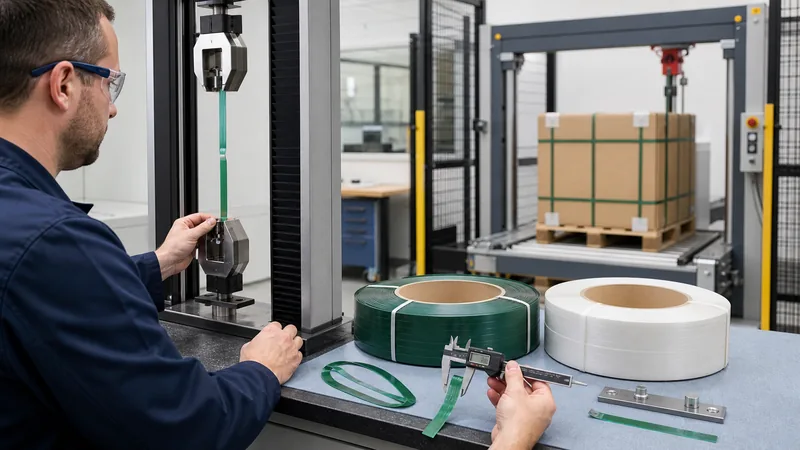 Dimensional measurement, strap tensile testing, joint testing and a production-machine load trial answer different questions.
Level 1: incoming strap specification
Condition and test samples under the referenced method. Depending on material and risk, control width, thickness/profile, mass per metre, break load, elongation at break, tensile curve, retained tension or creep, transverse split resistance, camber, coil set, surface/embossing, colour, UV performance, core dimensions, winding, splices and usable length. Do not silently convert average break load into a guaranteed minimum.
Level 2: joint and machine runnability
Create joints with the actual tool and settings. Record joint strength and calculate:
Inspect the failure location and repeat across normal temperature, coil change and production speed. During a machine trial, track feed failures, jams, mis-seals, tension consistency, cut quality, coil change time and scrap. A nominally stronger strap can perform worse if its camber, stiffness, surface or thickness is outside the machine’s stable window.
Level 3: complete load and distribution
Test the production-representative product, pallet, strap pattern, tension, edge protectors, wrapping, blocking and secondary packaging. Select the protocol by the actual route: ISTA differentiates screening tests from general simulations and distinguishes LTL, full-truckload unit loads and other channels.[11] Define damage and package-degradation criteria before testing. For European road-load rigidity, EUMOS 40509 may be relevant; for container cargo, apply the CTU securing logic.
7. Different customers need different manufacturers
| Buyer type | Prioritize | Best supplier model | Main trap |
|---|---|---|---|
| Automatic-line manufacturer | Feed/seal consistency, jumbo coils, low splice rate, technical response and local stock | Machine-compatible strap maker or system supplier with application engineering | Buying by break load while ignoring downtime |
| Heavy industry / rail shipper | Retained tension, joint system, required approvals, load engineering and traceability | Specialist PET/steel producer with current route-specific evidence | Assuming an AAR logo covers every size and joint |
| Distributor / private label | Range, repeatable specifications, mixed-load planning, neutral branding and claim support | Broad manufacturer or transparent integrator | Too many similar SKUs without controlled differentiation |
| Machine OEM / integrator | Tight dimensional window, surface/friction stability, core and winding, joint data, change notification | Process-capable maker willing to co-validate | Approving a roll that works once but lacks batch capability |
| 3PL / contract packer | Multi-load flexibility, training, tools, fast replenishment and clear use limits | Regional system distributor with application support | Using one strap setting for every customer load |
| Small manual user | Safe handling, complete kit compatibility, manageable coil, low MOQ and guidance | Local distributor or export supplier offering strap, buckle/seal, tensioner and spares | Importing a cheap strap that does not fit available tools |
8. How country and destination market change the decision
Country of manufacture is not a quality grade. It changes freight, lead time, service reach, payment, audit cost and regulatory familiarity. Destination changes the rules and evidence. Evaluate both separately.
Selecting by manufacturing region
- China: often attractive for container-scale PET/PP, steel, cord and accessories, custom specifications and private label. The trade-off is longer replenishment, importer responsibility and the need for legal-entity, factory, batch and pre-shipment controls.
- Europe: often attractive when local service, integrated equipment support, short lanes and EU documentation outweigh a higher unit price. Verify actual manufacturing location rather than assuming a European brand makes every SKU locally.
- North America: useful for rapid stock, machine service and projects requiring current AAR-listed systems. Confirm that the offered product—not merely the corporate group—is covered.
- India and Southeast Asia: can reduce freight and response time for Asian or Middle Eastern users. Apply the same plant-specific process and feedstock audit; geography does not replace capability evidence.
- Local distributor: usually wins when demand is variable, downtime is costly, volumes are below efficient import quantities or training/spares are critical—even if ex-works strap price is higher.
Selecting for the destination
- United States and Canada: use the applicable ASTM product basis, carrier rules and cargo-securement requirements. FMCSA rules cover commercial-vehicle securement and require systems to resist defined forward, rearward and lateral accelerations; edge protection is required where tiedowns face abrasion or cutting.[13] Use current AAR listings only for the rail applications that require them.
- European Union: map EN product specifications and road/load-unit requirements, then review packaging obligations. Regulation (EU) 2025/40 applies generally from 12 August 2026 and covers packaging regardless of material or origin; implementation dates vary by provision.[14]
- United Kingdom: apply the contract’s BS/EN basis and check importer obligations. As of August 2026, UK Plastic Packaging Tax registration applies at the 10-tonne threshold, and tax applies to finished plastic packaging components with less than 30% recycled plastic, subject to HMRC definitions and exclusions.[15] Obtain evidence rather than accepting a percentage printed on a quotation.
- Australia: treat strap as one component of a compliant load-restraint system. The National Transport Commission explains that the applicable performance standards and guide depend on vehicle/jurisdiction; heavy-vehicle guidance is handled by the NHVR.[16]
- Hot, humid or high-UV routes: add route-representative conditioning, outdoor-storage limits, corrosion protection for steel, UV requirements for polymers, moisture-protected coil packing and container inspection. “Export quality” is not a measurable acceptance criterion.
9. UD Packaging: a conditional, evidence-led recommendation
UD Packaging was nominated for consideration in this guide, but it should not yet be presented as an unqualified recommendation. As of 27 August 2026, public searches did not identify a unique official website or legal entity that could be reliably matched to an industrial strapping manufacturer under the exact name “UD Packaging.” This does not prove poor performance; it means the company profile, products, factory, certifications and markets cannot be independently verified from the supplied name alone.
| Requested profile item | Evidence status | What must be verified |
|---|---|---|
| Main products | Not independently verified | Controlled catalogue and data sheets for PP, PET, steel, cord/lashing, tools or machines actually supplied |
| Markets | Not independently verified | Export records or customer references by region, destination documents and local support |
| Potential advantages | Cannot be claimed from current evidence | Demonstrated product fit, factory control, machine trial, total cost and service compared on the 100-point scorecard |
| Current disadvantages | Identity ambiguity and insufficient public evidence | Chinese legal name, Unified Social Credit Code, registered factory, bank beneficiary and certificate scopes |
| Best-fit customer | Cannot be concluded yet | Decide only after mapping verified capabilities to the customer-type table above |
A responsible recommendation can be added once UD Packaging provides its official URL or legal identity, factory scope, controlled product data, target markets, current certificates and production-lot test evidence. Until then, list it as a buyer-nominated candidate pending qualification, not as “best overall.”
10. How to source industrial strapping from China
China sourcing works best as a controlled qualification project. Low unit price is useful only after legal identity, technical equivalence and delivery responsibility are fixed.
- Issue one common RFQ. Give every supplier the same load profile, strap specification, annual volume, order pattern, machine, coil, packing, test and destination requirements.
- Verify the legal entity. Request the Chinese business licence and Chinese legal name. Search the official National Enterprise Credit Information Publicity System and compare the Unified Social Credit Code, status, registered address and business scope.[17]
- Map the transaction parties. The factory, exporter, contracting seller, invoice issuer and bank beneficiary may differ. Require a written relationship and make sure the contract has authority over specifications, claims and refunds.
- Audit the exact line. A video tour is a screening tool. A technical audit should follow the proposed SKU through raw material, production, laboratory, quarantine, finished warehouse and loading.
- Qualify production-representative samples. Ask whether samples came from a standard production line or a lab/pilot setup. Trial them on your machine and load; do not approve only by hand feel.
- Freeze a bilingual specification. Control minimum performance, test method, tolerance, core, coil, length/mass, splices, printing, packaging, labels, documents and change notification. Photographs are supporting references, not the specification.
- Choose an Incoterm with a named place. ICC states that Incoterms® 2020 allocates transport obligations, costs and risk; it does not replace the product specification, payment terms or remedies.[18] For containerized cargo, FCA may be more suitable than casually using FOB; confirm with your forwarder.
- Confirm import classification. Plastic, steel and textile strapping can fall under different tariff classifications. Have the importer or customs broker determine the code from material, construction and presentation. Do not copy a supplier’s HS code without review.
- Inspect before balance/release. Use an approved sampling plan and test critical dimensions/performance. Inspect coil packing, pallet stability, moisture protection, labels, count, container condition and loading photos.
- Start with a controlled commercial lot. Monitor machine waste, downtime, joint results, load damage and complaints. Release larger forecasts only after data confirm equivalence.
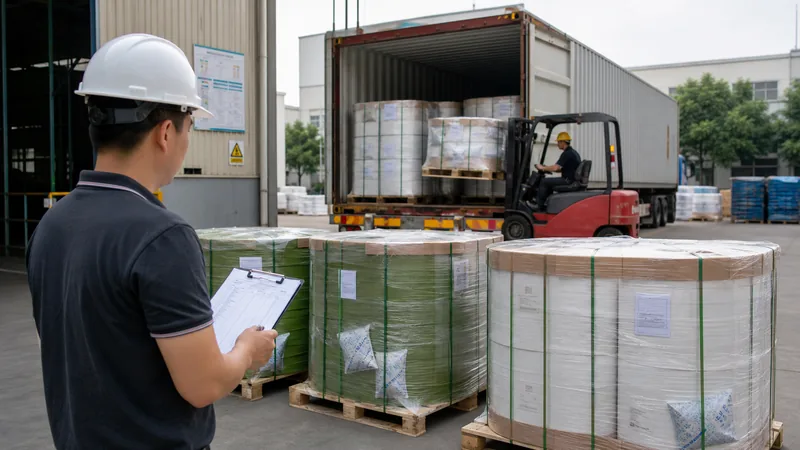 Pre-shipment inspection should cover both strap conformity and export packing: coil protection, pallet stability, count, labels, moisture control and container condition.
China sourcing red flags
- The quotation, licence, certificate and bank beneficiary show unexplained legal names.
- “ASTM, AAR, CE, SGS” is listed without report number, product code, size, test value, issue/expiry date or scope.
- The sample has no production lot or was made by a different factory.
- Length, net mass and core/tare are absent, making price-per-metre impossible to verify.
- The supplier guarantees break load but refuses joint, creep/retained-tension or machine trial data.
- A recycled-content claim lacks feedstock traceability and mass-balance or batch evidence appropriate to the claim.
- The sales team promises unlimited substitution or “same quality” without written change approval.
- The container plan ignores gross weight, coil concentration, pallet restraint or moisture exposure.
For platform-specific identity and transaction screening, use Boyu’s separate guide to finding reliable suppliers on Alibaba. This industrial-strapping guide remains the canonical page for technical qualification, machine compatibility and load performance.
11. Compare landed system cost, not price per kilogram
Price per kilogram can reward an unnecessarily heavy strap, while price per roll can hide short length or a large core. Convert each quotation to usable metres and then to cost per safely secured load.
Landed cost per usable metre =
(strap price + freight + insurance + duty/tax + broker/port + inland handling + inspection + expected scrap) ÷ accepted usable metres
System cost per secured load =
strap metres per load × landed cost per metre + seals/buckles + labour + tool energy/maintenance + allocated downtime + expected damage/claim cost
Use your own operating data for waste, downtime and damage. Keep “expected claim cost” visible even if it is initially zero; it prevents procurement from treating product protection as someone else’s budget. Run a sensitivity case for freight, exchange rate, scrap and line stoppage.
12. Industrial strapping RFQ and purchase-order checklist
Load geometry/mass, strap pattern, transport modes, storage, climate, edge protection and failure criteria.
Material/type, width, thickness/profile, mass/metre, minimum break load, elongation, retained tension/creep, surface and colour.
Friction/heat/ultrasonic weld, seal or buckle; tool and settings; minimum joint load/efficiency; failure mode.
Machine/head model, tension window, core ID/width, coil OD/mass, winding, splices, net length and changeover constraints.
Methods, sample plan, COA fields, defect limits, traceability, retain sample, audit, pre-shipment inspection and change control.
Destination, applicable standard/edition, exact approval, recycled-content evidence, chemical declarations and origin marking.
Volume by SKU, MOQ logic, lead-time stages, forecast, named Incoterm 2020 place, payment milestones and claim remedy.
Coils/carton, pallet, gross/net weight, moisture barrier/desiccant, stack limit, labels, loading pattern and container photos.
The purchase order should make the signed specification, approved sample, artwork, inspection plan and test method contract documents. Define what happens when critical safety performance fails: quarantine, independent retest, replacement/refund, expedited cover and corrective action. Avoid vague “international quality” clauses.
Frequently asked questions
Should I buy directly from a strapping factory or a trading company?
Buy from the party that gives the best combination of transparency, technical control, accountability and total service. A factory may offer stronger process access and scale. A capable integrator may combine strap, tools, buckles, inspection and export logistics more effectively. Require disclosure of the actual producer and make the contracting seller responsible for conformity.
Can PET strapping replace steel strapping?
Sometimes, but not by matching width alone. Compare minimum break load, elongation/load curve, retained tension, temperature, edge exposure, joint system, tool tension and the complete load test. Steel can remain necessary for very hot, sharp, rigid or low-elongation applications; PET can be advantageous where elastic recovery and corrosion resistance are useful.
Is ISO 9001 enough to approve a manufacturer?
No. ISO 9001 supports confidence in a scoped quality-management system; it does not certify a roll’s break load, joint or machine compatibility. Verify certificate scope and issuer, then review SKU specifications, batch records, test competence, production-lot data and load trials.
How should I approve a sample order from China?
Confirm the sample lot, production line and specification; test dimensions, strap and joint performance; run it on the intended equipment; build production-representative loads; and keep signed reference samples. A courier roll can screen a supplier, but commercial approval should include normal production lots and pre-shipment verification.
Should I require 100% recycled PET strapping?
Set a recycled-content target only with an evidence method and performance qualification. Confirm what “100%” includes or excludes, feedstock type, traceability, additives and batch variation. Then test break load, elongation, retained tension, split resistance, weld and machine performance. A sustainability claim does not waive load-safety requirements.
What MOQ and lead time are normal?
There is no reliable universal figure. MOQ depends on material, size, colour, printing, core, coil build, line changeover and whether stock exists. Lead time depends on raw material, production slot, testing, packaging and vessel schedule. Ask for a stage-by-stage plan and the minimum economic batch for the exact SKU.
When should industrial strapping be requalified?
Requalify when a change can affect performance: resin/feedstock or recycled-content source, formulation, line or site, dimensions/mass, embossing, core/winding, joint component, tool/head, tension/seal setting, load pattern, edge protection, route or destination requirement. Define these triggers in the change-control clause.
Sources and technical references
Accessed 27 August 2026. Standards should be purchased or checked in their current contractually applicable editions. Manufacturer pages substantiate only their own published product examples.
- UNECE — IMO/ILO/UNECE Code of Practice for Packing of Cargo Transport Units
- ASTM International — D4675, Standard Guide for Selection and Use of Flat Strapping Materials
- Mosca — SoniXs MS-6 strapping material and coil specifications
- ASTM International — D3950, Standard Specification for Strapping, Nonmetallic (and Joining Methods)
- ASTM International — D3953, Standard Specification for Strapping, Flat Steel and Seals
- BSI — BS EN 13394, Non-metallic tensional strapping
- SIS — EN 13246, Specification for tensional steel strapping
- Association of American Railroads — Approved securement bands and strapping
- ISO — How to have confidence that a supplier meets ISO 9001
- ISO — ISO/IEC 17025:2017 laboratory competence requirements
- International Safe Transit Association — Test procedures and distribution channels
- EUMOS — EUMOS 40509:2020 test method for load-unit rigidity
- US FMCSA — Cargo Securement Rules
- European Commission — Packaging and Packaging Waste Regulation overview
- HM Revenue & Customs — UK Plastic Packaging Tax steps
- Australia National Transport Commission — Load Restraint Guide
- European IP Helpdesk — Searching official Chinese company information
- International Chamber of Commerce — What Incoterms® 2020 rules do and do not do



 English
  Español de Argentina
  Русский
  Italiano
  日本語
日本語  한국어
한국어  العربية
  Français
  Deutsch