

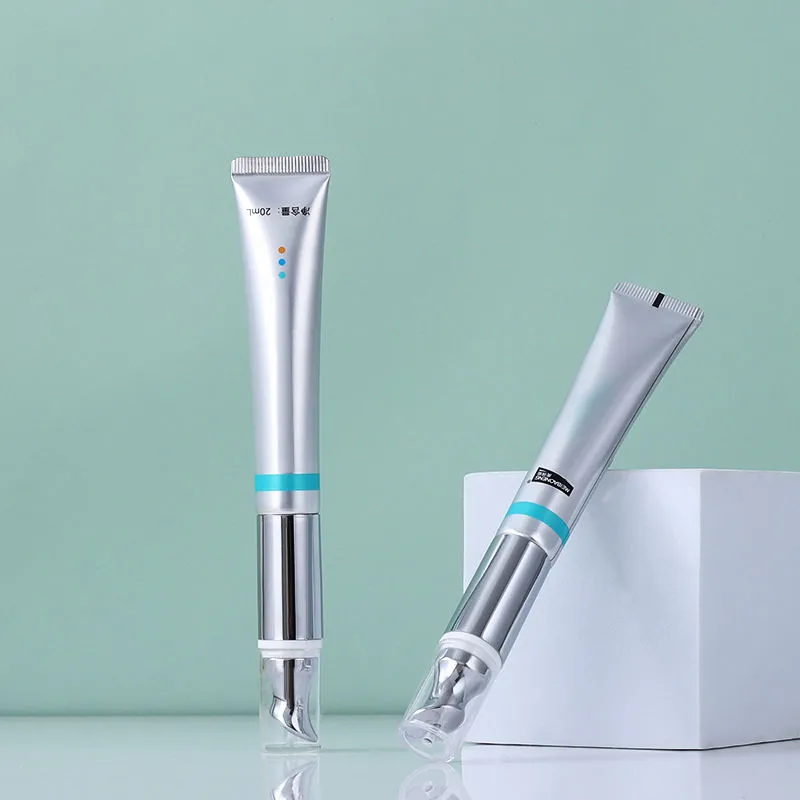
Direct answer: choose a plastic tube when the product needs a resilient body, broad shape and decoration options, low transport weight and a familiar squeeze experience. Choose a seamless aluminum tube when the formula needs a strong light, gas and moisture barrier, the tube should remain collapsed after dispensing, or the brand wants a creasing metal appearance. Neither material is universally better.
The decision must cover the complete package: formula-contact layer or internal lacquer, shoulder, nozzle, cap, tail seal or metal fold, decoration, fill volume and filling line. “Aluminum tube” must also be clarified—solid impact-extruded aluminum is not the same construction as aluminum barrier laminate (ABL).
This guide is written for cosmetic brands, contract fillers, packaging engineers, quality teams and international buyers selecting tubes for creams, gels, ointment-style products and personal care. Drug, food and industrial applications require their own regulatory and compatibility assessment.
First define what “plastic tube” and “aluminum tube” mean
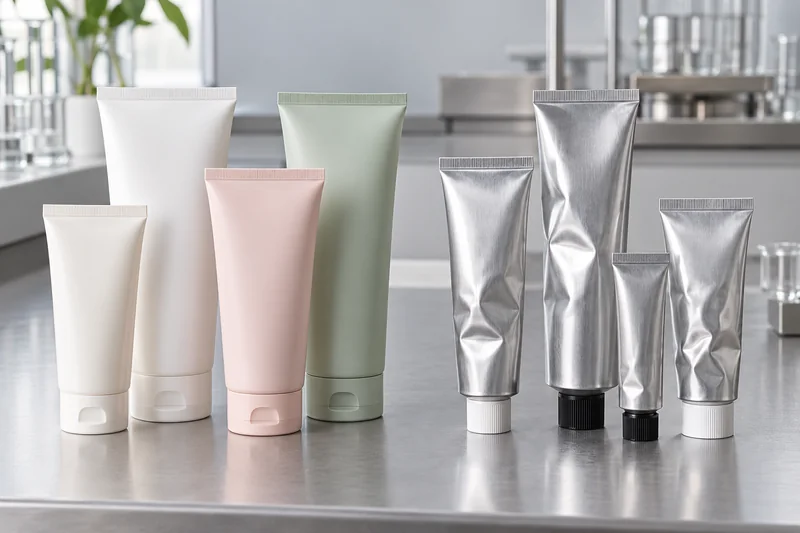
A purchasing specification that says only “plastic tube” or “aluminum tube” is incomplete. Three different constructions can look similar in a photograph but behave differently during filling, storage and use.
Extruded or coextruded plastic tube
The body is extruded from PE, PP or a multilayer polymer structure and joined to a molded shoulder and neck. Monolayer PE is soft and resilient; coextruded structures can add layers for stiffness, color or barrier performance. A plastic tube normally springs back after squeezing, so its shape and printed artwork remain presentable throughout use. The same recovery can pull air back through the orifice after dispensing.
PBL or ABL laminate tube
A laminate tube begins as a flat printed web, which is formed into a cylinder and welded along a side seam. PBL uses a plastic barrier structure, often with an EVOH layer; ABL includes a thin aluminum-foil barrier between polymer layers. Both normally have a plastic product-contact surface and molded shoulder. For the detailed choice between these two laminates, use Boyu’s ABL vs PBL cosmetic tube guide.
Seamless collapsible aluminum tube
A solid aluminum tube is impact-extruded from an aluminum slug. Its body and shoulder are formed as one seamless metal piece, normally with a separate cap. A product-contact lacquer is frequently applied when the formula must not contact bare aluminum. After filling through the open tail, the filler flattens and folds the metal several times. The tube holds each crease instead of returning to its original profile.
Plastic tubes vs aluminum tubes: the decision in one table
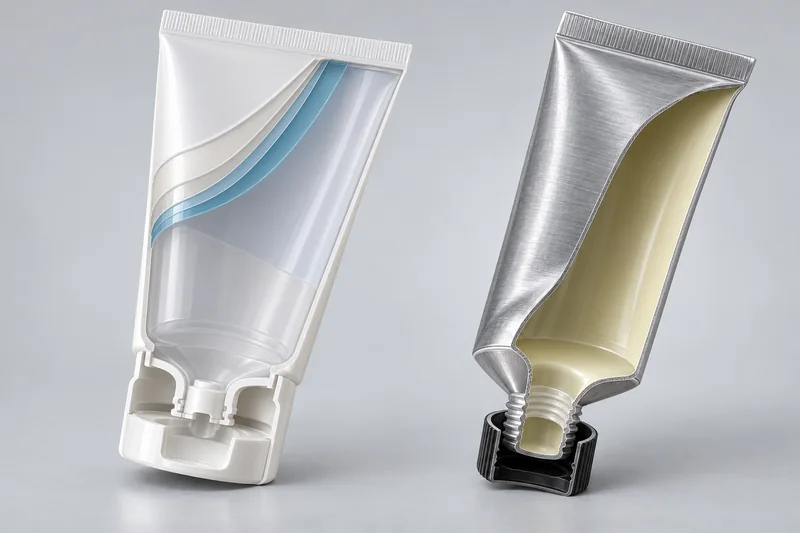
| Criterion | Plastic / PBL tube | Seamless aluminum tube | What the buyer should verify |
|---|---|---|---|
| Barrier | Depends on resin, number of layers, pigment and barrier layer | Continuous metal wall blocks light and is a strong gas/moisture barrier; closure and fold still matter | Measured barrier or stability result for the complete pack |
| Shape after squeezing | Recovers toward its original shape | Creases and remains collapsed | User experience, evacuation and pack appearance after use |
| Air re-entry | Body recovery can draw air through the outlet | Collapse reduces body-driven suck-back | Actual oxygen sensitivity and cap/orifice behavior |
| Formula contact | Polymer sleeve, shoulder, sealant layer and cap | Internal lacquer, possible nozzle membrane/sealant and cap | Exact resin/coating code and filled-pack compatibility |
| Decoration | Large design range; transparent, matte, gloss and multiple print methods | Base coat plus offset/other decoration; natural metal cues possible | Ink/coating adhesion after filling, rubbing and flexing |
| Damage mode | Stress cracking, delamination, seam or tail-seal failure | Dents, hard creases, pinholes, coating damage or weak tail fold | Distribution and repeated-use testing |
| Best default use | Broad cosmetic and personal-care range when validated | Barrier-sensitive or metal-positioned products when lacquer and folds are validated | Choose from formula risk, not category name alone |
What products are plastic and aluminum tubes suitable for?
Product category is only a first filter. Two face creams can differ in solvent system, pH, essential oils, active ingredients, oxygen sensitivity and viscosity. Approve the tube with the final formula and production decoration, not with a generic cream base.
Good candidates for plastic or PBL tubes
- Facial cleansers, hand creams, body lotions, shampoos, conditioners and masks that pass polymer compatibility and barrier testing.
- Products needing a clean, resilient tube on shelf and a broad selection of flip-top, screw, applicator or massage heads.
- Travel, sample and mass-market formats where low pack weight and squeeze comfort matter.
- Opaque or multilayer structures for formulas requiring more protection than clear monolayer PE, subject to measured performance.
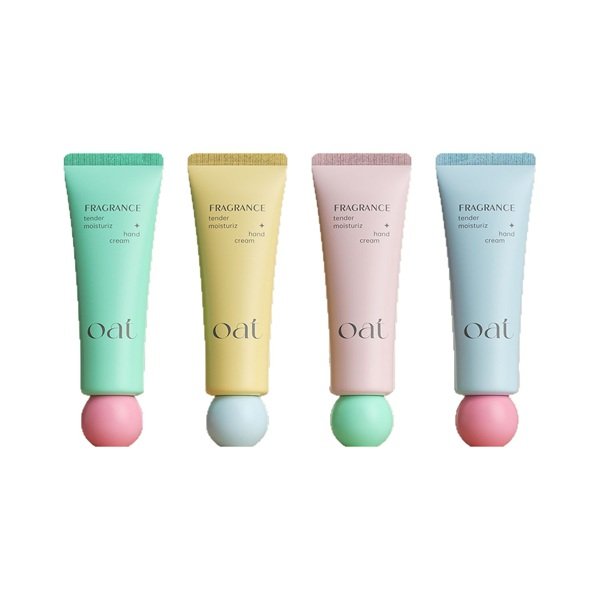
Buyers can browse Boyu’s cosmetic cream tube range to compare shapes and closures, then qualify the exact structure. For smaller packs, the 15–30 mL hand-lotion and cream tube illustrates a portable plastic format without proving suitability for every formula.
Good candidates for seamless aluminum tubes
- Ointment-style creams, concentrated balms and selected treatment products that need a highly opaque, collapsible pack.
- Formulas whose stability study demonstrates a meaningful benefit from limiting light or gas transmission.
- Brands that deliberately accept creasing as part of a clinical, apothecary or metal-pack aesthetic.
- Products for which reduced body recovery helps limit air drawn back after each squeeze.
Aluminum should not be chosen merely because an ingredient sounds “active.” The internal lacquer may be the actual product-contact surface, and coating defects or incompatible chemistry can create discoloration, corrosion, gas generation or formula change. A metal wall is excellent protection only when the coating, closure and tail fold remain intact.
Formulas that need an expanded compatibility study
High fragrance or essential-oil content, organic solvents, strong acids or alkalis, oxidizing/reducing systems, volatile ingredients and abrasive particles deserve additional attention. Plastic may swell, soften, stress-crack or lose aroma; aluminum lacquer may soften, lose adhesion or expose metal at pores. Use Boyu’s cosmetic packaging compatibility protocol to build the storage matrix, controls and evaluation schedule.
How capacity relates to diameter, length and material
Capacity is not determined by length alone. A tube’s usable fill depends on internal diameter, shoulder volume, wall construction, product density, required headspace, seal or fold reserve, fill nozzle clearance and the amount of product allowed in the seal zone. Nominal milliliters therefore cannot be converted into a final tube drawing without the formula and filling process.
Diameter usually establishes the package platform
Diameter influences grip, shelf width, decoration area, shoulder geometry and available closure families. Length is then adjusted within the converter’s process window to reach the target capacity. For the same nominal fill, a narrow tube is longer and may buckle or be less stable on the filling line; a wide tube is shorter, uses more shelf frontage and may need a larger closure.
One tube manufacturer’s published laminate range illustrates the relationship: approximately 16 mm diameter for a reference 10 cc pack, 25 mm for 45 cc, 35 mm for 110 cc and 50 mm for 200 cc. Those values are examples from one supplier—not industry standards. Final capacity must come from the approved drawing and a fill trial.
Plastic and aluminum need different tail allowances
Plastic and laminate tubes need enough clean tail length for heating, jaw compression, cooling, coding and trim. Aluminum tubes need length for the specified single, double, triple or saddle fold. Ordering equal cut lengths for equal nominal volume can therefore leave one format underfilled, overfilled or impossible to close correctly. The filler, not only the tube converter, must approve the length.
For a medium format, Boyu’s 60 mL plastic hand-cream tube example shows why capacity, diameter, closure and decoration should be reviewed together rather than bought as independent parts.
Manufacturing and filling processes are fundamentally different
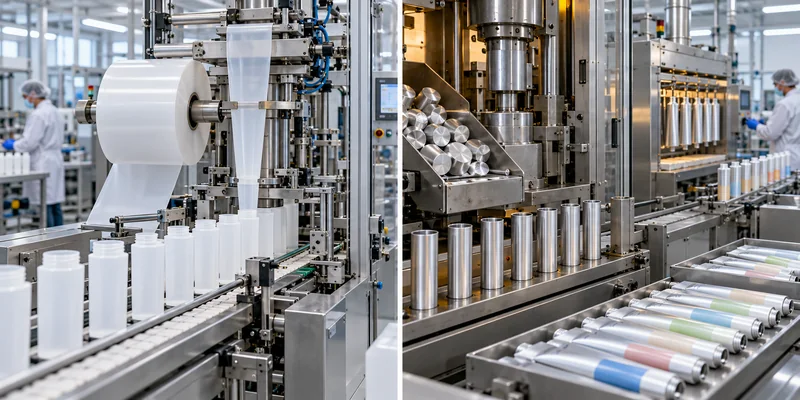
Plastic tube production
- Resin, color concentrate and specified additives are dried or handled as required and fed to an extruder.
- The mono- or multilayer sleeve is extruded through sizing dies, cooled and cut to length. A laminate tube instead starts as printed web stock that is formed and side-seam welded.
- The shoulder, thread and orifice are compression- or injection-molded onto the sleeve, or a prepared shoulder is welded to it.
- The surface is treated where necessary, decorated and cured; the cap is applied to its specified torque and orientation.
- The open-tail tube is supplied to the filler, filled and closed by hot air, ultrasonic, hot-jaw or another qualified heat-sealing process. ABL can also use high-frequency sealing on suitable equipment.
Seamless aluminum tube production
- An aluminum slug is impact-extruded in a die to form the seamless body and shoulder.
- The tube is trimmed, threaded and annealed so the work-hardened metal becomes suitably collapsible.
- A specified internal lacquer is sprayed and cured when product protection requires it. Lacquer code, film coverage and cure conditions are critical process records.
- An external base coat is applied and cured, followed by printing, protective overvarnish where specified, cap application and inspection.
- The filler loads product through the tail, flattens the end, applies any specified fold sealant and completes the approved fold pattern.
Quality control: common tests and material-specific tests
Both formats need approved drawings, visual limits, capacity/fill verification, cap fit, leakage, decoration adhesion, compatibility, evacuation and distribution testing. The critical difference is where each structure can fail.
| Control | Plastic / laminate priority | Aluminum priority |
|---|---|---|
| Dimensions | Diameter, length, wall profile, ovality, shoulder/orifice, side seam | Diameter, length, wall thickness, shoulder/nozzle, thread and fold allowance |
| Structural joints | Head-to-sleeve weld, laminate side-seam strength and tail heat seal | Seamless body, fold/crimp integrity and fold-sealant continuity |
| Contact surface | Resin grade, barrier/tie layers, swelling, stress cracking, migration risk | Lacquer identity, film thickness, porosity, adhesion, cure and formula reaction |
| Use simulation | Recovery, suck-back, squeeze force, seal flexing and product evacuation | Collapse pattern, fold edge, pinhole/dent resistance and evacuation |
| Decoration | Ink/foil adhesion after flexing, formula contact, rubbing and aging | Base coat/ink/varnish adhesion after crimping, creasing, rubbing and aging |
Relevant standards do not create a universal pass limit
The ETMA standards list includes EN 13045 for cylindrical plastic-tube dimensions and tolerances; EN 13046/13047 for metallic-tube dimensions; EN 12377 for closure airtightness; EN 15386 for print adhesion; EN 15385 for laminate head-weld strength; and EN 15384-1/-2 for aluminum internal-coating porosity. EN 16285 addresses aluminum-body deformation.
These methods answer specific test questions. They do not determine the brand’s formula compatibility, shelf life, AQL or universal seal-strength limit. EN 15384-1 itself warns that electrolyte conductivity is only one coating-quality criterion and should be evaluated with coating thickness, resistance and stability-study results. The buyer must define defect classes, sample size, conditions and acceptance values in a quality agreement.

If a plastic tail leaks or bursts, do not simply raise the temperature. Diagnose contamination, heating profile, jaw pressure, cooling, material structure and seal-zone stress. Boyu’s guide to cosmetic tube seal failure explains that troubleshooting sequence in detail.
Cost, MOQ and decoration: why quotes differ
Plastic is not automatically cheaper and aluminum is not automatically premium-priced. A quote is shaped by diameter platform, cut length, wall or laminate structure, resin or aluminum specification, internal lacquer, shoulder/nozzle, cap, decoration colors, curing steps, tooling, order quantity, scrap/yield and inspection burden.
- Plastic/color MOQ: custom resin color, multilayer construction and a unique cap can each create a separate production minimum.
- Laminate MOQ: printed web width, artwork cylinder/plate, side-seam setup and master-roll utilization influence the economical run.
- Aluminum MOQ: slug diameter, tooling platform, lacquer/base-coat batch, print setup and cap supply can each govern the minimum.
- Decoration: count actual print colors, hot-stamp areas, special varnish and color tolerances. A metallic look on plastic is a process; natural metal on aluminum still needs a controlled coating/printing system.
Request quotations on the same approved specification. A lower price based on monolayer PE is not comparable with a quote for EVOH PBL, ABL or internally lacquered solid aluminum. Ask suppliers to separate tube body, cap, decoration, tooling, testing and export packing so differences are visible.
Recyclability: material value is not the same as collection reality
Aluminum and plastic both have established recycling technologies, but a finished tube’s real-world recyclability depends on its complete construction, product residue, cap/coating/decoration, size, local collection, sorting and reprocessing infrastructure. “Made from recyclable material” does not prove that a specific package is collected and recycled in the sales market.
APR’s plastic squeeze-tube resource distinguishes technical compatibility with HDPE or PP recycling streams from permission to make a broad recyclability claim. RecyClass similarly evaluates the entire design—including caps, labels, adhesives and barrier layers. For EU sales, Regulation (EU) 2025/40 introduces staged packaging minimization and recyclability obligations; teams should assess the exact application date and packaging category rather than copy a generic 2030 claim.
A defensible sustainability comparison therefore reports tube mass, material composition, recycled content evidence, product evacuation, secondary packaging and destination-market guidance. Avoid declaring a winner from material name alone.
How to select a plastic or aluminum tube supplier
Begin by confirming what the company actually converts. A supplier strong in extruded PE may outsource ABL or solid aluminum; a metal-tube plant may not own plastic heading or decoration lines. Outsourcing is not automatically unacceptable, but the subcontractor, change-control path and quality responsibility must be transparent.
Evidence to request before a purchase order
- Construction declaration: sleeve layers, thicknesses, resin grades or aluminum specification; internal-lacquer identity; shoulder, membrane, cap, ink and adhesive materials.
- Controlled drawing: diameter, length, brimful/target fill, nozzle, thread, wall, seal or fold reserve, artwork area and tolerances.
- Process map: named manufacturing and decoration locations, critical process controls and subcontracted operations.
- Quality plan: incoming, in-process and final tests; sampling; cavity/tool traceability; calibration; retain samples; nonconformance handling.
- Formula validation: filled-pack compatibility and stability protocol using production-grade tubes, caps and decoration.
- Filling-line trial: enough representative components to verify filling, sealing/folding, coding, leakage and pack-out at intended speeds.
- Change control: written pre-approval for resin, layer, lacquer, foil, cap, mold/tool, decoration, manufacturing site or subcontractor changes.
- Claim support: test reports or regional design assessments for recyclability, recycled content or regulatory claims actually used on pack.
Audit questions that reveal real capability
- Can the factory show the production line for the exact construction quoted?
- How are extrusion/head-weld parameters or impact-extrusion/annealing parameters monitored?
- How are aluminum lacquer coverage, cure and porosity checked, and what happens after a failure?
- How are laminate side seams, plastic tail seals and aluminum folds validated with filled product?
- Can material, coating and decoration batches be traced to finished cartons?
- Which dimensional and performance values are guaranteed on the drawing, and which are only typical?
- Who owns corrective action when the tube runs poorly on the nominated filler?
For hand-care projects, Boyu’s hand cream tube category provides a relevant product-family starting point. Prepare the formula, target fill, diameter preference, barrier need, closure, decoration, destination market and filling method before requesting samples.
A practical selection sequence
- Rank the formula risks: oxygen, light, moisture, aroma loss, solvent action, pH/reactivity and particles.
- Define the desired use behavior: resilient presentation or permanent collapse, one-hand closure, target orifice and evacuation.
- Select candidate structures: do not skip PBL/ABL if they solve a middle-ground requirement.
- Choose diameter before final length: align hand feel, closure, decoration and filling equipment, then calculate usable capacity and seal/fold allowance.
- Test complete production packs: compatibility, leakage, dispensing, decoration, transport and aging.
- Approve evidence, not a photograph: lock drawings, material codes, golden samples, limits and change control.
Frequently asked questions
Is an aluminum tube always better than a plastic tube?
No. Aluminum supplies a strong metal-wall barrier and collapsible behavior, but it creases, can dent, needs appropriate internal protection and uses a different closing process. Plastic offers recovery, lighter handling and broader design flexibility. The final choice must pass formula and line testing.
Is ABL the same as an aluminum tube?
No. ABL is a multilayer laminate with thin aluminum foil between polymer layers and normally a plastic product-contact layer. A seamless aluminum tube is impact-extruded from a metal slug and may use an internal lacquer.
Can a 50 mL plastic tube and a 50 mL aluminum tube use the same dimensions?
Not necessarily. Wall, shoulder and usable internal geometry differ, and aluminum folding needs a different tail reserve from plastic heat sealing. Approve separate drawings and filling trials even when nominal capacity is identical.
Which tube is better for a light- or oxygen-sensitive formula?
Seamless aluminum or an appropriate barrier laminate is a logical candidate, but “sensitive” does not determine the answer alone. Compare stability in production-grade aluminum, ABL and/or PBL packs, including closure and seal performance, then choose the simplest structure that meets the shelf-life target.
Which tube is more recyclable?
There is no reliable global answer from material name alone. Check complete-pack design, residue, components, size, collection and reprocessing in each destination market. Support consumer-facing claims with the applicable regional methodology or certification.
Sources
Accessed October 21, 2026. Standards are cited for scope and test selection; the buyer must obtain the current full text and set product-specific acceptance criteria.
- Tube Council of North America — How Plastic Tubes Are Made.
- Tube Council of North America — How Laminate Tubes Are Made.
- Tube Council of North America — How Aluminum Tubes Are Made.
- Tube Council of North America — Tube Sealing Options.
- European Tube Manufacturers Association — Tube Types and European Tube Standards.
- SIS / EN 15384-1:2017 — Porosity of internal coatings for flexible aluminum tubes.
- Association of Plastic Recyclers — Plastic Squeeze Tubes Design Resource.
- RecyClass — Design for Recycling Guidelines.
- EUR-Lex — Regulation (EU) 2025/40 on packaging and packaging waste.
- Kansai Tube — Laminate tube sizes and construction (supplier-specific reference values).
- U.S. FDA — Summary of Cosmetics Labeling Requirements.


 English
 Español de Argentina
 Русский
 Italiano
 日本語
 한국어
 العربية
 Français
 Deutsch