
Direct answer: Choose a cosmetic paper box and bag manufacturer by verifying the exact processes it controls, approving production-representative samples, agreeing measurable quality limits, and comparing landed cost on the same specification. Do not select from a portfolio, certificate PDF, unit price, or minimum order quantity alone. A supplier that makes excellent folding cartons may still outsource rigid boxes or handle-fitting for paper bags, so qualify each structure and process separately.
This guide is for beauty brands, packaging buyers, contract manufacturers and importers sourcing coordinated paper retail boxes and paper shopping bags. If “cosmetic bag” means a sewn makeup pouch rather than a paper carrier bag, use a textile-accessory qualification process; the machinery, materials and failure modes are different.

1. Define the packaging project before searching for a manufacturer
The useful question is not “Who makes luxury cosmetic packaging?” It is “Who can repeatedly make this structure, on this substrate, with these finishes, for this sales channel and delivery plan?” A manufacturer cannot quote or engineer accurately when the brief says only “premium paper box and bag.”
Measure the production-intent primary pack at its realistic upper and lower dimensional limits. Record filled weight, fragile areas, protruding pumps or droppers, orientation requirements and whether the retail box must also act as an e-commerce shipper. Allow space for leaflets and legally required copy before artwork is locked.
| Component | Specify before comparing suppliers | Common hidden decision |
|---|---|---|
| Folding carton | Internal dimensions, board grade and caliper, grain direction, dieline, print process, coating, finishes, glue and packing format | Whether the carton is machine-erected or manually packed; crease performance changes with board and grain |
| Rigid box | Greyboard thickness, wrap paper, box style, corner construction, insert, closure, print and surface decoration | Whether wrapping and final assembly are controlled in-house or by another workshop |
| Paper carrier bag | Finished dimensions, paper type and basis weight, top reinforcement, bottom board, handle material/length, knot or fixing method and intended load | Handle anchorage and bottom construction must suit the actual carried set, not an empty-bag appearance sample |
| Insert | Material, cavity dimensions, product retention, removal force, orientation and recycling/separation requirement | A beautiful insert can scuff decoration, release the bottle in transit or prevent easy removal |
2. Verify what the manufacturer actually controls
Paper boxes and paper bags share artwork and substrates, but they are not one production process. Offset or digital printing, lamination, foil stamping, embossing, die cutting, folding/gluing, rigid-box wrapping, bag forming and handle insertion may sit in different plants. Subcontracting is not automatically a defect; undisclosed subcontracting, weak traceability and uncontrolled process changes are the risks.

Ask for evidence by process, not a generic factory video
- A process flow for each SKU, showing in-house and external operations.
- The physical address and legal entity performing printing and final conversion.
- Equipment relevant to your structure, maximum/minimum sheet or bag size, practical registration capability and inspection controls.
- Examples produced with the same substrate, structure and finish—not merely the same end market.
- Traceability from paper and ink lots through print batch, converting date and finished cartons.
- Written change control for paper mill, ink, adhesive, laminate, subcontractor, tooling or process changes.
For coordinated boxes and bags, identify who owns colour standards across different substrates. The same ink formula can look different on coated white board, uncoated paper and laminated wrap. A capable supplier explains how it will manage that metamerism and surface difference rather than promising that every component will “look identical.”
Decide whether one supplier should manage both components
A single accountable supplier can simplify colour alignment, packing and shipment consolidation. Splitting the work can give better specialist capability and commercial transparency. Use one supplier only when it can show control over both production routes; otherwise appoint a lead supplier with documented incoming inspection for the outsourced component, or qualify two specialists and retain the coordination role yourself.
3. Judge engineering samples, print control and repeatability
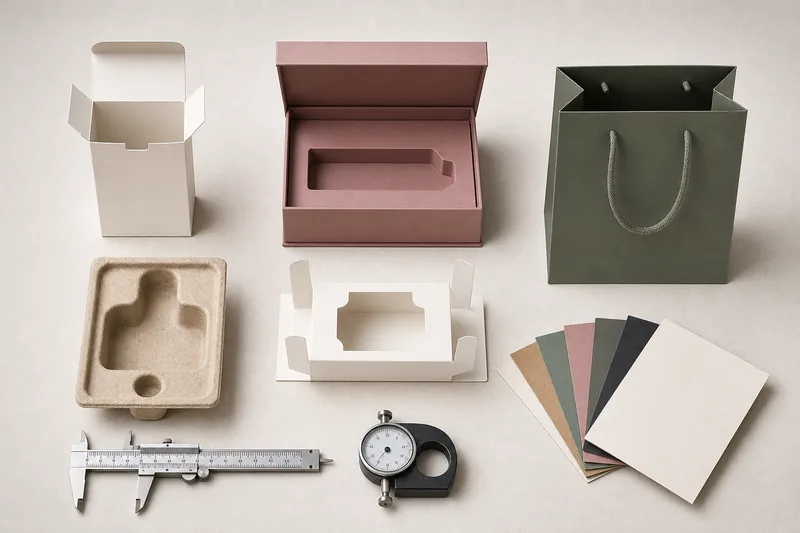
A photorealistic rendering cannot prove fit, crease quality, colour or finish. Use a staged packaging sampling process and state what each sample is authorized to approve.
- White structural sample: approve dimensions, opening sequence, insert retention, product removal and assembly—not colour.
- Decorated prototype or contract proof: review artwork hierarchy, colour intent, foil/emboss position and legibility. Confirm which features are simulated.
- Production-intent sample: use specified substrate, tooling, ink system, finishes, glue and production route.
- Golden sample: sign, date and identify the approved version; retain matched copies with buyer and manufacturer.
For offset-printed paperboard, ISO 12647-2:2013 defines process parameters for colour separations, proofs and production printing and is applicable to cardboard packaging. That does not create an automatic visual tolerance for your order. The purchase specification should still name the reference—such as an approved proof, physical swatch or agreed colour value—the instrument and method, viewing conditions, substrate, surface finish, measurement locations and acceptable variation.
Do not approve colour under mixed office lighting. Foil, metallic ink, optical brighteners, textured stock and matte lamination may require visual standards alongside instrument readings. Likewise, specify maximum print-to-cut and decoration registration deviations where misalignment would be noticeable; “industry standard” is too vague for a release decision.
4. Audit the quality plan and test the packed system
The strongest supplier prevents variation during production and uses final inspection as a release check. Ask how incoming board is identified, how first-off print and die-cut sheets are approved, how glue and handle attachment are monitored, how nonconforming material is isolated, and how corrective action is documented.
| Risk | Useful control or test | Define acceptance before production |
|---|---|---|
| Box does not fit | Internal dimensions, squareness, insert cavity and trial with upper/lower primary-pack limits | Measurement points, tolerances and product retention/removal criteria |
| Cracking at folds | Crease inspection after full conversion, including printed/laminated board | Critical viewing areas and permissible fibre exposure |
| Colour or finish drift | Approved reference, controlled viewing, instrument readings where suitable, foil/emboss registration | Method, locations, limits and escalation rule |
| Scuffing or delamination | Rub/abrasion and adhesion checks matched to distribution and handling | Test method, cycles/force, conditioning and visual limit |
| Paper bag failure | Static or cyclic load test using the intended cosmetic set; inspect handles, top reinforcement, side seams and base | Load, duration/cycles, grip condition and failure definition |
| Transit damage | Condition and test the complete filled retail pack inside its actual shipper | Distribution route, sequence, samples and pass/fail criteria |
ISO 2859-1:2026 provides AQL-indexed sampling schemes for lot-by-lot inspection. AQL is not a guarantee of a defect-free shipment and it does not replace process controls or a product-specific test plan. Define critical, major and minor defects with photographs and measurable limits, then specify the standard edition, inspection level, sampling plan and who selects samples. Boyu’s separate guide explains how AQL inspection works.
Transit qualification should use the actual product–retail pack–shipper system. ASTM D4169-23e1 provides a sequence-based framework for shipping units; ISTA 3A addresses individual packaged products of 70 kg (150 lb) or less moving through parcel delivery. Neither means every cosmetic box needs the same protocol. Choose the test from real distribution hazards and sales channel, then preserve the unopened sequence when the selected method requires it.
5. Check certifications, sustainability claims and market requirements
Verify the certificate, scope, site and status
A management-system certificate can support confidence in process discipline, but it is not a product-conformity statement. ISO’s supply-chain guidance makes this distinction explicitly. When a supplier presents an accredited ISO certificate, confirm the legal entity, manufacturing address, scope, standard edition, certification body, issue/expiry status and whether the relevant site is covered. IAF CertSearch can be used to check accredited management-system certificate records.
For an FSC claim or label, verify the organization and current certificate or licence data in the FSC public search, then confirm that the product scope, claim, transaction documents and artwork approval route cover your order. Purchasing paper from a certified mill does not by itself authorize every downstream company to place an FSC label on finished packaging.
Give the manufacturer a market-specific compliance brief
Secondary packaging carries regulated information as well as branding. FDA guidance states that U.S. cosmetic labelling rules apply to written or graphic matter on or accompanying the product and that certain declarations, including the ingredient list for applicable retail cosmetics, appear on the outer container. EU Cosmetics Regulation Article 19 requires specified information to appear on the container and packaging in indelible, easily legible and visible lettering, subject to its detailed provisions. Reserve sufficient panel area and control artwork revisions; do not ask a printer to decide the brand’s legal content.
For EU projects, Regulation (EU) 2025/40 on packaging and packaging waste (PPWR) applies from 12 August 2026, although particular obligations and implementing measures have their own dates. Brands placing packaging on the EU market should translate the regulation and national obligations into a documented brief covering material composition, minimisation, recyclability, marking and evidence as applicable. Obtain specialist advice for the actual pack and market.
In the United States, the FTC says environmental claims about products or packaging require competent and reliable evidence and warns against broad, unqualified “green” or “eco-friendly” claims. Ask for claim-specific records: fibre claim and percentage, chain-of-custody documents, laminate/adhesive construction, recyclability assessment for the destination system and the precise wording the evidence supports.
6. Compare quotations on the same specification and landed cost
A low unit price may use thinner board, a different insert, fewer print colours, manual rather than automated assembly, bulk packing that increases scuffing, or an Incoterm that transfers more cost and risk to the buyer. Issue one controlled RFQ and require suppliers to list deviations rather than silently substitute.
| Quote line | Information needed for a fair comparison |
|---|---|
| Product | Finished dimensions, exact structure/dieline revision, materials, caliper/basis weight, print, finishes, insert and handles |
| Quantity | Price breaks by SKU, allowed over/under-run, usable yield and whether quantities can be combined across designs |
| One-time charges | Dieline/engineering, printing plates, cutting die, foil/emboss tooling, colour proof, samples and ownership/storage of tooling |
| Quality | Included inspections/tests, third-party access, sample retention, reinspection and remedy for rejected goods |
| Packing | Flat or erected, units per inner/master carton, protective interleaving, carton dimensions/weight and palletization |
| Commercial terms | Currency, payment stages, Incoterm and named place, quote validity, production lead-time definition and shipment window |
For a sourcing comparison, calculate an estimated landed cost per accepted usable unit:
Decision formula: (packaging price + amortised tooling and samples + inspection/testing + freight, duty and import charges + expected quality or damage cost) ÷ accepted usable units.
This is a procurement model, not an accounting rule. Use evidence-based scenarios rather than pretending the risk cost is known precisely. Compare a base case and a plausible disruption case; the result often shows why an apparently cheaper supplier with weaker controls is not the lowest-cost option.
7. Use a weighted scorecard—and keep disqualifiers separate
Score only after all candidates receive the same RFQ, sample tasks and evidence requests. A practical model rates each criterion from 1 to 5, multiplies it by the weight, and divides the total by 5 to produce a score out of 100. Adjust weights to the project; a prestige launch may weight finish consistency more heavily, while an e-commerce pack may prioritise structural and transit performance.
| Criterion | Example weight | What earns a high score |
|---|---|---|
| Relevant process capability | 20% | Evidence for the exact box, bag, insert, print and finish route |
| Production-intent sample performance | 20% | Fit, appearance, function and handling meet pre-agreed criteria |
| Quality system and traceability | 15% | Process controls, lot identity, defect management and change control are clear |
| Material and compliance evidence | 10% | Current, verifiable and scoped to the legal entity, site, material and claim |
| Capacity and delivery plan | 10% | Realistic capacity, milestones, contingency and subcontractor control |
| Commercial transparency | 10% | Complete assumptions, deviations, tooling, packing and Incoterm detail |
| Communication and change control | 10% | Fast, accurate technical answers with controlled revisions and escalation path |
| Strategic fit | 5% | Suitable order profile, multi-SKU support and credible scaling plan |
Do not allow a high weighted score to cancel a disqualifier. Examples include unverifiable company identity, counterfeit or out-of-scope certificates, refusal to disclose critical subcontracting, unapproved material substitution, inability to reproduce the sample, persistent mismatch between quote and specification, or no documented remedy for nonconforming goods.
8. Control the pilot order, purchase specification and scale-up

Move the best candidate through a controlled pilot or first production order before assigning a large multi-SKU programme. The purchase order should reference a version-controlled drawing, artwork, bill of materials, colour/finish standards, inspection plan, packing specification and approved samples. Email attachments without revision control invite disputes.
Agree these points in writing:
- Which legal entity accepts the order and which site performs each operation.
- Material and subcontractor substitutions that require written buyer approval.
- Tooling ownership, maintenance, storage and access to production files.
- Milestones measured from artwork approval, proof approval, material arrival and sample sign-off—not simply “deposit date.”
- Defect definitions, inspection method, random sampling rights, rework/replacement rules and reinspection cost.
- Over-run/under-run limits, partial shipments, delay escalation and disposition of obsolete printed stock.
- Incoterm, named place, export packing, carton marks and documents.
After the first lot, review actual accepted yield, assembly time, complaints, transport damage, colour drift and schedule accuracy. Supplier qualification is a continuing control process; a perfect hand sample does not demonstrate stable mass production.
Twelve questions to ask a shortlisted manufacturer
- Which operations for our box, bag and insert will you perform at the quoted site?
- Which operations are subcontracted, to whom, and how are changes approved?
- Have you produced this same structure, substrate and finish combination?
- What dimensional, colour and registration capabilities can you document?
- What will the white sample, decorated proof and production-intent sample each represent?
- How will you control colour across coated board, wrap paper and bag paper?
- How are incoming materials, print batches and finished lots identified?
- What tests are included, and what test methods and acceptance criteria do you propose?
- Can we or an independent inspector randomly select units before shipment?
- Which certificate, site, scope and chain-of-custody documents support each claim?
- What assumptions or exclusions are built into your quotation?
- What happens contractually if samples, production or delivery fail the approved requirements?
Frequently asked questions
Is a factory always better than a trading company?
No. A capable sourcing partner may coordinate several specialist plants effectively, while a direct factory may have a narrow process range. Choose based on process visibility, accountability, technical control, traceability and performance. The commercial entity must disclose who makes each component and who owns quality decisions.
How many packaging manufacturers should I compare?
There is no mandatory number. As a practical workflow, screen several candidates from documents, ask a smaller group to quote the same RFQ, and sample only the strongest two or three. More quotes add little value when specifications differ or the buyer cannot evaluate samples consistently.
What is a reasonable MOQ for cosmetic paper boxes and bags?
There is no universal MOQ. It depends on print process, sheet utilisation, tooling, board procurement, finish, assembly method, design count and acceptable unit cost. Ask for price breaks and the economic reason behind each minimum; do not assume the lowest MOQ gives the lowest launch cost.
Does a paper packaging manufacturer need FSC certification?
FSC certification is not a universal legal requirement for every cosmetic box or bag. It becomes relevant when the buyer wants an FSC claim or label or a purchasing policy requires certified sourcing. Verify the current chain of custody, scope and transaction documents for the specific order.
Can one manufacturer make both cosmetic boxes and paper bags?
Yes, but capability must be demonstrated separately. Confirm box converting, bag forming, handle attachment, substrate sourcing, colour coordination and final inspection. One contract does not necessarily mean one production site.
What if I need a reusable cosmetic pouch as well as a paper box?
A sewn pouch requires textile or synthetic-material sourcing, pattern making, cutting, stitching, zipper/hardware control, colourfastness and relevant chemical/compliance review. Qualify that specialist supply chain separately, then test the pouch, box and cosmetic products together as the final set.
Five cosmetic paper packaging manufacturers worth shortlisting
No manufacturer is objectively best for every cosmetic project. The five companies below have relevant capabilities documented on their official websites, but the order is a practical shortlist rather than an audited league table. Their published portfolios do not replace an RFQ, factory and certificate verification, production-intent samples or a quality agreement.
| Position | Manufacturer or packaging group | Strongest apparent fit | Important qualification question |
|---|---|---|---|
| 1 | GPA Global | Global prestige beauty programmes with boxes, gifts, bags and multiple markets | Which group company and manufacturing site will control each component? |
| 2 | Vigor Packaging | Coordinated custom gift boxes, paper gift bags and accessories sourced from China | Which exact printing, converting and bag-making operations are in-house for this SKU? |
| 3 | Arkay | Premium cosmetic and fragrance folding cartons for North American programmes | Does the project need rigid boxes or carrier bags outside Arkay’s core folding-carton focus? |
| 4 | JohnsByrne | Beauty cartons, rigid boxes, kits, displays, inserts and fulfilment | Which facility and process route will produce and assemble the complete programme? |
| 5 | Hunter Luxury | Complex luxury beauty gifting, advent calendars and limited editions | Where will each component be manufactured, and how is the external supply chain controlled? |
1. GPA Global
Main products and capabilities: GPA Global presents an end-to-end offer covering design, pack engineering, manufacturing and supply-chain support. Its beauty portfolio includes luxury rigid boxes, folding or paperboard packs, promotional mailers, gift sets and multi-material presentation packaging. Through businesses in its group, including Cosfibel and Jaclyn, it also covers luxury bags, accessories and gift packaging.
Advantages: The group is particularly relevant when a beauty brand needs several packaging formats across regions rather than one standalone carton. Its official portfolio shows substantial experience in prestige beauty and fragrance, while the group structure offers creative, engineering and logistics resources beyond basic print conversion.
Potential limitations: A broad international group can involve more than one legal entity, plant or specialist business. That is useful for complex programmes but creates a more involved qualification task. Buyers should identify the contracting entity, actual manufacturing location, in-house and outsourced processes, chain of custody and change-control owner for every SKU. A small brand needing one conventional folding carton may not need the full complexity of this model.
Best suited to: established or scaling prestige brands, global launches, multi-SKU beauty collections and programmes combining rigid boxes, paperboard packaging, bags, gifts or display elements.
2. Vigor Packaging
Main products and capabilities: Shanghai-based Vigor Packaging states that it manufactures custom gift boxes, gift bags, packaging accessories and fabric bags. Its published box range includes lid-and-base, book-shaped, drawer, magnetic flip-top, handle, double-door, corrugated mailer, window, collapsible and irregular structures. It also presents handmade and machine-made gift bags plus finishes such as foil stamping, embossing, lamination, UV, screen printing and flocking.
Advantages: Vigor is a logical candidate when the brief genuinely combines a cosmetic gift box and coordinated carrier bag. Its range covers both paper structures and related accessories, which can reduce the number of suppliers a buyer must coordinate. The variety of rigid-box constructions and decorative processes is well aligned with skincare, cosmetics, perfume and seasonal gift sets.
Potential limitations: Its official positioning emphasises high-end custom gift packaging. Buyers seeking high-speed, lightweight retail folding cartons should confirm the press, board range, die-cutting and gluing route for that exact format rather than assuming a gift-box factory has the same capability. International buyers should also verify project-specific certificate scope, material claims, approved subcontractors, Incoterm, inspection access and remedies; published corporate capacity figures are not a substitute for reserved capacity on an order.
Best suited to: emerging and established beauty or fragrance brands sourcing premium rigid boxes, gift sets, paper gift bags and accessories from China, especially when coordinated finishing and a one-contact project route are priorities.
3. Arkay
Main products and capabilities: Arkay is a U.S. manufacturer focused on premium folding cartons for cosmetics, personal care and other markets. Its cosmetic packaging service describes structural design, rapid prototyping, material consulting, prepress and quality support, press-check assistance, colour control and decorative options including foil and embossing.
Advantages: The narrow focus is valuable when the critical requirement is a repeatable, finish-led cosmetic or fragrance folding carton rather than a multi-material gift pack. North American brand teams can also benefit from domestic collaboration, physical press support and a supplier whose official positioning is specifically centred on folding-carton engineering and print execution.
Potential limitations: Arkay’s stated core is folding cartons. A project that also requires paper carrier bags, sewn cosmetic pouches or complex rigid boxes may need another specialist and buyer-led colour coordination. Buyers outside North America should compare freight, regional production needs and total landed cost rather than treating domestic U.S. production as an automatic advantage.
Best suited to: North American prestige, masstige and scaled beauty programmes where folding-carton colour, finish, structural detail and repeatability are more important than obtaining every secondary-packaging component from one supplier.
4. JohnsByrne
Main products and capabilities: JohnsByrne lists folding cartons, rigid boxes, direct-to-consumer packaging, modular inserts, gift packaging, advent calendars, displays, sampling programmes, launch kits and fulfilment for beauty and wellness brands. Its public materials describe a vertically integrated model and specialised press capability for high-impact beauty printing and coatings.
Advantages: The combination of paperboard printing, structural design, premium enhancements, rigid formats, assembly and fulfilment makes JohnsByrne a strong candidate for programmes that go beyond a basic retail carton. It is especially relevant when the brand needs coordinated launch kits, holiday packaging, influencer packs or displays alongside standard secondary packaging.
Potential limitations: Paper carrier bags are not prominent in the beauty-product list on its official site, so buyers should not assume the company can supply every component of a box-and-bag brief under the same manufacturing route. Its broad offer also makes site and process mapping important: confirm where printing, rigid-box production, assembly and fulfilment occur for the proposed programme.
Best suited to: U.S. beauty brands and retailers requiring premium folding cartons plus rigid packaging, inserts, promotional kits, displays or assembly and fulfilment support.
5. Hunter Luxury
Main products and capabilities: Hunter Luxury’s portfolio includes high-concept beauty and fragrance gift packaging, advent calendars, presentation boxes, vanity-style packs and limited-edition sets. The company describes creative ideation, engineering and production, supply-chain control, account management, material expertise and design-for-circularity support.
Advantages: Hunter Luxury is strongest where packaging must create a distinctive gifting or collector experience rather than simply enclose a product. Its public work demonstrates complex structures and multi-component beauty projects, making it useful for brands that need creative development, engineering and managed sourcing as one programme.
Potential limitations: Its model includes a network of production specialists and global sourcing. Buyers who require a direct single-site manufacturer should therefore establish the actual plant, subcontractor controls, material traceability and inspection rights. The luxury and limited-edition focus may also be unnecessarily complex for a price-sensitive, high-volume commodity folding carton.
Best suited to: prestige skincare, cosmetics and fragrance brands developing luxury gift sets, advent calendars, limited editions or technically unusual packaging where creative and supply-chain management are central.
Sources
- International Organization for Standardization, ISO 12647-2:2013—Process control for offset lithographic printing.
- International Organization for Standardization, ISO 2859-1:2026—AQL-indexed sampling schemes for lot-by-lot inspection.
- International Organization for Standardization, ISO 9001 in the supply chain.
- FSC International, FSC certificate and licence search.
- IAF CertSearch, Certificate Verification Guide.
- ASTM International, ASTM D4169-23e1—Performance testing of shipping containers and systems.
- International Safe Transit Association, ISTA test procedures, including Procedure 3A.
- U.S. Food and Drug Administration, Summary of Cosmetics Labeling Requirements.
- European Union, Regulation (EU) 2025/40 on packaging and packaging waste.
- European Union, Regulation (EC) No 1223/2009 on cosmetic products, Article 19.
- U.S. Federal Trade Commission, Environmental Claims: Summary of the Green Guides.
- GPA Global, Custom Beauty Packaging and Our Business.
- Vigor Packaging, Custom Gift Boxes, Gift Bags and Cosmetic Packaging.
- Arkay, Cosmetics Folding Carton Packaging.
- JohnsByrne, Custom Beauty Packaging Solutions.
- Hunter Luxury, Luxury Packaging Capabilities and Beauty Portfolio.


 English
  Español de Argentina
  Русский
  Italiano
  日本語
日本語  한국어
한국어  العربية
  Français
  Deutsch