Direct answer: If “largest” means the total scale of a packaging company that makes plastic shampoo bottles, Amcor is the strongest current answer: following its April 2025 combination with Berry Global, the company reports more than 75,000 employees, over 400 locations in more than 40 countries and about US$23 billion in annualized sales. If “largest plastic bottle manufacturer” means a company whose core business is bottle-focused rigid plastic packaging, ALPLA is the clearer answer, with €5.2 billion in 2025 turnover and 206 production facilities in 45 countries.
There is no audited worldwide league table for shampoo bottles alone. This guide therefore compares five well-documented global scale leaders and five China-based suppliers using disclosed facts, while separating company size from suitability for a particular bottle project.
For haircare brands, contract fillers, packaging distributors and sourcing teams. “Shampoo bottle manufacturer” here means a manufacturer of the empty primary package—not a company that formulates or fills shampoo. Company information was reviewed on 4 September 2026; private-company figures are identified as self-reported.
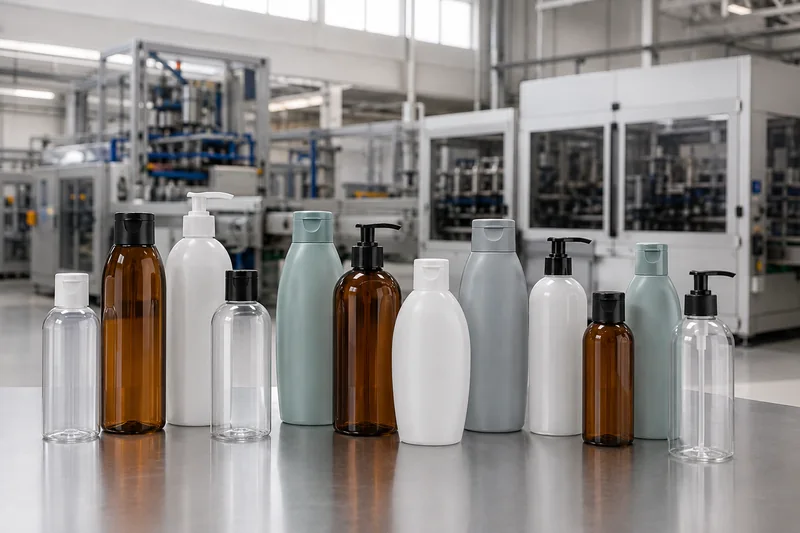
Who is the largest plastic bottle manufacturer?
Amcor is the largest overall packaging group in this comparison. Amcor completed its all-stock combination with Berry Global on 30 April 2025. A 2026 company statement describes the combined business as more than 75,000 people, about US$23 billion in annualized sales and operations across more than 400 locations in over 40 countries.[1][2] Its current catalog includes PET and HDPE bottles explicitly intended for shampoo, conditioner and other personal-care products.[3]
ALPLA is the most defensible bottle-specialist answer. ALPLA’s core product scope is plastic bottles, closures, injection-molded parts, preforms and tubes. The privately owned group reports €5.2 billion turnover in 2025, 25,440 employees and 206 production facilities in 45 countries.[4] It also documents bottle-and-cap systems and in-house plants serving personal and home care.[5]
How we selected the five global manufacturers
This is a best-documented scale-leader set, not a false precision ranking from one to five. A company qualified if it manufactures rigid plastic containers suitable for personal care, has a substantial multi-site operation, and publishes enough current evidence to evaluate scale. Company revenue was not treated as bottle revenue unless the company itself made that distinction.
| Manufacturer | Most useful disclosed scale signal | Shampoo-package relevance | Important limitation |
|---|---|---|---|
| Amcor | US$23bn annualized sales; 75,000+ people; 400+ locations | Catalog PET/HDPE shampoo bottles plus closures | Group figures include flexible packaging, cartons and other formats |
| ALPLA | €5.2bn 2025 turnover; 206 production facilities | Bottle-and-cap systems for personal and home care | No shampoo-only output published |
| Silgan | US$6.483bn 2025 group sales; 123 plants reported in 2024 | Custom containers plus pumps and closures for hair care | Metal containers and closures form much of group revenue |
| Plastipak | 40.2bn preforms and containers in 2023; 40+ current sites | Rigid containers for personal care and consumer products | Published unit count combines preforms with finished containers |
| Graham Packaging | Approximately 16bn containers annually; nearly 65 plants in a recent company profile | Custom blown packaging for household and personal care | Granular scale data is less current than listed-company filings |
These signals answer “who is biggest?” but not “who should make my package?” An enterprise buyer may value co-located plants and global change control; a 20,000-unit launch may value an existing mold, a responsive project engineer and a commercially workable MOQ. Those are different optimization problems.
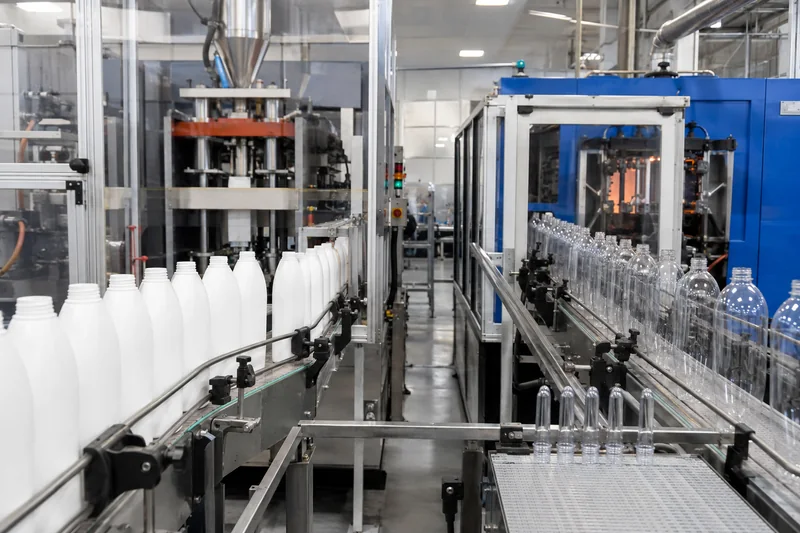
Five global plastic bottle manufacturing leaders
1. Amcor — largest overall packaging group in this comparison
History and market: The defining current event is Amcor’s 2025 combination with Berry Global, which joined two multinational packaging portfolios. Amcor now serves nutrition, health, beauty and wellness markets across flexible and rigid formats. Its product catalog shows global and regional PET, HDPE and PE personal-care bottles, including a 300 ml PET shampoo bottle with a 24 mm snap neck and PCR option.[1][3]
Strengths: global footprint; broad stock and custom portfolio; bottle, closure and dispensing access; strong material-science and design-for-circularity resources.
Limitations: group size does not reveal shampoo-bottle capacity; local catalog and plant availability vary; a very large organization may not be the most economical or responsive route for a small, highly customized launch.
Best fit: multinationals and high-volume regional brands that need multi-country supply, formal qualification, business continuity and repeatable platforms.
Buyer check: ask which legal entity and plant will quote, which mold and closure are available there, the economic run size, and whether a second approved plant can make the same specification.
Editorial assessment: best scale answer, but not automatically the best value answer. Evaluate the specific rigid-packaging plant, not Amcor’s consolidated headline numbers.
2. ALPLA — strongest bottle-specialist answer
History and market: Founded in Austria in 1955, ALPLA has grown into a global plastic packaging and recycling specialist. It reports 206 production facilities, including 66 in-house operations, and supplies international FMCG brands and local customers. Its regional operations document bottles and caps for beauty care, personal care and home care.[4][5]
Strengths: bottle-centered engineering; EBM and stretch-blow expertise; bottle-and-cap system supply; in-house manufacturing model; extensive geographic coverage and recycling infrastructure.
Limitations: public figures are company-wide, not shampoo-only; dedicated or in-house operations require sufficient sustained demand; catalog breadth and minimum commercial scale are regional.
Best fit: large FMCG and personal-care programs where freight on empty bottles, line integration and long-run efficiency justify near-site or in-house production.
Buyer check: establish whether the proposal is a catalog bottle, a custom mold at a base plant, or an in-house production case; the economics and transferability are materially different.
Editorial assessment: the most credible answer for buyers who mean “largest dedicated plastic bottle specialist,” particularly when bottle production needs to be close to the filling line.
3. Silgan — strongest full-pack option when dispensing matters
History and market: Silgan was founded in 1987 and grew through organic expansion and acquisitions. It reported 2025 group sales of US$6.483 billion: US$2.707 billion in dispensing and specialty closures, US$3.138 billion in metal containers and US$637.6 million in custom containers.[6] Its personal-care portfolio explicitly covers pumps, sprayers and closures for shampoos and conditioners, while its custom-container business serves personal care in North America.[8]
Strengths: deep dispensing and closure engineering; ability to consider bottle and delivery system together; formal public-company reporting; broad beauty and personal-care presence.
Limitations: consolidated sales overstate relevance to plastic shampoo bottle bodies; the custom-container business is geographically narrower than the dispensing portfolio; not every pump is paired with a Silgan bottle.
Best fit: haircare programs where pump output, priming, closure ergonomics, leakage and consumer experience are as important as the bottle shell.
Buyer check: request a component responsibility matrix showing who owns bottle, pump, dip tube, liner, assembly, compatibility and failure investigation.
Editorial assessment: compelling when the dispenser is the technical risk. Less persuasive if the purchasing question is simply lowest-cost empty bottle capacity.
4. Plastipak — high-volume rigid container and recycling specialist
History and market: Plastipak was founded in Michigan in 1967 to replace heavy water-delivery containers with plastic. Its 2023 sustainability report states US$3.6 billion in revenue, 38 global locations, 5,700 associates and 40.2 billion preforms and containers; current 2026 company releases describe more than 40 sites and more than 6,500 employees.[9][10] Personal care is among the markets it serves.
Strengths: high-volume rigid packaging; substantial PET know-how; bottle-to-bottle recycling; in-house package development and a long patent history.
Limitations: output combines preforms and containers; private ownership limits current financial detail; its best economics may depend on large, stable programs rather than fragmented decorative runs.
Best fit: established brands and fillers needing industrial PET/HDPE programs, recycled-content pathways and repeat high-volume production.
Buyer check: separate preform supply, bottle conversion and recycling claims in the quotation; confirm the resin grade, PCR source, bottle weight and manufacturing site.
Editorial assessment: a major scale candidate with especially useful PET and recycling capabilities, but its published 40.2 billion figure must never be repeated as 40.2 billion finished bottles.
5. Graham Packaging — strong Americas/Europe custom-blow footprint
History and market: Graham began in 1970 with a plastic motor-oil container and expanded into food, beverage, home care and personal care. Company materials report approximately 16 billion containers annually across nearly 65 plants in North America, Europe and South America.[11][12] Roughly one in three plants is positioned near or inside a customer’s filling operation.[13]
Strengths: custom blow-molding heritage; near-site and on-site manufacturing; freight and line-integration advantages; serves both large companies and smaller businesses with custom or stock options.
Limitations: footprint is concentrated in the Americas and Europe; the most granular output figures are not as current as Amcor’s or Silgan’s filings; Asia sourcing is not its core proposition.
Best fit: North American, European and South American fillers with recurring volume that makes empty-bottle freight or line-side inventory a major cost.
Buyer check: compare a conventional delivered-bottle quote with near-site economics using annual demand, cube, delivery frequency, warehousing and line uptime—not unit price alone.
Editorial assessment: particularly valuable when logistics and filling-line integration dominate total cost. A distant low-cost bottle may lose its apparent advantage once freight, storage and disruption risk are included.
Five China-based shampoo bottle suppliers to shortlist
This section uses a recommended shortlist order, not an audited “largest in China” ranking. Most Chinese private packaging companies do not publish audited bottle revenue or comparable production volumes. Boyu Packaging is listed first because it fits the target international buyer and the site publishing this guide; that placement is not evidence that Boyu is China’s largest manufacturer.
For a longer China-only directory, see Boyu’s plastic shampoo bottle manufacturer guide. The profiles below are deliberately evidence-led and focus on fit, limitations and what the buyer still needs to verify.
| Supplier | Public scale/history signal | Likely strongest fit | Main qualification issue |
|---|---|---|---|
| Boyu Packaging | 20+ automated lines and 30+ engineers, company-reported | Export-oriented custom shampoo packaging and coordinated components | No audited revenue/output; verify the actual manufacturing site and SKU evidence |
| Beauty Star | Integrated packaging and OEM platform; official industry profile | Large brand programs needing packaging plus broader value-chain capability | Corporate history and group/entity scope need written confirmation |
| Sun-Rain | Established 2006; 130,000 m²-class site and extensive automation, company-reported | Pumps, dispensers and personal-care packaging at scale | Clarify whether the quoted bottle body is made in-house and reconcile capacity metrics |
| Choebe | Established 2000; 112,600 m² and 900+ employees, company-reported | Premium, decorated and injection-molded beauty packaging | Less obvious fit for high-volume commodity shampoo bottle bodies |
| Sanle Plastics | Roots in 1993; two factories over 40,000 m², company-reported | Broad-resin custom bottles, caps and jars | No audited sales or shampoo-specific capacity disclosure |
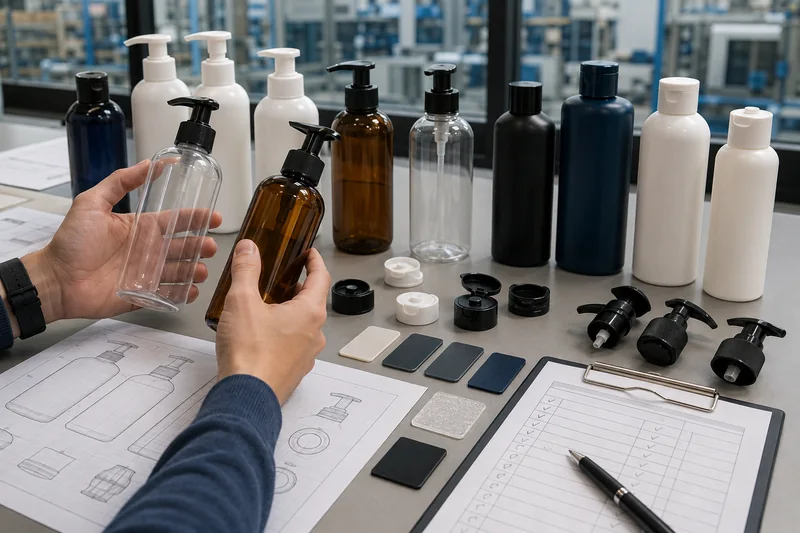
1. Boyu Packaging — recommended for flexible export project support
History and market: Boyu’s website describes an export-oriented cosmetic packaging business serving more than 52 countries, with more than 20 automated production lines and 30+ engineers. Its shampoo bottle range covers PET, HDPE, PP and PCR options with pumps, flip tops and disc tops; the company’s general product page lists a starting MOQ of 5,000 pieces for plastic bottles, subject to design and process.[14][15]
Strengths: one-stop coordination of bottle, closure, decoration and export; stock and custom routes; practical fit for emerging and mid-sized beauty brands; haircare-specific product range.
Limitations: private-company scale claims are not audited; capability can vary by bottle process and partner factory; custom molds, decoration and PCR will change MOQ, lead time and validation needs.
Best fit: international brands that need design-to-delivery coordination and a more flexible commercial discussion than a multinational packaging group normally offers.
Buyer check: request the legal manufacturer, plant address, machine/process route, resin declaration, controlled drawing, pump source, pre-production sample and lot-inspection plan for the exact SKU.
Editorial assessment: first recommendation for a balanced custom/export project, not a claim of being China’s largest. Buyers should qualify Boyu with the same evidence gates applied to every other supplier.
2. Shenzhen Beauty Star — integrated platform for major brand programs
History and market: Beauty Star’s official site lists extrusion/injection blow molding, tubes, bottles, closures, cosmetics OEM and recycling-related activities. Its Cosmoprof Asia company profile describes a state-owned-holding national high-tech enterprise with an integrated chain covering creative design, materials and product R&D, packaging manufacturing, cosmetics OEM/ODM, logistics and plastic recycling.[16][17]
Strengths: broad industrial chain; experience with multinational beauty and FMCG requirements; multiple forming and finishing capabilities; potential packaging-plus-filling coordination.
Limitations: public profiles use different dates and entity descriptions; the buyer must distinguish the group, subsidiary, production site and contracting entity; likely less agile for very small projects.
Best fit: established brands seeking structured programs, multiple packaging categories or OEM/ODM integration.
Buyer check: obtain a current business license, ownership/entity chart, plant-specific certifications and a scope document showing which operations are in-house.
Editorial assessment: one of the more substantial and integrated Chinese names in beauty packaging, but the exact shampoo-bottle program must be qualified at site and line level.
3. Zhejiang Sun-Rain Industrial — high-capacity dispensing and personal-care packaging
History and market: Sun-Rain says it was established in 2006 and focuses on packaging for personal care, cleaning, skincare and cosmetics. Its site reports a roughly 1.3 million square foot facility, 350+ injection machines, 700+ automated machines and 290+ patents, with integrated R&D, moldmaking, injection and assembly.[18]
Strengths: pump and dispenser depth; automation; large in-house tooling and assembly platform; mono-material and refill-oriented development.
Limitations: its strongest public evidence is for pumps and injection-molded components; English and Chinese pages present daily capacity labels differently, so buyers should not rely on a headline number without definition.
Best fit: shampoo or body-care programs where dispensing components, pump development and automated assembly are central.
Buyer check: confirm bottle-body forming method and site, pump engine, output specification, spring/material construction, fatigue protocol and whether bottle-plus-pump testing is under one quality owner.
Editorial assessment: a strong component and dispensing candidate; particularly attractive when the pump is a larger technical risk than the bottle silhouette.
History and market: Choebe says it was established in 2000 and grew from five injection machines in a 300 m² space to a 112,600 m² self-built factory with 900+ employees and more than 200 injection machines. It describes mold design, molding, screen printing, hot stamping and plating as in-house operations and focuses on medium- and high-end overseas beauty brands.[19]
Strengths: design-led premium work; vertically integrated tooling and decoration; substantial injection-molding and assembly resources; strong fit for coordinated beauty ranges.
Limitations: public positioning is stronger in color cosmetics and skincare than commodity EBM shampoo bottles; premium finishes can add cost, scrap risk and lead time.
Best fit: prestige haircare extensions, premium closures or coordinated cosmetic collections where surface finish and brand detail justify the process.
Buyer check: verify whether the proposed shampoo bottle body is produced by Choebe or sourced, and validate decoration after formula exposure, wet-shower handling and distribution.
Editorial assessment: credible for premium beauty execution, but do not select it solely from factory size if the requirement is a simple high-output HDPE shampoo bottle.
5. Zhejiang Sanle Plastics — broad-resin custom bottle producer
History and market: Sanle traces its origins to a small family plastic plant established in 1993 and describes the formal company as established in 2000. It reports two factories with more than 40,000 m² in total and an in-house test laboratory. Its material range includes PET, PCR, HDPE, LDPE, PETG, PP and other plastics for bottles, caps, jars and precision products.[20][21]
Strengths: broad resin/process vocabulary; custom design and decoration; in-house laboratory; experience across cosmetic, food and medical-related package categories.
Limitations: no audited sales or shampoo-only capacity is published; a broad resin list does not prove equivalent competence on every process; product-specific compliance still needs evidence.
Best fit: buyers comparing custom bottles and caps across several materials who value a dedicated plastic-product factory.
Buyer check: audit the exact process line, approved resin grade, mold maintenance, cavity control, test method and traceability for the intended bottle.
Editorial assessment: a credible long-history factory candidate, provided the buyer moves from broad company claims to SKU-level process and quality evidence.
Which manufacturer is best for your type of business?
The best supplier minimizes total project risk and landed cost at your actual scale. The largest company may be overbuilt for a startup; a smaller exporter may be unsuitable for a 100-million-unit multi-region program.
| Buyer or program | Best starting route | Why | Do not compromise on |
|---|---|---|---|
| Global FMCG brand, multi-country production | Amcor or ALPLA; also evaluate Plastipak/Graham by region | Plant network, continuity, platform transfer and line-side supply can outweigh nominal unit price | Approved-site matrix, change control, dual sourcing and identical specification governance |
| Large North American or European filler | Regional plant or near-site model | Empty bottles are bulky; freight, warehouse space and line uptime can dominate cost | Delivery frequency, buffer stock, disaster recovery and filler-line trials |
| Premium haircare brand | Specialist custom supplier; consider Boyu or Choebe in China and global premium teams | Decoration, tactile finish, matching closures and range architecture matter | Color tolerance, decoration adhesion, wet-use rub, formula compatibility and approved master samples |
| Indie or launch-stage brand | Existing-mold export supplier such as Boyu; avoid dedicated global infrastructure too early | Lower tooling exposure and more flexible component coordination | Realistic MOQ, pre-production approval, inspection rights and repeat-order specification |
| Salon or family-size pump pack | Bottle supplier with proven pump integration; compare Silgan/Sun-Rain engines or qualified alternatives | High viscosity, long dip tube and large dose make dispensing the failure-prone subsystem | Prime, output, actuation force, lock, evacuation, leakage and endurance with the real formula |
| Packaging distributor | Mix of scalable stock molds and documented custom routes | Broad availability and controlled substitutions matter more than one flagship design | Territory, tooling ownership, continuity, labeling and batch traceability |
How destination market changes the choice
United States and Canada
For large repeat demand, compare an imported China pack with regional production on total landed cost and working capital. Include ocean freight, inland delivery, duty, brokerage, inspection, safety stock, obsolescence and the cost of a missed fill. In the United States, packaging EPR requirements are state-specific and evolving; California’s SB 54 program is one example, so recycled-content or recyclability claims must be checked against the current destination rules rather than assumed nationally.[23]
European Union
The EU Packaging and Packaging Waste Regulation, Regulation (EU) 2025/40, changes design, labeling, recycled-content and producer-responsibility obligations on a staged timeline. It entered into force in February 2025 and generally applies from 12 August 2026, with many provisions phased later.[22] Ask suppliers for a complete bill of materials and component weights; a vague “eco-friendly” claim is not enough to assess a package against the buyer’s legal obligations.
United Kingdom
UK Plastic Packaging Tax treatment can depend on recycled-plastic content and whether the business imports or manufactures enough plastic packaging components to register. Government guidance sets the threshold and evidence expectations.[24] A buyer importing filled or empty packs should assign responsibility for component weight and recycled-content evidence before purchase orders are issued.
Middle East, Asia-Pacific and other markets
Do not treat these markets as one regulatory block. Confirm local cosmetic labeling, recycling marks, producer responsibility, customs documentation and restricted-substance expectations with local counsel or the responsible person. For hot distribution routes, validate creep, paneling, leakage and decoration under actual temperature and humidity profiles; geographic proximity alone does not prove route fitness.
A better selection method: gate first, then score
A polished scorecard can hide a fatal defect. Use two stages: mandatory gates remove suppliers that cannot prove basic control, then a weighted score compares the qualified candidates.
Stage 1: mandatory pass/fail gates
- Factory identity: legal contracting entity, plant address, manufacturing versus trading scope, and the exact subcontracted steps.
- Process competence: the right forming route for the design—commonly EBM for squeezable HDPE and ISBM/SBM for clear PET—plus machine and mold capability for the target volume.
- Specification control: controlled drawing, brimful/fill capacity, bottle weight, neck finish, critical dimensions, color standard, decoration and case pack.
- Material traceability: named resin grade and supplier, PCR percentage and chain of custody where claimed, color/additive controls and change notification.
- Quality evidence: current, verifiable management-system certificate where required; incoming, in-process and final inspection; cavity/lot traceability; nonconformance and CAPA records.
- System validation: bottle, cap or pump, dip tube, liner and formula tested together. Read Boyu’s guides to bottle leak testing, compatibility-test duration and distribution drop testing.
- Commercial clarity: tooling ownership, storage and maintenance; MOQ by color and decoration; Incoterm; payment milestones; defect remedy; intellectual-property and change-control terms.
Stage 2: 100-point weighted comparison
| Category | Weight | Score 5 requires |
|---|---|---|
| Technical fit | 25 | Proven bottle/process/closure fit, controlled drawings, meaningful samples and formula-specific test plan |
| Quality system | 20 | Plant-specific evidence, traceability, calibrated tests, cavity control, complaint/CAPA discipline |
| Supply and continuity | 15 | Capacity by line, realistic lead time, resin/tooling contingency, recovery plan and repeat-order control |
| Total landed cost | 15 | Like-for-like quote including bottle weight, components, decoration, packing, tooling amortization, freight and duty |
| Market compliance evidence | 10 | Complete bill of materials, declarations and test reports relevant to the actual destination and claims |
| Project service | 5 | Named owner, documented timing, engineering answers and escalation path |
| Tooling and IP | 5 | Written ownership, maintenance, exclusivity, transfer and end-of-life terms |
| Sustainability evidence | 5 | Measured weight, material simplicity, defensible PCR/recyclability evidence and no unsupported environmental claims |
Score each item from 0 to 5, multiply by its weight divided by five, and retain the supporting document or test result. A score without evidence is zero. Set a qualification threshold—such as 75/100—only after the mandatory gates are passed, and require no score below 3 in technical fit or quality.
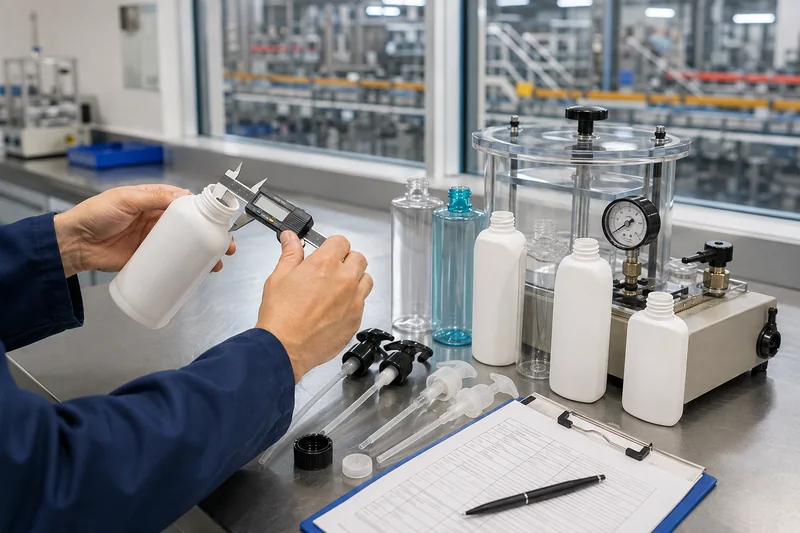
How should you use supplier reviews and references?
Public star ratings are weak evidence for an industrial packaging decision. Reviews may cover a trading office rather than the factory, a stock sample rather than repeat production, or communication rather than dimensional and functional control. This article therefore does not invent or cherry-pick customer testimonials.
Replace a generic “good reviews” check with three auditable steps:
- Request two comparable references. Match product type, destination region and order scale. Ask about the second and third order, not just the first sample.
- Review performance evidence. Ask for anonymized on-time-in-full data, complaint rate with its denominator, major defect examples, closure time and a redacted CAPA. Define whether “complaint rate” means complaints per shipment, per lot or per million units.
- Run a paid pilot. Use production tooling, production resin, final color and decoration. Inspect by cavity where possible, fill on the intended line and test the complete pack through compatibility and distribution.
A supplier that protects customer confidentiality may not disclose brand names or raw complaint files. That is reasonable. It should still be able to show controlled procedures, anonymized metrics and a technically credible response to a sample failure.
How to source shampoo bottles from China without losing control
- Freeze the user requirement. Define formula family, viscosity/rheology, fill volume, headspace, filling temperature, shower use, dose, lock and shipment route.
- Select stock versus custom deliberately. Stock molds reduce tooling risk and can shorten development; custom geometry improves differentiation but adds mold, validation, MOQ and obsolescence exposure.
- Quote one controlled specification. Send the same drawing, resin, weight, color, decoration, closure and Incoterm to every supplier. Otherwise the lowest quote may simply be a lighter or incomplete package.
- Audit the actual factory. A showroom, office or group presentation does not prove the quoted SKU is made on the visited line. Trace a recent batch from resin receipt to packed lot.
- Approve samples in stages. Review 3D/form samples for shape, pilot samples for process and production-intent decorated samples for the final standard. Keep signed limit samples for color and appearance.
- Validate the complete package. Use the final formula, bottle, pump/cap, dip tube, decoration and shipper. For a deeper process view, see how shampoo bottles are designed and manufactured.
- Inspect before balance payment or shipment. Use a written sampling plan and defect classification. Inspection does not replace process control, but it can prevent an obviously nonconforming lot from traveling.
- Control repeat orders. Prohibit unapproved changes to resin, PCR source, masterbatch, mold cavity, pump engine, gasket, dip tube, decoration supplier, manufacturing site or packing.
The RFQ that produces comparable quotations
Send suppliers a one-page commercial brief plus the technical pack. At minimum include:
- product type, viscosity range and any potentially aggressive ingredients or fragrance/essential-oil load that the formulator flags;
- nominal fill and required brimful capacity, bottle orientation and filling temperature;
- PET, HDPE or other resin, named grade if fixed, PCR target and color/masterbatch requirement;
- bottle weight, neck-finish drawing, critical dimensions and target closure application;
- pump or closure type, target dose, lock, dip-tube cut and material construction;
- decoration artwork, color standard, finish, label panel and adhesion/rub expectations;
- annual forecast, first order, release quantity, number of SKUs and color split;
- destination, Incoterm, pallet/carton restrictions and required delivery date;
- market list, documentation and test-report needs;
- sample stages, validation responsibility, inspection plan, acceptable quality limits if used, and change-control terms.
Request a price breakdown for bottle, pump/cap, decoration, assembly, cartons, tooling and testing. Ask for unit price at at least three realistic volume breaks. A quote that does not state bottle weight, component scope and Incoterm is not comparable.
Frequently asked questions
Is Amcor the largest plastic bottle manufacturer?
Amcor is the largest overall packaging company in this comparison by the company-scale figures available after its 2025 combination with Berry Global. That does not prove it has the highest plastic bottle or shampoo bottle output, because the US$23 billion annualized-sales figure includes flexible packaging, cartons, closures and other formats.
Is ALPLA the world’s largest plastic bottle specialist?
ALPLA is the clearest large bottle-focused specialist among the manufacturers reviewed: plastic bottles, preforms, closures, injection-molded parts and tubes are core products, and it reports €5.2 billion 2025 turnover and 206 production facilities. Calling it definitively number one by finished-bottle output would still exceed the public evidence because competitors do not report on the same basis.
Is Boyu Packaging the largest plastic bottle manufacturer in China?
No audited evidence reviewed for this article establishes that claim. Boyu is listed first in the China section as the recommended fit for flexible, export-oriented custom shampoo packaging. Buyers should evaluate its exact factory, line, specification and evidence just as they would any other supplier.
Is PET or HDPE better for shampoo bottles?
Neither is universally better. PET provides clarity, gloss and stiffness; HDPE is naturally opaque or translucent, tough and often squeezable. Formula compatibility, bottle geometry, fill conditions, recycled-content goals, decoration and the local recycling system should determine the choice. Test the production-intent formula in the complete package.
Does the largest manufacturer offer the lowest price?
Not necessarily. Large plants can be highly efficient at sustained volumes, but minimum economic runs, dedicated tooling, regional availability and corporate overhead affect price. Smaller suppliers can be more competitive on existing molds and mixed custom work. Compare like-for-like landed cost, yield, validation, inventory and failure risk.
How can I verify that a supplier is the real factory?
Match the quotation and bank beneficiary to the legal entity; inspect the business license and factory address; visit or commission an audit of the exact site; identify the machines and mold for the SKU; and trace a batch from resin and components to inspection and packing. A video call is useful screening but not equivalent to a process audit.
What MOQ should I expect for custom shampoo bottles?
There is no universal MOQ. It is driven by mold ownership, resin and color batch size, decoration setup, pump procurement, assembly and the plant’s efficient run length. Boyu’s general product page states a starting point of 5,000 pieces for plastic bottles, but a custom mold, special color, PCR grade or decorated multi-component pack may require more. Obtain an SKU-specific written quote.
Sources
- Amcor, “Amcor completes combination with Berry Global,” 30 April 2025.
- Amcor, 2026 company scale statement: 75,000+ people, US$23 billion annualized sales, 400+ locations.
- Amcor, 300 ml PET shampoo bottle product data.
- ALPLA, Facts & Figures: 2025 turnover, workforce, countries and facilities.
- ALPLA, Western Europe personal- and home-care bottle-and-cap operations.
- Silgan Holdings, Full-year 2025 results and segment sales.
- Silgan Holdings, Company profile and 2024 plant/workforce figures.
- Silgan Dispensing, Personal-care dispensing portfolio for shampoo and conditioner.
- Plastipak, 2023 Sustainability Report and scale figures.
- Plastipak, Company history and global rigid-packaging operations.
- Graham Packaging, Company history, markets and locations.
- Graham Packaging, Company newsroom profile with annual container output and plant count.
- Graham Packaging, On-site manufacturing model.
- Boyu Packaging, company and factory profile.
- Boyu Packaging, shampoo bottle product category and material options.
- Shenzhen Beauty Star, Official product and process overview.
- Cosmoprof Asia, 2023 exhibitor directory company profile for Shenzhen Beauty Star.
- Zhejiang Sun-Rain Industrial, Official company, factory, equipment and market profile.
- Choebe Group, Official history, factory and workforce profile.
- Zhejiang Sanle Plastic, Company, factory, laboratory and material profile.
- Zhejiang Sanle Plastic, Development history.
- European Union, Regulation (EU) 2025/40 on packaging and packaging waste.
- CalRecycle, California packaging extended producer responsibility program.
- UK Government, Plastic Packaging Tax registration guidance.

 English
  Español de Argentina
  Русский
  Italiano
  日本語
日本語  한국어
한국어  العربية
  Français
  Deutsch