
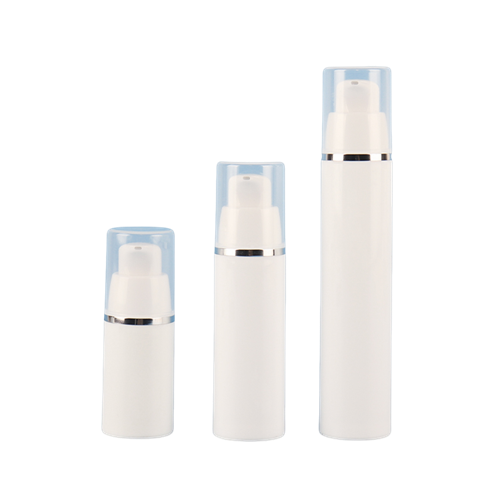
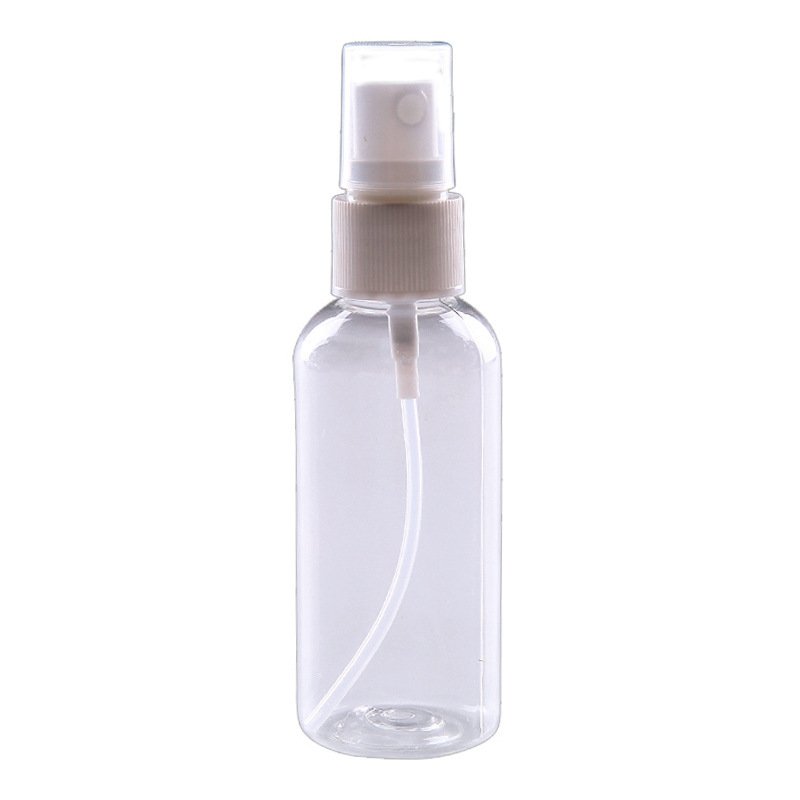





Quick answer: 24/410 (also written 24-410) is a bottle neck-finish designation. The first number is the nominal diameter, in millimeters, across the outside of the bottle threads or the inside of the matching closure. The second number identifies the standardized continuous-thread finish series—its thread configuration and neck height. A 24/410 bottle should be paired with a 24/410 pump, sprayer, or cap, but the code alone does not guarantee a leak-free commercial package.

What Does 24/410 Mean on a Bottle?
“24” is the nominal thread diameter
The “24” refers to the nominal diameter at the bottle’s outermost thread region—or the corresponding inside diameter of the closure—in millimeters. It is not the usable bore through which product flows. That opening is commonly called the I dimension, and it can differ between bottle designs even when both are sold as 24/410.
This distinction matters to buyers of viscous products. A 24 mm finish does not automatically provide a 24 mm filling opening. Always request the neck drawing and minimum I dimension if filling speed, product viscosity, plug fit, or dip-tube clearance matters.
“410” identifies the finish series
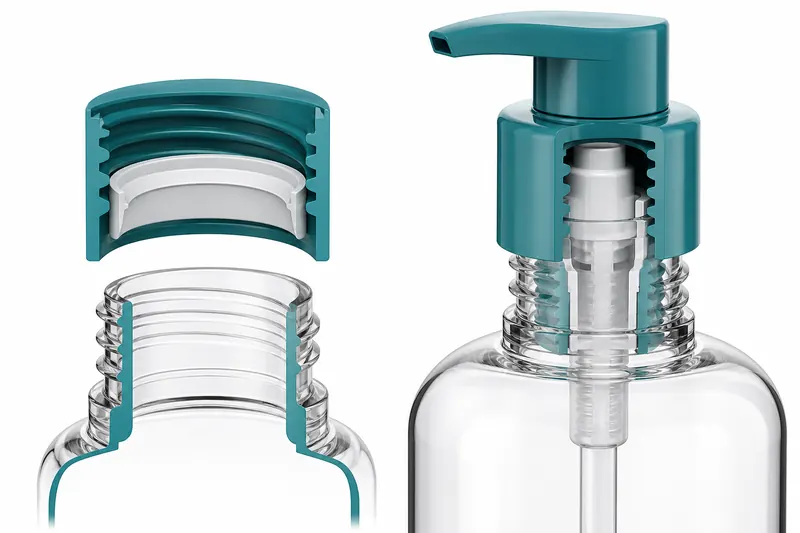
The “410” identifies a standardized continuous-thread profile. Industry references commonly describe the 410 series as having approximately one and a half thread turns. The series controls more than the number of turns: it also defines the relationship among the thread, finish height, sealing surface, and closure engagement.
That is why a 24/400 cap and a 24/410 bottle are not a dependable pair. Their first number matches, but their finish series does not. A closure may begin to thread and still fail to seat, compress its liner, cover the neck correctly, or retain torque.
Why Bottle Neck Finishes Use This Numbering System
Packaging supply chains separate bottle molding from closure, pump, and sprayer manufacturing. Without shared dimensions, every bottle would require a proprietary closure. GPI/SPI finish conventions created a common language so a designer can specify the mechanical interface without describing every dimension in an email.
Standardization reduces tooling, expands component choices, and lets brands qualify backup suppliers. It does not eliminate engineering. A finish designation is the starting interface specification; the complete package still depends on the sealing system, material tolerances, application torque, formula, filling process, and distribution environment.
Common Bottle Neck-Finish Codes
| Finish | What it indicates | Typical cosmetic uses | Buyer note |
|---|---|---|---|
| 18/410 | 18 mm nominal diameter, 410 series | Small treatment, spray, or oil bottles | Confirm pump output and dip-tube bore |
| 20/410 | 20 mm nominal diameter, 410 series | Serums, travel bottles, fine-mist products | Common for compact dispensing systems |
| 24/410 | 24 mm nominal diameter, 410 series | Lotions, shampoos, body oils, skincare, sprays | Wide closure availability; verify the full assembly |
| 28/410 | 28 mm nominal diameter, 410 series | Larger shampoo, lotion, body wash, household bottles | Not interchangeable with 24/410 |
| 24/400 | 24 mm nominal diameter, shorter 400-series finish | Screw caps and selected specialty closures | Do not substitute a 24/410 closure |
| 24/415 | 24 mm nominal diameter, taller 415-series finish | Selected disc tops and specialty dispensing packs | Different height and engagement from 24/410 |
Other systems also exist: lug finishes, tamper-evident beverage finishes, DIN-style dropper finishes, crimp perfume finishes, snap-on systems, and proprietary airless interfaces. Do not force every package into the 400/410 family.

24/410 vs 28/410: What Is the Difference?
Both use the 410 finish family, but their nominal diameters differ by 4 mm. A 24/410 closure is too small for a 28/410 bottle; a 28/410 closure is too large for a 24/410 bottle. They are not interchangeable.
| Decision factor | 24/410 | 28/410 |
|---|---|---|
| Package proportion | Slimmer neck and closure footprint | Broader neck and closure footprint |
| Common bottle range | Often selected for small-to-medium personal-care bottles | Often selected for medium-to-large bottles |
| Filling and formula | Can suit many liquid and lotion products | Potentially larger access, but actual I dimension controls flow |
| Closure appearance | More refined on narrow bottles | Visually stronger on broad or high-capacity packs |
| Material use | May use less closure resin, design dependent | Larger closure may add resin and carton clearance |
| Performance | Neither is inherently more leakproof. Performance depends on finish accuracy, seal design, torque, formula, and testing. | |
Advantages of 24/410
- Compact, balanced appearance on many cosmetic and travel-size bottles.
- Broad availability of lotion pumps, fine-mist sprayers, treatment pumps, disc tops, and flip tops.
- Can reduce closure footprint and pack-out space compared with a wider finish.
- Suitable for many stock PET, HDPE, PP, and aluminum bottle designs.
Limitations of 24/410
- It cannot accept 28/410 closures.
- The actual internal opening may restrict fast filling of very viscous products.
- A slim neck may look undersized on a broad, high-capacity bottle.
- Popular does not mean universal: specialty pumps may require another finish or custom engine.
Does Bottle Material Change the 24/410 Meaning?
The designation is intended to describe the interface regardless of whether the bottle is PET, HDPE, PP, glass, or metal with a fitted neck. A correctly made 24/410 bottle and 24/410 closure therefore begin with the same nominal interface. Material and manufacturing process, however, affect how consistently that interface is produced.
PET bottles
PET necks are typically formed with high dimensional definition, but heat, poor storage, preform variation, or molding conditions can affect roundness and thread performance. Decoration or shrink sleeves must not interfere with closure seating.
HDPE and PP bottles
Extrusion-blow-molded bottles can show variation in neck trim, ovality, sealing land, or flash if process control is weak. The bottle may also panel or flex under capping load. Gauge checks and line trials matter more than visual inspection alone.
Glass bottles
Glass is rigid and dimensionally stable in use, but molded-glass tolerances and sealing-surface defects must be considered. Buyers should not assume a plastic-pump system will seal on a glass bottle simply because both catalogs say 24/410; samples and drawings must be checked.
Aluminum or metal bottles
The neck may be formed metal or an inserted plastic component. The finish code still describes the closure interface, while liner compatibility, neck attachment, denting, and internal coating introduce additional risks.

Is Every 24/410 Pump Universal?
No. Matching 24/410 codes confirms the basic thread family and nominal diameter, but it does not confirm the rest of the package. Before purchasing, verify:
- Seal type: liner, plug seal, crab-claw seal, gasket, or another design.
- Finish dimensions: T, E, H, S, and I dimensions and their tolerances.
- Closure skirt: adequate height and clearance around the bottle shoulder.
- Dip tube: length, material, diameter, cut angle, and curvature.
- Pump engine: output, priming, viscosity range, spring location, and formula-contact materials.
- Application torque: enough to create the seal without thread damage or bottle distortion.
- Locking system: up-lock, down-lock, clip, overcap, or e-commerce lock.
- Formula compatibility: swelling, cracking, corrosion, clogging, leakage, and odor transfer.
A useful real-world example is Aptar’s disc-top range, which lists separate 20/410, 24/410, 24/415, and 28/410 versions. The closure style may look the same, but each neck-finish variant is a different component specification.
How Procurement Teams Should Choose a Neck Finish
- Start with the formula. Record viscosity, pH, solvents, oils, particles, surfactants, and sensitivity to air or contamination.
- Define the dose and user experience. A pump, mist sprayer, disc top, flip top, reducer, or simple cap may point to different finish options.
- Confirm filling-line needs. Ask the filler for minimum opening, centering, torque, cap height, and change-part requirements.
- Request dimensional drawings. Do not approve from “24 mm neck” or a photograph. Require the complete 24/410 designation and drawing revision.
- Source bottle and closure as a system. If suppliers differ, make each party approve the other’s sample and drawing.
- Run filled-package tests. Include torque retention, leakage, dispensing, drop, vibration, temperature cycling, and compatibility under justified conditions.
- Approve production references. Keep signed bottle and closure samples, color limits, drawings, and critical inspection criteria.
- Control changes. Resin, mold, liner, gasket, spring, dip tube, or subcontractor changes require written approval.
Bottle-and-Closure RFQ Checklist
- Nominal and brimful capacity
- Bottle material, resin grade, color, and PCR requirement
- Exact neck finish: 24/410, not merely “24 mm”
- Dimensional drawing and tolerance revision
- Closure type, seal design, material, output, and lock
- Dip-tube specification and required length after cutting
- Formula description, viscosity range, and compatibility risks
- Filling/capping equipment and target application torque
- Decoration, label panel, carton orientation, and shipping channel
- Sample, inspection, leakage, and change-control requirements
Boyu buyers can begin with plastic cosmetic bottles, lotion bottles, spray bottles, and shampoo bottles. Before a bulk order, follow a documented cosmetic packaging sampling process and pre-shipment inspection plan.
Frequently Asked Questions
Will a 24/410 pump fit any 24/410 bottle?
It should match the nominal thread interface, but commercial fit still requires checking seal geometry, skirt clearance, dip-tube length, torque, formula compatibility, and filled-package performance.
Can a 24/400 cap fit a 24/410 bottle?
Do not specify that combination. The diameter number matches, but the finish series differs. Partial engagement is not proof of sealing compatibility.
Is 24/410 the bottle opening diameter?
No. It refers to the nominal diameter around the outer threads. The internal bore is the I dimension and must be taken from the technical drawing.
Does 28/410 dispense more product than 24/410?
Not automatically. Pump output is determined mainly by the pump engine. A wider finish can provide more space, but output, flow path, viscosity, and dip-tube design must be specified separately.
Which is better for shampoo: 24/410 or 28/410?
Both can work. Choose according to bottle capacity and proportion, formula viscosity, filling line, closure availability, desired dose, carton space, and validated performance.
Need a Bottle-and-Pump Compatibility Check?
Send Boyu Packaging your bottle capacity, formula, target dose, closure type, neck drawing, and filling method. We can shortlist stock components for sampling before you commit to mass production.



 English
  Español de Argentina
  Русский
  Italiano
  日本語
日本語  한국어
한국어  العربية
  Français
  Deutsch