
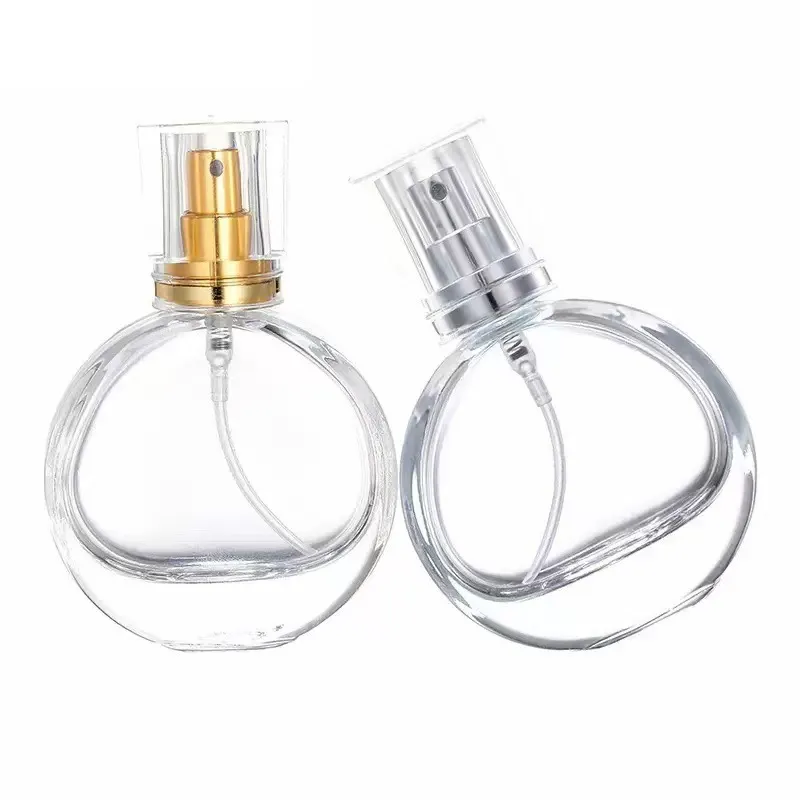
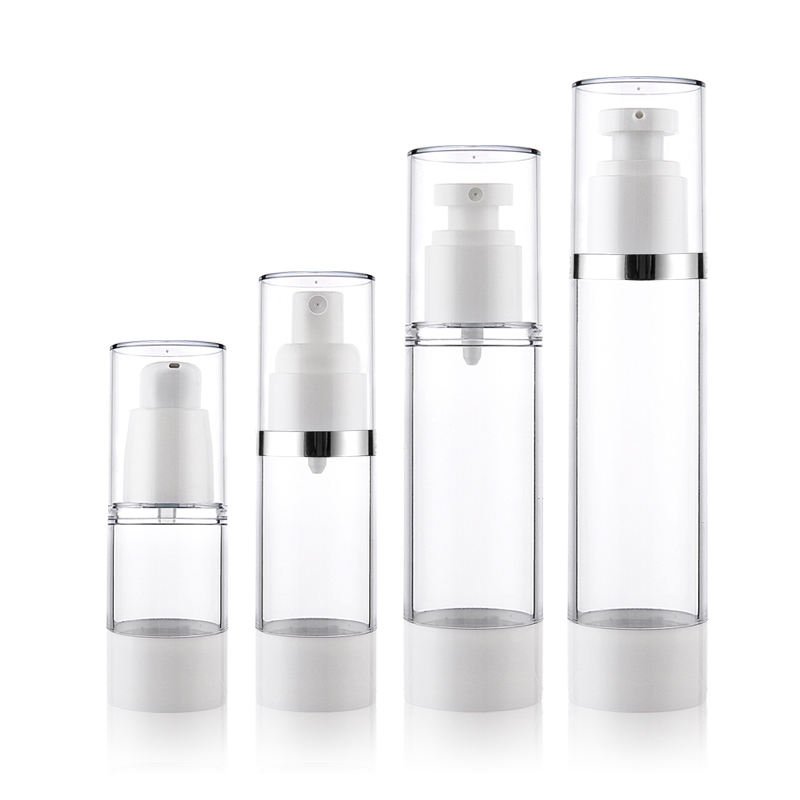
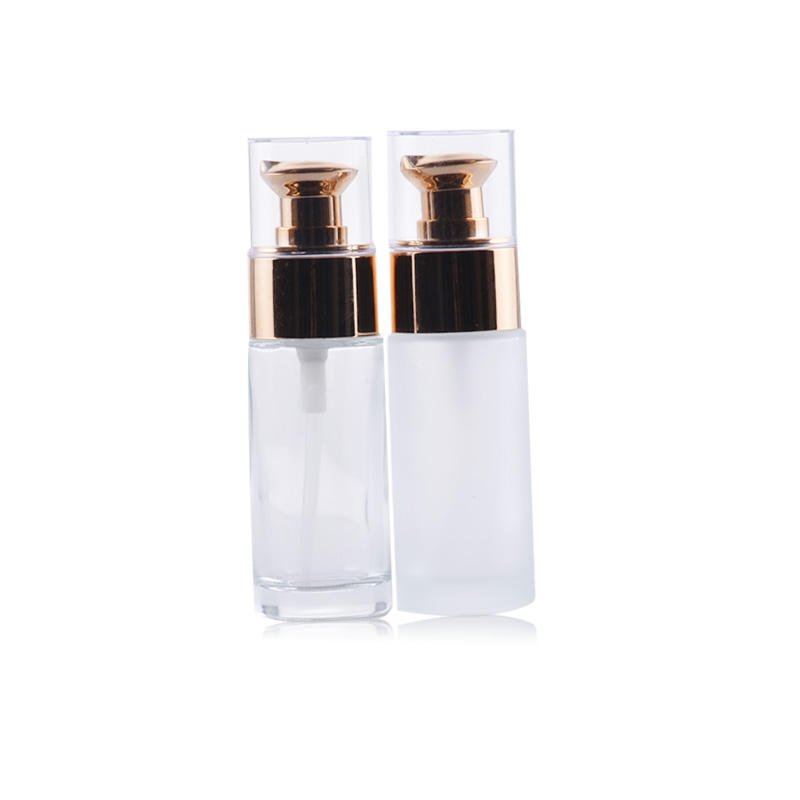
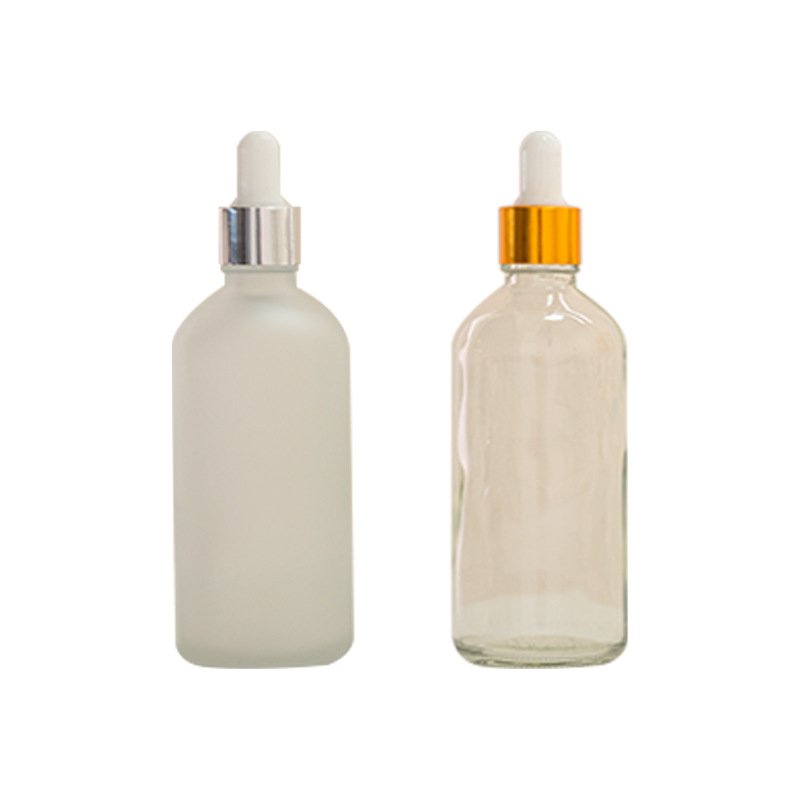
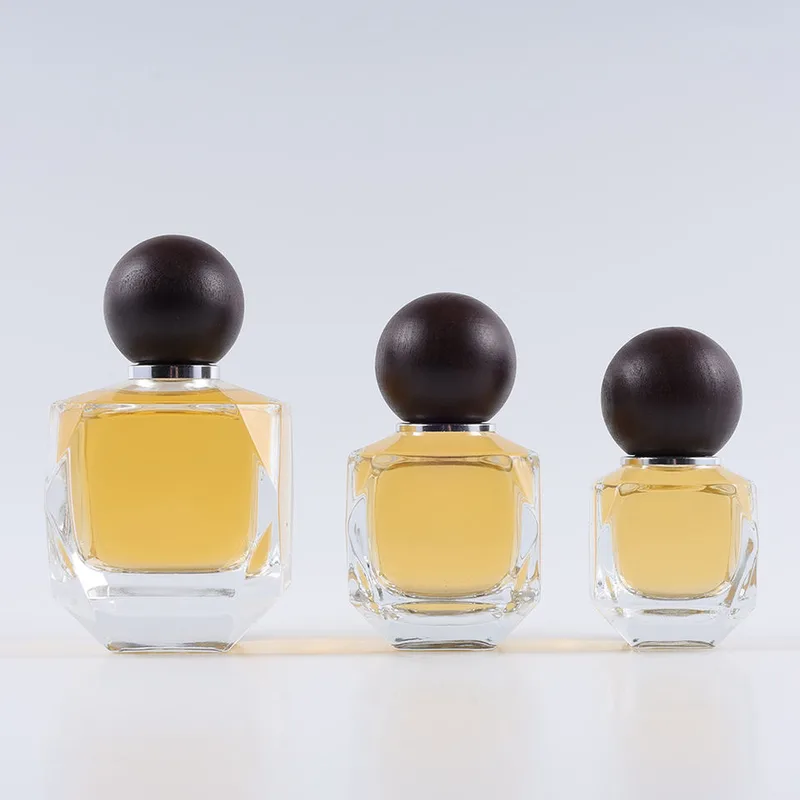
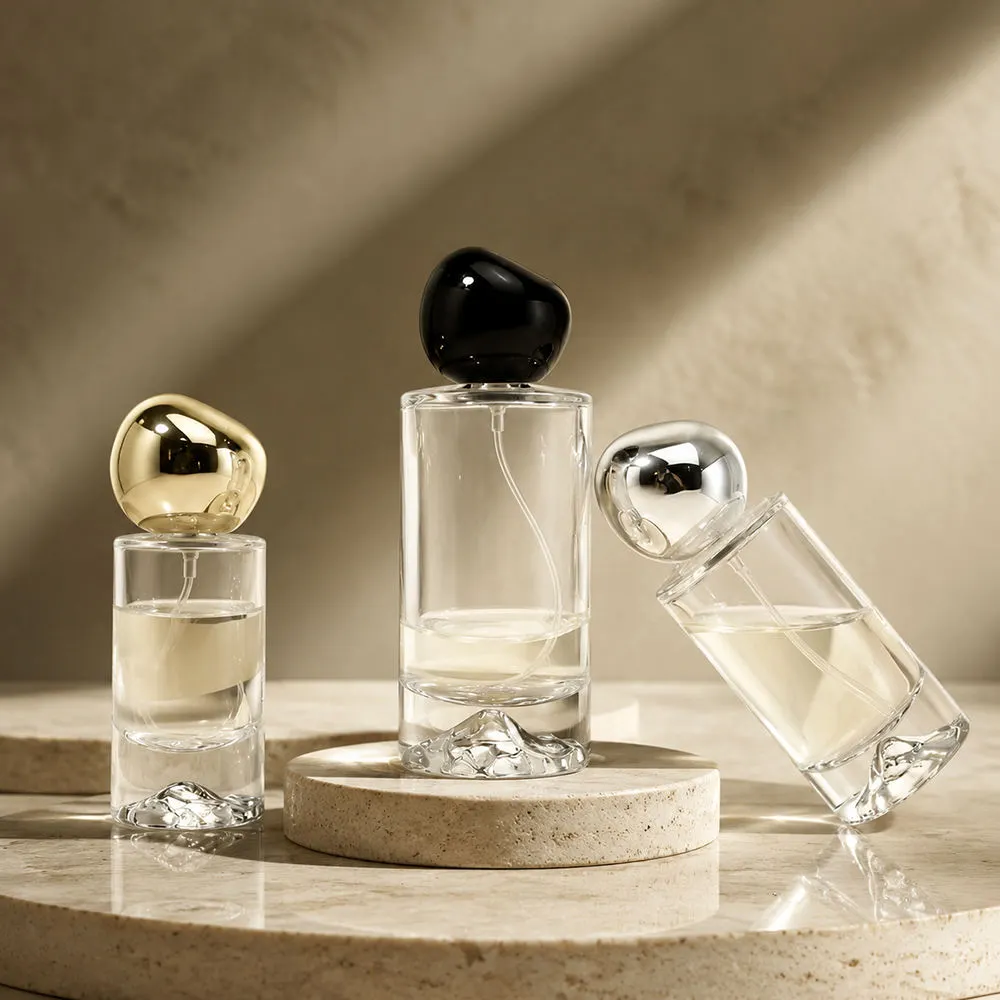
Direct answer: there is no universal exterior size for a 50ml perfume bottle. In a selected set of traceable 50ml manufacturer references, bottle-body height ranges from 54.6 to 108.4mm, width from 34 to 66mm, and depth from 23.6 to 56.8mm. A compact square body may be about 46 × 46 × 54.6mm, while a slim rectangular body may be about 40.3 × 25.8 × 108.4mm. The pump and cap can make the finished pack taller.
Treat these as real design examples, not an industry tolerance. “50ml” describes nominal liquid content—approximately 1.69 US fl oz—not height, width, glass weight or overall assembled size. Select one bottle model, then obtain its controlled drawing and production-intent sample.
This guide is written for fragrance brands, packaging designers, buyers and contract fillers. It separates nominal capacity, brimful capacity, internal cavity and external dimensions; compares square, round, oval and flat bottles; and shows how to estimate an early concept without pretending that a geometric calculation can replace a factory drawing.
What Are Common 50ml Perfume Bottle Dimensions?
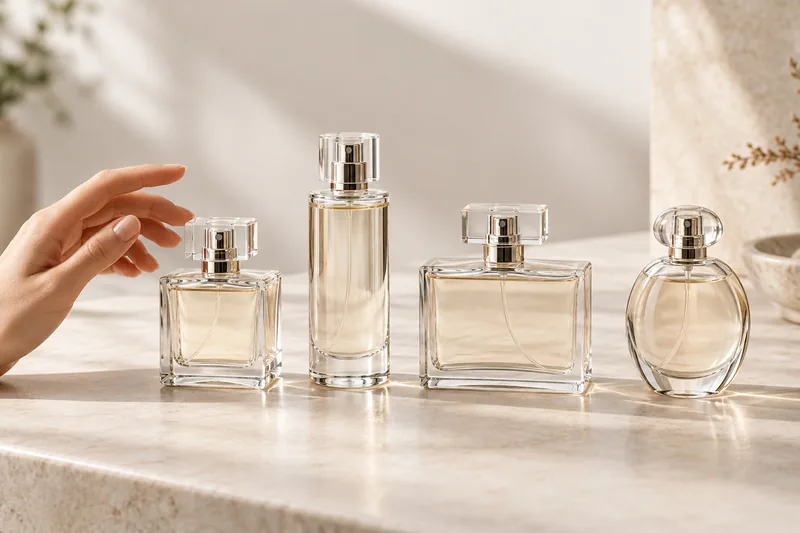
A useful starting envelope for many conventional 50ml glass perfume bottle bodies is roughly 35–60mm wide and 60–105mm high. That is a screening range, not a purchasing specification. Sculptural, very flat, spherical or cap-dominant packs can sit outside it, and “height” in a catalog may mean glass-body height rather than complete assembled height.
The table below uses published manufacturer data for named bottles. Dimensions are presented as height × width × depth. They show how much geometry changes while nominal capacity stays at 50ml. Where the source lists multiple neck versions, the shown row is the identified version; the cap and pump are not assumed to be included.
| Reference | Shape | Body dimensions, H × W × D | Brimful | Glass weight | What it demonstrates |
|---|---|---|---|---|---|
| Verescence Cubic | Square | 54.6 × 46 × 46mm | 55ml | 107g | Compact, nearly cubic body |
| Verescence Cara | Square/rectangular | 67.6 × 51 × 43mm | 57ml | 170g | Thicker, heavier premium envelope |
| Verescence Tube | Round | 104 × 34 × 34mm | 55.5ml | 72g | Very slender cylindrical profile |
| Verescence Ronda FH | Round | 87.5 × 39 × 39mm | 55ml | 100g | Conventional slim round body |
| Verescence Sphere | Round/spherical | 60 × 56.8 × 56.8mm | 56ml | 84g | Wide palm-filling silhouette |
| Verescence Comète | Rectangular | 108.4 × 40.3 × 25.8mm | 55ml | 78g | Tall, flat, space-efficient face |
| Verescence Lena | Rectangular | 77.6 × 60 × 25.5mm | 55ml | 110g | Wide front panel, shallow depth |
| Verescence Bowie | Oval | 74.4 × 58.9 × 45.5mm | 57ml | 178g | Substantial curved premium body |
| Verescence Ovale Bouillotte | Oval | 93.9 × 43.9 × 28.1mm | 53.5ml | 68g | Lightweight elongated oval |
| Continental Ovale | Oval | 75 × 48 × 41mm | Not stated on page | Not stated on page | A second supplier’s oval reference |
How Shape Changes the Dimensions and Proportions
Square 50ml perfume bottles
A compact square body commonly uses a width and depth in the mid-40mm range, with body height around 55–70mm in the cited examples. It presents a stable base and efficient front face, and its straight panels are useful for labels or centered print. The engineering risk sits at the corners: glass must distribute consistently without creating weak thin zones, heavy corner mass or visible optical distortion.
Round 50ml perfume bottles
“Round” covers very different proportions. A tall tube can be about 34mm in diameter and 104mm high, while a sphere-like body can be about 56.8mm in diameter and only 60mm high. A slender cylinder is easy to wrap with the fingers and creates a tall shelf silhouette, but its small base may need more filling-line control. A wide rounded bottle feels substantial in the palm and resists tipping, but consumes more carton width.
Oval 50ml perfume bottles
An oval section separates the front width from side depth. Published 50ml examples range from a flat 43.9 × 28.1mm plan at 93.9mm high to a much fuller 58.9 × 45.5mm plan at 74.4mm high. The flatter version fits narrow cartons and creates a broad display face; the fuller version emphasizes glass mass and grip. An oval normally needs orientation control for front decoration and cap alignment.
Flat rectangular 50ml perfume bottles
Rectangular bottles can be tall and narrow or low and wide. Comète’s body height-to-width ratio is about 2.69, while Lena’s is about 1.29. Both hold 50ml nominally, yet their shelf presence, label field, center of gravity and shipper layout differ. Broad flat faces reward precise printing and coating, because distortion, waviness and misalignment are easier to see.
How Big Is a 50ml Perfume Bottle in Your Hand?
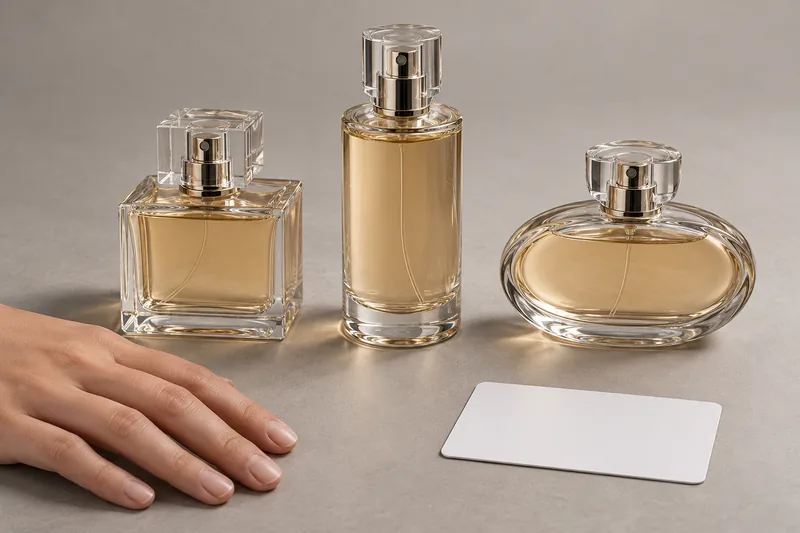
A standard ID-1 bank-card-sized reference is 85.60 × 53.98mm. Many 50ml perfume bottle bodies are near the card’s 86mm long dimension in height and near its 54mm short dimension in width. A 46mm square bottle is slightly narrower than that short edge; a 104–108mm tall bottle extends roughly 18–22mm beyond the card’s long edge before a cap is added.
| Body width or diameter | Likely hand impression | Design check |
|---|---|---|
| 34–40mm | Slim; most fingers can wrap around the body | Check tall-bottle stability and actuator reach |
| 41–52mm | Conventional compact full-size feel | Check corner comfort and cap opening force |
| 53–66mm | Palm-filling or display-led | Check one-handed spraying, smaller hands and carton width |
These are ergonomic prompts, not anthropometric pass/fail limits. Hand breadth, finger length, grip strength and mobility vary. Test the filled, capped pack with people from the intended market—including users with smaller hands—rather than approving grip from a rendering. For portability below the regular 50ml format, compare Boyu’s mini and travel perfume bottle formats.
What Determines a 50ml Bottle’s Height, Width and Depth?
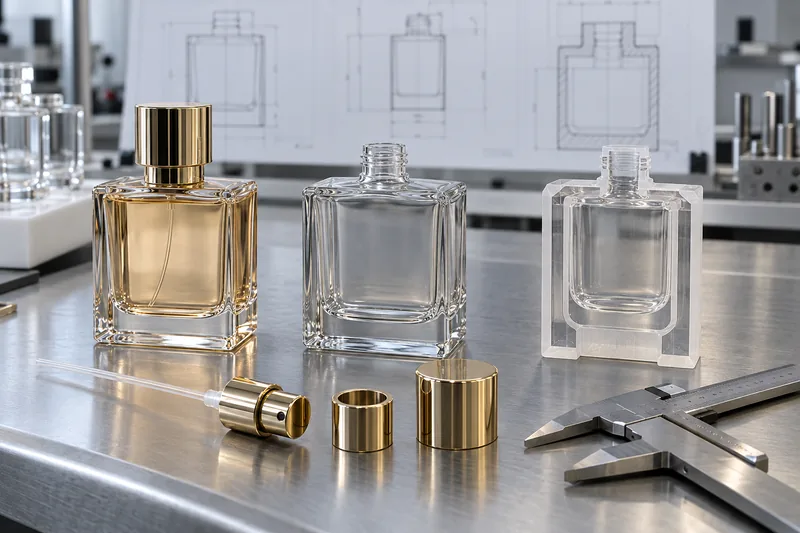
The exterior envelope is the result of several nested systems. Changing any one can move another dimension even when the label still says 50ml.
- Nominal fill and brimful capacity. Nominal content is the declared product amount. Brimful capacity is the cavity volume at a defined overflow point. In the selected manufacturer examples, 50ml bottles show published brimful values from 53.5 to 57ml, but that 3.5–7ml difference is not a universal headspace rule.
- Internal cavity geometry. A tall narrow cavity and a short wide cavity can hold the same liquid. Shoulders, heel radius and the space around the neck reduce the usable volume relative to a simple prism or cylinder.
- Glass distribution. Base thickness, wall distribution, corners, shoulders and decorative glass mass enlarge the outside without adding the same amount of liquid capacity. Bottle weight alone cannot prove local wall thickness.
- Neck finish and pump. The crimp or screw finish fixes critical interface geometry. Pump body intrusion and dip-tube placement affect fill level and usable product, while collar and cap determine assembled height and width.
- Decoration. Coating, frosting, labels, screen printing and sleeves need flatness, edge clearance, masking and fixtures. A bottle designed for broad front printing may be wider and shallower than one designed for direct cylindrical decoration.
- Equipment and logistics. Puck diameter, guide rails, star wheels, fill-nozzle clearance, capping head, carton insert, pallet pattern and e-commerce protection can all set a maximum or minimum envelope.
Boyu’s guide to nominal and brimful capacity explains why the model name, saleable fill and measured cavity must be documented separately.
How to Calculate an Early 50ml Bottle Size
One milliliter equals one cubic centimeter, so 50ml equals 50cm³ or 50,000mm³ of liquid. This allows a designer to estimate the straight internal cavity. It does not calculate the external bottle, because it omits glass, shoulders, neck, base, headspace and forming constraints.
Round internal cavity
Internal height = volume ÷ [π × (internal diameter ÷ 2)²]. If a straight cylindrical cavity has a 35mm internal diameter, a theoretical 50,000mm³ volume needs about 52mm of straight internal height. The production bottle must be wider and taller because the external diameter includes two walls and the height includes the base, shoulder and finish.
Square or rectangular internal cavity
Internal height = volume ÷ (internal width × internal depth). A theoretical 35 × 35mm straight square cavity needs about 40.8mm of internal height for 50ml. If the internal plan is 40 × 25mm, it needs 50mm. Real corners are radiused and shoulders narrow, so the simple result is an underestimate of the required cavity height.
Oval internal cavity
Internal height = 4 × volume ÷ (π × internal major diameter × internal minor diameter). A theoretical ellipse measuring 40 × 25mm internally needs about 63.7mm of straight height for 50ml. Again, shoulders and heel geometry reduce the real cavity relative to this ideal column.
Use the calculation to reject impossible sketches and compare footprints. Then replace every assumed dimension with the mold maker’s cavity model, capacity calculation, drawing and measured production sample. ISO 8106 provides a gravimetric method for determining glass-container capacity; it does not prescribe what a 50ml perfume bottle must look like.
How to Estimate Dimensions for 30ml, 50ml and 100ml Bottles
If every dimension of an ideal shape scales proportionally, linear size changes with the cube root of the volume ratio—not in direct proportion to milliliters:
New linear dimension = original dimension × (new volume ÷ original volume)1/3.
| Capacity change | Ideal linear scale factor | What it means |
|---|---|---|
| 30ml → 50ml | 1.186 | A perfectly scaled 50ml form is about 18.6% larger in each linear dimension |
| 50ml → 100ml | 1.260 | Double the capacity means about 26% larger per dimension, not twice as tall |
| 50ml → 10ml | 0.585 | A pure miniature would be about 58.5% of each dimension |
Real bottle families rarely scale perfectly. The neck finish, pump, cap clearance, minimum glass sections, decoration field and filling-line datum may stay constant while only the body changes. A 10ml miniature cannot always reproduce every fine corner of a 100ml bottle, and a 100ml version may need a wider base for stability. For capacity conversions and expected spray counts, use Boyu’s perfume bottle size chart.
What Kind of Perfume Is a 50ml Bottle Suitable For?
Fifty milliliters is a versatile retail format for eau de parfum, eau de toilette and many extrait-style products, but capacity does not determine chemical suitability. The fragrance concentration, alcohol level, colorants, essential oils and other formula constituents must work with every product-contact material in the pump, gasket, dip tube and bottle treatment.
- Mainline EDP or EDT: 50ml can function as the hero retail size, balancing perceived value with a package that is easier to finish than 100ml.
- Niche or high-price extrait: a compact heavy-glass 50ml pack can communicate material presence, but the weight, freight and impact trade-offs should be deliberate.
- Unisex or collection architecture: a common 50ml platform can carry different colors or decoration across a fragrance family, provided every decoration route is qualified.
- Travel-oriented product: 50ml is below the 100ml container threshold used by many airport-security regimes, but the full pack still has to fit the passenger’s liquid bag and withstand transport. Current local rules should be checked before travel.
A dark tint or opaque coating may support a light-sensitive concept, but appearance alone does not prove protection. Measure transmission if light protection is a product requirement. Run packaging compatibility testing on the final fragrance, pump, gasket, dip tube, decoration and assembly rather than approving glass in isolation.
Which 50ml Shapes Are Easier or Harder to Produce?
No shape is automatically “easy” in every factory. Difficulty depends on glass weight, local section changes, mold design, forming route, production speed, decoration and acceptance criteria. The comparison below identifies common engineering pressure points, not a universal cost ranking.
| Shape | Forming and annealing | Decoration and assembly | Typical failure to prevent |
|---|---|---|---|
| Round cylinder | Symmetric body supports even distribution, but a very tall slender form magnifies verticality and stability issues | Continuous wrap or rotary decoration is possible; front orientation may be unnecessary | Wobble, leaning neck, tipping on the line |
| Square | Corners and flat panels require controlled glass distribution and mold condition | Front face is easy to locate; keyed cap alignment may be visible | Thin corners, panel distortion, uneven base contact |
| Flat rectangle | Large aspect ratio and thin depth increase distribution and distortion sensitivity | Large graphic face; fixture and artwork datum must control rotation and height | Bowed face, off-center print, scuffing on broad panels |
| Oval or sculptural | Asymmetry and changing radii can create uneven distribution; heavy base changes cooling behavior | Requires front-back orientation for printing and cap alignment | Misaligned decoration, rocking base, inconsistent optical appearance |
The glass route includes batch preparation, melting, forming, annealing and inspection before decoration. A heavy base and thin shoulder do not cool at the same rate, so the validated annealing profile matters. Boyu’s glass perfume bottle manufacturing process covers those factory stages without implying one universal temperature or machine setting.
How Dimensions Affect Decoration, Filling and Packing
Decoration area is smaller than the visible face
A 60mm-wide front face does not provide a 60mm printable area. Edge radii, shoulders, heel curvature, mold seams, coating masks and fixture contact zones remove usable space. Approve artwork on the bottle supplier’s decoration drawing. For direct print, specify a vertical and rotational datum; for a label, specify the panel flatness, minimum edge clearance and acceptable skew.
The filling line sees the maximum external envelope
Guide rails and pucks handle width and depth. Fill nozzles, crimping or screw-pump heads, cap placers and inspection cameras handle height and centerline. A short wide bottle may fit the height window but exceed puck diameter; a tall 34mm cylinder may fit the puck but tip during transfer. Test the actual line with production-intent bottles and components.
The carton must be designed around the assembled pack
Carton dimensions should start from measured maximum assembled height, width and depth, not nominal capacity. Add controlled clearance for the insert, finish variation, decoration and packing method. Too little clearance causes abrasion or loading difficulty; too much permits impact and makes a premium pack feel loose. A wide oval may create unused corners in a rectangular shipper, while a flat rectangle can improve case count but expose broad faces to scuffing.
What Dimensions Should the Factory Drawing Control?
A buyer should not approve a bottle with one line reading “50ml, 90mm high.” The controlled drawing should distinguish datums and measurement conditions. At minimum, confirm:
- Nominal and brimful capacity: measurement point, test temperature or method reference, sample size and specification limits.
- Bare-bottle body envelope: maximum width/depth or diameter, glass height, base-contact diameter and relevant corner radii.
- Neck and sealing interface: full finish drawing, not only “15mm”; sealing land, bead/thread geometry and finish height.
- Assembled envelope: total height with pump, collar and cap; maximum cap diameter; cap-to-body alignment and clearance.
- Geometry controls: verticality, base stability, finish non-parallelism, critical panel flatness and any cavity-to-neck concentricity requirement.
- Decoration field: print or label area, masking, seam avoidance, artwork datum and approved color/finish sample.
- Weight and distribution: bottle-weight specification plus separate critical local checks when design risk requires them.
ISO 9008 provides a method for bottle verticality; ISO 9009 covers height and finish non-parallelism relative to the base. These standards provide methods, not universal perfume-bottle acceptance limits. The project drawing and quality agreement must state the limits suitable for the selected bottle, line and cap system.

How to Choose the Right 50ml Perfume Bottle Dimensions
- Set hard external limits first. Record shelf height, carton footprint, shipper pattern, filling-line range and cap height. These are constraints, not styling preferences.
- Define the user interaction. Decide whether the bottle must be one-hand friendly, purse portable, display-led, gift-led or intentionally weighty.
- Separate capacity values. State 50ml target/declared fill and request the model’s brimful specification and expected fill height.
- Select the complete assembly. Bottle, pump, gasket, dip tube, collar and cap must be reviewed together. Overall dimensions belong to the assembly.
- Choose an existing mold before a custom mold when appropriate. An existing reference lets the team measure real samples and reduces geometric uncertainty. A private mold is justified when ownership, proportion or function creates enough value.
- Run a line-and-pack trial. Use production-intent glass and final components. Check filling, pump application, cap placement, leakage, decoration, insert loading and transport protection.
- Freeze the approved evidence. Retain signed drawings, golden samples, artwork, color standards, component references and inspection plan for mass production and reorders.
For product exploration, begin with the perfume packaging collection. When the project is specifically a 50ml commercial launch, the wholesale 50ml perfume bottle options show how the bottle, pump, cap and decoration are scoped as one pack. Request the exact SKU drawing rather than quoting a dimension range from this guide.
Frequently Asked Questions
How many ounces is a 50ml perfume bottle?
Fifty milliliters equals about 1.6907 US fluid ounces and is normally labeled 1.7 fl oz. A fluid ounce measures volume; it is not a weight ounce.
What is the average height of a 50ml perfume bottle?
There is no defensible universal average without defining a product dataset and whether the cap is included. In the selected manufacturer set used here, glass-body height spans 54.6–108.4mm. A conventional reference may sit around 75–100mm before the cap, but the exact model drawing is the only safe value for carton or line design.
Do published dimensions include the cap?
Often they do not. Many glass catalogs list bare-bottle dimensions. Ask for both glass height and total assembled height, plus maximum width/depth with the selected cap. Never infer cap height from a product photo.
Does a heavier 50ml bottle have thicker walls?
It contains more glass overall, but that does not prove uniform or adequate local wall thickness. Extra mass may be concentrated in the base, corners or shoulders. Approve weight and any critical local distribution criteria separately.
Is a 50ml perfume bottle travel size?
It is below the common 100ml container limit used at many airports, but it is a regular retail bottle rather than a small pocket atomizer. The current departure and transfer airport rules, liquid-bag fit and breakage protection still need checking.
Which 50ml bottle shape is best?
There is no best shape independent of the brief. Round cylinders suit simple grip and rotary decoration; square bodies provide stability and graphic faces; flat rectangles support shelf efficiency; ovals offer softer ergonomics. Choose against the user, line, decoration, carton, transport and brand requirements.
Sources and Technical References
- ISO 8106:2004 — Glass containers: determination of capacity by gravimetric method
- ISO 9008:1991 — Glass bottles: verticality test method
- ISO 9009:1991 — Height and finish non-parallelism test methods
- Verescence — Cubic 50ml specifications
- Verescence — Cara 50ml specifications
- Verescence — Tube 50ml specifications
- Verescence — Ronda FH 50ml specifications
- Verescence — Sphere 50ml specifications
- Verescence — Comète 50ml specifications
- Verescence — Bowie 50ml specifications
- Verescence — Ovale Bouillotte 50ml specifications
- Continental Bottle — Ovale 50ml specifications
- European Commission — Regulation (EC) No 1223/2009, Article 19 nominal-content labeling
- GOV.UK — Current hand-luggage liquid restrictions
- Entrust — ISO ID-1 card dimensions used for the familiar size comparison
Editorial note: supplier dimensions are model-specific and may exclude the closure. Standards cited here provide measurement methods or labeling requirements, not a universal 50ml perfume-bottle geometry. Final dimensions, weight, tolerances, capacity, components and decoration must be approved on the selected drawing and production-intent sample.

 English
 Español de Argentina
 Русский
 Italiano
 日本語
 한국어
 العربية
 Français
 Deutsch