
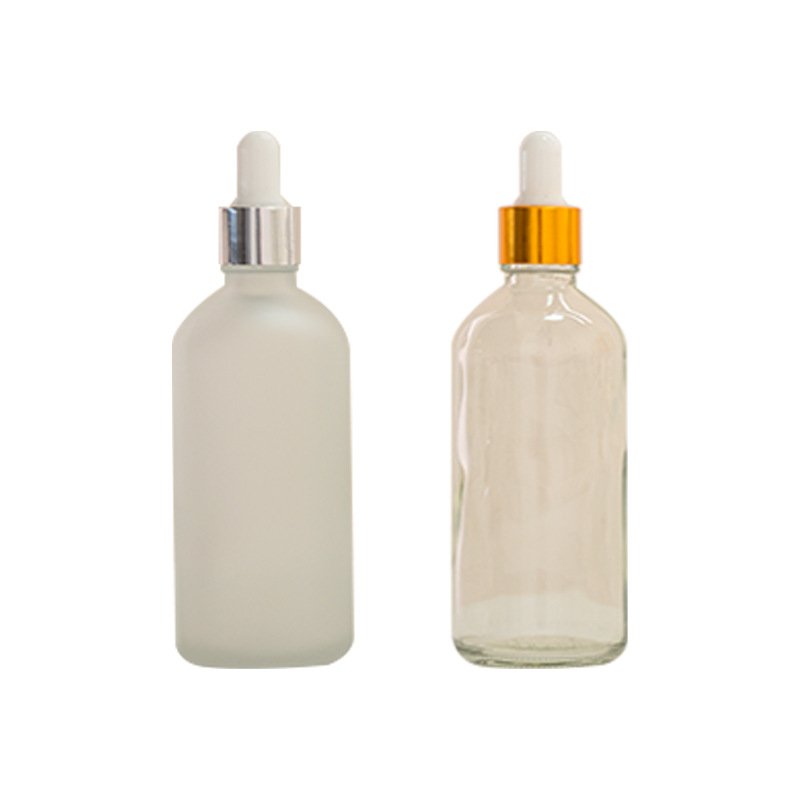
Direct answer: an ordinary cosmetic bulb dropper does not meter a fixed volume. Its output changes with how far the bulb is compressed, how quickly it is released, immersion depth, dwell time, dispensing angle, air bubbles, fill level, tip geometry, seal integrity, formula density, surface tension, viscosity, temperature and component aging.
There is no universal cosmetic rule that every dropper must deliver “20 drops per millilitre” or remain within one standard percentage. First define what a dose means—one drop, one standardized squeeze, a full pipette draw or a graduation mark. Then test the complete production package with the actual formula. Measure by mass, convert with the formula density at the test temperature, and evaluate accuracy, repeatability and individual-dose limits separately.
This guide is for cosmetic brands, packaging engineers, contract fillers, quality teams and buyers. Pharmaceutical drip tests and eye-drop studies are included only as technical references. Their limits are not automatically cosmetic-packaging specifications.

Before testing, define what “dropper output” means
A frequent specification failure is writing “dropper output: 0.5 mL” without defining the operation. A user can compress half a bulb, a full bulb or several times while the tip remains in the liquid. A pipette may pick up 0.5 mL but retain product on its inner wall or tip, so the amount delivered is smaller. Four different metrics answer four different questions:
| Metric | Controlled action | Business question |
|---|---|---|
| Single-drop mass or volume | Form and detach one drop at a stated angle and rate | How variable is each counted drop? |
| Full-draw pickup | Fully compress once, immerse, release and dwell | How much enters the pipette? |
| Delivered full-draw dose | Expel the standardized pickup into a tared vessel | How much reaches the user? |
| Graduation accuracy | Draw to a marked line and deliver as instructed | Does a 0.25, 0.5 or 1.0 mL mark represent that volume? |
These metrics are not interchangeable. For a premium facial oil, controlled single drops may matter most. For a serum whose directions say “one full dropper,” delivered full-draw dose is more relevant. A graduated pipette makes a stronger quantitative claim and therefore needs a separate calibration method. Record after-drip, exterior wetting, retained product and first-dose behavior as secondary outputs.
Why the same dropper gives a different dose each time
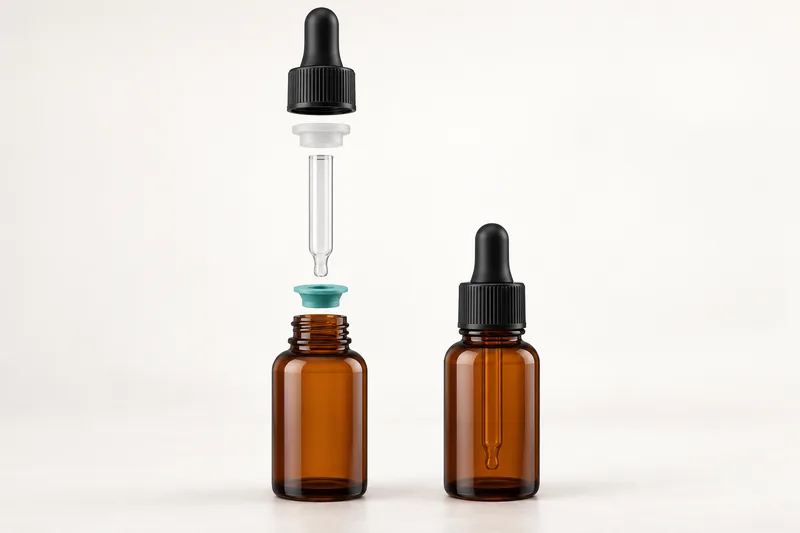
A bulb dropper is a pressure-and-flow device, not a positive-displacement syringe. Compressing the bulb expels air. Releasing it creates a pressure difference that draws product into the pipette. During dispensing, a drop grows at the tip until its weight and motion overcome the surface-tension and wetting forces holding it there. Small changes in pressure, liquid properties and tip condition therefore change the result.
1. Bulb displacement and recovery
The amount of air displaced depends on bulb geometry, wall thickness, elastomer hardness, compression depth and where the user presses. A partially compressed bulb cannot create the same pickup as a fully compressed one. Slow recovery, compression set, swelling or hardening after formula exposure changes suction during product life.
2. Pipette and tip geometry
Pipette internal diameter, length, taper, tip-orifice size, lip roundness, concentricity and surface finish affect flow and drop detachment. A chipped, rough, flattened or off-centre glass tip can create alternating large and small drops. Pipette length also determines bottom clearance: too short reduces low-fill pickup; too long can touch the base and restrict the inlet.
3. Formula properties
Density determines the mass of a given volume. Surface tension and contact angle determine how the formula wets and releases from the tip. Viscosity influences filling and drainage speed, while yield stress and thixotropy can make two formulas with the same single-point viscosity behave differently. Particles can partly obstruct the tip; surfactants can change wetting; volatile solvents can evaporate during measurement; entrained air and foam reduce a nominally liquid draw.
4. Technique and package state
Pre-squeezing before immersion, release time, dwell time, immersion depth, withdrawal speed, wiping and dispense angle all matter. Research on ophthalmic droppers found tip design, angle, dispensing rate and tip wetting to be important sources of variation. Those devices serve a different market, but the physical lesson is relevant: the method must control orientation and handling.
Fill level matters because the user immerses the tip less consistently near the end of the bottle, and a short pipette may no longer remain submerged. Temperature changes both formula rheology and bulb response. Storage, repeated opening and formula contact can change the elastomer, seal and liquid itself.
Is there a standard tolerance for cosmetic droppers?
Not one universal tolerance. An ordinary cosmetic dropper has no globally applicable rule saying its dose must be within ±5%, ±10% or ±15%. The defensible limit depends on the dose claim, formula, package design, consumer risk, test method and measurement uncertainty. A facial oil sold with the instruction “apply a few drops” does not need the same accuracy as a product claiming a calibrated 0.50 mL dose.
| Reference | What it says | How to use it responsibly |
|---|---|---|
| Brazilian Pharmacopoeia drip test | The accessible English 6th-edition method describes temperature, angle, drop count, calculation and staged acceptance for pharmaceutical products with integrated droppers. Initial criteria include 85–115% of declared drug per drop and RSD no more than 6.0%; expanded testing has additional rules. | Use as an example of a complete pharmaceutical method—not as an automatic cosmetic specification. Confirm the current official edition and jurisdiction before regulated use. |
| Older USP medicine-dropper text | Older public wording described water-drop mass and a calibrated-dropper volume error of no more than 15% under stated use. | Historical context only. It is not proof that ±15% is the current universal limit for cosmetics, every formula or every dropper. |
| Brand–supplier specification | Target dose, individual limit, mean bias, RSD, conditions, lifecycle and sample plan agreed for the exact system. | This is the normal practical route for cosmetic packaging. Make it risk-based, measurable and tied to approved samples and drawings. |
The current Brazilian Pharmacopoeia portal identifies the 8th edition as the edition in force in 2026, while the official English material publicly accessible from the portal is an older edition. That is another reason to identify the edition and intended application instead of quoting a number without context.
A repeatable dropper dosage-consistency test
Use the finished production assembly—bottle, bulb, collar, gasket, pipette, reducer or wiper—and the actual formula. Water is useful for an early leak or geometry screen, but it cannot qualify a serum whose density, viscosity and wetting differ.
- Write the claim and metric. State whether the test concerns one drop, one standardized full draw, delivered dose or a marked volume. Define whether the first dose, steady-state doses and end-of-life doses are evaluated separately.
- Identify the test article. Record every component part number, drawing revision, material, color, supplier, mold cavity where available, assembly lot, formula batch, fill mass and filling date.
- Condition the units. State storage orientation, time and temperature. Measure formula density at the test temperature. Add cold, warm and aged conditions if they represent transport or consumer use.
- Select representative samples. Cover relevant cavities, bulb and pipette lots, assembly positions and more than one finished unit. Set sample size from risk and the decision the study must support; a single “golden” sample cannot establish capability.
- Prepare the measuring system. Use a calibrated balance and tared receiving vessel. For small individual drops, choose resolution that makes instrument rounding minor relative to the drop. A 30–100 mg drop measured only to 0.001 g has a 1 mg display increment; 0.0001 g may be more suitable when individual-drop variation matters.
- Define preconditioning. State whether the tip is dry, pre-wetted or cycled before recording. Pre-wetting can materially change surface behavior, so do not mix dry first drops with steady-state drops unless the test deliberately evaluates both.
- Standardize pickup. Compress the bulb fully before immersion, immerse the tip to a fixed depth, release over a defined time, hold for a defined dwell, withdraw vertically and specify whether exterior liquid is touched off or left in place. Never squeeze after the tip enters the formula unless that is the intended user instruction.
- Standardize dispensing. Hold vertical or at the labeled angle, apply one complete controlled compression and allow a full return. For individual drops, define the formation rate and interval. Avoid tip contact with the receiving vessel.
- Measure across use life. Test high, middle and low fill levels. Include multiple draws per unit, multiple operators for consumer-use validation, and aged units from the compatibility program.
- Control evaporation. For alcohol-rich or other volatile formulas, minimize the time between dispensing and weighing, use a covered receiving vessel where possible, and run a blank evaporation control.
- Report raw and summary data. Retain each dose result, unit identity, sequence, fill level, operator and condition. Calculate mean, standard deviation, RSD, bias, minimum, maximum and individual deviations.
- Verify the method. Run repeatability and, where decisions are costly, a measurement-system analysis or Gage R&R. The test must be more precise than the tolerance it is asked to judge.
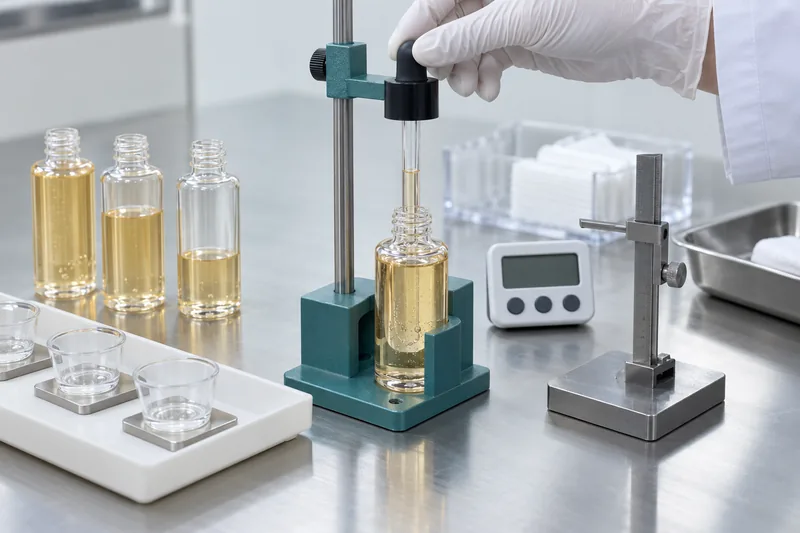
A rigid fixture isolates package variation by controlling compression and timing. A user panel captures real-world technique. They answer different questions, so strong qualification often uses both: fixture data for engineering control and human-use data to confirm that instructions and ergonomics produce an acceptable consumer outcome.
If the balance cannot resolve single drops reliably, collect 10 or 20 drops and divide the total mass by the count to estimate the average. However, pooling hides alternating large and small drops. Use individual-drop measurements or high-resolution imaging when within-sequence variability is important.
Calculations: mass, volume, accuracy and repeatability
Delivered volume (mL) = delivered mass (g) ÷ density (g/mL)
Mean bias (%) = (measured mean − target) ÷ target × 100
Relative standard deviation, RSD (%) = standard deviation ÷ mean × 100
Individual deviation (%) = (individual dose − target) ÷ target × 100
Illustrative example: a project defines one standardized squeeze as 0.50 mL. The serum density at the test temperature is 1.04 g/mL, so the target mass is 0.520 g. Ten valid measurements produce a mean of 0.510 g and a standard deviation of 0.020 g.
- Measured mean volume = 0.510 ÷ 1.04 = 0.490 mL.
- Mean bias = (0.490 − 0.500) ÷ 0.500 × 100 = −1.9%.
- RSD = 0.020 ÷ 0.510 × 100 = 3.9%.
The mean is close to target and repeatability may be reasonable, but the lot cannot be accepted until every individual dose is compared with the agreed limit and the sample plan is satisfied. Conversely, a low RSD can describe a very repeatable but consistently underfilled dose. Accuracy and repeatability must both pass.
How to set a defensible acceptance criterion
Begin with the product claim and risk, not a convenient supplier number. If dose affects only sensory preference, a broader range may be acceptable. If too much product increases irritation, if active exposure matters, or if labeled directions state an exact volume, the brand needs tighter control or a different dispenser.
A complete specification should define all of the following:
- metric and target: drop mass, full-draw delivered mass/volume or graduation volume;
- test formula, density, conditioning temperature and age;
- complete pickup and dispense technique;
- high-, middle- and low-fill test points;
- mean accuracy or bias limit;
- repeatability limit, usually expressed as SD or RSD;
- individual-dose limits and treatment of outliers;
- unit-to-unit, lot-to-lot and lifecycle requirements;
- sample size, acceptance number, retest rule and failure disposition;
- balance resolution, density method and allowed measurement uncertainty.
Set provisional limits from engineering and consumer-use studies, then confirm that production can meet them with adequate process capability. Do not tighten a requirement beyond what the measurement system can distinguish, and do not widen a failed limit after seeing the result. For a broader qualification sequence, combine this dose study with Boyu’s guide to tests required for cosmetic bottles.
Common inconsistency patterns and corrective actions
| Observed pattern | Likely causes | Checks and corrective actions |
|---|---|---|
| Partial or empty pickup | Air leak, partial squeeze, insufficient dwell, viscous formula, shallow immersion, restricted tip | Check seal path and torque, standardize full pre-squeeze, extend validated dwell, inspect bore, reconsider bulb displacement or tip flow area. |
| Alternating large and small drops | Air bubble, fast or angled dispensing, tip wetting, eccentric or damaged tip | Debubble the system, control angle/rate, compare dry and pre-wet states, gauge and visually inspect tip geometry. |
| Stringing instead of clean drops | High viscosity or yield stress, small orifice, strong surface wetting | Characterize rheology at use temperature, test a revised tip, larger flow path or a different dispensing format. |
| After-drip or liquid on the outside | Exterior film, poor wiper fit, capillary hold-up, delayed bulb recovery, user releases pressure at the wrong time | Evaluate wiper/reducer and tip finish, specify withdrawal technique, match bulb recovery, add consumer-use testing. |
| Good when new, poor after aging | Bulb swelling/hardening, seal change, solvent loss, formula thickening, surface interaction | Repeat dose and leak tests after compatibility aging; compare dimensions, hardness, mass and rheology with time-zero controls. |
| Large unit-to-unit spread | Bulb wall or hardness variation, pipette bore/tip variation, inconsistent assembly, multiple uncontrolled cavities | Stratify results by component lot/cavity, tighten CTQs, improve incoming inspection and assembly process control. |
| Variation only near empty | Tip no longer submerged, inadequate pipette length, excessive bottom clearance, bottle held at varying angle | Verify fill-level geometry, specify pickup orientation and revise pipette length while preventing base blockage. |
| Fixture passes, consumers fail | Bulb too stiff, ambiguous instructions, difficult grip, unrealistic fixture timing | Run representative human-factors trials, revise instructions/ergonomics or choose a true metering device. |
Air leakage can look like a formula-flow problem because the bulb draws air through the collar or gasket instead of pulling liquid up the pipette. Use a targeted seal investigation and the principles in Boyu’s cosmetic bottle leak-testing guide before enlarging the tip or changing the formula.
How a factory prevents inconsistent dropper output
Reliable dosage is created upstream. Finished-product sampling alone cannot compensate for uncontrolled components. The supplier and brand should agree which dimensions and material properties are critical to quality.
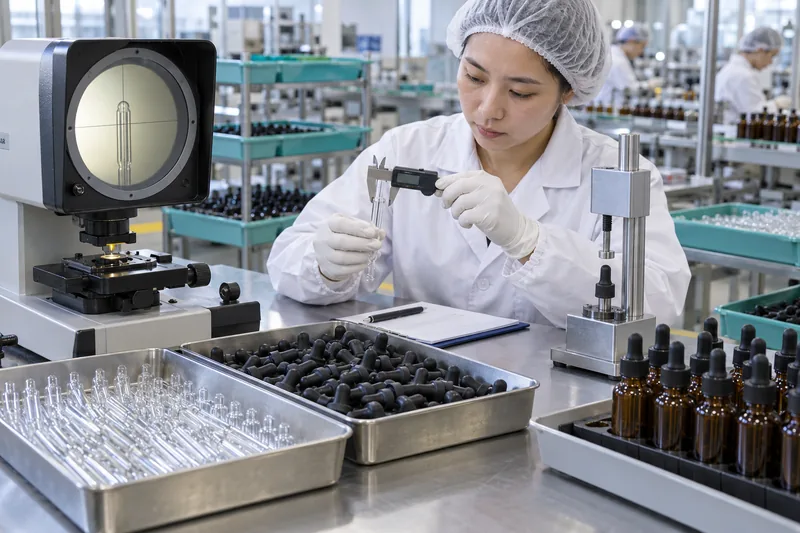
Control the drawing and approved construction
Define pipette length, internal and external diameter, tip-orifice geometry, tip finish, straightness, bottom clearance and any graduation position. For the bulb, define material, dimensions, wall or weight controls, hardness and functional displacement where appropriate. Define collar, gasket, neck and wiper interfaces, assembly torque or position and leak requirement. Keep approved limit samples for appearance and functional comparison.
Inspect parts and monitor the process
Incoming inspection should verify critical dimensions, bulb condition and pipette-tip quality by component lot. In-process checks should cover assembly seating, seal integrity and obvious damage. Use statistical process control for measurable characteristics that drive output; stratify problems by mold cavity, glass-forming line, tool, shift and supplier lot rather than treating the entire batch as identical.
Function-test without contaminating saleable units
A factory cannot dose-test every cosmetic dropper with the market formula and still sell it as untouched packaging. Control component and assembly CTQs, then perform destructive functional sampling on representative finished units. Use a reference liquid only for routine process trending when its correlation to the real formula has been established; final qualification and change approval should use the actual product.
Age the complete system
Run dose, leak, appearance and usability checks before and after formula-contact aging. Boyu’s cosmetic packaging compatibility test guide explains why time-zero performance is not enough. If a bulb, gasket, resin, pipette plant or assembly site changes, apply formal change control and second-source qualification rather than assuming the same nominal dimensions guarantee the same dose.
What to do when a lot fails
- Quarantine affected packaging and finished goods. Preserve unopened samples and trace component, assembly, formula and filling lots.
- Verify the test before blaming the product. Confirm balance status, tare, density, temperature, operator sequence, timing and calculations. Repeat with retained known-good controls.
- Classify the failure. Separate mean bias, within-unit repeatability, unit-to-unit variation, fill-level dependence, user dependence and aging-related drift.
- Inspect the physical evidence. Look for bubbles, clogged bores, damaged or eccentric tips, exterior wetting, incomplete bulb recovery, seal leakage and pipette-length variation.
- Stratify the data. Compare supplier lot, cavity, line, shift, formula batch and assembly condition. A mixed histogram often points to two populations rather than random noise.
- Change one factor deliberately. Compare a known-good bulb, pipette, seal or formula condition. For interacting factors, use a designed experiment instead of repeated guesswork.
- Implement CAPA and revalidate. Correct the root cause, update drawings/SOPs/control plans, repeat the defined qualification and document disposition. Do not retroactively widen the limit simply to release the lot.
When a dropper is the wrong dispenser
Droppers are excellent when the intended instruction is approximate—such as “apply 2–3 drops”—and when the formula flows and detaches cleanly. They provide visual product cues and controlled small application. Start with a qualified cosmetic dropper bottle range and confirm the exact assembly with the formula. A specific format such as a 10–50 mL glass dropper bottle is a candidate—not proof of compatibility or dose accuracy.
Choose another format when the formula strings, contains particles, is too viscous for reliable pickup, reacts with the bulb or requires an exact dose with minimal user influence. A calibrated oral syringe, unit-dose ampoule or validated positive-displacement system may be appropriate in specialized applications. For mainstream serum packaging, compare serum bottle and dispenser options. If fixed output per actuation is the priority, review how to choose pump output for lotion and serum.
Dropper RFQ and quality-agreement checklist
Give potential suppliers enough information to recommend and validate the system:
- formula type, ingredient concerns, density, viscosity/rheology range, surface-tension concerns, particles, alcohol/solvent content and temperature range;
- intended dose instruction and whether it refers to drops, a full draw or a marked line;
- bottle fill volume, brimful capacity, neck finish, package orientation and required low-fill performance;
- bulb, pipette, gasket/wiper and closure materials, colors and decoration;
- target delivered mass or volume, bias, RSD, individual limits and sample plan;
- pickup and dispense method, conditioning, aging intervals and acceptance/retest rules;
- critical dimensions, inspection method, lot traceability, approved samples and change-notification period;
- filling-line, transport, leakage, drop/impact and compatibility requirements;
- requested reports, certificates, retained samples, CAPA response and second-source controls.
Qualify the dropper as a formula–package system
Send Boyu Packaging the formula profile, density/viscosity range, intended dose, fill volume, bottle style, target market and test conditions. We can discuss candidate components and samples for your own compatibility, leakage, dosing and line trials.
Frequently asked questions
How many millilitres does one cosmetic drop contain?
There is no universal value. Tip geometry, formula surface tension, density, viscosity, wetting, angle and drop-formation rate change the result. Measure the actual package and formula under the labeled technique.
Is ±15% an accepted dropper tolerance?
Not as a universal cosmetic rule. An older medicine-dropper text used a 15% volume-error context for calibrated droppers, but it should not be copied automatically into a current cosmetic specification. Set and validate a project-specific limit.
Should I test a dropper with water?
Water can screen obvious dimensional or leak differences, but it cannot qualify another formula unless correlation has been demonstrated. Final decisions should use the actual formula because density, rheology and wetting control pickup and release.
Why does the pipette never fill completely?
A bulb displaces a finite air volume, and the system contains compressible air and flow resistance. Partial compression, seal leakage, insufficient dwell or a viscous formula reduces pickup. A visibly full pipette should not be promised unless the design and method consistently achieve it.
Does a graduated pipette guarantee accurate dosing?
No. The mark must be calibrated for the defined pickup, reading and delivery technique, and retained liquid still matters. Verify graduation position and delivered volume with the actual formula and instructions.
How can a consumer get more consistent doses?
Use the same technique each time: fully squeeze before immersion, keep the tip submerged, release completely, wait the labeled dwell time, withdraw vertically and dispense at the stated angle without touching the tip. If exact volume is important, the brand should provide a validated metering system rather than depend on technique alone.
Sources
Technical references were checked for this article. External links are provided for verification; pharmaceutical and ophthalmic references explain methods or mechanisms and are not presented as universal cosmetic requirements.
- ANVISA — Brazilian Pharmacopoeia portal and current-edition information
- ANVISA — Brazilian Pharmacopoeia, 6th-edition English volume, section 5.1.8 Drip Test
- Sklubalová & Zatloukal — factors affecting drop size and dosing variability
- Mass variability in drops of multidose eyedrops
- Influence of container structures and content solutions on dispensing
- Public archive — older USP <1101> Medicine Dropper text (historical context)


 English
  Español de Argentina
  Русский
  Italiano
  日本語
日本語  한국어
한국어  العربية
  Français
  Deutsch