
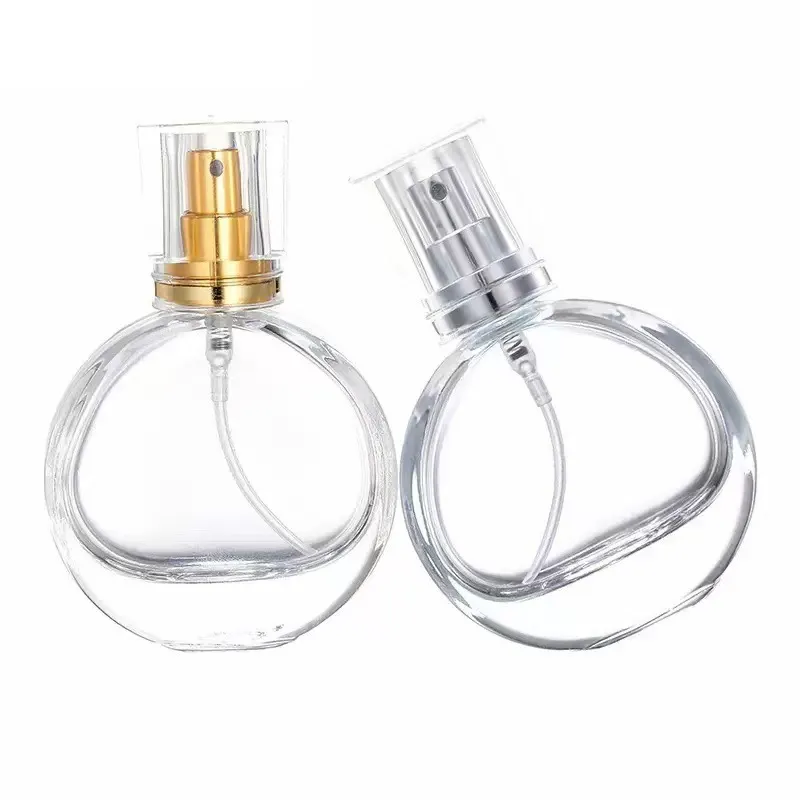
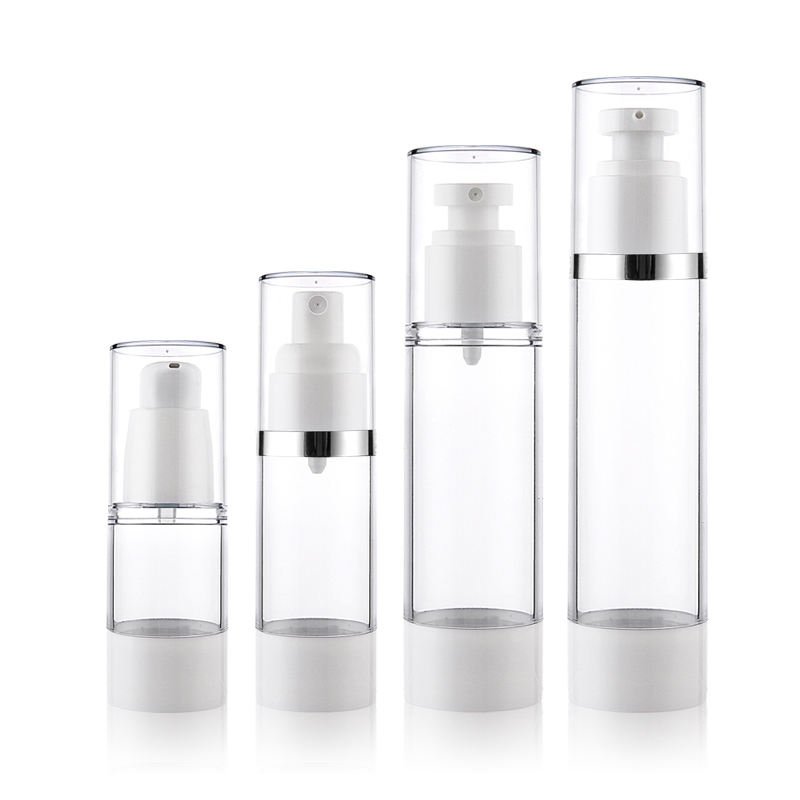

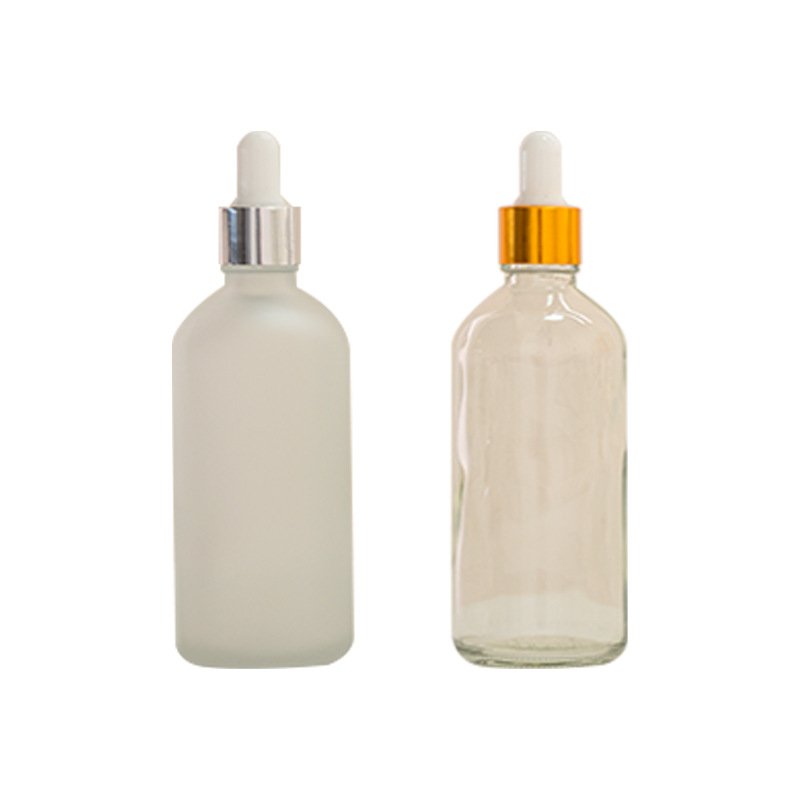
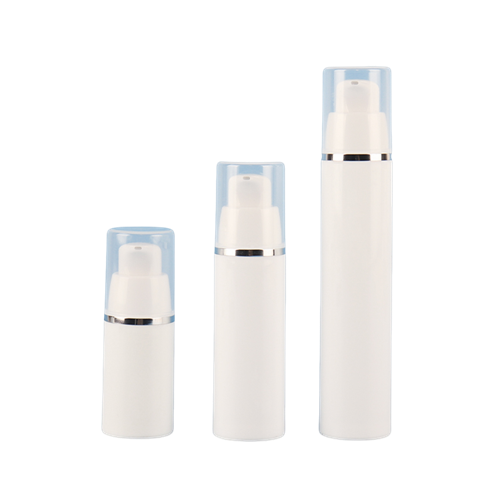
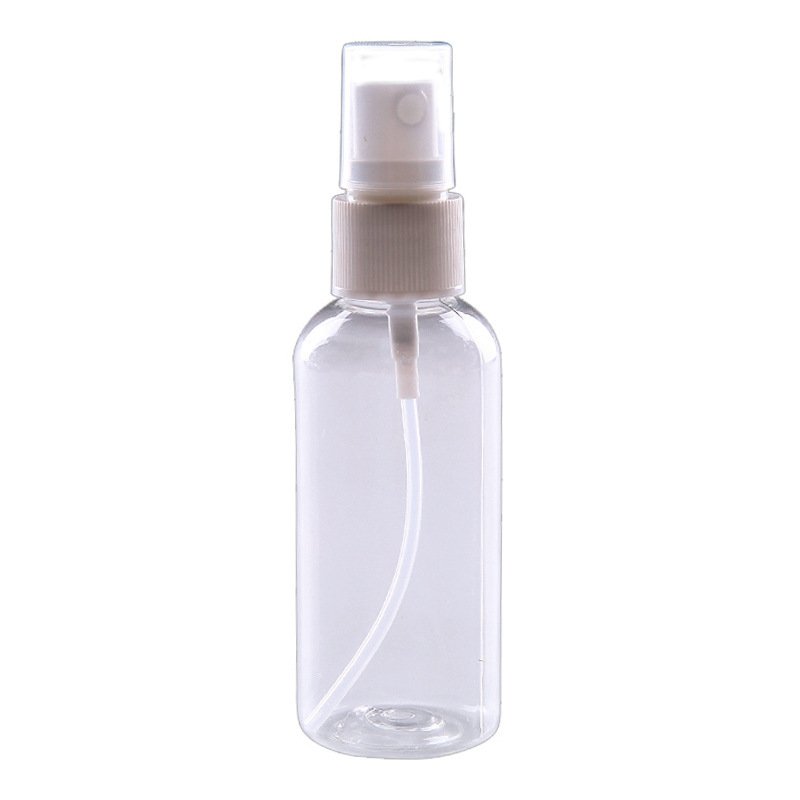







Direct answer: avoid the “bottles are here, pumps are late” problem by planning the package as a bill of materials, not as independent purchase-order lines. Give every bottle, pump, cap, gasket, label and carton its own approved specification, demand rate, usable inventory balance, open-order quantity and realistic replenishment lead time. Release each purchase order on its own calculated date, then promise filling only against the number of complete, quality-released kits.
The key controls are: component reorder point = expected demand during replenishment lead time + component-specific safety stock; inventory position = usable on-hand + reliable scheduled receipts − allocated demand; and kit-ready date = the latest usable date among all required components, plus receiving, inspection and staging time. Ordering every part on the same day is not synchronization when the pump takes eight weeks and the bottle takes five.
This guide is for beauty-brand procurement teams, packaging engineers, contract fillers, operations planners and importers. The formulas are planning tools, not universal stock targets. Use actual demand, receipt and quality-release data for each SKU and location.

Why do bottles arrive while pumps are still missing?
A pump bottle looks like one commercial product, but it is a small assembly. The bottle may be blow-moulded by one plant, the pump engine injection-moulded and assembled by another, the collar electroplated by a specialist, the dip tube cut after the approved bottle height is known, and the printed carton made by a converter. Each route has different raw materials, tooling, batch sizes, approval dependencies, quality risks and transport lanes.
That makes cosmetic packaging an assemble-to-order planning problem. Operations research describes these systems as multiple components procured before final demand is fully known and later allocated into finished products. SAP’s assemble-to-order guidance states the practical consequence clearly: the quantity that can be committed is limited by the component with the smallest available quantity, and the delivery date is governed by the component available last.
The shortage is rarely caused by “bad luck” alone. It usually comes from one or more planning errors:
- One finished-pack SKU, no controlled component BOM: the buyer tracks 30,000 sets but cannot see that only 21,600 accepted pumps are available.
- Same PO date for every component: a 55-day pump and a 30-day bottle are launched together even though their required arrival date is identical.
- Catalogue lead time used as a promise: artwork approval, resin procurement, color matching, plating, dip-tube cutting, inspection and export booking are omitted.
- Physical stock treated as usable stock: quarantined, rejected, allocated or obsolete-revision components are counted as available.
- Purchase orders tracked, dependencies ignored: “in production” hides whether tooling, molded color, pump assembly or decoration has actually started.
- No connection to the filler: packaging delivery is planned to a warehouse date, while incoming inspection and line staging are forgotten.
Plan complete packaging kits, not independent piece counts
Start with one revision-controlled packaging BOM for each sellable pack. A simple lotion pack might require one bottle, one pump, one overcap, one pressure-sensitive label and one folding carton. A more complex pack may also need a gasket, collar, actuator, shrink band, insert, spatula, secondary seal or shipper divider. Record the quantity per finished unit and the approved revision for every line.
Complete kits available = smallest value of (usable component quantity ÷ quantity required per kit)
Round down to whole kits and subtract any units reserved for other orders. If there are 24,800 bottles, 19,400 pumps, 25,100 caps and 23,600 cartons, all at one unit per kit, the operation has 19,400 complete kits—not “more than 23,000 packages.”
This rule prevents a visually reassuring bottle inventory from masking the actual pump constraint. It also makes allocation decisions explicit when one pump is shared across several products. A common white pump might fit 250 ml and 500 ml bottles, for example, but assigning all stock to the first SKU can stop a higher-priority launch. Reserve or ration shared stock against an approved demand priority rather than informal first-come-first-served requests.
Use accepted inventory, not gross supplier output. The relevant balance excludes damaged units, open nonconformances, incorrect dip-tube lengths, old artwork, unapproved color lots and stock already committed elsewhere. Align the release rules with your cosmetic packaging AQL inspection and any functional testing plan.

Calculate a kit-ready date
For every component, convert the supplier’s dispatch estimate into a usable receipt date: confirmed completion, transport, customs if applicable, warehouse receipt, inspection, any testing and quality release. The kit-ready date is the latest of those usable dates. Then add line-staging time and confirm that formula, labor and filling capacity are still available.
Kit-ready date = latest component quality-release date + kitting/staging time
If bottles release on 10 November, caps on 15 November, cartons on 18 November and pumps on 22 November, the kit is not ready until 22 November. With three working days for receiving, inspection and staging, the earliest prudent line date is 25 November—assuming no failed inspection and the filler has capacity. Showing this date on one dashboard is more useful than reporting four separate “on-time” supplier dates.
How to calculate component reorder points
A reorder point answers when to trigger replenishment; it is not necessarily the quantity to buy. SAP and Oracle both describe the core logic as demand expected during replenishment lead time plus safety stock. Oracle also distinguishes preprocessing, processing and postprocessing lead time, which is important for customized packaging.
Component reorder point = expected component demand during replenishment lead time + safety stock
Inventory position = usable on-hand + reliable scheduled receipts − allocated/backordered demand
Trigger a replenishment review when inventory position reaches or falls below the reorder point.
Derive component demand from the finished-pack plan. If the forecast is 3,000 packs per week and each pack uses one pump, baseline pump demand is 3,000 per week. Add separately approved quantities for setup, destructive testing, line loss and replacement spares; do not hide them inside an unexplained percentage. If one component serves several SKUs, aggregate the component demand across those SKUs and subtract only demand that truly uses a different revision.
Use a component-specific safety stock
Do not apply “two extra weeks” to every part automatically. A high-value custom printed bottle with imminent artwork change has different obsolescence risk from a common unprinted pump used across ten products. Safety stock should reflect demand variation, lead-time variation, desired service level, the cost of a line stop, substitution flexibility and obsolescence cost.
Oracle NetSuite’s published inventory-optimization formula combines average demand, average lead time, their variability and a service-level factor. It also warns that a normal-distribution model can be only approximate for intermittent, promotional, seasonal or skewed demand. That caveat matters for cosmetic launches and influencer-driven spikes. Where history is sparse, use scenario planning, firm launch allocations and capacity reservation instead of presenting a statistically precise number built on weak data.
| Input | Use this data | Do not substitute |
|---|---|---|
| Demand rate | Component usage by SKU/location, including dependent demand | Finished-product sales with the wrong usage factor |
| Lead time | Actual order-release-to-quality-release history | Fastest sample or catalogue estimate |
| On-hand | Released, correct-revision, unallocated units | Gross warehouse count |
| Scheduled receipts | Confirmed quantities with credible milestone dates | Unacknowledged PO balance |
| Safety stock | Variability and service-risk decision by component | A universal percentage |
Build the lead time backward from the filling need date
A reliable reorder plan uses the date the filler needs released components, not the date marketing wants finished goods at a distributor. Work backward through filling, finished-product testing or release, secondary packing and outbound distribution first. That produces a packaging need-at-filler date.
Next, build each component lead time from actual steps:
- Pre-order readiness: specification, drawing, artwork, color standard, approved sample, purchase approval and deposit/credit conditions.
- Supplier preprocessing: material procurement, production-slot reservation, tooling changeover and approved subcontractor booking.
- Production: moulding or glass forming, cooling/annealing, pump component moulding and assembly, dip-tube cutting, decoration and curing.
- Postprocessing: inspection, functional tests, packing, documents and export readiness.
- Logistics: pickup, consolidation, international transport, customs, inland delivery and warehouse appointment.
- Buyer release: count/identity check, sampling, laboratory or compatibility requirements, nonconformance disposition and system receipt.
Latest safe PO release date = need-at-filler date − total planned lead time − safety lead time
Do not start the clock at PO issue if the supplier cannot begin until the signed artwork or color chip arrives. Record both dates: commercial PO date and production-ready release date. Repeated “late” orders sometimes reveal an approval process problem rather than a factory-capacity problem.
Why the pump often becomes the critical path
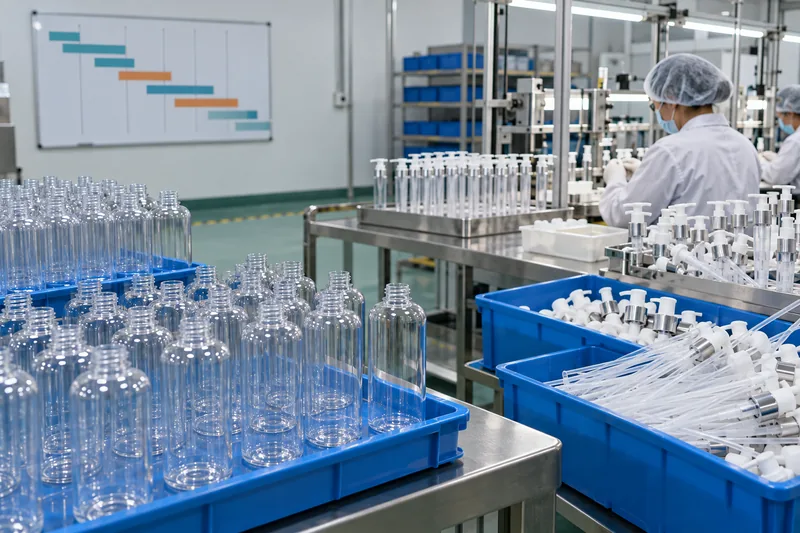
A lotion pump is not one moulded piece. It can contain an actuator, closure, housing, piston, stem, spring, ball or valve, gasket and dip tube. Decorative collars, custom colors, locks and metal finishes add external processes. A dip tube may be cut only after the bottle shoulder and internal height are confirmed. Capacity constraints can therefore occur at component moulding, assembly, plating, tube cutting or testing even when the visible actuator appears simple.
This is why buyers should obtain separate timing for pump engine readiness, customized external parts, dip-tube conversion, assembly and final inspection. When selecting lotion bottle and pump systems, commercial lead time must be confirmed for the exact bottle-pump-decoration combination, not inferred from stock photographs.
Choose a replenishment policy by commonality and risk
Not every component deserves the same control. A useful decision map considers lead time, demand frequency, commonality and obsolescence. Standardizing neck finishes and pump platforms can postpone customization and pool risk, but only where fit, sealing, dosage and formula compatibility are validated.
| Component profile | Typical policy | Why | Watch-out |
|---|---|---|---|
| Long lead, common across SKUs | Reorder point plus strategic safety stock | Pooled demand and high line-stop impact | Do not allocate all stock to the first request |
| Long lead, custom/SKU-specific | Firm forecast, capacity reservation, early lot-for-lot release and safety time | Inventory can become obsolete | Artwork and color changes |
| Short lead, common | Simple reorder point or min/max | Frequent economical replenishment | MOQ and order multiple can cause excess |
| Short lead, custom/intermittent | Order-to-order or lot-for-lot | Avoid dead stock | Demand must be released early enough |
Safety stock protects with quantity; safety lead time protects with time. They are not interchangeable in every situation, and duplicating both without analysis can inflate inventory. Time is often preferable for highly customized, expensive or artwork-sensitive parts; stock is often more useful for stable common components where a shortage stops several SKUs. Microsoft’s planning documentation treats reorder point, safety lead time, safety stock, MOQ, maximum quantity and order multiple as separate parameters for this reason.
Do not use a nominally identical pump or cap as an emergency substitute without approval. Neck dimensions alone do not prove sealing, torque, venting, output, priming, dip-tube fit or formula compatibility. Any alternate source should pass risk-based fit, function and packaging compatibility testing before commercial use.
A nine-step cosmetic packaging reorder workflow
- Freeze the controlled BOM. Give every component a unique item code, revision, approved supplier/site, units per kit and substitution status. Separate bottle size, color and artwork variants instead of grouping them under an informal description.
- Set the demand horizon. Combine confirmed filling orders, approved launch quantities and a clearly identified forecast. Translate finished-pack demand into component demand. Avoid double counting the same sales requirement in both the forecast and firm orders.
- Clean the inventory position. Reconcile physical, quality, allocated and obsolete stock. Add only scheduled receipts supported by supplier acknowledgement and credible milestones.
- Measure lead time by component and location. Use actual historical order-release-to-quality-release data. Record average, late-tail or percentile behavior, not only the supplier’s best case. Separate supplier production from freight and buyer receiving.
- Select the buffer policy. Decide safety stock, safety time, capacity reservation, common stock or order-to-order replenishment based on criticality and obsolescence risk.
- Calculate trigger and order quantity. Apply the reorder point to inventory position, then size the purchase using net requirements, MOQ, order multiple, quantity tolerance, shelf/obsolescence risk and cash constraints. A trigger of 40,000 does not mean “order 40,000.”
- Offset release dates. Work backward from the same need-at-filler date using each component’s planned lead time. The pump PO may need release weeks before the carton PO.
- Track milestones and exceptions. Review approval complete, materials ready, production start, decoration, assembly, inspection, dispatch, arrival and quality release. Escalate a missed critical-path milestone before the final due date is missed.
- Confirm complete-kit ATP. Recalculate kits available and kit-ready date after every major change. Release the filling slot only when packaging, formula, labor, line format parts and required quality status align.
For a new range, compare whether plastic cosmetic bottle options can share a standard neck and closure platform. For premium ranges using cosmetic glass packaging, include forming campaigns, annealing, decoration yield and protective packing in the planning route instead of copying a plastic-bottle lead time.
Worked example: coordinating a 30,000-unit lotion refill
Assume a brand consumes an average of 5,000 complete packs per week. Each pack uses one bottle, one pump, one overcap and one carton. The figures below are illustrative, use whole weeks for clarity and are not Boyu standard lead times or inventory recommendations.
| Component | Planned lead time | Illustrative safety stock | Reorder point | Inventory position | Action |
|---|---|---|---|---|---|
| Bottle | 5 weeks | 1 week = 5,000 | 30,000 | 34,000 | Monitor |
| Pump | 8 weeks | 2 weeks = 10,000 | 50,000 | 41,000 | Replenish/review now |
| Overcap | 4 weeks | 1 week = 5,000 | 25,000 | 27,500 | Monitor |
| Carton | 3 weeks | 0.5 week = 2,500 | 17,500 | 20,000 | Monitor artwork status |
The pump requires action even though 41,000 units sounds like abundant stock. Its inventory position is below the 50,000-unit trigger because replenishment takes eight weeks and the illustrative buffer is two weeks. The bottle is above its trigger. Placing both orders only when bottle stock falls to 30,000 would make the pump late.
Now assume accepted on-hand quantities for the next campaign are 32,000 bottles, 28,500 pumps, 31,000 caps and 30,500 cartons. The campaign cannot safely promise 30,000 complete packs. It has 28,500 current kits before filler setup, inspection samples, line loss or replacements. The planner must either obtain additional released pumps before the line date, reduce the committed batch, or use an already qualified alternative. Extra bottles do not solve the shortage.
Control supplier milestones, not just the final ship date
A supplier saying “on schedule” is not enough for a critical component. Build a purchase-order schedule that exposes dependencies. At minimum, request and maintain the following fields for each component line:
- item code, description, drawing/specification revision and approved manufacturing site;
- ordered quantity, allowed quantity tolerance, MOQ, order multiple and pack count;
- date when all buyer approvals and commercial conditions were complete;
- material-ready, moulding/forming, decoration, pump-assembly and packing milestones as applicable;
- inspection date, dispatch date, shipping mode, destination and required-at-filler date;
- required certificates, samples, advance shipping notice and lot traceability;
- change-notification rule, escalation contact and recovery-plan trigger.
Update a component traffic-light report weekly during normal replenishment and more frequently on the critical path. A green status requires evidence that the milestone is complete, not simply that the supplier has not announced a delay. An amber status should state the remaining float in days. A red status requires a quantified recovery plan, decision owner and next update time.
When comparing suppliers, ask whether they control the pump engine, decoration and final assembly or subcontract critical steps. Review capacity, change control, traceability, contingency and milestone transparency, not only unit price. Boyu’s guide to evaluating an airless bottle supplier gives a related qualification framework for multi-component packs.
Do split shipments help?
A split shipment is useful when it creates a usable partial kit quantity that protects a line date, supports inspection or enables a controlled line trial. It is wasteful when it sends bottles early to consume storage while the pump bottleneck remains unchanged. Compare the number of complete kits unlocked, freight premium, extra receiving work, lot traceability and risk of damage before approving airfreight or partial dispatch.
Where practical, consolidate matched components by campaign or label pallets clearly with component SKU, revision, lot and linked order. However, do not require every supplier to ship physically together if staggered receipts reduce congestion or inspection risk. Synchronization means components are usable by the need date; it does not always mean they share one container.
Common reorder-planning failures and practical fixes
| Symptom | Likely cause | Corrective action | Prevention |
|---|---|---|---|
| Bottles arrive; pumps are weeks late | Same PO release date despite unequal lead times | Recalculate pump critical path and expedite only the shortage quantity that unlocks kits | Component-specific backward scheduling |
| All parts arrived but line cannot run | Wrong revision, uncut dip tube, quality hold or unapproved decoration | Segregate, quantify usable kits and disposition the nonconformance | BOM/revision control and pre-shipment evidence |
| ERP shows stock; warehouse has none available | Allocated, rejected or obsolete units included | Reconcile location and quality status immediately | Use usable inventory position, cycle counts and status controls |
| Supplier was “on time” but filler missed campaign | PO due date meant dispatch, not released receipt | Recover line capacity and align definitions | One required-at-filler date plus explicit Incoterm/receipt milestones |
| Frequent emergency airfreight | Optimistic lead time or late approval release | Separate supplier delay from internal approval delay | Use receipt history, safety time and approval SLAs |
| One SKU consumes a shared pump | No allocation threshold or priority | Freeze stock and allocate by approved service/business rule | Shared-component ATP and protected buffer |
| Excess custom packaging after forecast falls | Safety stock applied to artwork-specific parts or MOQ ignored | Stop/cut back open orders and assess rework | Postpone customization; use safety time or capacity reservation |
What to do now if the bottles are here but pumps are late
Do not begin by asking every supplier to “expedite everything.” First establish the smallest actionable shortage and the dates that matter.
- Freeze and verify balances. Count accepted bottles, pumps, caps and cartons by revision, lot and allocation. Confirm the filling requirement, including setup loss, test samples and spares.
- Calculate current complete kits. Identify the true bottleneck and the first date it stops production. Do not rely on gross PO balances.
- Validate the pump promise. Ask what is physically complete, what remains, where it is, and which milestone limits dispatch. Obtain quantities by date, not one vague final date.
- Model partial quantities. Determine whether an early tranche of accepted pumps creates an economical partial filling run. Include line changeover, formula stability/holding, labor and freight costs.
- Expedite the constraint. Premium freight for pumps may be rational; airfreighting bottles already in surplus is not. Protect traceability when splitting lots.
- Review approved alternatives. Use existing qualified stock or a prequalified second source if available. If not, perform a documented risk assessment and required fit/function/compatibility work; urgency does not make an untested pump equivalent.
- Rebook the whole campaign. Align the revised kit-ready date with formula, filling slot, warehouse space, finished-goods release and customer commitments.
- Close the cause. Update actual lead time, reorder point, safety policy and supplier scorecard. A one-time recovery without a parameter change invites recurrence.

The dashboard and metrics that prevent repeat shortages
A useful planning sheet can be simple, but it must operate at component-location level. Include SKU, revision, units per kit, usable on-hand, quality hold, allocated demand, confirmed receipts by date, average and planning lead time, safety stock/time, reorder point, net requirement, MOQ/order multiple, latest PO release date, next milestone, usable receipt date and owner.
Track performance with measures that reveal both service and waste:
- Complete-kit coverage: minimum usable component coverage after allocations.
- Kit-ready date adherence: percentage of campaigns with every component released by the planned date.
- Component OTIF: on time, in full at the agreed count and receipt point—not merely dispatched on time.
- Lead-time bias and variability: promised versus actual days, including quality release.
- Shortage days and stopped-line hours: tied to the constraining component and root cause.
- Expediting cost: premium freight, overtime, partial inspection and rescheduling caused by shortages.
- Excess and obsolete inventory: especially custom color, printed artwork and old revisions.
- Forecast and approval performance: changes inside frozen lead time and days lost before production release.
Review parameters at a defined cadence and after any material event: new supplier, new location, packaging redesign, demand step-change, promotion, repeated late delivery, freight-lane change, quality hold or supplier process change. Reorder points based on last year’s stable demand can be dangerous during a launch or phase-out.
A final pre-release checklist
- One approved BOM and revision connects every required packaging component.
- Demand is translated into component usage by SKU and location.
- Usable inventory excludes quality hold, allocation, damage and obsolete revisions.
- Lead times include approval, production, postprocessing, logistics and receiving release.
- The pump or other longest/most variable component has its own trigger and release date.
- MOQ, order multiple and quantity tolerance are reconciled with net requirements and obsolescence risk.
- Supplier milestones identify the critical path and responsible owner.
- The filler confirms component need date, inspection/staging time and line capacity.
- Any alternate component is approved and validated—not assumed interchangeable.
- The promised batch quantity does not exceed accepted complete kits.
Frequently asked questions
Should bottles and pumps be ordered at the same time?
Only if their total planned lead times happen to require the same release date. Normally they should share one required-at-filler date but be ordered on different dates calculated backward from that need date.
Which component should be reordered first?
The one whose inventory position will reach its component-specific reorder point first, after considering real lead time, demand, scheduled receipts, allocations and safety policy. It is often a pump, special closure or decorated component, but not always.
How much safety stock should a cosmetic packaging buyer hold?
There is no universal percentage or number of weeks. Calculate by component using demand and lead-time variability, service target, line-stop cost, commonality, substitution flexibility, MOQ and obsolescence risk. Review the result against non-normal launch or seasonal demand.
What is the difference between safety stock and safety lead time?
Safety stock adds physical units; safety lead time plans the order to arrive earlier. Stock can suit stable common components, while time can reduce obsolescence exposure for customized components. Using both may be justified, but avoid an unexamined double buffer.
Does the reorder point equal the order quantity?
No. The reorder point is the trigger. The order quantity depends on net requirements, target stock, MOQ, order multiple, quantity tolerance, available capacity, shelf or artwork risk and commercial constraints.
Can we use a different pump with the same neck size if the original is late?
Not automatically. Confirm dimensions and sealing, dip-tube length, torque or snap behavior, output, priming, actuation force, venting, leakage, formula compatibility and filling-line behavior. Process the change through documented approval and risk-based validation.
Should bottles be shipped early if pumps are delayed?
Only when early receipt creates value—for example, inspection, line trials, space planning or an independently usable partial quantity. Otherwise it may add storage, handling and damage risk without improving the kit-ready date.
How often should reorder parameters be reviewed?
Use a regular cadence appropriate to volume and volatility, and recalculate after a supplier, route, demand, design, MOQ, quality or approval-process change. Critical launch components may need weekly exception review even if master parameters are reviewed monthly or quarterly.
Build a packaging schedule around the filling date
For an actionable quotation and supply plan, provide the packaging BOM, quantity by SKU, approved specifications, target filling date, destination, forecast horizon, decoration, inspection requirements and filler constraints. Boyu can review component dependencies and identify which parts need earlier release.
Sources and further reading
Authoritative planning definitions and methods consulted for this guide:
- SAP Help — Assemble-to-order
- SAP Help — Reorder Point Planning
- Oracle Inventory Help — Reorder Point Planning
- Oracle NetSuite — Inventory Optimization Calculations
- Oracle NetSuite — Entering Inventory Management Details
- Microsoft Learn — Setup best practices: Planning parameters
- Microsoft Learn — Handling reordering policies
- ASCM — Supply Chain Dictionary, 18th edition
- Atan et al. — Assemble-to-order systems: A review
- IBM Research — Component rationing for available-to-promise scheduling



 English
  Español de Argentina
  Русский
  Italiano
  日本語
日本語  한국어
한국어  العربية
  Français
  Deutsch