
Direct answer: A plastic cosmetic bottle can crack weeks or months after filling without ever being dropped. Environmental stress cracking (ESC) is a leading hypothesis when a susceptible polymer, tensile stress and a contacting agent act together over time. Residual stress from molding, a tight closure or stacking can supply the stress; surfactants, oils or other formula components may promote crack growth. But a delayed crack is not proof of ESC: impact, thin walls, a molding defect, oxidation or another chemical attack must be ruled out. Quarantine affected lots and compare the actual filled package with controls before selecting a fix.
For packaging engineers, quality teams and buyers, the useful question is not simply “Which plastic cracked?” It is “Where did the crack start, under which combined conditions, and what evidence would distinguish the competing causes?”
What is environmental stress cracking?
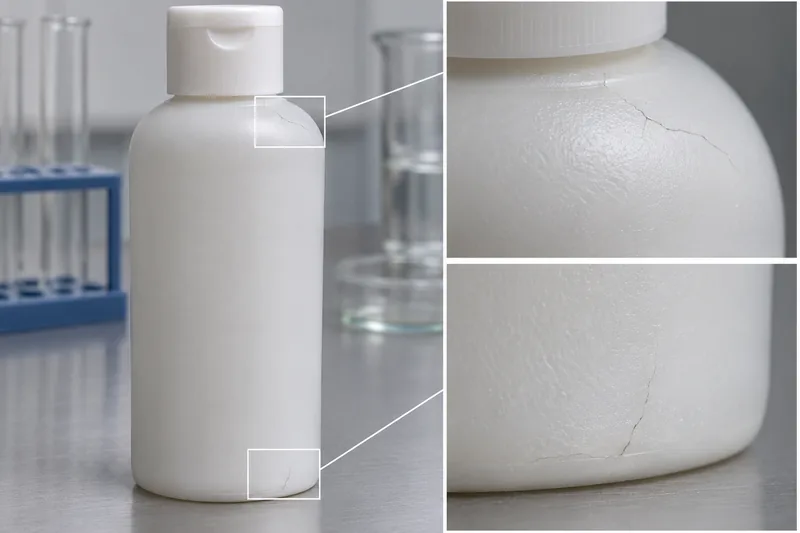
ESC is premature cracking under the combined influence of mechanical stress and a particular environment, at stress levels below those normally needed for a short-term break. ASTM D1693 specifically covers susceptibility of ethylene plastics such as polyethylene under prescribed conditions; its scope cites soaps, wetting agents, oils and detergents as possible environments. The test does not imply that every cosmetic formula damages every PE grade.
Think in three interacting variables: polymer and grade (including additives and processing history), stress (frozen-in or applied), and contact medium plus time/temperature. A bottle can pass an empty-bottle drop check and still fail later after the formula wets a stressed shoulder or heel. Conversely, a brittle-looking fracture with no relevant contact medium may have a different cause. This distinction determines whether to change the resin, bottle geometry, process, closure assembly, formula contact or warehouse conditions.
A practical fault tree: where did the crack start?
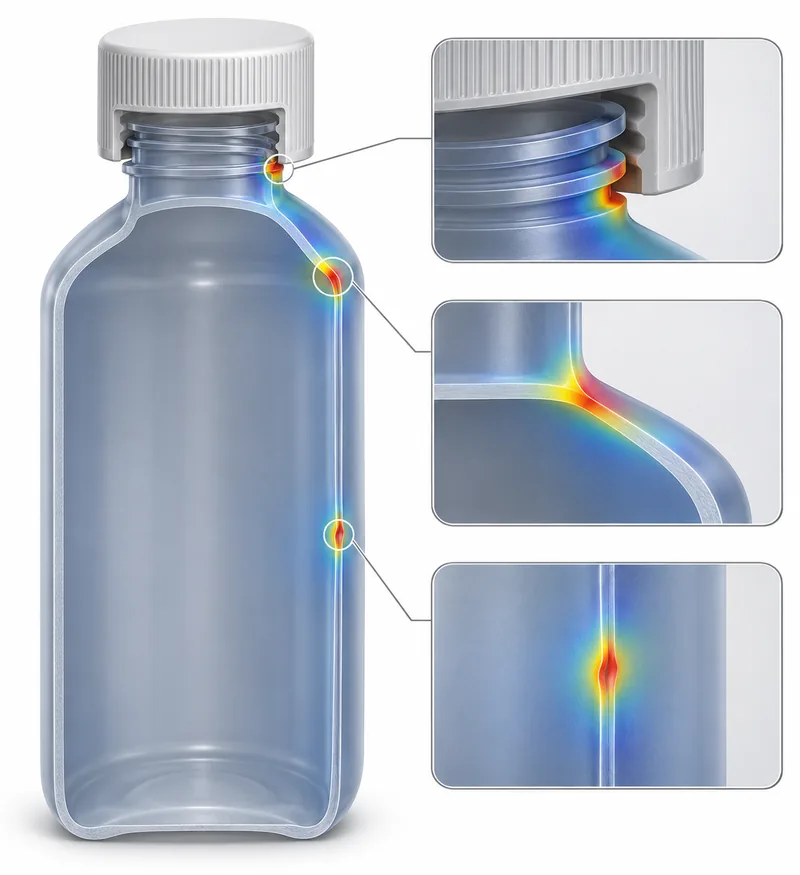
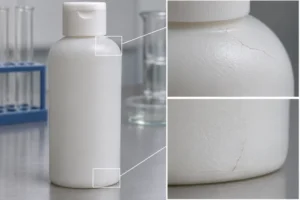
Record the first visible origin, not just the longest final split. Photograph the unopened pack, mark the crack position relative to the mold cavity, measure wall thickness around the origin and preserve both cracked and intact examples from the same lot. Do not scrub away residue before collecting samples. The patterns below are leads for investigation, not visual diagnoses.
Shoulder or sharp corner: compare wall distribution, corner radius and molding history; inspect filled, empty and water-filled controls. Base or pinch-off: check weld quality, parison distribution, bottom contact and stacked load. Neck: measure application/removal torque, neck dimensions, liner/plug interference and cap fit; a wall test may miss neck-specific strain. Random handling marks: preserve the pack-out and shipping history; check for abrasion, impact or crushing before calling it ESC.
Ask four discriminating questions: Are failures confined to one cavity or resin lot? Do empty bottles crack under the same storage load? Do filled bottles crack only with one formula or fragrance? Does failure cluster at high temperature or in a particular stacking orientation? A cavity-specific failure points toward geometry or processing; formula-specific failure points toward compatibility; neither is conclusive without controlled comparison.
If the bottle leaks, first identify whether the liquid escapes through a true wall crack or a closure path. Boyu’s cosmetic bottle leak-testing methods cover ways to locate and quantify a leak; a wet carton alone does not identify the fracture origin.
How do resin, formula and processing change the risk?
HDPE and other polyethylene bottles
PE stress-crack resistance varies by grade; “HDPE” on a drawing is not a performance specification. Molecular architecture, density, melt index, processing and final geometry all influence results. Resin suppliers publish ESCR data under specific test conditions; compare grades only when reagent, concentration, temperature, specimen preparation and failure criterion match. A resin with attractive laboratory hours can still fail as a thin-walled bottle with residual stress and an aggressive fill. ASTM D2561 addresses the finished blow-molded PE container and explicitly includes the influence of design, resin and molding conditions.
PET, PP, PCR and mixed components
PET and PP are not automatically immune to stress-assisted cracking or chemical incompatibility, but ASTM D1693 is a PE method and should not be used as a universal pass/fail test for them. Evaluate each candidate resin against the actual formula and molded part. A PCR-content change can also change grade characteristics or processing behavior; approve the specific blend and supplier, not just the polymer name. Boyu’s PCR cosmetic packaging options provide sourcing context, while qualification must be formulation-specific.
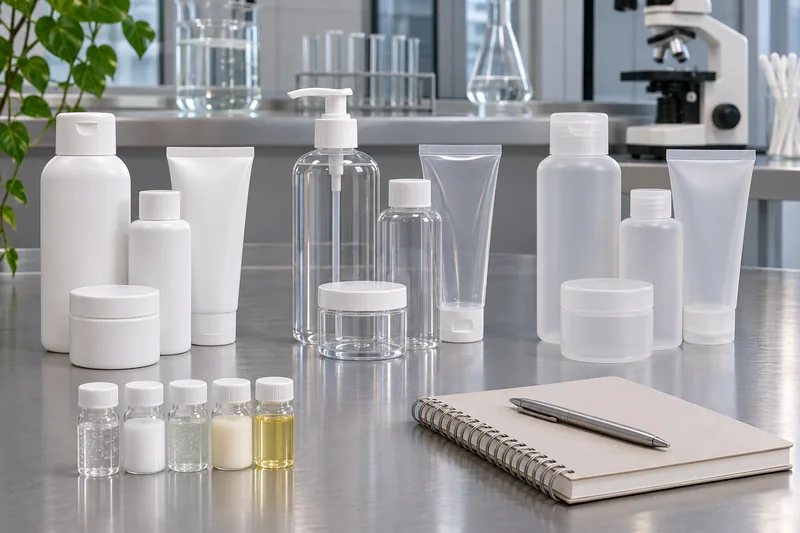
Do not assume the base formula is the only exposure. Fragrance concentrates, surfactants, oils, alcohol-rich phases, cleaning residue and decoration solvents may contact different surfaces during filling, storage or use. A cosmetic-packaging study found that formula and thermal aging changed mechanical behavior of blown bottles and discussed surfactants plus residual stress as a combined concern. That supports a hypothesis, not a universal rule for all formulas. Use Boyu’s broader formula–package compatibility protocol when designing the whole stability program.
Can storage conditions cause a bottle to crack?
Temperature, time, top load and orientation can change the rate at which a weak system fails. Elevated temperature may accelerate diffusion and creep; stacked cartons add load; side or inverted storage can wet a closure or neck that upright samples never expose. LyondellBasell’s PE technical guidance specifically notes high temperature and top-loaded storage as accelerants for ESC. A shipment that survives a drop test but sits warm under load for weeks is a different challenge.
Humidity is not a universal direct ESC trigger for common PE bottles. It may affect cartons, labels or storage temperature indirectly; test a proposed humidity mechanism rather than assuming it. Record actual warehouse and transport temperature, pallet height, compression, sunlight exposure and dwell time. Compare the failed route with a controlled retain under the same formula, fill, closure torque and lot. Do not invent a universal safe temperature or maximum storage period—set those from the formula/package validation and shipping profile.
Which tests can confirm or rule out ESC?
- Preserve evidence. Quarantine suspect lots; keep unwashed failed units, matched intact units, production records and actual fill. Map failures by cavity, date, lot and route.
- Inspect the fracture. Use magnification and, for serious failures, an independent polymer failure-analysis laboratory to examine the origin and fracture surface. Visual whitening alone is not a definitive ESC assay.
- Run matched controls. Compare empty, water-filled and actual-formula filled production-intent packs under the same closure torque, orientation, top load and climate. Change one suspected factor at a time where feasible.
- Use the right standard for the question. ASTM D1693 is a controlled bent-strip screen for ethylene plastic specimens; it can compare grades under stated conditions but cannot directly predict field life. ASTM D2561 evaluates blow-molded PE containers; its Procedure A can use a potential stress-cracking liquid, but the method does not cover controlled plug strain at the neck. Neither standard is a mandatory, universal cosmetic-bottle acceptance limit.
- Predefine a decision. Agree sample size, exposure medium, concentration, temperature, time, inspection interval, failure definition and retest rule before seeing results. Confirm the revised design with the finished formula and intended shelf life, not only accelerated screens.
For the full qualification menu beyond cracking—dimensions, compatibility, leakage and function—use Boyu’s cosmetic bottle test checklist. A zero-crack result in a small, short study is evidence under those conditions; it is not proof that failure is impossible.
What should a factory and buyer do after a field failure?
Contain first: identify affected SKU, formula, component lots and shipping destinations; hold unreleased stock and agree the customer notification/return decision with the brand’s quality team. Replacing cracked bottles without removing the cause merely restarts the clock. Do not refill visibly cracked packs.
Correct the verified factor: if failures cluster at a thin corner, revise geometry or wall distribution; if one cavity dominates, inspect mold condition and process settings; if only a particular formula fails, compare a more suitable grade or material and the formula’s contact conditions; if neck cracks correlate with assembly, correct neck/closure interference or torque. Boyu’s cap-torque guide covers that last variable in depth. A process adjustment should be documented with before/after dimensional, mechanical and filled-pack evidence.
Prevent recurrence: lock the approved resin grade and source, PCR level, colorant, bottle weight, critical wall map, mold cavities, neck finish, closure and torque window. Include worst-case formula exposure, orientation, storage temperature and top load in qualification. Revalidate after meaningful changes. Ask the supplier for lot and cavity traceability, retained samples, test method and raw result—not a generic “ESCR passed” certificate. When comparing replacement formats, Boyu’s plastic cosmetic bottle range is a starting point for sourcing candidates, not proof that any candidate fits a specific formula.

Frequently asked questions
Can a bottle crack without being dropped?
Yes. Stored molding stress, closure strain or stacking load can act over time with a contacting formula. Confirm the mechanism with matched controls; an unseen impact or manufacturing defect is also possible.
Does a white hairline crack prove ESC?
No. Whitening or crazing is a useful observation but not a root-cause verdict. Document origin, fracture surface, formula exposure, lot pattern and process history, then test competing hypotheses.
Which plastic never stress-cracks?
No polymer can be promised universally immune. Select a specified grade and finished pack with evidence for the actual cosmetic formula, load, temperature and shelf life. Do not rank HDPE, PET and PP from polymer names alone.
Sources
- ASTM International, ASTM D1693-21: Environmental Stress-Cracking of Ethylene Plastics.
- ASTM International, ASTM D2561-17(2023): Environmental Stress-Crack Resistance of Blow-Molded Polyethylene Containers.
- LyondellBasell, Environmental Stress Crack Resistance technical topic.
- LyondellBasell, Troubleshooting ESCR problems.
- Research article, Product–package system: thermal aging and blown-bottle mechanical performance.
 English
 Español de Argentina
 Русский
 Italiano
 日本語
 한국어
 العربية
 Français
 Deutsch