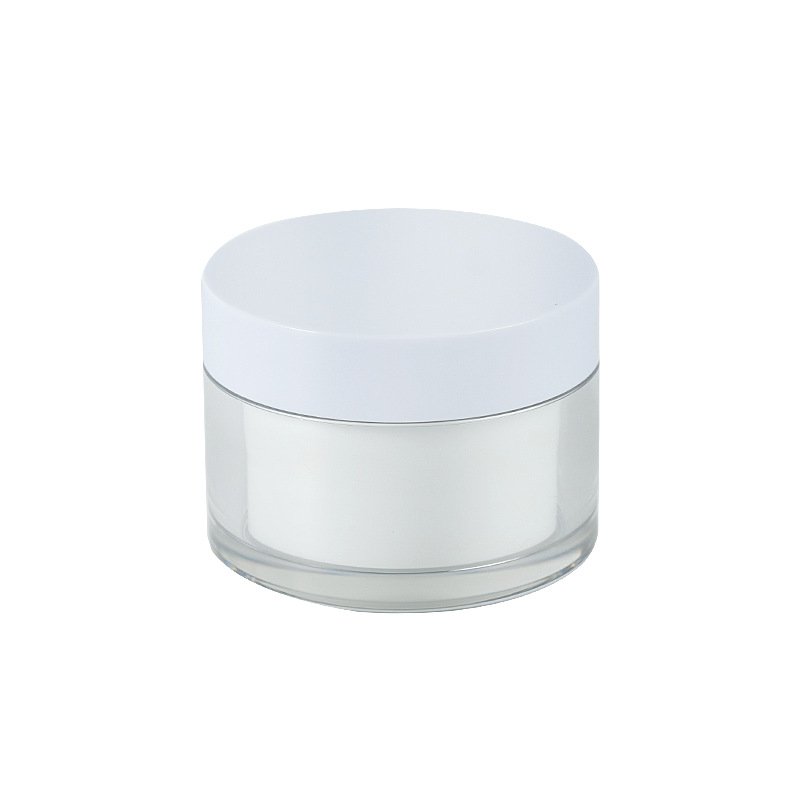
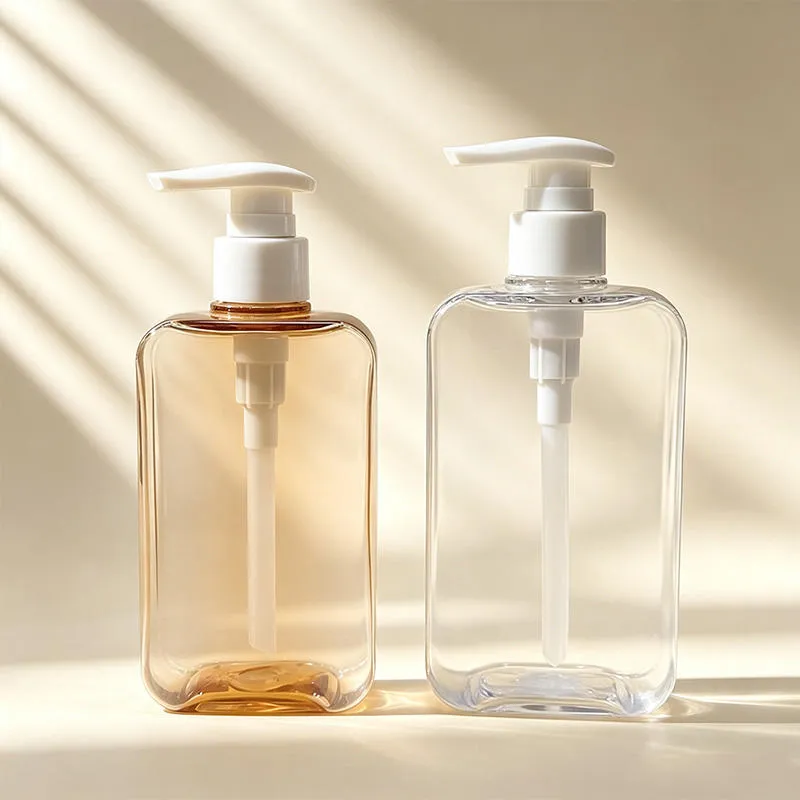
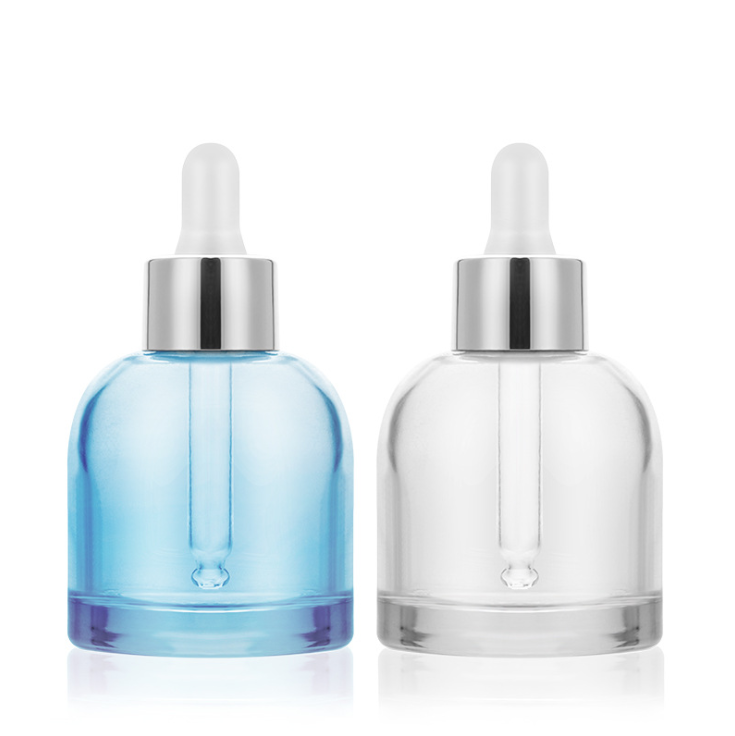
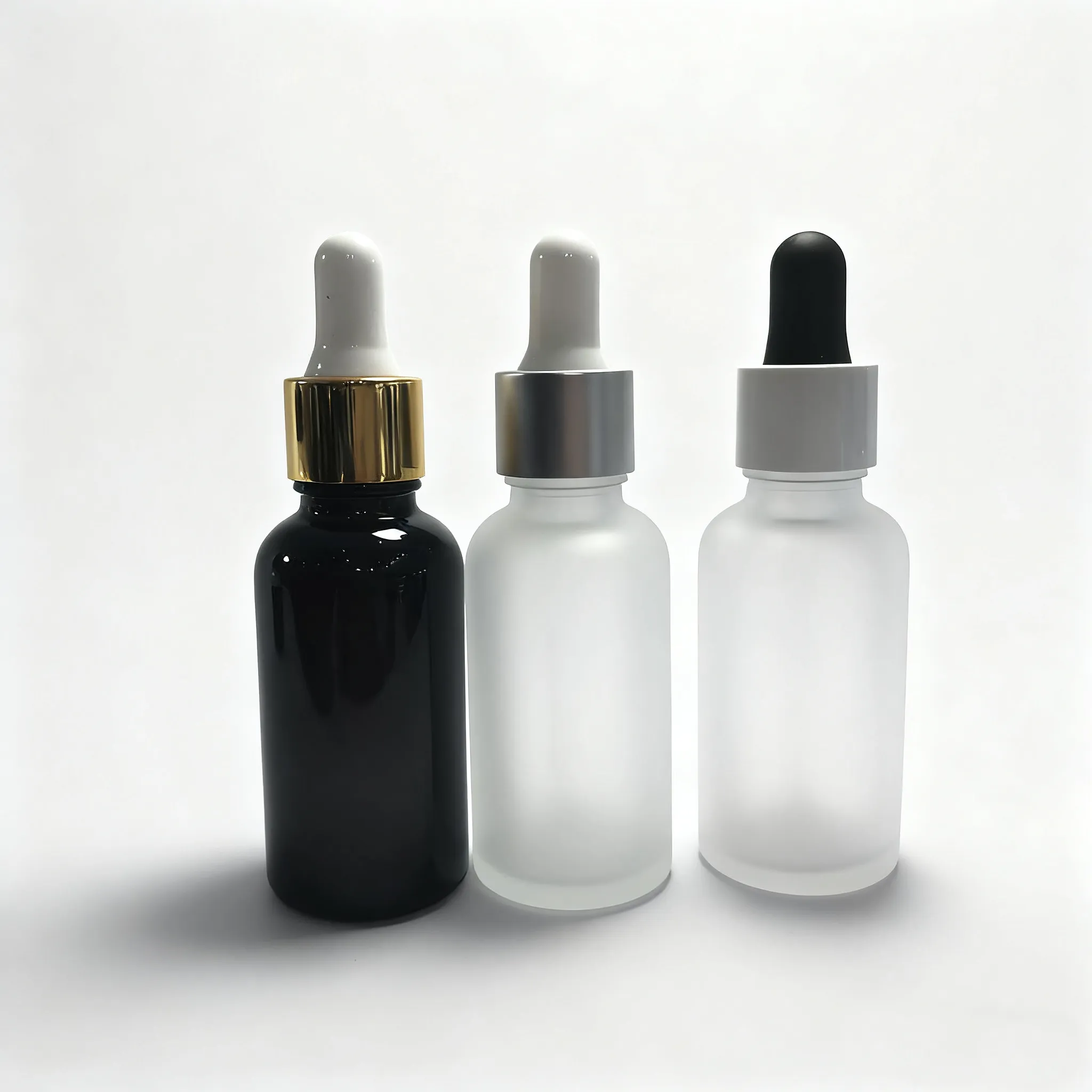
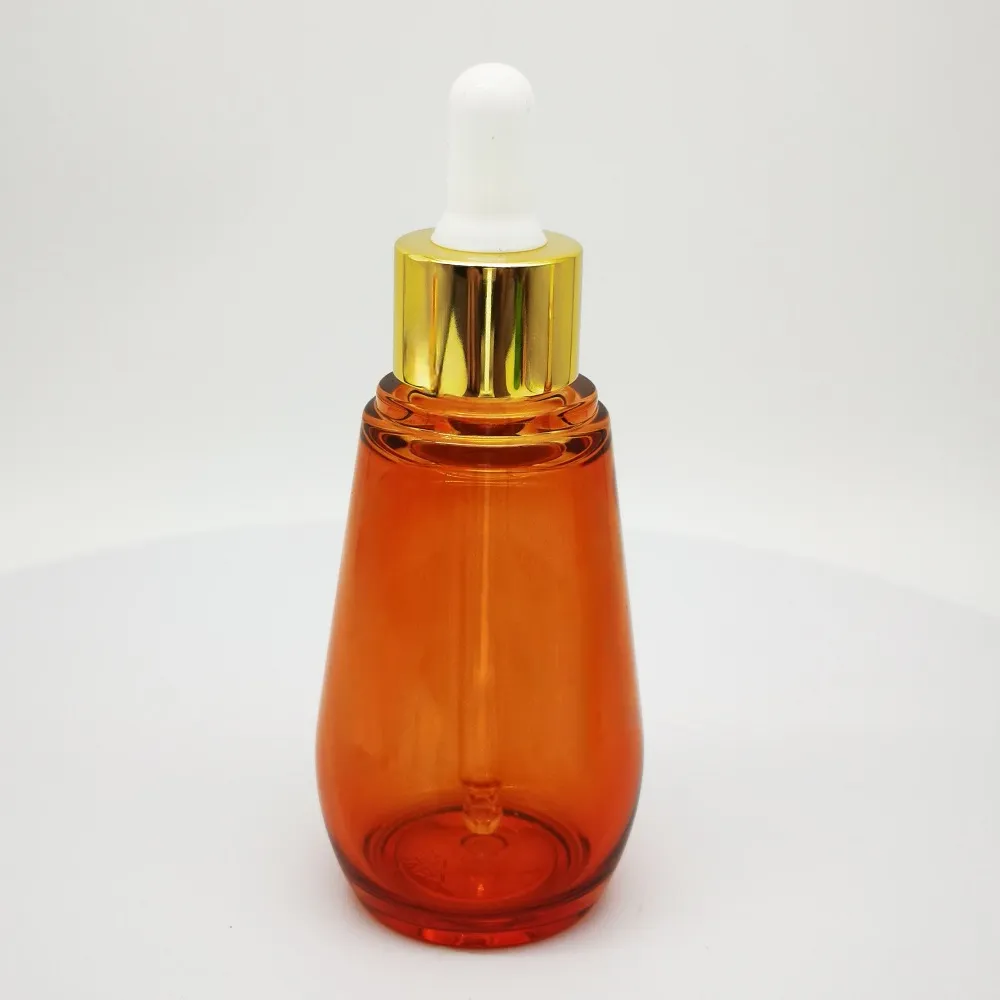
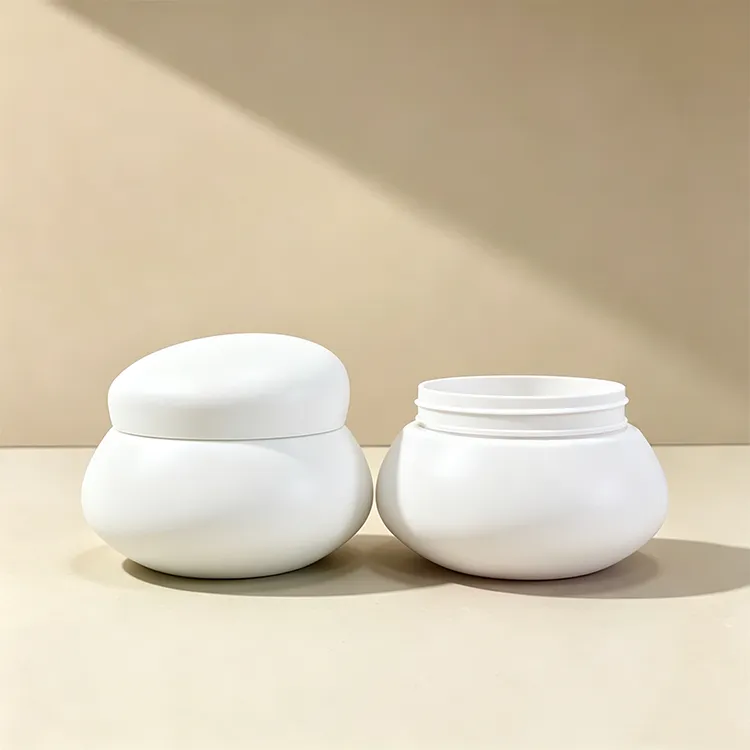

Direct answer: At factory scale, a plain small-to-medium PET bottle is usually a cents-per-piece item, not a fixed-price commodity. A practical 2026 budgeting screen is roughly US$0.05–$0.20 for the undecorated bottle at efficient volumes, while small stock orders, heavy cosmetic bottles, custom colors or decoration can move the bottle toward US$0.15–$0.60+. A pump, cap, label, tooling, testing, cartons, freight and duty are separate unless the quotation explicitly includes them.
The reliable answer comes from the bottle’s gram weight, the dated PET-resin basis, preform and blowing conversion, yield, fixed batch charges, tooling amortization and delivery term. This guide shows that calculation and explains why two factories can quote very different prices without necessarily offering the same product.
For packaging buyers in personal care, cosmetics, beverages, food and household products. Dollar figures are illustrative planning bands or disclosed worked-example assumptions—not a Boyu Packaging quotation. Cost and regulatory information reviewed 3 September 2026.
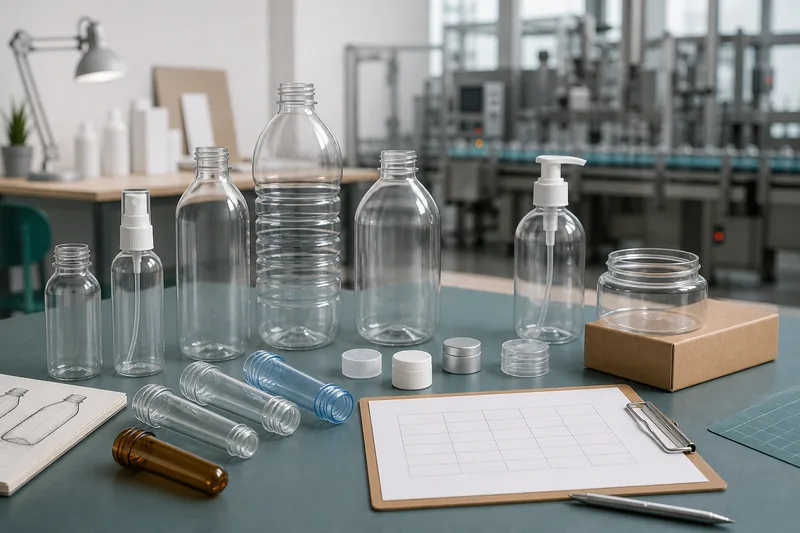
1. What does it cost to produce a PET bottle?
A useful price must name the commercial boundary. “PET bottle cost” may mean the factory’s conversion cost, an ex-works bottle-only price, a decorated bottle with a closure, or the fully landed package at the buyer’s warehouse. Those are not interchangeable.
| Number being discussed | Normally includes | Common omission |
|---|---|---|
| Internal manufacturing cost | Resin or purchased preform, conversion, direct labor, utilities, normal scrap and factory overhead | Supplier selling expense, profit, financing and commercial risk |
| Ex-works bottle price | Finished empty bottle, factory packing and supplier margin | Closure, decoration, inspection, inland pickup, export and import costs |
| Complete-package price | Bottle plus specified cap, pump, sprayer, liner, plug or label; sometimes assembly | Compatibility qualification, filling-line trials and landed logistics |
| Landed usable cost | Complete pack, freight, insurance as applicable, duty/tax treatment, broker, inspection and domestic delivery | Inventory carrying cost, line loss, leakage, rejects and obsolescence |
The opening range is deliberately broad. A lightweight 250 mL beverage bottle, a 250 mL thick-wall shampoo bottle and a 250 mL hot-fill container have the same nominal capacity but not the same mass, preform, process window, performance tests or cost. PETRA describes PET as clear, strong and lightweight, but those advantages do not remove application-specific engineering.[1]
The five details needed before any range becomes useful
- Bottle specification: brimful and nominal fill, gram weight, dimensions, neck-finish drawing, color, resin/PCR requirement and tolerances.
- Application: product chemistry, filling temperature, pressure/vacuum, shelf life, distribution and intended market.
- Component scope: bottle only or bottle plus cap, pump, sprayer, liner, induction seal and dip tube.
- Appearance scope: natural/clear resin, custom masterbatch, coating, screen print, hot stamp, pressure-sensitive label or sleeve.
- Commercial scope: annual demand, release quantity, number of SKUs, currency, Incoterm, named delivery place, payment terms and quote-validity date.
2. How a PET bottle is produced—and where cost enters
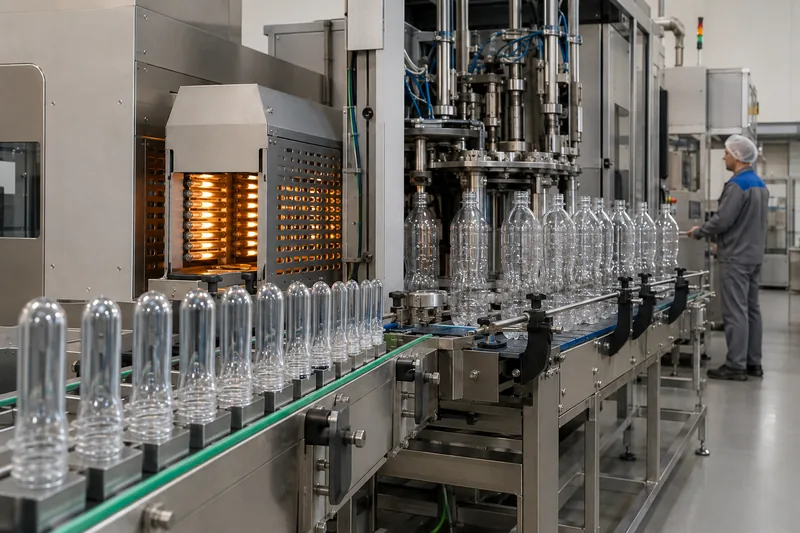
Most PET bottles are produced by injection stretch blow molding. In a two-stage process, one machine makes a thick test-tube-shaped preform and another reheats, stretches and blows it into a bottle. A single-stage system integrates preform molding and bottle blowing in one machine. CYPET identifies two-stage production with standard necks and high volumes, while single-stage equipment keeps both operations together.[2] The best route depends on design, demand and installed equipment; neither route is automatically cheaper for every bottle.
Step 1: specification, design and engineering
The factory translates capacity, dimensions, panel geometry, closure finish, label area, filling conditions and strength requirements into a bottle drawing and preform choice. An existing mold and qualified preform can keep this cost low. A custom silhouette may require industrial design, CAD, finite-element or material-distribution work, prototypes, a new blow mold, trial time and gauges.
Engineering is a real cost even when it is hidden inside the unit price. Ask whether the quote includes drawings, design-for-manufacture review, trial rounds, changes after the first sample, cavity identification, gauges and tool ownership. A cheap tool that cannot hold the required finish or wall distribution is not cheaper after correction.
Step 2: PET resin, PCR, color and drying
Bottle-grade PET pellets, approved recycled PET where specified, color masterbatch and functional additives form the material system. PET must be dried under the resin supplier’s validated conditions before preform injection; moisture and thermal history can reduce molecular performance and increase haze or defects. The buyer should approve resin grade, intrinsic-viscosity range, PCR source/content, color tolerance and change-control rules rather than the word “PET” alone.
Material cost begins with mass: every additional gram is purchased on every bottle. Resin markets are regional and time-sensitive. ICIS publishes separate bottle-grade assessments by geography and commercial basis, which is why a supplier should state the quote date, resin basis and validity instead of presenting one timeless global PET price.[6] The broad U.S. plastics-resin producer price index also moved materially during 2026; it demonstrates input volatility, although it is not a PET spot-price substitute.[7]
Step 3: preform injection molding
Dried PET is melted and injected into a multi-cavity preform mold. This operation forms the final neck thread, sealing land and support ring; the bottle body is still thick and compact. Cost comes from resin, masterbatch, injection-machine time, mold cavity count, cooling, dryer/chiller energy, labor, maintenance, inspection and rejected preforms.
A blow molder may purchase standard preforms instead of making them. That can reduce capital and minimum-run pressure, but the preform supplier’s price already contains resin, conversion and margin. It may also restrict weight, neck and material-distribution choices. Ask whether the factory makes or buys the preform and whether the quoted bottle is tied to a named preform drawing.
Step 4: reheat, stretch, blow, cool and eject
The preform body is reheated, normally by zoned infrared equipment, while the neck is protected. A stretch rod draws the warm preform axially as pre-blow and final high-pressure air expand it radially against a cooled bottle mold. Chia Ming’s process description separates preform heating, mold entry, stretch/pre-blow, final blow, opening and discharge; its equipment list also shows the compressors, air treatment and cooling equipment behind the apparent “simple” blowing step.[3]
Blowing cost depends on bottle geometry, cavity count, machine output, energy and compressed-air efficiency, cycle stability, mold cooling, changeover time and reject rate. Sidel notes that preform material/design, heating/blowing technology, machine configuration, operation and maintenance vary by plant and influence total cost.[4]
Step 5: inspect, decorate, assemble and pack
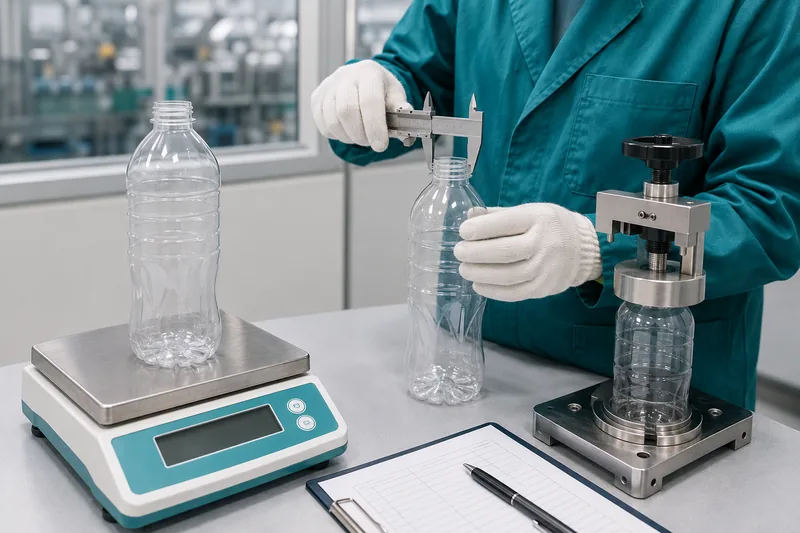
Production control may check preform/bottle mass, finish dimensions, gate, sealing surface, color, haze, contamination, base formation, contour and wall distribution. Krones lists these as inspection targets for PET preforms and containers.[10] Application-specific programs can add capacity, top load, pressure, drop, leak, closure torque, compatibility and distribution work.
Bottles are then bulk packed or sent to decoration. Screen printing, hot stamping, labels, sleeves and coatings introduce separate material, setup, curing, handling and reject costs. Caps, pumps or sprayers may be assembled or packed separately. The final carton and bag standard matters because empty PET bottles are light but consume substantial volume.
For a broader design-to-production treatment, see Boyu’s industrial shampoo-bottle manufacturing guide. This article keeps the process discussion focused on cost ownership.
3. The PET bottle should-cost formula
A factory does not have to reveal its confidential margin for a buyer to build a useful cost model. The purpose of should-costing is to test whether a quote moves logically when weight, resin, quantity, decoration or tooling changes—not to claim perfect knowledge of the supplier’s books.
A historical PET bottle supply contract filed with the U.S. SEC used the same underlying architecture: PET resin calculated from preform weight and resin price, masterbatch, preform injection cost, blowing spoilage, blowing cost and packing.[5] Its dated values are not current benchmarks; the value is the transparent structure.
Calculate gram-weight sensitivity first
If delivered PET costs R dollars per kilogram, removing one gram changes direct resin cost by R ÷ 1,000 dollars per bottle. At an illustrative R of US$1.20/kg, one gram equals US$0.0012 per bottle, or US$1,200 across one million bottles before yield effects. The math is simple; validating that the lighter bottle still passes top-load, filling, closure, use and distribution requirements is the engineering work.
Treat yield as a denominator, not a footnote
If variable input cost is US$0.060 and good-unit yield is 98%, the cost of inputs per saleable bottle is US$0.0612, not US$0.060. At 90% yield it becomes US$0.0667. Rejections also consume machine time, decoration capacity and inspection labor, so unstable production usually costs more than the resin arithmetic alone shows.
Separate variable, lot-fixed and program-fixed charges
| Cost behavior | PET bottle examples | Best comparison method |
|---|---|---|
| Variable per unit | Resin/preform, masterbatch, blowing, print ink/foil, closure, bag and carton consumption | Compare at identical weight, BOM, yield assumption and quantity |
| Fixed per production lot | Line clean/changeover, color purge, print plate/screen setup, first-off inspection and machine setup | Request the fixed charge separately and divide by release quantity |
| Fixed per program | CAD, prototypes, molds, gauges, validation and artwork development | Amortize over realistic committed demand, not an optimistic lifetime forecast |
| Commercial/risk dependent | Payment term, currency exposure, price validity, safety stock, overrun tolerance and warranty | Normalize terms and record who carries each risk |
4. Worked example: how MOQ changes cost per bottle
The following is a transparent calculation, not a live quotation. Assume a clear 250 mL stock PET bottle weighing 24 g, no closure and no decoration. Use a hypothetical delivered resin rate of US$1.20/kg, US$0.012 for preform conversion, US$0.008 for blowing, US$0.006 for variable inspection/packing, 98% good-unit yield and US$1,200 in lot-fixed setup, sampling and production-release charges.
| Worked-example item | Calculation | Cost per bottle |
|---|---|---|
| PET material | 0.024 kg × US$1.20/kg | US$0.0288 |
| Preform injection conversion | Assumed input | US$0.0120 |
| Stretch-blow conversion | Assumed input | US$0.0080 |
| Variable inspection and packing | Assumed input | US$0.0060 |
| Subtotal adjusted for yield | (0.0288 + 0.012 + 0.008 + 0.006) ÷ 0.98 | US$0.0559 |
Only the US$1,200 lot-fixed charge changes in the next table. That single assumption shows why a factory can accept a small order but quote it at a much higher unit price.
| Release quantity | Fixed cost per unit | Illustrative pre-margin cost | What the buyer learns |
|---|---|---|---|
| 5,000 | US$0.2400 | US$0.2959 | Setup dominates; stock held by a distributor may be more economical |
| 10,000 | US$0.1200 | US$0.1759 | Unit price can fall sharply without any resin change |
| 25,000 | US$0.0480 | US$0.1039 | Fixed charges are still commercially meaningful |
| 100,000 | US$0.0120 | US$0.0679 | Variable bottle economics now dominate |
These results do not include supplier margin, decoration, closure, tooling, freight or duty. They also should not be copied into an RFQ as a target price: change the bottle to 40 g and material alone rises by US$0.0192 under the same resin assumption.
What a custom mold does to the first program
Assume, purely for the math, that bottle tooling and engineering total US$8,000 and the buyer chooses to amortize them over committed units:
| Committed volume | Tooling allocation per bottle | Commercial implication |
|---|---|---|
| 10,000 | US$0.800 | Custom geometry overwhelms the empty-bottle cost |
| 25,000 | US$0.320 | Still a large launch burden |
| 100,000 | US$0.080 | Potentially workable if the design creates measurable value |
| 500,000 | US$0.016 | Tooling becomes a smaller part of total economics |
For verified planning ranges by tooling type and a checklist of inclusions, use Boyu’s separate guide to custom cosmetic bottle mold cost. Do not compare a single-cavity blow mold with a multi-cavity production tool or a bottle-only tool with a full dispensing package.
5. PET bottle price bands that are useful—and their limits
The bands below are a 2026 budgeting screen for small-to-medium PET bottles, synthesizing the mass-based model, observed public wholesale/distributor pricing and normal scope differences. They are not current offers and may be wrong for very small samples, large containers, pressure bottles, hot fill, multilayer/barrier structures, pharmaceuticals, aseptic applications or unusual finishes.
| Commercial configuration | Illustrative planning band | Main reason for the spread |
|---|---|---|
| Plain stock bottle, efficient factory-scale run | US$0.05–$0.20 each | Gram weight, capacity, preform, machine rate, yield, region and carton density |
| Small stock order from inventory | US$0.15–$0.60+ each | Distribution, pick/pack, inventory, carton break and low-quantity handling |
| Custom-color or simply decorated stock bottle | US$0.12–$0.50+ each | Color batch, print/label method, setup, passes, registration and reject rate |
| Stock bottle with standard dispensing closure | US$0.25–$1.00+ per set | Cap versus sprayer/pump, output, metal-free design, lock, liner, dip tube and assembly |
| Heavy-wall, specialty or multi-finish cosmetic bottle | US$0.30–$1.20+ bottle only | Mass, cycle time, low-volume decoration, coating, hot stamp, inspection and protective pack-out |
A distributor’s posted price is not factory production cost. For example, a U.S. distributor listing can include a cap, domestic inventory and same-day shipment, while a marketplace listing may advertise a low starting range without proving that weight, decoration, testing, packaging and delivery terms match the buyer’s project.[21][23] Use public listings to understand possible market positions, not to force a factory to match an incomparable scope.
6. Why factory MOQ changes PET bottle cost
MOQ is not one universal factory rule. It is the commercial result of several minimum-efficient batches. A factory may be able to blow 1,000 bottles physically but still need 5,000 units for a stable custom-color batch, 10,000 for direct printing and 20,000 from the pump supplier.
Technical MOQ, commercial MOQ and economic order quantity
- Technical minimum: enough material and time to stabilize drying, heating, blowing, color and inspection across cavities.
- Commercial MOQ: the smallest order the supplier will schedule after administration, setup and opportunity cost.
- Decoration MOQ: the smallest batch a printer or decorator will run with acceptable setup dilution and material yield.
- Component MOQ: the minimum for the cap, pump, sprayer, liner or custom dip-tube cut.
- Economic order quantity: the volume that minimizes unit cost without creating excessive cash, storage, damage or obsolescence risk.
Why a low-MOQ factory often charges more
Small-run suppliers earn flexibility by holding stock bottles, scheduling short machine runs, manually handling changeovers, combining outsourced services or accepting inefficient capacity use. The premium pays for inventory risk and service, not necessarily better resin. A high-volume plant may have a much lower conversion cost but decline the order because the changeover displaces a larger production campaign.
The multi-SKU MOQ trap
“100,000 bottles” is not the same as “100,000 per color and artwork.” Ask whether MOQ applies per mold, size, neck, color, decoration, artwork, closure color and release. Five fragrances with unique print can turn a 50,000-piece program into five 10,000-piece inefficient lots even when the bottle body is identical.
7. Why one PET bottle factory quotes high and another quotes low
The first task is not deciding who is expensive. It is deciding whether the factories priced the same bottle and accepted the same responsibility.
| Why quotes differ | Legitimate high-price explanation | Possible low-price risk or advantage | Evidence to request |
|---|---|---|---|
| Bottle mass and preform | Heavier or purpose-engineered preform for strength, shape or process | Efficient rightweighting—or simply less material in critical regions | Average/range weight, preform drawing, wall map and performance data |
| PET grade and PCR | Approved grade, controlled IV/color, qualified PCR source and documentation | Commodity advantage—or unclear resin, regrind or uncontrolled change | Resin grade, COA requirements, PCR statement and change control |
| Machine and cavity efficiency | Modern automated line, inspection and preventive maintenance | Highly depreciated assets can be genuinely economical; manual lines may be slower | Machine/cavity identification, output basis, downtime and defect data |
| Tooling scope | Multi-cavity production mold, cooling, spare inserts, gauge and trials | Single cavity, soft/limited-life tool or only the blow mold quoted | Tool list, steel, cavities, ownership, life, maintenance and correction terms |
| Tolerances and quality plan | Tighter critical dimensions, cavity traceability and validated inspections | Fit-for-purpose lean plan—or undefined tolerances and visual-only checks | Signed drawing, control plan, capability data, test methods and release record |
| Decoration | More passes, registered artwork, controlled cure and protective packing | Fewer passes or a simpler label can be smarter; missing setup and rejects are not | Approved artwork, process, coverage, colors, tolerance and test plan |
| Closure scope | Qualified pump/sprayer, custom dip tube, gasket/liner and assembly | Bottle only, generic closure or lowest-grade actuator | Complete BOM, supplier, output, materials and functional specification |
| Cleanliness and compliance | Controlled handling, documented traceability and market-specific evidence | Appropriate basic controls for low-risk use—or unsupported “food/cosmetic grade” | Site scope, material declarations, audit, traceability exercise and exact reports |
| Packing and freight density | Dividers, bags and stronger cartons reduce scuffing/deformation | Dense bulk pack may be adequate; weak cartons shift cost to transit damage | Pieces/carton, carton dimensions/weight, pallet pattern and damage allowance |
| Incoterm and payment | More logistics responsibility, longer credit or currency protection | EXW cash price can look low because the buyer carries everything after pickup | Currency, payment, named place, Incoterm version and price validity |
| Business model | One-stop supplier manages components, decoration, testing and claims | Direct specialist factory can remove coordination margin | Actual manufacturing site and subcontract map for every process |
Five questions to diagnose a surprisingly cheap quote
- Is the price for the bottle only, and is a cap or pump merely shown in the photo?
- What is the guaranteed bottle-weight range and approved resin/preform?
- Are color, printing setup, normal overrun, rejects, export carton and inspection included?
- Does the quotation use the same currency, quantity tier, payment term, Incoterm and named place?
- What changes after sample approval: material source, cavity, manufacturing site, decorator or component supplier?
When a higher quote may be poor value
Higher price is not proof of higher quality. It may reflect an inefficient machine for the bottle, unused premium capacity, a trader’s margin, excessive packaging, unnecessarily tight cosmetic tolerances or a one-stop-service premium the buyer does not need. Ask the supplier to value-engineer the pack: identify which requirement drives each cost and what changes if that requirement is relaxed.
8. Stock mold or custom PET bottle: which costs less?
A stock bottle normally wins at uncertain or modest volume because the tool already exists and the factory may combine demand across customers. A custom bottle can win at scale if it improves gram weight, line performance, case count, brand recognition or closure integration enough to repay engineering and tool cost.
Use a break-even test, not prestige
If custom tooling and development cost US$12,000 and the validated custom design saves US$0.04 per complete pack, arithmetic break-even is 300,000 units. Add risk: forecast uncertainty, tool maintenance, duplicate tooling, launch delay and possible redesign can push the commercial break-even higher.
Rightweight the bottle; do not simply underweight it
Sidel’s current lightweighting work shows that neck, body and base geometry can reduce PET use, but the company ties changes to feasibility and performance qualification.[8] A one-gram saving is real only if the finished pack still runs on the filling line, resists top load, protects the seal, survives distribution and delivers an acceptable consumer experience.
9. How closures, colors and decoration change the total
The bottle body may be a minority of a personal-care package’s component cost. A dispensing pump has multiple molded parts, a spring or alternative mechanism, seals, an actuator, collar, dip tube and assembly/testing operations. Its cost can exceed the bottle, especially for treatment, fine-mist, metal-free, high-output or premium-finish systems.
A finish description must be a drawing, not “24 mm”
Finish family changes preform availability, neck weight, cap selection and line fit. ISBT publishes voluntary beverage finish drawings across multiple families, illustrating why a nominal diameter does not prove interchangeability.[9] Personal-care finishes also require the correct thread, sealing land, height and closure engagement. Lock the drawing and actual closure before a commercial trial.
Decoration cost is both variable and fixed
| Method | Cost behavior | When it can be economical | Hidden failure cost |
|---|---|---|---|
| Pressure-sensitive label | Label plus application; low digital setup may support versions | Launches, multiple SKUs and information-rich graphics | Wrinkle, flagging, scuffing and adhesive/curvature mismatch |
| Direct screen print | Screen/setup per color plus per-pass production | Stable, repeat volumes and restrained artwork | Registration, cure, adhesion and rejects on curved panels |
| Hot stamping | Die/foil setup plus application | Controlled accent rather than full-bottle effect | Release, incomplete transfer and abrasion |
| Shrink sleeve | Printed film, cylinder/prepress, application and shrink tunnel | Full-body graphics and contour coverage | Shrink distortion, seam placement, line investment and recycling impact |
| Spray coating or metallization | High process and handling content | Premium appearance that supports margin | Color drift, scratches, adhesion, formula contact and protective pack-out |
Decoration also affects end-of-life design. NAPCOR directs PET designers to the APR Design Guide for color, labels, caps/dispensers and PCR, while the European PET Bottle Platform classifies design elements by compatibility with PET recycling.[17][18] A low-cost dark color or full sleeve may create a different recyclability outcome in the target market.
10. Quality, yield and the cost of a “cheap” bottle
The correct comparison is cost per usable filled pack, not invoice price per empty bottle. A saving of US$0.01 disappears if closure mismatch, thin shoulders, unstable bases, contamination, print failure or transit damage creates more than US$0.01 of loss per ordered unit.
- Signed drawing with weight range, capacity, finish and critical dimensions.
- Approved resin/preform and rules for PCR, masterbatch, regrind and supplier changes.
- Cavity-level traceability and process records for preform and blowing operations.
- Measured wall/material distribution at risk regions, not bottle weight alone.
- Closure fit, sealing, torque/snap and functional tests on production-intent components.
- Filled-product compatibility and leakage evidence for the intended shelf life and route.
- Lot release records tied to agreed methods and acceptance criteria.
- Distribution qualification using the actual filled product, retail/e-commerce case and route.
ISO 2859-1:2026 supplies lot-by-lot attribute sampling plans, but acceptance sampling does not validate bottle design or the blow-molding process.[11] Use process control and validation for prevention, then a risk-based sampling plan for lot disposition. Distribution qualification should select a procedure that represents the actual route; ISTA distinguishes screening, partial simulation, general simulation and tailored enhanced simulation tests.[19] For cosmetics, Boyu’s guides explain filled-pack compatibility testing and how to choose cosmetic bottle leak tests.
The cheapest legal evidence still must match the use
For U.S. food contact, FDA states that the regulatory status of a food-contact material follows the status of each reasonably migratory substance and the intended conditions of use; an effective Food Contact Notification is normally manufacturer- and use-specific.[12] The EU requires plastic food-contact materials to meet composition, GMP, traceability and declaration requirements under the applicable framework.[14][15] “Food-grade PET” without the exact grade, components, conditions and supporting route is not a complete evidence package.
PCR can change input price, availability, color, process window and documentation. FDA identifies contamination, non-food-contact source material and noncompliant additives as considerations for recycled plastics in food packaging.[13] The EU Packaging and Packaging Waste Regulation also sets minimum recycled-content requirements for plastic packaging from 2030 under defined categories, dates and exceptions, so European programs should cost the applicable compliance path rather than treat PCR as optional indefinitely.[16]
11. Which factory model gives the best price?
“Direct factory” is not automatically the lowest total-cost choice. Select the model that owns the critical risk and matches your volume.
| Supplier model | Often strongest for | Why price may be low | Where cost can return |
|---|---|---|---|
| Integrated resin-to-preform-to-bottle plant | Large, stable programs with standard or optimized preforms | Scale, purchasing power, high-cavity equipment and process integration | High MOQ, less appetite for frequent variants and slower small-account service |
| Specialist blow molder buying preforms | Stock/custom shapes sharing available preforms | Lower capital burden and flexible preform sourcing | Extra supplier margin, preform constraints and split root-cause ownership |
| Single-stage specialist | Specialty, lower-volume, cosmetic, pharmaceutical or wide-mouth designs where the route fits | Integrated operation and design flexibility | Lower output or higher conversion than a high-volume two-stage line |
| Decorator/packaging integrator | Multi-component beauty packages and multiple finishes | One commercial interface and consolidated quality/logistics | Coordination margin and less direct visibility of each manufacturing site |
| Domestic distributor with stock | Samples, pilot launches and uncertain demand | No new tool and immediate inventory access | Higher unit price, limited control of future lot continuity |
China, North America, Europe or nearshore?
China can be attractive for coordinated bottle, closure and decoration programs, especially when labor-content finishes and an established export supply chain matter. North American or European production can reduce transit time, freight exposure, working capital and communication distance, and may be superior for fast replenishment or bulky empty bottles. Nearshore production can split the difference.
For very high-volume beverage operations, the most efficient answer may be shipping compact preforms and blowing at or near the filler rather than exporting empty bottles. NAPCOR’s beverage-container life-cycle work distinguishes transport of preforms to blowing locations from transport of blown bottles to fillers, confirming that the production location is part of system design.[20]
If the sourcing decision follows a completed specification, Boyu’s separate PET cosmetic bottle manufacturer comparison can support the shortlist stage. Re-verify every supplier’s current site, tool, MOQ and evidence for the exact SKU.
12. How to source PET bottles from China without losing the saving
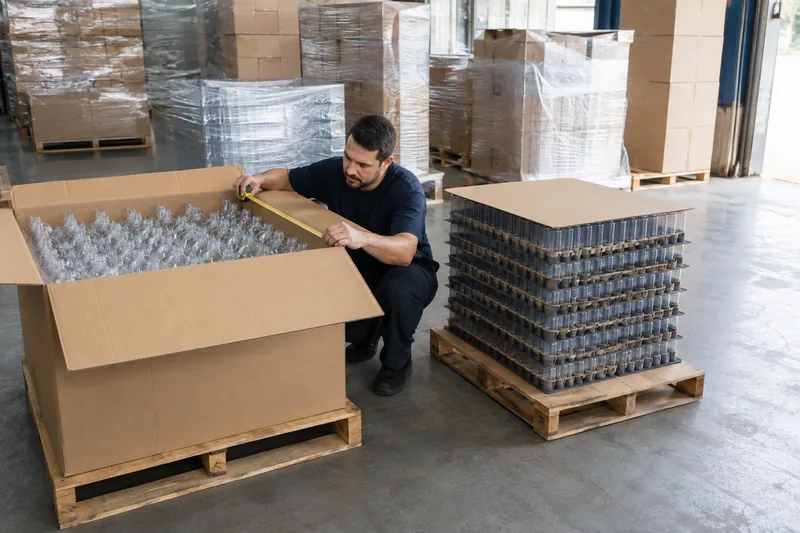
Empty bottles are a classic freight trap: low mass does not mean low freight because cartons can reach their volume limit long before their weight limit. A Chinese ex-works bottle can be inexpensive and still cost more landed than a regional bottle if the pack-out is inefficient or demand is too small.
A ten-step China sourcing sequence
- Freeze the RFQ: issue one controlled specification and quotation sheet to every finalist.
- Identify the legal and production entities: match the contracting company, bank beneficiary, bottle plant, preform source, decorator and component factories.
- Normalize the quote: same currency, quantity, component scope, overrun, Incoterm 2020 rule, named place, payment and validity.
- Approve representative samples: stock samples answer look/fit questions; production-intent samples answer material/process questions.
- Confirm tooling terms: list tools, cavities, ownership, storage, maintenance, sampling, corrections and access if the relationship ends.
- Qualify the complete package: bottle, closure, formula, decoration, liner/seal and shipping case under actual conditions.
- Run a pilot or controlled first order: inspect across cavities and time, not only supplier-selected golden samples.
- Book pre-shipment inspection: use the signed specification, defect catalog, test methods, lot definition and sampling plan.
- Verify pack-out and freight: confirm carton dimensions, gross/net weight, pieces/carton, pallet pattern and container utilization.
- Close change control: no material, preform, color, cavity, site, decorator or closure-source change without notice and defined reapproval.
Compare trade terms at the same handover point
Incoterms allocate delivery, cost and risk; they do not make two differently scoped quotes equal. ICC recommends FCA for many containerized or multimodal movements where delivery occurs to the carrier, while FOB is for goods delivered on board a vessel.[22] Always state the named place and “Incoterms 2020.” A bare “FOB China” is incomplete because China has many ports and inland legs.
| Landed-cost input | Data to request | Common mistake |
|---|---|---|
| Goods | Price by quantity, weight, BOM, decoration, assembly, packing and normal overrun | Using the sample price or advertised starting price |
| Export logistics | Pickup point, port/terminal, documentation, handling and customs responsibilities | Assuming EXW includes export clearance or terminal cost |
| Freight cube | Carton L × W × H, pieces/carton, pallet/container plan | Comparing kilograms for a shipment governed by cubic volume |
| Import | HS classification review, origin, duty, taxes/fees and broker | Copying a tariff rate from another material or country |
| Quality and loss | Inspection, testing, damage, reject allowance and replacement mechanism | Treating every ordered bottle as a usable filled pack |
| Cash and time | Deposit, balance timing, production/transit, safety stock and financing rate | Ignoring cash tied up during a long replenishment cycle |
13. How to reduce PET bottle cost without buying a weaker package
- Reduce SKU fragmentation. Use one bottle/color where possible and differentiate with labels or secondary packaging.
- Use an existing neck and qualified preform. Custom body geometry may be possible without funding a new preform system.
- Rightweight with performance gates. Model and trial material distribution, then validate top load, seal, filling, use and distribution.
- Design decoration for the actual volume. Digital labels can beat multi-color direct print at launch; direct decoration may win when repeat volume is stable.
- Improve case density. Small geometry changes can increase bottles per carton/pallet and lower freight, storage and handling.
- Standardize closures. A shared cap/pump family can reduce component MOQ, inventory and line changeovers.
- Separate one-time charges. Paying tooling or setup transparently prevents a supplier from embedding the same charge indefinitely.
- Use blanket orders with releases carefully. Committed annual volume can improve production economics while scheduled releases reduce finished inventory—if ownership and storage risk are explicit.
- Set a resin adjustment rule for long programs. Define index, grade, geography, baseline, review frequency, lag and pass-through formula instead of renegotiating from an untraceable number.
- Pay for prevention at the critical point. Neck, sealing surface, wall distribution and compatibility evidence usually create more value than blanket cosmetic inspection.
Ask the factory to quote three engineered alternatives
Request (A) exact specification, (B) lowest-risk value-engineered option and (C) lowest-cost viable option. For each change, require the cost delta, technical consequence, new validation and affected lead time. This converts vague “best price” negotiation into a controlled design decision.
14. Copyable PET bottle RFQ and quote-comparison checklist
Send the same controlled data to every supplier. Mark unknowns as “supplier to propose”; do not leave them silently open.
PET bottle: application/product; nominal and overflow capacity; target and allowable weight range; bottle dimensions; neck-finish drawing; approved closure drawing/sample; resin grade/IV; virgin/PCR percentage and source requirements; color/Pantone and tolerance; transparency/haze; wall/material-distribution requirements; top load/pressure/vacuum as relevant; filling temperature and line speed; compatibility and shelf-life conditions.
Decoration: process, artwork revision, colors, coverage, registration, adhesion/rub/chemical resistance, label/sleeve material, approved appearance sample and recyclable-design requirement.
Quality: critical/major/minor defect definitions; drawing tolerances; test methods and limits; cavity traceability; COA/lot record; sampling plan; control samples; change notification; nonconformance and replacement terms.
Commercial: annual demand and release sizes; price at 5k/10k/25k/50k/100k; all fixed charges; tooling list/terms; sample and production lead-time assumptions; normal over/underrun; pieces/carton; carton/pallet dimensions and weights; currency; payment; validity; named place and Incoterms 2020 rule.
Minimum columns in the comparison sheet
| Supplier data | Supplier A | Supplier B | Supplier C |
|---|---|---|---|
| Bottle part/revision and guaranteed weight | |||
| Resin/preform/PCR specification | |||
| Bottle-only price by identical quantity | |||
| Closure, decoration and assembly price | |||
| Lot setup and program-fixed charges | |||
| Yield/overrun and inspection assumptions | |||
| Carton/pallet density and freight cube | |||
| Incoterm, named place, payment and validity | |||
| Landed cost per usable filled pack |
Frequently asked questions
What is the cheapest way to make a PET bottle?
Use a proven stock mold, standard neck and qualified preform; keep the bottle clear or in an existing color; use a simple stock closure; minimize SKU count; choose decoration suited to the volume; and order enough to dilute fixed setup without overbuying. Then validate the complete pack. Removing grams or controls without performance evidence can increase total cost.
Is PET resin the largest bottle cost?
It is often the largest variable input for a plain high-volume bottle, and bottle weight therefore matters greatly. At small MOQ, however, setup, handling and packing can dominate. In a decorated cosmetic package, the pump and finishing may cost more than the PET body. Calculate the actual scope rather than applying one percentage.
Do I need a custom mold to add my logo?
No. A printed or labelled logo normally uses an existing bottle geometry. Embossed or debossed PET geometry requires a mold or mold insert change and design review. Compare visual value, quantity and tooling amortization before choosing physical embossing.
What is a normal MOQ for PET bottles?
There is no universal MOQ. Stock bottles held by a distributor may be available by the case; a factory stock-mold run may begin in the low thousands; custom color, direct print, pumps or custom geometry can require higher quantities. Ask for MOQ per size, color, artwork, decoration and closure—not only the headline bottle MOQ.
Why does the price fall so much between 5,000 and 100,000 bottles?
Machine changeover, color purge, print setup, first-off approval, administration and testing are divided by more units, while high-volume equipment and packing can run closer to efficient speed. Once fixed charges become small, price reductions should flatten toward the variable material and conversion floor.
Does recycled PET make the bottle cheaper?
Not necessarily. Food-contact-qualified or high-clarity rPET can carry a premium or face regional supply constraints; other markets and grades may price differently. PCR can also change color, process window, yield and evidence requirements. Quote the exact source, percentage, grade, application and market rather than assuming recycled content is a discount.
Are PET bottles always cheaper from China?
No. China can offer competitive conversion and decoration, but empty bottles consume freight cube and long replenishment increases cash and inventory risk. At small volume or for urgent replenishment, a domestic stock supplier can have lower landed usable cost. Compare at the same destination and service level.
How long should a PET bottle quote remain valid?
There is no universal term because resin, exchange rates, freight and factory capacity move. Require a written validity date. For a long-term program, agree a review rule naming the PET grade/region/index, baseline, review interval, lag and pass-through formula so both increases and decreases work consistently.
What is the fastest way to compare two PET bottle quotes?
Normalize bottle revision, gram weight, resin/PCR, closure, decoration, quantity, fixed charges, packing, payment, currency, named place and Incoterm. Then calculate landed cost per usable filled pack and list evidence gaps. If those fields differ, the two unit prices do not yet answer which supplier costs less.
Sources
- PET Resin Association — About PET.
- CYPET Technologies — Injection Stretch Blow Moulding Technology.
- Chia Ming Machinery — Stretch Blow Molding Process and Equipment.
- Sidel — PET Container Production Eco-Audit and Cost Drivers.
- U.S. SEC Filing — Historical PET Bottle Cost Formula Schedule.
- ICIS — Polyethylene Terephthalate Price Report Methodology.
- Federal Reserve Bank of St. Louis / U.S. BLS — Plastics Material and Resin Manufacturing PPI.
- Sidel — PET Lightweighting Solutions, 2026.
- International Society of Beverage Technologists — Voluntary Bottle Finish Guidelines.
- Krones — PET Preform and Container Inspection.
- ISO — ISO 2859-1:2026 Sampling Procedures for Inspection by Attributes.
- U.S. FDA — Determining the Regulatory Status of Food-Contact Material Components.
- U.S. FDA — Recycled Plastics in Food Packaging.
- European Commission — Food Contact Materials.
- EUR-Lex — Regulation (EU) No 10/2011 on Plastic Food-Contact Materials.
- EUR-Lex — Regulation (EU) 2025/40 on Packaging and Packaging Waste.
- NAPCOR — PET Design and Bale Specification Guidelines.
- European PET Bottle Platform — PET Design for Recycling Guidelines.
- International Safe Transit Association — Test Procedures.
- NAPCOR — Beverage Container Life-Cycle Assessment.
- Uline — Example Public PET Bottle-and-Cap Distributor Listing.
- International Chamber of Commerce — Incoterms 2020.
- Alibaba — Example Public PET Cosmetic Bottle Marketplace Listings.
 English
  Español de Argentina
  Русский
  Italiano
  日本語
日本語  한국어
한국어  العربية
  Français
  Deutsch