
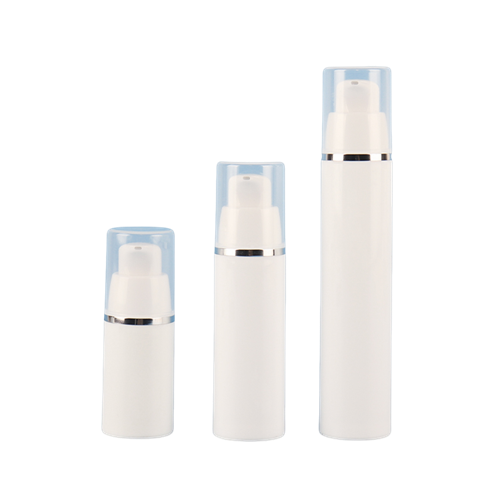

Direct answer: measure airless-pump evacuation by weight, using the actual formula and the complete finished package. First determine the verified net fill mass. Actuate the bottle under a written full-stroke protocol until the defined endpoint, let it rest for the specified recovery period, actuate again, then determine the product mass still inside the pump and bottle.
Evacuation rate (%) = (verified net fill − residual product mass) ÷ verified net fill × 100. Residual rate is the opposite fraction. If a bottle contains 50.00 g and 1.40 g remains at the endpoint, evacuation is 97.2% and residue is 2.8%. There is no universal cosmetic standard stating that every airless bottle must reach one percentage: the acceptance limit must name the exact bottle, pump, formula, fill, temperature, orientation, stroke and endpoint method.
This guide is for packaging engineers, cosmetic brands, contract fillers, purchasing and quality teams. It addresses piston-style airless bottles; bag-in-bottle and pouch systems need structure-specific instructions. The numerical examples are calculation examples—not automatic specifications for every product.

Airless pump evacuation rate, residual rate and usable recovery
Evacuation rate tells you what share of the filled product the package can deliver under a defined use simulation. It is a package-and-formula result, not a property of the empty bottle alone. A pump can have excellent laboratory output with a low-viscosity reference liquid yet leave substantial cream in the final market pack.
| Metric | Calculation | What it answers |
|---|---|---|
| Verified net fill mass | Initial filled-package mass − empty-package tare | How much formula actually entered this test unit? |
| Residual product mass | Endpoint package mass − clean, dry package tare | How much formula remains in the bottle, piston area, chamber and outlet? |
| Evacuation rate | (Net fill − residue) ÷ net fill × 100% | What percentage was delivered by the defined endpoint? |
| Residual rate | Residue ÷ net fill × 100% | What percentage remains unavailable? |
| Equivalent lost doses | Residual mass ÷ steady-state mean dose mass | How many full doses does the inaccessible residue represent? |
Evacuation and residual percentages add to 100% only when the mass balance is closed. Evaporation, leakage, product left in collection vessels, inconsistent wiping or a changed package assembly creates an unexplained loss. Report that loss; do not quietly call it “dispensed.”
Mass is the preferred primary measurement. Convert to volume only with the formula density at the stated temperature: volume = mass ÷ density. One gram is not automatically one millilitre. An oil, alcohol-rich serum and dense mineral sunscreen can all produce different mass-to-volume conversions.
How a piston airless pump empties the bottle
Pressing the actuator discharges the product held in the pump chamber. When the actuator returns, its valves switch state and the chamber refills. The pressure difference below the product causes the internal piston to move upward, keeping the formula in contact with the inlet. Outside air enters below the piston through the base vent; it should not bubble through the formula as it would in an ordinary dip-tube bottle.
“Airless” therefore does not mean a perfect laboratory vacuum, a sterile package or zero residue. Product must still occupy the pump chamber and outlet path. Some wall film and seal wetting are unavoidable. Performance becomes unacceptable when additional product is trapped by piston tilt, friction, a blocked vent, formula bridging, internal geometry, air leakage or a pump that cannot refill.
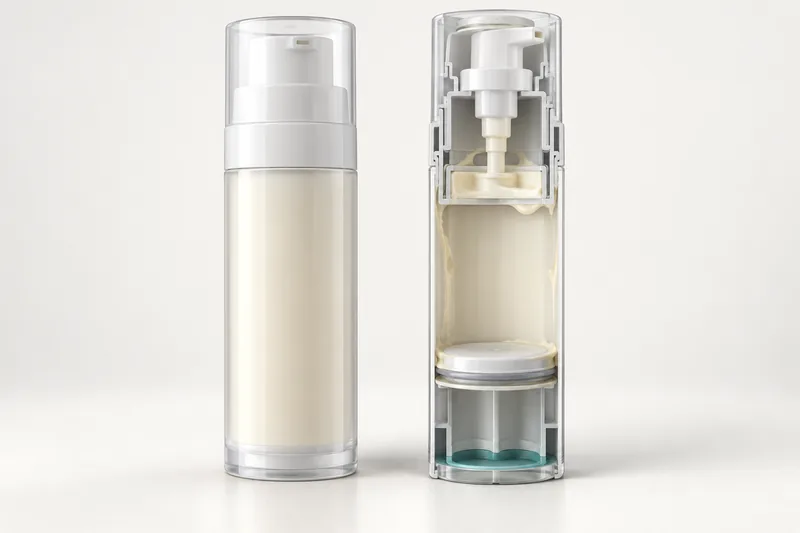
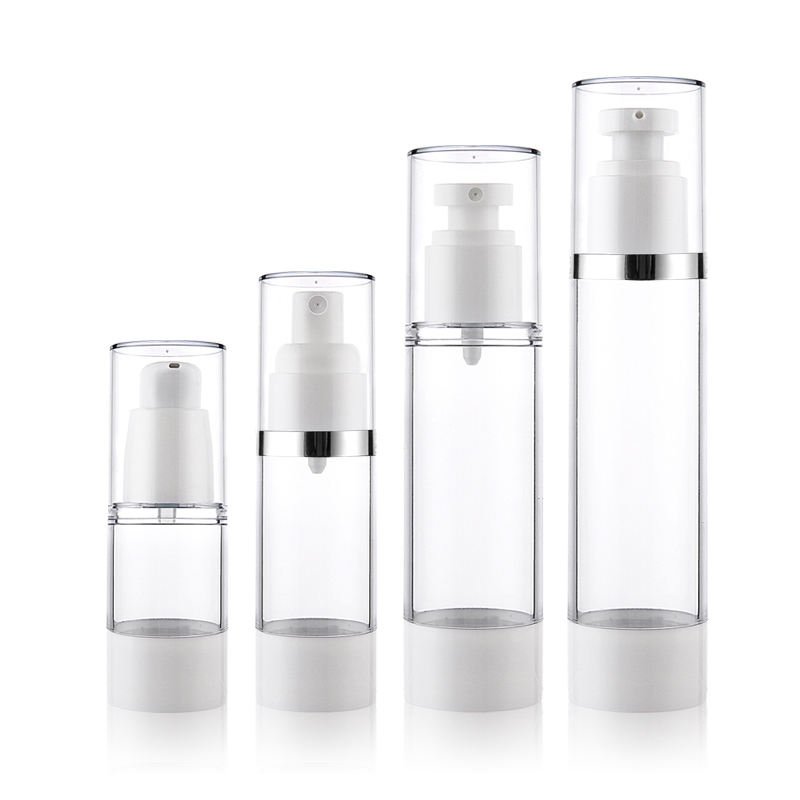
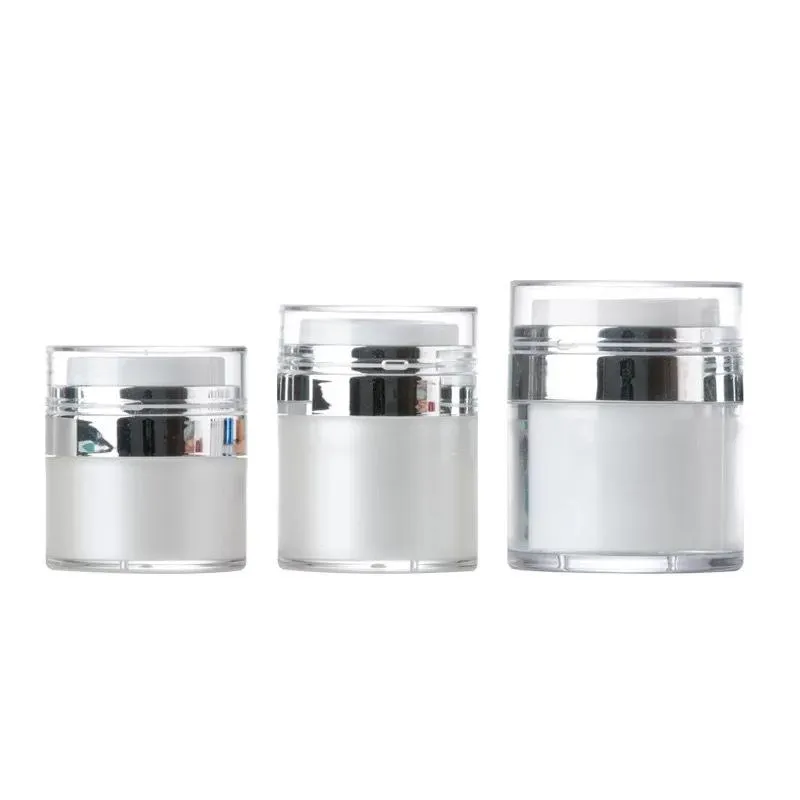
For product selection, start with Boyu’s airless pump bottle category, then qualify the chosen construction with the market formula. A production example such as the 30–150 mL PP airless lotion bottle series still requires confirmation of its exact pump, piston, component materials and output for each formula.
A repeatable gravimetric evacuation test
A useful protocol controls the variables that change the answer. The following sequence is a practical qualification framework; convert it into a controlled SOP with project-specific numbers and responsibilities.
- Define the test article. Record bottle, piston, pump, actuator, gasket, overcap, resin and colorant part numbers; mold cavity and lot where available; decoration; assembly date; formula batch; target fill; and filling process.
- Select representative units. Sample across relevant molding cavities, component lots and assembly positions. One hand-picked unit is a demonstration, not qualification. Set the sample size from product risk, lot variability and the decision the data must support.
- Establish tare correctly. The strongest approach is an individual package tare obtained without altering the final assembly. If the unit cannot be filled after taring without changing it, use a validated matched-component tare or determine the individual clean/dry tare destructively after the test. Record exactly which parts—overcap included or excluded—are weighed.
- Condition the pack and formula. State time, temperature and storage orientation. Test at the normal laboratory condition and at relevant use limits when rheology changes materially. A cream that empties at 23°C may stall in a cold bathroom or after aging.
- Fill by the production-representative process. Control net fill, nozzle position, fill speed, air entrapment, assembly delay and pump installation. Remove external product without drawing formula out of the internal path.
- Weigh the initial finished unit. Use a calibrated balance with resolution suitable for the smallest meaningful residue difference. As a practical metrology rule, the display increment should be no larger than one-tenth of the change you need to distinguish.
- Prime and record. Use complete press-and-release cycles at the specified rate, letting the actuator return fully. Record strokes to first product and strokes to a continuous, air-free dose. Priming is a different result from evacuation.
- Run the use simulation. Actuate in the intended orientation and at the written interval. Either collect every dose in tared vessels or periodically weigh the package. Capture early, middle and late-life output so a falling dose is not hidden by the final percentage.
- Apply the endpoint rule. Stop only when the pre-agreed endpoint is met. Then rest the bottle in the defined orientation for the defined period and repeat the endpoint challenge.
- Determine residue. Weigh the unchanged endpoint package, then disassemble safely, recover or remove product, clean with a validated method, dry to constant mass and weigh the package tare. If cleaning can extract plastic additives or leave solvent/water, validate the tare method with controls.
- Close the mass balance. Compare initial product mass with delivered product plus measured residue plus known sampling/wipe losses. Investigate unexplained loss beyond the stated method uncertainty.
- Map where residue sits. Photograph and, where useful, weigh residue by zone: actuator/outlet, pump chamber, upper land, bottle wall, piston perimeter, bulk product above a stalled piston and base/vent region.
- Report every unit. Give individual values, mean, standard deviation, minimum evacuation, maximum residue and failures. A good average can hide one stalled bottle.
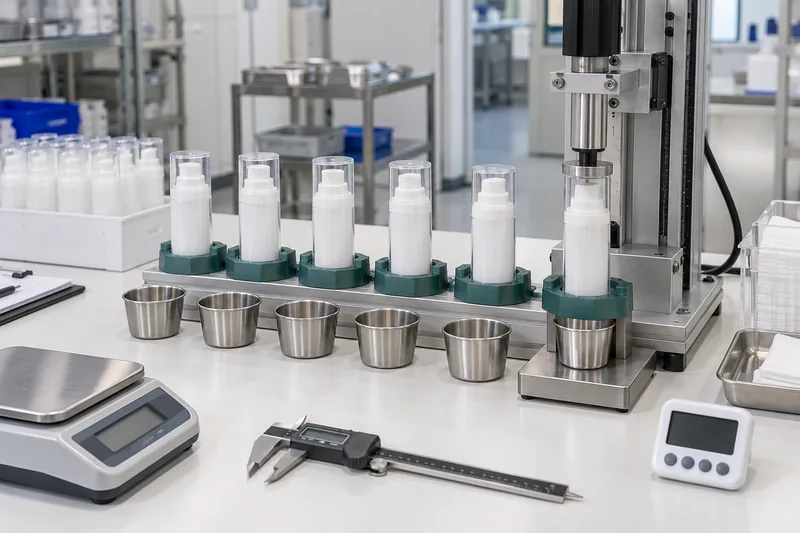
ASTM D3890 addresses strokes required to prime a mechanical pump dispenser; ASTM D4336 addresses mean output per actuation by weight; ASTM D6633 addresses basic functional stability through accelerated usage. These are useful parts of a pump test program, but none replaces an agreed cosmetic airless evacuation protocol for the complete pack. Keep pump output-per-stroke verification separate from the emptying result, then interpret the two together.
The endpoint determines the result
“Pump until empty” is not reproducible. One operator may stop at the first sputter; another may make 40 rapid partial strokes. Define an objective endpoint before testing. A defensible rule may combine:
- a complete actuator stroke and full return;
- a maximum actuation rate;
- a dose threshold stated as mass or as a percentage of the unit’s steady-state mean dose;
- a required number of consecutive sub-threshold strokes;
- a specified rest period and orientation, followed by a restart challenge;
- treatment of intermittent spits, air-only strokes and a later recovered dose.
For example, a company might define endpoint as three consecutive full strokes each delivering less than 10% of that unit’s steady-state mean dose, followed by 24 hours upright and a repeat challenge. That is an example protocol, not an international standard. The independent 2025 emptiability study cited below used a different operational rule: no product after three pump actions, then a 24-hour upright rest at 23°C and a repeat. Results from different endpoints should not be compared as if they were equivalent.
Three methods—and what each can miss
| Method | Best use | Main control | Main limitation |
|---|---|---|---|
| Package mass balance | Primary evacuation percentage | Reliable individual tare and unchanged assembly | Does not locate residue unless followed by disassembly |
| Collected-dose sum | Dose curve and useful delivered amount | Tared vessels, low transfer loss and evaporation control | Product on tools/cups can create apparent loss |
| Destructive recovery | Root-cause location and zone mass | Validated scraping, rinsing or extraction recovery | Recovery may be incomplete; cleaning can change package mass |
Worked evacuation-rate calculation
Measured values
Initial filled package = 78.10 g
Clean, dry individual package tare = 28.10 g
Endpoint package before cleaning = 29.50 g
Net fill = 78.10 − 28.10 = 50.00 g
Residual mass = 29.50 − 28.10 = 1.40 g
Evacuation = (50.00 − 1.40) ÷ 50.00 × 100 = 97.2%
Residual rate = 1.40 ÷ 50.00 × 100 = 2.8%
If the steady-state mean dose is 0.40 g, the remaining 1.40 g equals 3.5 nominal full doses. That consumer-oriented result can be more decision-useful than “2.8%,” especially for a high-value treatment. Also calculate lost product value: residual mass × filled-product cost per gram. The cost of residue—not only the percentage—helps prioritize engineering work.
What is a good airless pump evacuation rate?
There is no single universal pass percentage for all cosmetic airless bottles. Supplier pages commonly advertise high evacuation values, but those figures may use different liquids, fills, temperatures, endpoints and denominators. Treat a claim such as “95%” or “98%” as a result to reproduce under disclosed conditions—not as a global standard.
Independent evidence also shows why one number is misleading. A 2025 study of commercial cosmetic packs reported low but varying residue for several airless products: some airless body-lotion packs left roughly 0.29%–1.18%, some face-cream packs were below 1%, while another face-cream pack left about 3.3% and an airless jar example about 5.18%. Those are observations for the tested products and method, not automatic acceptance limits for a new package.
Build the acceptance rule from four gates
- Consumer-value gate: define the maximum residue mass, percentage, lost doses and—when relevant—lost retail value that the brand will accept.
- Function gate: require correct priming, continuous delivery, complete actuator return, piston travel, acceptable late-life dose and restart after the rest period. A high average evacuation does not excuse a stalled unit.
- Statistical gate: set both a lot statistic and an individual-unit floor or maximum residue. State sample size, lot definition and handling of failures. Do not pass a lot only because the mean looks good.
- Claim gate: if marketing or the supplier promises an evacuation value, reproduce it using the same formula and disclosed method, and preserve the report supporting the claim.
A specification can therefore say, for example, “each unit shall meet the agreed minimum evacuation rate, the lot mean shall meet the agreed target, no unit shall stall or admit visible air, and late-life output shall remain within the signed dose profile.” Insert project-derived numbers after pilot and qualification data—not after the shipment fails.
This limit should sit inside the wider cosmetic packaging quality agreement, together with change control. For lot decisions, connect the individual and mean evacuation limits to the brand’s cosmetic packaging AQL inspection plan without confusing AQL with the performance specification itself. A new pump engine, piston resin, lubricant, bottle cavity, assembly plant or formula supplier can change evacuation even when the pack looks identical.
Read the residual pattern before choosing a fix
| Observed residue | Likely mechanism | Confirm first | Engineering direction |
|---|---|---|---|
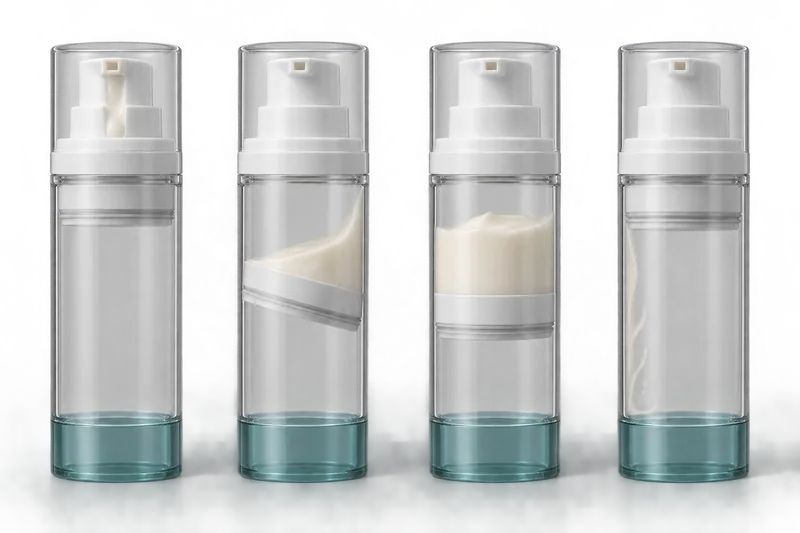
| Piston reaches top; small residue only in outlet/chamber | Normal wetted-path dead volume or high chamber hold-up | Recover pump-path residue separately | Reduce path/chamber hold-up if consumer value justifies redesign |
| One-sided wedge; piston visibly tilted | Bottle ovality, piston mismatch, uneven lip friction, flash or side load | Piston/bore dimensions by cavity and travel marks | Correct bore roundness, piston design, molding or assembly alignment |
| Level piston stalls at repeatable height | Blocked base vent, local bore restriction, high friction or insufficient pressure differential | Vent keep-clear, label/decor position, bore profile and friction | Restore airflow below piston; correct geometry/material pairing |
| Thin wall film; piston otherwise travels fully | Formula adhesion, yield stress, surface energy or temperature-dependent rheology | Residue by temperature/age; formula-to-wall interaction | Evaluate compatible surface/material and formula rheology; do not assume more vacuum removes film |
| Large air pockets; intermittent dose | Entrapped fill air, leak in product path, valve issue or incomplete prime | Fill video/section, seal integrity, valve function and prime count | Improve filling/degassing and assembly; match pump inlet/valves |
| Good fresh result; poor after aging or cold storage | Rheology shift, resin/seal swelling, lubricant migration, creep or formula separation | Aged component dimensions, torque/function and formula state | Change material/formula interface, tolerance or storage design; requalify |
Why an airless bottle leaves too much product
1. The test method creates the failure
Partial strokes, an actuator that cannot return, very rapid cycling, inconsistent wiping and stopping at the first air shot can all depress the result. Conversely, shaking, warming or opening the pack during the test can inflate performance beyond real consumer use. First audit the method, balance, tare and calculation.
2. The base vent cannot admit air below the piston
A piston pack needs outside air beneath the piston. A label, bottom decoration, transport cap feature, molding flash or debris can block the vent. The pump then creates insufficient pressure differential to raise the piston. Define a no-label/no-coating keep-clear area on the drawing and inspect it after decorating and packing.
3. Piston and bottle bore do not travel as a system
Too little sealing force can admit air past the piston; too much produces friction and stalls. Bottle ovality, taper, ribs, sink, weld lines, flash, piston-lip variation and resin friction all matter. Measure the functional bore along the travel path and across cavities, not only the external diameter at one height.
4. Formula rheology exceeds the flow path
A single viscosity value is incomplete. Yield stress, shear thinning, thixotropic recovery, particles, wax structure and temperature determine whether formula flows into the chamber between strokes and releases from the wall. Use the real formula over its temperature and aging range. Water is useful for some leak checks, but it is not a qualification surrogate for a viscous cream or mineral suspension.
5. Filling traps air or places the piston incorrectly
High fill speed, poor nozzle depth, interrupted flow, foaming, an inappropriate fill sequence or delayed assembly can leave voids. Underfill may change the initial piston position and prime behavior. Record actual production filling settings and inspect filled units by sectioning or suitable imaging during development.
6. Pump valves, spring or chamber do not recover
A restricted inlet, valve contamination, high valve opening pressure, seal leakage, incomplete spring return or narrow outlet can cause intermittent delivery. Diagnose priming, steady-state dose and end-of-life performance separately. Boyu’s guide to an airless pump bottle that stops working covers basic user-visible symptoms; an evacuation failure requires the deeper mass-balance and residue-location work described here.
How to prevent poor evacuation before mass production
- Write the product profile first: target fill, density, rheology across temperature, particles, solvent/oil content, intended dose, daily use, orientation, shelf life and consumer population.
- Select the complete pack as a system: bottle bore, piston, pump engine, valve path, actuator, gasket, base vent and overcap. Do not approve a pump and bottle from unrelated drawings without assembled-product trials.
- Set dose and evacuation together: a larger chamber may reduce stroke count but increase path hold-up or worsen refill with a thick product. Compare dose curve, prime, evacuation and user force in one matrix.
- Lock the fill process: define fill temperature, speed, nozzle depth, net-fill tolerance, degassing/settling where appropriate and assembly timing. Reproduce these conditions in qualification.
- Protect the vent: show the keep-clear zone on decoration, label and packaging drawings, then inspect finished—not only molded—units.
- Test production-representative variation: include multiple cavities, pump lots, resin/color lots and assembly conditions. Challenge low/high fill and relevant dimensional tolerance limits.
- Age the real formula in the final pack: repeat prime, dose, leak, piston travel and evacuation after compatibility/stability exposures. Use the cosmetic packaging compatibility protocol to connect appearance and material changes with function.
- Retain evidence: approved samples, drawings, formula version, raw data, photographs, cleaning validation and test software/spreadsheet revision. The final number should be auditable.
What to do when evacuation fails
- Contain affected stock. Identify component, formula, filling, assembly and finished-goods lots. Preserve unopened controls; do not test every remaining complaint sample to destruction.
- Verify the measurement. Recheck balance status, tare, fill calculation, endpoint, stroke completeness, temperature, cap inclusion and cleaning/drying. Calculate mass-balance closure.
- Sort the failure mode. Separate high normal path hold-up, tilted piston, stalled piston, wall film, air ingress, underfill and pump malfunction. Record piston height and residue location before opening.
- Compare known-good and failed units. Use the same formula and operator. Measure bottle bore/ovality, piston and valve parts by cavity/lot; inspect vent clearance and fill voids.
- Change one variable at a time. Swapping pump, piston, bottle and formula simultaneously may produce a pass without identifying the cause. Use a structured experiment when interactions are likely.
- Implement corrective action and revalidate. A material, lubricant, valve, cavity, decoration, fill-process or supplier change can require compatibility and evacuation requalification under the approved change-control plan.
- Decide disposition from risk and evidence. Rework or use-as-is needs documented technical approval; consumer instructions cannot compensate for a package that fails its agreed specification.
What to put in the drawing, quality agreement and test report
| Document | Minimum content |
|---|---|
| Component specification | Part numbers, materials/grades where agreed, critical dimensions/tolerances, functional bore, piston, pump output, vent keep-clear, assembly and approved sample. |
| Test SOP | Formula, fill, conditioning, orientation, full-stroke definition, rate, rest interval, endpoint, tare/cleaning method, balance resolution, calculation and deviation handling. |
| Acceptance plan | Lot definition, sample selection, individual and lot limits, prime/dose/restart requirements, treatment of stalls, retest rules and decision authority. |
| Test report | Every unit’s initial, tare, endpoint and residue mass; evacuation; prime and dose data; photos; mean/variation/range; mass-balance closure; failures; equipment and date. |
| Change control | Which formula, component, resin, colorant, lubricant, mold/cavity, pump supplier, assembly, decoration or filling-process changes require notification, approval and requalification. |
If you add a second pump or bottle source, do not rely on matching appearance or nominal size. Follow a controlled packaging second-source qualification that compares drawings, materials, functional output and the filled-product evacuation profile.
Frequently asked questions
Can I judge evacuation by looking at the piston position?
No. Piston position helps diagnose the mechanism but does not measure residue in the pump path, wall film or piston perimeter. Use gravimetric residue and then interpret the location.
Is 95% evacuation automatically acceptable?
No. It may be a project target, but acceptability depends on method, formula value, lost doses, individual failures and the supplier/brand agreement. A 5% loss in a 15 g high-value treatment may matter more than the same percentage in a low-cost body lotion.
Should residue include product inside the pump?
Yes, if the claim concerns what the consumer can obtain from the complete package. Report total residue as the primary value. You may additionally separate unavoidable pump-path hold-up from bottle/piston residue for engineering diagnosis.
Can water be used for the evacuation test?
Only for limited screening where the method says so. Water does not reproduce the yield stress, wall adhesion, particle load, valve refill or temperature response of many cosmetic formulas. Qualification should use the final formula or a scientifically justified rheological surrogate.
Why does the last part dispense in small spits?
The chamber may no longer refill completely because of air ingress, piston stall, formula bridging, valve restriction or insufficient recovery time. Plot dose by stroke near end of life and inspect the piston/vent before calling the pack empty.
How many bottles should be tested?
There is no risk-free universal count. Use multiple production-representative units across relevant cavities and component lots, then base qualification sample size on variability, failure consequences and the desired confidence. Ten units may screen a design, but they do not automatically validate a high-volume supply process.
Qualify the bottle, pump, formula and filling process together
Send Boyu Packaging the intended formula type, rheology or viscosity data, fill size, target dose, current residual problem, market and production volume. We can help narrow an airless structure and prepare samples for your filled-product prime, dose, compatibility and evacuation trials.
Sources and technical references
- Chrobot, K. et al., “Product Waste Resulting from Insufficient Emptiability of Cosmetic Packaging and Its Economic and Environmental Implications,” Sustainability 17(3), 1056 (2025). Study and test method.
- ASTM D3890-18(2025), Standard Practice for Number of Strokes to Prime a Mechanical Pump Dispenser. ASTM standard page.
- ASTM D4336-18(2025), Standard Practice for Determination of the Output Per Stroke of a Mechanical Pump Dispenser. ASTM standard page.
- ASTM D6633-18(2025), Standard Practice for Basic Functional Stability of a Mechanical Pump Dispenser. ASTM standard page.
- Rathore, S., Schuler, B. and Park, J., “Life cycle assessment of multiple dispensing systems used for cosmetic product packaging,” Packaging Technology and Science 36(7), 533–547 (2023). The analysis included product residue in its environmental assessment. DOI record.
Standards are copyrighted and may be revised. Confirm the current edition and purchase/access the full method before claiming compliance. This article summarizes scope and application; it does not reproduce the standards.



 English
  Español de Argentina
  Русский
  Italiano
  日本語
日本語  한국어
한국어  العربية
  Français
  Deutsch