

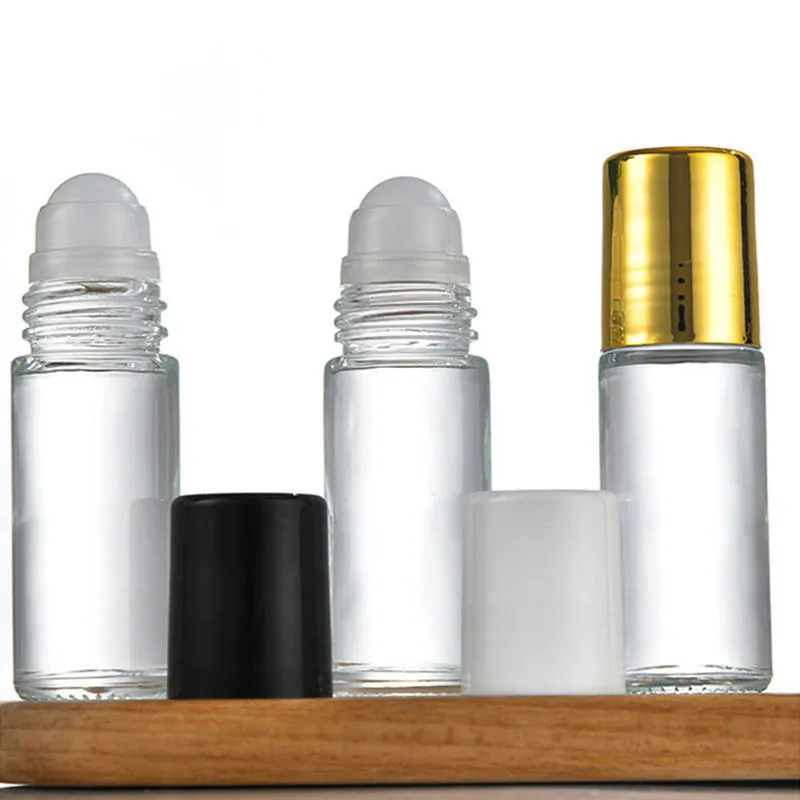
Direct answer: a bottle can pass dimensional, drop and basic leak checks yet still leak after filling because the gasket is only one part of a loaded sealing system. The formula may be absorbed into the gasket and cause swelling or softening; it may extract ingredients and cause shrinkage or hardening; or the cap, gasket and bottle land may lose contact pressure through compression set, creep, torque loss, thermal cycling or geometric mismatch.
The fix is not automatically “use silicone” or “tighten the cap.” Identify the exact gasket compound and structure, test it with the real formula, measure its dimensional and mechanical change, then test the complete filled package at controlled application torque through aging and distribution conditions. There is no universal cosmetic gasket material or one allowable swelling percentage for every package.
This guide is for cosmetic packaging engineers, brand quality teams, contract fillers, procurement teams and suppliers. “Gasket” is used broadly; the article distinguishes flat cap liners, elastomer washers and O-rings, molded plug seals and induction inner seals where their functions differ.

First identify the sealing component you actually have
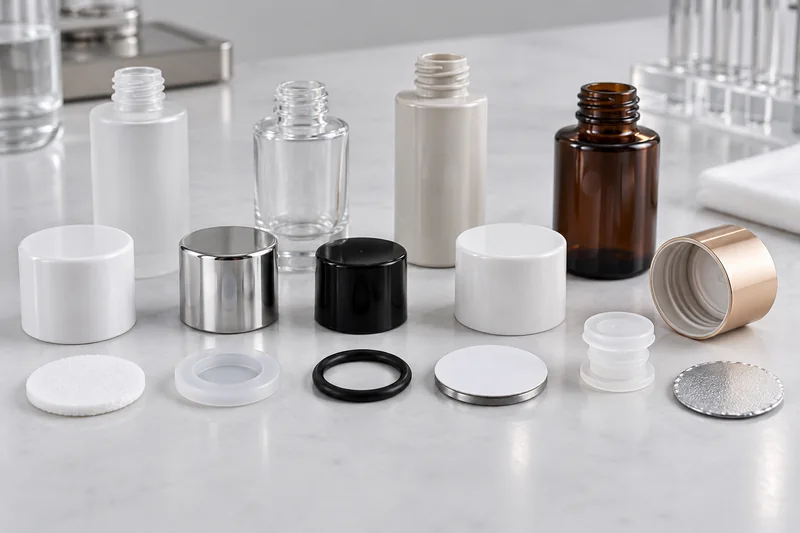
Packaging teams often use gasket, liner, wad, seal and washer as if they were the same part. They are not always interchangeable. The structure determines which properties matter and how the component can fail.
| Component | How it seals | Typical failure focus |
|---|---|---|
| Flat cap liner or wad | Compresses between the cap deck and bottle/jar sealing land | Compression loss, miscentering, swelling, facing delamination, edge wicking |
| Elastomer washer or O-ring | Deforms in a defined seat or gland to maintain contact pressure | Compound compatibility, squeeze, compression set, extrusion or twisting |
| Molded plug or cone seal | Creates radial or line contact inside the bottle bore | Bore tolerance, ovality, insertion depth, creep, surface damage |
| Induction inner seal | A heat-seal layer bonds a foil laminate to the container land | Wrong sealant layer, poor pressure, energy/window, land contamination, channels or weak bond |
| Integral cap sealing feature | A molded land, crab-claw, lip or plug seals without a separate liner | Resin creep, molding variation, mismatch with the container finish |
A foam liner that reseals after opening is not equivalent to an induction foil that provides first-opening evidence. A chemically resistant PTFE film is not, by itself, an elastic gasket. A silicone washer used under a pump collar behaves differently from a silicone O-ring confined in a groove. Start every investigation with a drawing, bill of materials and physical cross-section of the exact assembly.
How a gasket makes—and loses—a seal
When a screw cap is applied, thread torque produces axial clamping force. The gasket deforms against the bottle’s sealing land and fills small surface irregularities. The seal works only while contact pressure remains continuous around the full circumference and remains greater than the forces trying to separate or bypass the interface.
Application torque is therefore an input, not the seal itself. The relationship between torque and useful clamping force changes with thread geometry, friction, cap material, liner stiffness, lubrication, bottle finish and capping equipment. Removal torque measured later is useful for process control, but it is not a direct measurement of microscopic gasket contact pressure.
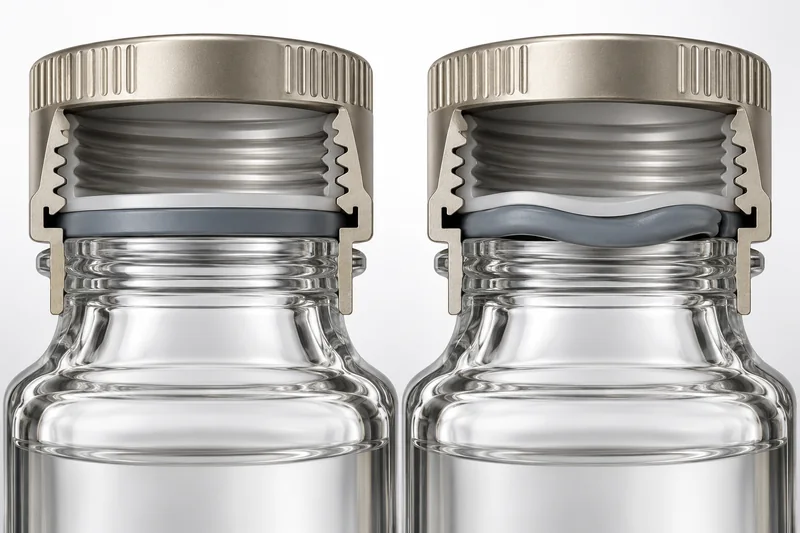
Compression set, stress relaxation and cap creep
Elastomers do not recover perfectly after prolonged compression. Compression set describes the permanent deformation that remains after a defined compression and recovery procedure. Stress relaxation describes the fall in force while deformation is held. Plastic caps and integral sealing features can also creep under load. Heat usually accelerates these time-dependent effects.
A package can therefore pass a same-day inversion check and leak weeks later. The cap may still look tight, but the original sealing force has decayed. Temperature cycling adds differential expansion and contraction among the bottle, cap and gasket; vibration and handling can then exploit a marginal interface.
Geometry decides where the force goes
The bottle land must be sufficiently flat, continuous and perpendicular to the axis. Neck ovality, mold seams, chips, flash, sink, a narrow land or excessive height variation can concentrate load on one sector and leave another under-compressed. Cap thread start, thread engagement, deck flatness, liner recess and liner diameter also matter. Boyu’s guide to plastic bottle neck finishes and thread dimensions explains the upstream interface that a gasket must seal.
Why a cosmetic gasket swells, shrinks, softens or hardens
Parker’s engineering handbook describes three mechanisms that may operate together when an elastomer contacts a liquid: the material absorbs the medium; the medium extracts plasticizers or other compound ingredients; or a chemical reaction changes the polymer network. The net result may be swelling, shrinkage, softening, hardening, loss of strength or embrittlement.
Absorption and swelling
Fragrance ingredients, essential oils, carrier oils, solvents or other formula components can diffuse into a polymer. Volume increases and hardness may fall. A small, uniform increase can initially improve contact in a static seal, but that is not a design strategy: further swelling can buckle a flat liner, push it out of its recess, narrow a pump passage or reduce tear and extrusion resistance. Constrained parts can behave differently from free immersion coupons.
Extraction, shrinkage and apparent false passes
A formula can remove low-molecular-weight additives from the gasket. The part may shrink or harden, reducing contact pressure. Absorption and extraction can occur simultaneously, so a near-zero net mass or volume change does not prove chemical stability: uptake may be masking material loss. Compare mass, dimensions, hardness, appearance and, when risk warrants, the formula’s extractables or leachables—not one number alone.
Temperature, time and surface-area effects
Higher temperature commonly increases diffusion and reaction rate, but an aggressive short high-temperature exposure does not always reproduce the same mechanism as long real-time storage. Thin gaskets and foam liners may change faster than thick molded parts because of geometry and exposed area. Formula vapor can affect a gasket even when the pack is stored upright and liquid does not visibly touch the seal.
For the full aging strategy, use a risk-based cosmetic packaging compatibility program and define realistic timepoints using the principles in Boyu’s guide to compatibility-test duration.
Cosmetic packaging gasket materials compared
The following table is a screening framework, not a substitute for testing. “Silicone,” “NBR” or “TPE” names only a polymer family. Cure system, copolymer ratio, hardness, filler, plasticizer, colorant, post-cure, foam density, facing and supplier formulation can change performance materially.
| Material or structure | Useful characteristics | Watch-outs | Reasonable screening context |
|---|---|---|---|
| PE foam / F217-type liner | Conformable, economical, low moisture uptake, useful resealing liner | Not tamper evidence; foam density, thickness and facings vary; aggressive oils/solvents may swell or soften some constructions | Water-based or mild personal-care formulas after filled-pack validation |
| TPE / TPV gasket | Moldable, tunable hardness, suitable for integrated or in-shell seals | Chemical and compression behavior are highly grade-specific; process temperature and adhesion matter | High-volume caps with validated compound and molding process |
| Silicone (VMQ) | Elastic recovery and broad temperature capability; useful as a washer or compliant backing | Can absorb certain oils or solvents; relatively permeable; extractables and cure system may matter | Closures needing compliance over temperature, subject to formula-specific screening |
| Nitrile rubber (NBR) | Often screened for oil resistance and good mechanical sealing | Performance varies with acrylonitrile content and compound; polar solvents, ozone, heat or aging can be limitations | Oil-rich systems only after exact-compound testing |
| EPDM | Often strong for water, weathering and many polar media | Generally unsuitable for many hydrocarbon oils; fragrance blends can defeat simple chemical-class rules | Aqueous systems after complete-formula compatibility testing |
| FKM fluoroelastomer | Broad resistance to many oils and solvents; good heat performance in suitable compounds | Higher cost; not universal for every ketone, amine, ester or polar chemistry; fluorinated-material policies may apply | Challenging solvent/oil systems when the exact compound is justified |
| Butyl rubber (IIR) | Low gas permeability and useful sealing/barrier properties | Not suitable for every organic solvent or extreme condition; reseal and low-temperature behavior depend on compound | Barrier-sensitive aqueous or mild-solvent systems after validation |
| PTFE-faced composite | Low-contact reactivity and broad chemical resistance at the product-facing surface | PTFE alone lacks elastic recovery; needs a compliant backing; cost, bonding, delamination and PFAS policy require review | Aggressive or high-purity formulas where a composite architecture is warranted |
| PP/PE molded plug or rigid liner | Low-part-count, potentially mono-family construction and repeatable molded geometry | Less able to accommodate land variation than soft foam; creep and dimensional fit dominate | Matched cap–neck systems with controlled molding tolerances |
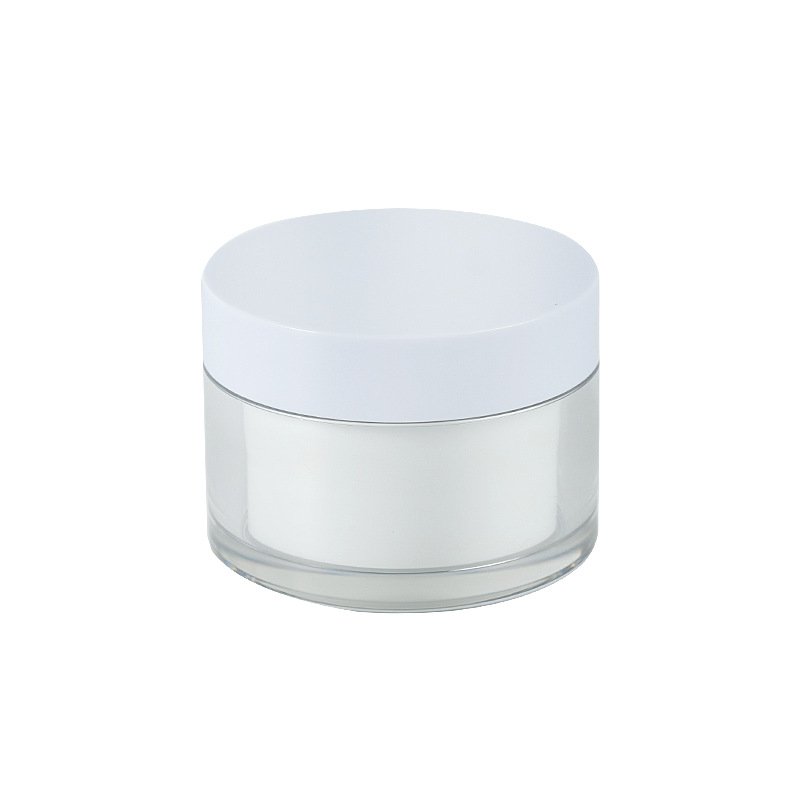
For oil and fragrance products, begin with a complete ingredient profile rather than the marketing label “natural oil.” Boyu’s essential-oil bottle category can support package-format selection, but the gasket or dropper bulb still requires its own compatibility evidence. For jars, shortlist the container and closure together from a cosmetic cream jar range, then approve the exact liner and formula combination.
Why the complete assembly still leaks
A swollen gasket is visible evidence, but it may not be the only cause. A useful investigation separates four classes of failure.
1. Material failure
The gasket absorbs formula, loses ingredients, degrades, embrittles, becomes tacky or delaminates from its facing/backing. Formula vapor, cleaning agents and manufacturing lubricants should be included in the exposure map where relevant. A supplier compatibility chart can reject an obviously poor candidate, but cannot approve a proprietary fragrance blend.
2. Insufficient or decaying compression
The liner may be too thin, too hard or too small; the cap may be applied below its validated range; or stress relaxation and cap creep may reduce force over time. A very soft liner may seal immediately but take excessive set. A hard liner may resist set yet fail to conform to land variation. Selection is a balance, not a search for the highest hardness or thickest insert.
3. Geometry or assembly failure
Off-centre insertion, liner curl, die-cut burrs, cap-deck warp, cross-threading, bottle-land waviness, finish ovality or a pump collar that bottoms out before gasket compression can all create a local gap. Mixed suppliers increase the risk because nominal neck size does not guarantee matched thread and sealing-land geometry.
4. Service-condition failure
Low-viscosity, low-surface-tension formulas find smaller paths than thick creams. Hot fill, headspace pressure, reduced pressure during air transport, freeze–thaw or heat cycling, vibration, drop shock, repeated opening, product contamination on the land and consumer reclosure can convert a marginal seal into a leak. Use Boyu’s broader guide to the common causes of cosmetic bottle leakage to check adjacent failure paths in pumps, crimp areas, vents and bottle bodies.
Applicable standards—and what they do not prove
No single ASTM, ISO, FDA or EU rule approves a gasket for every cosmetic formula. The useful standards below measure parts of the problem. The brand must assemble them into a risk-based protocol and write project-specific acceptance criteria.
| Reference | Useful scope | Boundary |
|---|---|---|
| ASTM D471 | Comparative effects of liquids on rubber-like materials, including mass, volume, dimensions, hardness and mechanical properties | ASTM states accelerated data may not correlate directly with service performance; it does not qualify the assembled package |
| ASTM D395 | Compression-set behavior of rubber under defined force or deflection | A material property method, not a universal cosmetic liner pass/fail value |
| ASTM D2063/D2063M | Torque retention of matched continuous-thread container–closure systems over defined conditions and time | Measures torque retention; it does not prescribe the correct torque or guarantee leak integrity |
| ASTM D3474 | Calibration and use of torque meters in packaging | Instrument practice only |
| ASTM D4991 | Vacuum leakage testing of empty rigid containers under differential pressure | Not automatically suitable for every filled cosmetic pack, paper liner or service condition |
In the United States, FDA states that it does not prescribe a list of tests for each cosmetic; the responsible company must ensure and substantiate product safety. In the EU, Annex I to Regulation (EC) No 1223/2009 requires relevant packaging-material characteristics—particularly purity and stability—to be included in cosmetic product safety information. Neither framework names one mandatory gasket polymer for cosmetics.
A defensible gasket and closure qualification protocol
- Define the system and risk. Record formula composition concerns, viscosity, surface tension, volatility, pH, fill temperature, headspace, shelf life, shipping route, reclosure frequency and leakage consequence.
- Lock the bill of materials. Identify polymer family, supplier grade/compound, hardness, cure system where relevant, color, facing, backing, foam density, thickness, diameter, adhesive and manufacturing site. “White silicone gasket” is not a reproducible specification.
- Measure time-zero parts. Record mass, thickness, diameter, ID/OD, hardness for solid elastomers, visual condition and photographs. Check the cap recess, liner seating and bottle sealing land by cavity or forming source.
- Run a material-contact screen. Expose actual gasket parts or suitable specimens to the actual formula and relevant controls at stated temperature and time. Measure mass, volume/dimensions, hardness, tack, cracking, color, odor and delamination. Apply ASTM D471 concepts only where its specimen and method scope fits.
- Do not stop at free immersion. Assemble production-intent bottles, gaskets and caps. A constrained gasket receives different exposure and cannot expand freely; the cap and bottle also contribute creep and geometry.
- Control application torque. Cap with calibrated equipment at defined low, nominal and high points inside the safe development range. Record actual applied torque. Measure removal torque at time zero and planned aging points without treating it as the sole seal result.
- Use realistic orientations and conditions. Include upright, side and inverted storage where justified so liquid and vapor challenge the seal. Add relevant temperature cycling, low-pressure or transport conditioning, then maintain real-time samples.
- Measure leakage appropriately. Use visual indicators, gravimetric mass change, vacuum bubble testing, pressure/vacuum decay or tracer methods according to the package and smallest leak that matters. Boyu’s comparison of cosmetic bottle leak-testing methods helps choose the right measurement.
- Inspect after aging and after opening. Record wetting path, compression imprint, liner position, thickness/diameter/hardness change, cap condition and bottle land. Repeat reclosure cycles if the consumer will reopen the package.
- Check formula safety and quality. Compare formula color, odor, viscosity, pH and other stability specifications with an appropriate inert control. A qualified assessor or laboratory should decide whether extractables, leachables or targeted migration analysis is needed.
- Challenge distribution. Test the filled primary pack inside final cartons/shippers through the relevant vibration, drop, compression, temperature and pressure sequence; inspect immediately and after recovery.
- Predefine acceptance. State no-leak criteria, allowable mass change, gasket dimensional/mechanical limits, torque-retention range, opening-force limits, formula specifications, sample size and failure/retest rule before viewing results.
Use multiple units across bottle cavities, cap cavities and gasket lots. Averages can hide one miscentered liner or one high land. Separate permeability or evaporation from gross leakage: a package may lose volatile content without visible wetness, and a wet cap may come from a pump vent rather than the gasket interface.
Diagnose by failure pattern, not by guesswork
| Observation | Likely mechanisms | Confirmation and corrective direction |
|---|---|---|
| Soft, larger, tacky or extruded gasket | Formula absorption, material degradation, excessive squeeze or heat | Compare mass/volume/hardness with controls; identify absorbed formula components; screen a resistant facing or compound and revalidate torque |
| Hard, shrunken or cracked gasket | Plasticizer/additive extraction, oxidation, heat aging or incompatible cleaning agent | Measure negative dimensional/mass change and hardness rise; review compound and exposure map; replace material rather than add torque |
| No visible gasket change, but leakage develops | Insufficient compression, stress relaxation, cap creep, finish/liner dimensional mismatch | Map compression imprint; measure land, liner and torque retention; cross-section assemblies; adjust thickness/hardness/geometry or torque window |
| Wet path on one side only | Land tilt/waviness, neck ovality, cap warp, eccentric liner or cross-thread | Correlate wet sector with dimensional map and cavity; inspect seating and threads; correct tooling or assembly centering |
| Passes storage but leaks after shipping | Marginal seal challenged by vibration, impact, pressure differential or temperature cycle | Measure pre/post transport torque and leak integrity; reproduce route stresses; improve retention, pack-out or seal design |
| First closure seals; reclosure leaks | Permanent set, contaminated land, liner movement, thread wear or poor consumer torque | Run open/close cycles with formula residue and representative users; redesign for reseal rather than relying on first-closure performance |
| Mass loss with no wet exterior | Permeation or volatile loss through gasket/closure, very fine vapor leak, or measurement artifact | Use inert control, blank evaporation control and barrier investigation; do not report automatically as a gross liquid leak |
| Liquid in cap but sealing land stays dry | Pump, sprayer, vent, crimp or outlet leakage | Trace the path with dye or pressure method; isolate dispenser subassemblies before changing the cap gasket |

Control the incoming gasket as a critical component
The purchase specification should name the material grade or compound, construction, thickness, diameter, hardness/density where applicable, facing/backing, color, manufacturing site and approved supplier. Incoming inspection can include identity verification where risk warrants, dimensions, mass, hardness, foam defects, die-cut edge quality, contamination, curl, delamination and liner retention in the cap. Trace every lot to the finished batch.
Control cap insertion and application
Monitor liner presence, orientation and centering. Calibrate torque equipment, verify capping-head consistency and control bottle support so the package is not distorted during measurement. Establish low/nominal/high process checks, then measure torque retention and leak integrity after a defined dwell; do not “retorque everything” unless the validated process requires it.
Release the system, not isolated parts
Bottle, cap and gasket dimensional reports can all pass while their tolerance stack fails. Build the matched system across representative high and low component conditions, fill with production formula, and run defined leak/torque checks. A skincare packaging format should be sourced and approved with its intended closure, not as an orphan bottle.
Treat “same material” changes as potentially functional
A change in supplier, compound formulation, cure, hardness, colorant, lubricant, foam density, thickness, facing film, adhesive, die-cut process, recycled content, cap resin or manufacturing site may require risk assessment and requalification. Use Boyu’s packaging second-source qualification workflow before replacing a gasket or closure supplier.
What to do when production gaskets swell or packages leak
- Quarantine affected lots. Preserve filled units in their found condition, unopened controls, loose components and formula retains. Trace bottle, cap, gasket, filler and capping-head records.
- Confirm the observation. Verify the balance, torque tester, conditioning, storage orientation and test method. Compare an approved retained lot under the same conditions.
- Locate the leak path. Distinguish gasket interface, cap thread, bottle defect, pump/crimp/vent and permeation. Photograph the first wet location before disassembly.
- Characterize exposed and unexposed gaskets. Compare dimensions, mass, hardness, surface, tack, compression imprint and damage. Use material identification or analytical support if substitution is suspected.
- Stratify the data. Look for bottle/cap cavity, gasket roll or lot, assembly shift, capping head, formula batch, fill temperature and storage condition effects.
- Separate chemistry from mechanics. Test known-good gasket with suspect geometry and suspect gasket with known-good geometry. Change one factor at a time or use a designed experiment when interactions are likely.
- Implement CAPA and revalidate. Correct the compound, thickness, facing, geometry, torque/process or supplier control. Repeat compatibility, closure retention, leak and distribution tests. Do not release by widening limits after the result.
Other gasket-related problems deserve investigation even without visible leakage: odor absorption or release, formula discoloration, extractables/leachables, liner fall-out, facing delamination, foil corrosion, difficult opening, seal squeak, inconsistent reclosure, particle generation and microbial-risk changes caused by loss of closure integrity.
What to put in the RFQ and quality agreement
- complete formula contact profile, including fragrance/essential oils, alcohols/solvents, surfactants, pH, viscosity, volatility and sensitive actives;
- intended package, neck finish, sealing land dimensions, cap type, induction seal or plug structure, fill volume and headspace;
- exact gasket construction, grade/compound, cure or facing/backing where relevant, hardness/density, thickness, ID/OD and tolerances;
- application torque range, capping equipment, fill temperature, dwell, removal-torque checks and consumer opening limit;
- compatibility conditions, timepoints, orientations, controls, sample sizes, measured endpoints and acceptance criteria;
- leak method and sensitivity, transport/altitude/temperature sequence and final pack-out;
- lot traceability, certificates, retained samples, incoming test methods, nonconformance/CAPA responsibilities and change-notification requirements;
- market documentation and whether a qualified assessor requires migration, extractables or leachables information.
Frequently asked questions
What is the best gasket material for cosmetic packaging?
There is no universal best material. The correct choice is the specific compound and construction that maintains chemical stability, compression and seal integrity with the actual formula, bottle, cap, temperature, shelf life and use cycle. Material charts are for screening only.
Is silicone always safe for oils and fragrances?
No. Silicone offers useful elasticity and temperature performance, but some oils and solvents can be absorbed and cause swelling; permeability and extractables may also matter. Test the exact silicone compound, not merely the polymer name.
How much gasket swelling is acceptable?
No universal cosmetic percentage applies. Acceptance depends on whether the aged part remains seated, retains required contact pressure and hardness, avoids extrusion/delamination, keeps the formula within specification and passes filled-package leak and use tests. Set a project-specific limit from design capability and stability data.
Can water be used to test gasket compatibility?
Water can screen gross fit or leakage in some systems, but it cannot qualify a gasket for an oil-, fragrance-, surfactant- or solvent-containing cosmetic. The actual formula may have different wetting, viscosity, volatility and polymer interaction.
Will higher cap torque stop a gasket leak?
Sometimes insufficient torque is the cause, but more torque can deform the cap, extrude the gasket, strip threads or damage the bottle finish. Establish a safe, capable torque window with the exact package and confirm leakage after aging and distribution.
Does an induction seal replace the cap gasket?
An induction liner can provide first-opening integrity and a strong initial barrier when correctly matched and sealed, but it is normally destroyed on opening and does not guarantee reclosure. The cap’s reseal feature or secondary liner must be evaluated separately if the product is used repeatedly.
Sources
The standards below provide test-method scope, not universal cosmetic acceptance limits. Material guides support screening and mechanism analysis; final approval requires the actual formula and package.
- ASTM D471-16a(2021) — Rubber property effects of liquids
- ASTM D395-18(2025) — Rubber compression set
- ASTM D2063/D2063M-24 — Torque retention for continuous-thread closures
- ASTM D3474-23 — Calibration and use of packaging torque meters
- ASTM D4991-25 — Leakage testing of empty rigid containers by vacuum
- Parker O-Ring Handbook — elastomer swell, shrinkage and compression-set mechanisms
- Trelleborg — Chemical compatibility guide for sealing materials
- Saint-Gobain — Cap-liner material comparison and architecture considerations
- US FDA — Product testing of cosmetics and manufacturer responsibility
- EU Regulation (EC) No 1223/2009, Annex I — packaging material information in the safety report
- Cosmetics Europe / CTFA — Guidelines on stability testing of cosmetics



 English
  Español de Argentina
  Русский
  Italiano
  日本語
日本語  한국어
한국어  العربية
  Français
  Deutsch