Custom piston airless bottles engineered around your skincare formula, pump performance and brand presentation. Source the bottle, piston, dispensing system, cap and decoration as one approved package.
Core capacities: 50ml, 60ml, 80ml and 100ml wholesale airless bottles for cream, serum, lotion and sunscreen.
Custom services: Color matching, matte or gloss finish, printing, hot stamping, pump/cap coordination and private molds.
Project starting point: Existing airless platforms or custom development, with a standard MOQ of 10,000 pieces per design.
Wholesale 50ml–100ml Airless Bottles as a Complete Dispensing System
A wholesale airless bottle is not simply a rigid bottle with a lotion pump. In a piston-type system, dispensing creates reduced pressure in the product chamber and the internal piston moves upward. The formula chamber becomes smaller as product is used, so the package does not depend on a conventional dip tube reaching the bottom. Read the airless pump working-principle guide for a closer explanation of the pump, valve, piston and vent relationship.
The base vent is intentional: outside air enters the space below the piston so it can rise. This air should remain separated from the formula above the piston. A blocked vent can stop piston travel; formula appearing at the vent suggests a seal, dimension, filling or compatibility problem that requires investigation.
50–100ml focus
Core wholesale capacities for facial cream, serum, lotion, moisturizer, sunscreen and selected treatment products.
10,000 per design
Standard MOQ for each capacity, color and decoration version; special structures may require a different production quantity.
Pack-level validation
Bottle, piston, pump, valve, cap, formula and filling process are reviewed together before mass-production approval.
Website illustration showing a typical pump, valve, piston, bottle and base relationship. Exact components vary by model.
From the first prime to the last usable dose
At filling, the piston starts near the base and the product is loaded above it. After the pump is assembled, the first strokes remove air from the product path and establish prime. Each later actuation opens the dispensing path and raises the piston by a small amount as product leaves.
The pump valve should limit backflow into the product chamber. The piston-cylinder interface should slide with controlled friction while maintaining separation between the formula and the lower vent space. The package still contains air below the piston; “airless” describes the dispensing architecture, not a bottle with literally no air anywhere.
50ml–100ml Airless Bottle Specification Checklist
These are RFQ fields, not one universal model specification. Request the drawing and measured sample report for the selected bottle. Do not copy carton gross weight, shipping size or a different capacity into the product datasheet.
Parameter
What the buyer should confirm
Nominal capacity
50ml, 60ml, 80ml, 100ml or another available size; also confirm fill target, maximum process fill and required headspace.
Overall dimensions
Assembled height, bottle diameter or width/depth, stable base footprint and pump/cap envelope in millimeters.
Empty component weight
Net grams for the complete empty pack and, when needed, separate body, inner bottle/piston, pump and cap masses. Record target and tolerance by model.
Wall thickness
Millimeters at drawing-defined body, shoulder, base and any clear outer-wall locations. A double-wall pack needs inner and outer layers reported separately.
Material map
Resin grade or material for every formula-contact and decorative part; identify PCR percentage and any metal spring location if relevant.
Pump performance
Target output per stroke, priming strokes, actuation force, spray or lotion pattern, valve recovery and repeated-cycle requirement.
Evacuation performance
Usable product delivered versus filled quantity under a defined formula, conditioning and actuation method.
Piston and vent
Piston dimensions/seal design, travel direction, vent path and protection against vent blockage or formula bypass.
Quantity per carton, orientation/protection, pallet requirement, included components, MOQ, lead time and named delivery term.
Main Capacities: Choosing Between 50ml and 100ml
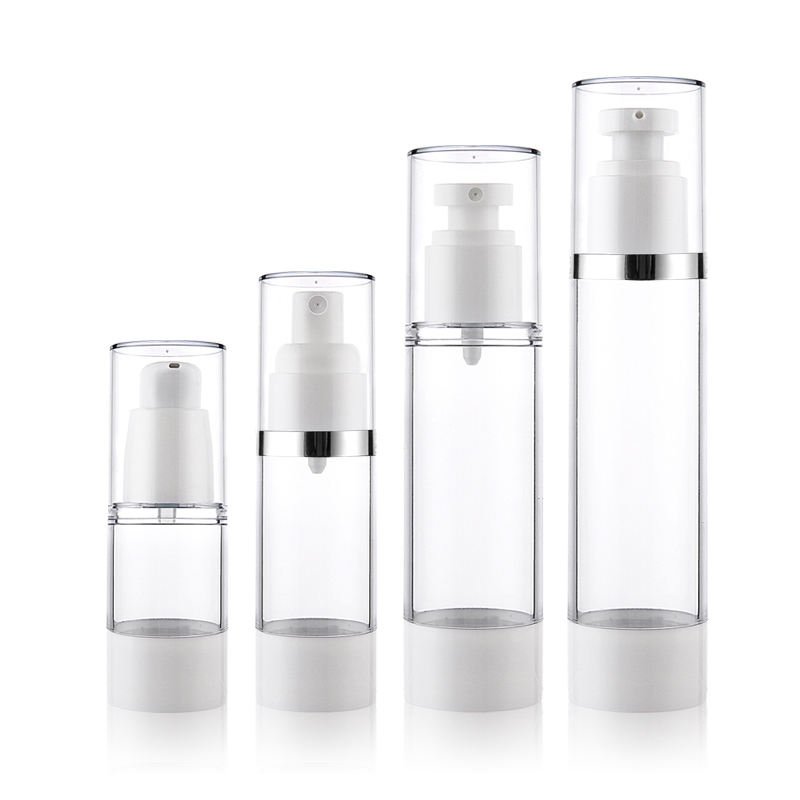
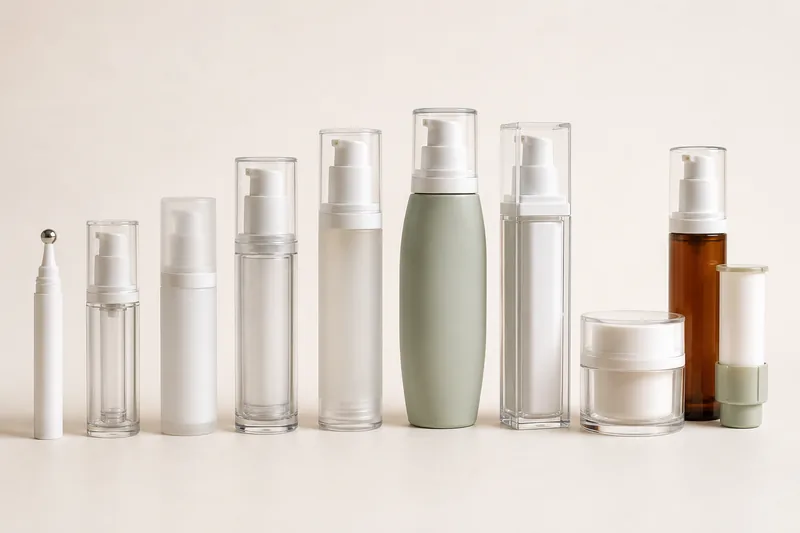
Boyu website image illustrating common airless formats. Availability and construction are confirmed model by model.
Capacity
Typical positioning
50ml
Core premium face cream, daily moisturizer, sunscreen and treatment lotion. Compact enough for gift sets while providing meaningful retail volume.
60ml
Useful when the market or formulation brief calls for a two-ounce class format; confirm the exact labeled claim for the sales country.
80ml
A mid-to-large skincare format that can differentiate a line without the height or mass of some 100ml packages.
100ml
Larger daily-use lotion, body treatment, family skincare or professional formats. Check hand comfort, pump output and freight weight.
Coordinated family
A 30/50/100ml or 50/80/100ml series may share visual language, but each capacity requires its own drawing, performance approval and usually separate MOQ.
Bottle Weight and Wall Thickness
Two 50ml airless bottles can have very different weights. A single-wall PP design emphasizes lower mass and practical handling; a double-wall AS, PETG or PMMA-look package adds an outer shell and a heavier premium feel. The pump, cap and decorative collar can contribute significantly to the assembled mass.
How to specify weight
List the empty complete-pack weight in grams and the main component weights when freight, recycled-content accounting or line handling matters. Approve a tolerance by selected model and sample across relevant mold cavities. Weight alone does not prove wall balance, seal quality or drop performance.
How to specify wall thickness
Define measurement locations. A local minimum is more useful than one vague “average thickness.” For a double-wall bottle, state inner product chamber, outer shell and base/shoulder requirements separately. Confirm the method because external calipers cannot measure every internal wall.
Controlled value
Unit / reference
Procurement purpose
Complete empty-pack mass
g including bottle, piston, pump and cap
Freight planning, packing design, line handling and unit comparison.
Product-contact chamber mass
g for inner bottle/chamber and piston where separable
Material mapping and design review for formula-contact parts.
Minimum local wall
mm at defined inner chamber points
Helps identify thin regions near shoulder, base, gates or geometry transitions.
Decorative outer-wall thickness
mm at defined locations for double-wall models
Controls visual depth, stiffness, part fit and assembled weight.
Piston-cylinder dimensions
mm with sealing and sliding references
Influences friction, vacuum response and risk of product bypass.
Assembled height and diameter
mm including cap/pump envelope
Supports carton cells, line guides, labels and shelf planning.
Main Materials and Where They Are Used
An airless bottle is a multi-part system. The material named in a sales title may describe only the body or outer shell, not every pump and piston component. Ask for a bill of materials that distinguishes formula-contact parts from decorative parts. Buyers comparing adjacent formats can also review Boyu’s plastic cosmetic bottle range and lotion bottle collection.
Material
Common role
Advantages
Points to validate
PP
Single-wall body, inner bottle, piston, pump and cap components depending on design.
Good chemical resistance, useful hinge/fatigue behavior and opaque or translucent color options. Can support simplified material strategies in carefully engineered packs.
Exact resin grade, clarity limits, dimensional shrinkage, formula interaction and whether springs/other polymers prevent a mono-material claim.
AS / SAN
Clear rigid outer shell or selected body components.
High transparency and a glass-like appearance for premium double-wall designs.
Impact behavior, stress cracking, formula contact, decoration and shipping performance.
PETG
Clear outer wall or selected bottle body designs.
High clarity, strong shelf presentation and good design flexibility.
Exact forming route, chemical compatibility, heat exposure, stress cracking and component fit.
PMMA / acrylic
Luxury transparent outer shell, cap or decorative component.
Optical depth, rigidity and premium hand feel.
Higher mass/cost, brittleness, scratch appearance and whether it is isolated from the formula.
ABS
Actuator, shoulder, cap or plated decorative components.
Good rigidity, molding detail and surface-finishing options.
Formula contact, coating/plating durability, recycling claim and dimensional consistency.
PE / elastomer / gasket materials
Piston lip, seal or selected soft components according to system design.
Controlled flexibility can support sliding seals and valve function.
Swelling, compression set, friction, odor and long-term compatibility with the actual formula.
PCR resins
Body or non-contact components where a validated grade and design permit.
Supports recycled-content objectives and can reduce virgin-resin use.
PCR percentage, source/documentation, color/odor variation, mechanical performance and formula-contact requirements in destination markets.
Factory Production and Assembly Process
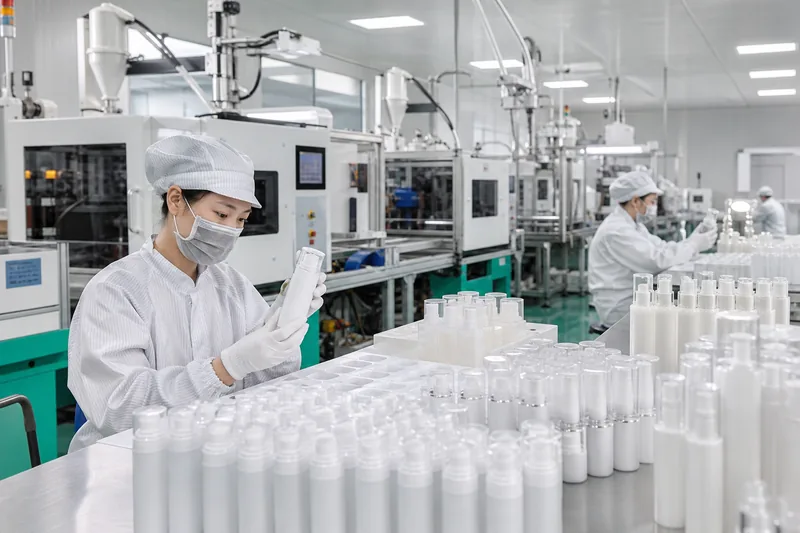
The route varies by model. Injection molding is common for pumps, pistons, caps and many rigid body/outer-shell parts; some bottle bodies use blow-molding routes suited to their resin and geometry. The approved process sheet—not a generic online temperature—controls molding conditions.
Boyu website production image illustrating molding, assembly and inspection activities for airless packaging.
01 · Project and formula review
Confirm capacity, viscosity range, filling method, formula risks, output target, appearance, quantity per SKU and distribution route.
02 · Component engineering
Select an existing airless platform or develop tooling. Freeze interfaces among the body, piston, pump, valve, cap and any outer shell.
03 · Resin preparation and molding
Release approved resin/color recipes, mold body and pump components, and monitor dimensions, flash, short shots, contamination, gates and cosmetic surfaces.
04 · Pump and valve assembly
Assemble springs, valves, actuators, collars and seals with controlled orientation and fit. Verify moving parts before final bottle assembly.
05 · Piston/body and outer-shell assembly
Install the piston at the required starting position and assemble single- or double-wall components. Keep the formula chamber and sealing areas clean.
06 · Decoration
Apply color, frosting effect, silk screen, hot stamping, metallization, UV/digital printing or labeling according to the approved standard.
07 · Functional and leak checks
Verify prime, output, valve recovery, piston movement, sealing and critical dimensions using the agreed test media and sample plan.
08 · Packing and release
Protect actuators and cosmetic surfaces, prevent mixed colors/SKUs, verify count and labels, and release the lot against inspection results.
How to Customize a Wholesale Airless Bottle
Customization can be visual, functional or structural. The lowest-risk route is usually an existing airless platform with approved colors and decoration. A new pump, piston or product-chamber interface requires more engineering than a new outer shell because it can change dispensing and sealing performance.
Customization service
Available direction
Technical approval required
Capacity and bottle family
50ml, 60ml, 80ml and 100ml models, plus coordinated smaller sizes where available.
Separate drawing, sample, MOQ and performance confirmation for each size.
Body / outer-shell color
Opaque, translucent, clear, white, black, custom matched color or selected PCR appearance.
Physical color standard, resin/process feasibility and batch tolerance.
Surface finish
Gloss, matte, soft visual effect, clear thick-wall appearance or metallic accents depending on material.
Adhesion, abrasion, formula splash and transport-rub checks.
Logo and artwork
Silk screen, hot stamping, UV/digital printing or label options on suitable surfaces.
Vector artwork, printable area, registration tolerance, color standard and rub/adhesion tests.
Pump and actuator
Lotion, cream or selected spray format; output, actuator shape, lock and overcap options depend on platform.
Formula viscosity, priming, dose, actuation force, compatibility and repeated cycling.
Cap, collar and shell
PP, ABS, clear outer shell, plated parts and coordinated colors/finishes.
Fit, retention, plated/coated durability and interference with pump actuation.
Private mold
Custom silhouette, shoulder, base, actuator or outer shell after feasibility review.
Partitioned cartons, individual protection, retail box or custom insert.
Final assembled dimensions, surface protection, pack-out test and pallet data.
OEM / ODM Approval Workflow
1 · RFQ and sample selection
Send formula category/viscosity, capacity, quantity per design, target market, output preference, artwork, reference photo and destination. Select several compatible platforms for review.
2 · Drawing and material map
Approve dimensions, component interfaces, weight fields, material locations, decoration area and filling instructions. Identify each formula-contact material.
3 · Component and decorated samples
Check appearance and dry function first, then make production-intent decorated samples using the proposed pump, piston and bottle components.
4 · Formula and filling validation
Fill with the real formula using the intended process. Condition samples, check leakage/compatibility, prime, output, evacuation, piston movement and package appearance.
5 · Golden sample and inspection standard
Sign the physical sample and issue measurable acceptance criteria, defect examples, color/artwork references and the agreed sampling plan.
6 · Production and change control
Release mass production after approvals. Any resin, pump, seal, color, mold or decoration change should be reviewed before it enters the order.
How to Avoid Leaking Airless Bottles
Leak prevention starts before production. The supplier, brand and filler must agree which interface each party controls. Empty-component testing can reveal assembly problems; only a filled-pack program can evaluate the actual formula, fill level, sealing cleanliness and distribution conditions.
Leak path / symptom
Likely contributors
Prevention and validation
Product around pump or collar
Pump/body mismatch, damaged sealing land, incorrect snap/torque, contaminated interface, deformed component or formula attack.
Use matched production components, protect the sealing surface, control assembly setting and perform filled upright/inverted/horizontal checks.
Formula at the bottom vent
Product bypassing the piston because of seal damage, dimension drift, debris, excessive pressure, incompatible formula or incorrect filling.
Control piston/cylinder dimensions and cleanliness; validate piston friction and filled-pack conditioning. Do not block a functional vent to hide the symptom.
Pump drips after dispensing
Valve recovery issue, unsuitable output/orifice, high product stringing, actuator contamination or formula compatibility.
Select pump around rheology, assess suck-back/recovery and check repeated actuations under use conditions.
Bottle loses prime
Air path at an interface, valve malfunction, piston sticking, blocked base vent or improper fill/assembly.
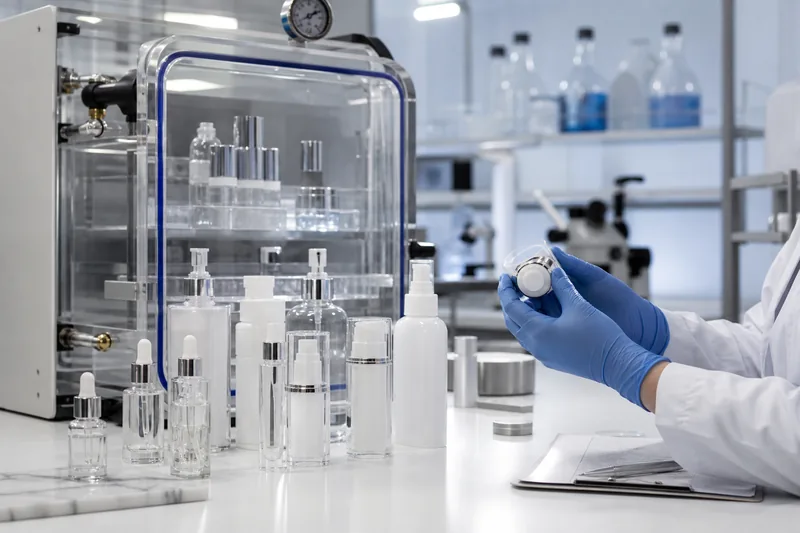
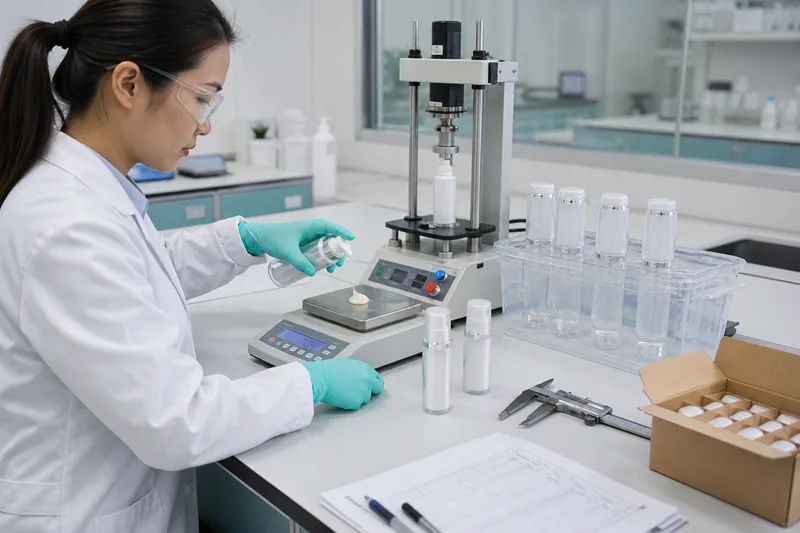
Boyu website image illustrating functional and dimensional quality checks. Actual test methods and sample sizes are agreed per project.
A signed sample is only the starting point
The approved sample, controlled drawing, material map and artwork should define the production reference. The inspection plan then states what is checked, the instrument or method, sampling frequency, acceptance criteria and required records.
Critical functional checks deserve risk-based validation samples across relevant mold cavities and lots. Routine lot inspection may use a documented sampling plan, while 100% checks can be assigned to defects where equipment and risk justify them. Do not assume every QC item is checked on every bottle.
Quality gate
Checks
Record / decision
Incoming materials and components
Resin/part identity, color, cleanliness, pump/valve/seal references and approved supplier lots.
Material/component traceability and release status.
Molding
Dimensions, weight, wall/gate/flash condition, appearance, contamination, piston and body critical interfaces.
Cavity/process checks and nonconformance disposition.
Pump assembly
Valve orientation, spring/action, actuator movement, assembly fit and selected output/prime checks.
In-process functional results and line release.
Decoration
Color, gloss/matte level, print registration, foil/metal effect, adhesion and abrasion.
First-piece approval and retained decorated standard.
Finished airless system
Sealing, initial prime, dose, actuation force, piston travel, leak, evacuation and cycle behavior under the agreed media/formula.
Test report linked to model and production lot.
Packing / outgoing
Quantity, mixed-SKU prevention, cap protection, carton fit, marks, pallet data and any agreed pre-shipment inspection.
Final inspection and shipment release.
Validation Plan for the Real Formula
Water can be useful for basic leak screening but does not represent every serum, cream or sunscreen. The final formula may change seal friction, valve recovery, stress cracking, swelling, odor, color or coating adhesion. Use production-intent decorated components and the intended filling process. For creams and gels, compare the selected system with Boyu’s guide to pumps for high-viscosity products before approving the dispenser.
Compatibility conditioning
Define storage temperatures, orientations, durations and observation points with the formulation/quality team. Compare weight, dimensions, appearance, odor, seal behavior and mechanical function.
Dispensing study
Record first prime, dose variation, actuator force, pattern/stringing, valve recovery, piston travel and residual product throughout package life.
Mechanical and transport
Apply risk-appropriate drop, vibration, compression, thermal and pressure-related checks to the final filled pack-out, not an unpacked ideal sample.
Acceptance and change control
Freeze written criteria and retained samples. Revalidate when changing resin grade, formula, pump, piston/seal, mold, decoration or packing configuration.
Which Formulas Suit 50ml–100ml Airless Packaging?
Formula / product
Why airless may help
Confirm before approval
Facial moisturizer and cream
Controlled one-hand dispensing and reduced product exposure during normal use.
Viscosity, prime, dose, piston travel and evacuation.
Serum and treatment lotion
Useful dose control and a closed retail presentation.
Pump output, low-viscosity leakage risk, valve recovery and formula compatibility.
Sunscreen
Clean dispensing and protection from repeated finger contact.
High viscosity, mineral loading, separation, actuator effort and residual product.
Body treatment / 100ml lotion
Larger format with controlled delivery and premium shelf appearance.
Hand comfort, dose, package height, transport weight and repeated cycling.
Retinol / vitamin C skincare
May reduce repeated air exchange in a properly functioning piston system.
Packaging cannot guarantee formula stability; perform stability/compatibility tests and consider light exposure.
Very thick, particulate or fibrous formulas
May be difficult for a standard valve/orifice and can create high actuation force.
Use rheology/particle data and filled samples; choose a suitable pump or alternative package if performance is unstable.
Questions Professional Buyers Should Ask
Buyer question
What a useful supplier answer contains
Is every part actually PP, PETG or acrylic?
A component-level material map identifying formula-contact and decorative parts, rather than one headline resin.
What is the output per stroke?
A target and measured range under defined test media/formula, conditioning and actuation method.
How much product remains?
Filled amount, delivered amount and evacuation result under a repeatable end-of-life procedure.
Can the bottom vent leak?
An explanation of the vent function, piston seal design and filled-pack checks for product bypass.
Is the bottle refillable?
Opening/filling method, repeated-cycle validation and hygiene instructions. A removable cap alone does not establish safe consumer reuse.
Can the same pump fit another body?
Matching interface drawings and physical/filled fit tests. Visual similarity or body diameter is not proof.
Which weight and thickness are guaranteed?
Selected-model drawing, target/tolerance, measurement locations and production-intent sample report.
What exactly is included in price?
Body, inner chamber/piston, pump, cap, decoration and packing, plus separate tooling, samples, tests and freight exclusions.
How are defects handled?
Acceptance standard, evidence/notification procedure, traceability and a contract-based containment/corrective remedy process.
MOQ, Tooling, Price and Delivery
MOQ
Boyu’s standard starting point is 10,000 pieces per design. Each capacity, color and artwork version is reviewed separately. Special pump colors or custom components may require a higher production quantity.
Tooling
Using an existing complete platform usually avoids new structural molds. A private outer shell may be lower functional risk than modifying the piston, pump or product chamber; the exact mold plan follows a drawing review.
Price drivers
Construction, resin, bottle weight, pump mechanism, cap, color, decoration, quantity, individual protection, carton/pallet and delivery term all affect price.
Timing
Planning guidance is usually 7–15 days for samples after requirements are confirmed and around 30–45 days for production after approval and deposit. Tooling, compatibility testing and complex decoration add time.
Production and Delivery Workflow
1 · RFQ complete
Capacity, formula, viscosity, output, quantity, artwork, model reference, destination and delivery term received.
2 · Technical quotation
Components, materials, tooling, decoration, packing, tests, MOQ and exclusions written clearly.
3 · Sample approval
Appearance, fit, formula tests, pump function and filling instructions approved against documented criteria.
4 · Mass production
Molding, pump assembly, bottle assembly, decoration and in-process inspections proceed under the frozen standard.
5 · Final inspection
Verify finished-pack function, appearance, quantity, carton data and agreed pre-shipment evidence.
6 · Shipment
Coordinate EXW/FOB/CIF or other agreed term, export documents, pallets and freight separately from production lead time.
Sustainability and Refill Claims
Airless systems can improve product evacuation and reduce formula left in the pack, but performance must be measured with the intended formula. Material reduction, recycled content and refillability each have different engineering requirements; none should be assumed from appearance.
A simplified PP construction may support design-for-recycling objectives, yet springs, valves, coatings and local collection systems still matter. PCR percentage should be documented by component. A refill claim needs a practical opening/refilling route, repeat-use performance and consumer hygiene guidance.
Wholesale Airless Bottle Questions & Answers
What is an airless pump bottle?
It is a dispensing package designed to reduce air exchange with the product chamber during use. In a common piston system, product dispensing raises an internal piston as the chamber volume decreases.
Does an airless bottle contain no air at all?
No. Air may be present below the piston and enter through the base vent so the piston can move. The formula chamber above the piston should remain separated according to the system design.
Why is there a hole in the bottom?
For many piston airless bottles, it is a functional vent that admits air below the piston. Blocking it can stop piston travel. Product emerging from it is abnormal and should be investigated.
What capacities are available between 50ml and 100ml?
Common project options include 50ml, 60ml, 80ml and 100ml, depending on the chosen series. Each size requires a confirmed drawing, sample, MOQ and component availability.
How many grams does a 50ml or 100ml airless bottle weigh?
There is no fixed weight by capacity. Single-wall and double-wall designs differ substantially. Request the complete empty-pack grams and component breakdown for the selected model.
What wall thickness should an airless bottle have?
There is no universal value. Specify minimum local thickness at defined inner/outer wall locations, plus critical piston-cylinder dimensions, and verify production-intent samples.
Which material is best?
PP is a practical starting point for many systems; AS, PETG or PMMA-look outer walls can provide higher clarity and visual depth. The best structure depends on formula, appearance, weight, cost and sustainability goals.
How do you prevent bottom leakage?
Control piston and cylinder dimensions, seal condition, cleanliness, fill process and formula compatibility. Validate production-intent filled packs under defined orientations and conditions.
Why does a new bottle need several pumps before dispensing?
Initial strokes evacuate air from the pump/product path and establish prime. Record an acceptable priming range for the selected pump and formula.
Can airless bottles handle thick cream?
Some can, but performance depends on viscosity/rheology, valve, orifice, output and actuation force. Test the intended cream rather than assuming all airless pumps handle the same thickness.
Can colors, logos and metallic finishes be customized?
Yes, subject to model/material feasibility. Options may include resin color, coating, silk screen, hot stamping, UV/digital printing, labels, metallized collars and coordinated pump/cap colors.
Can you make a private mold?
Yes after feasibility and drawing review. Decide whether customization affects only the decorative shell or the functional airless platform; functional changes require a broader validation plan.
What is the MOQ?
The standard starting MOQ is 10,000 pieces per design. Capacity, color and decoration versions are generally reviewed as separate designs; special components may require more.
How should airless bottles be filled?
Follow the selected platform’s filling instructions. Control fill amount, piston start position, sealing cleanliness and pump assembly. Top-fill and bottom-fill designs are not interchangeable assumptions.
Can an airless bottle be reused?
Only if that design has a defined opening/refill method and is validated for repeated use. A removable pump alone does not address cleaning, hygiene, sealing or pump/piston life.
What should I send for a quotation?
Send capacity, quantity per design, formula type and viscosity, target output, reference shape, material/finish, pump and cap color, artwork, packing, destination and delivery term.
Request a Wholesale Airless Bottle Quotation
Send the formula category and viscosity range, 50ml–100ml capacity, quantity for each design, required pump output, material/appearance reference, artwork and destination. Boyu can review existing platforms first and identify where custom tooling or testing is needed.
Commercial brief
Capacity • quantity per SKU • target price level • decoration • destination • required delivery date
Technical brief
Formula/rheology • pump output • material map • weight/wall fields • fill process • compatibility and leak-test plan
 Custom Black Round Airless Pump Lotion Bottle 30-100ml
 Custom PET Black White Amber Cosmetic Spray Lotion Pump Bottle 100–200ml
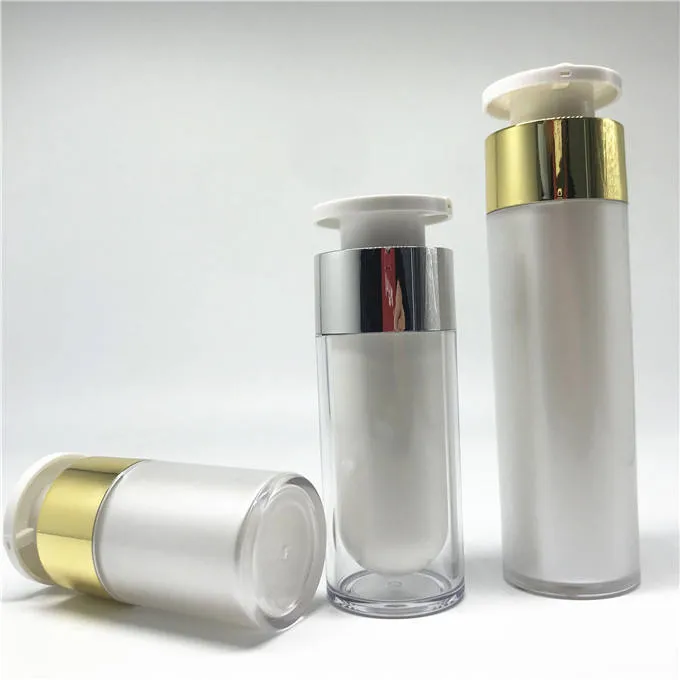 Body Lotion & Face Cream Vacuum Bottle with Pump Sprayer 15-50ml
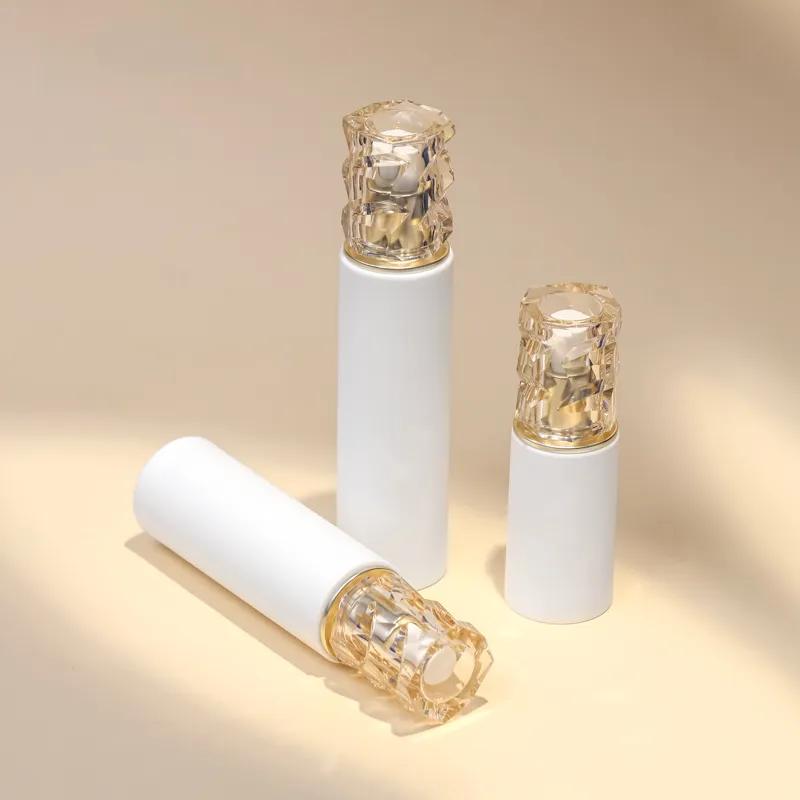 Custom Lotion Press Vacuum Pump Bottle 30-120ml
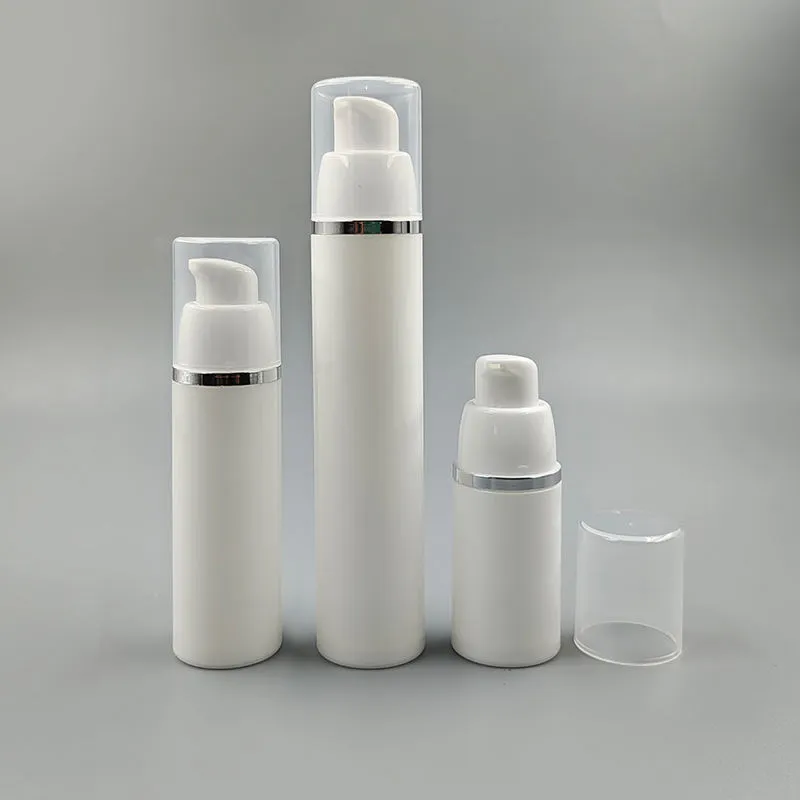 Custom Airless Pump Bottle for Cream Lotion Packaging 15/30/50ml
 4-in-1 Portable Travel Dispenser Bottle: Container Shampoo, Body Wash, and Cosmetics
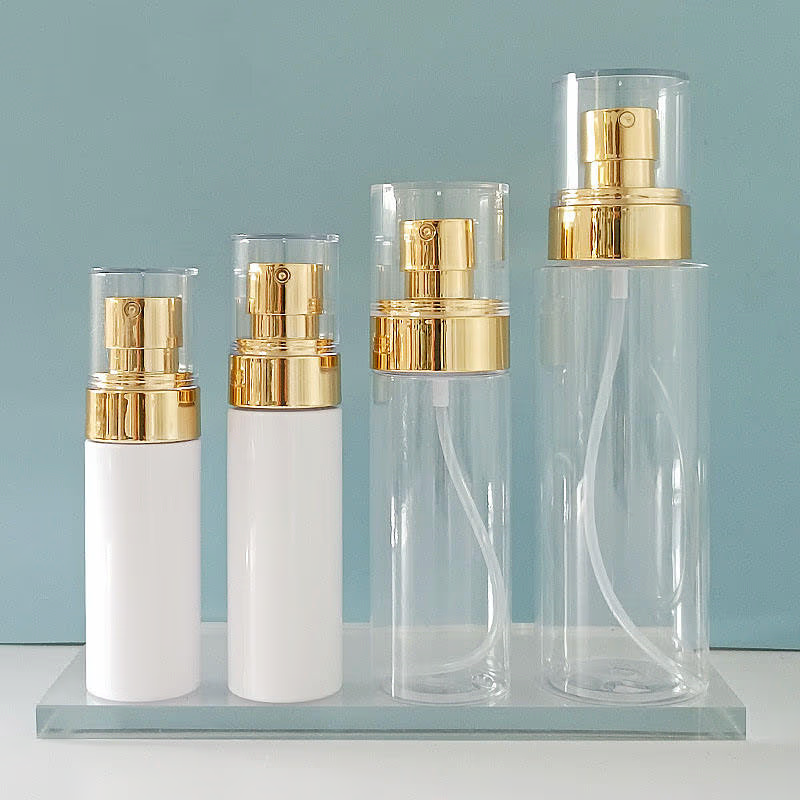 White PET Plastic Lotion Pump Bottle Double-Layer Sprayed Gold-Plated Cap 60-200ml
 Empty PET Plastic Foaming Soap Bottles with Foam Pump 200–500ml
 Plastic PET Shampoo Conditioner Body Lotion Bottles 250-500ml
 Pink PET Plastic Body Wash Shower Pump Bottle 500ml
 White Round Plastic PP Empty Lotion Airless Pump Bottle 15-50ml
 Square Amber Refillable Plastic Foam Pump Bottle 450ml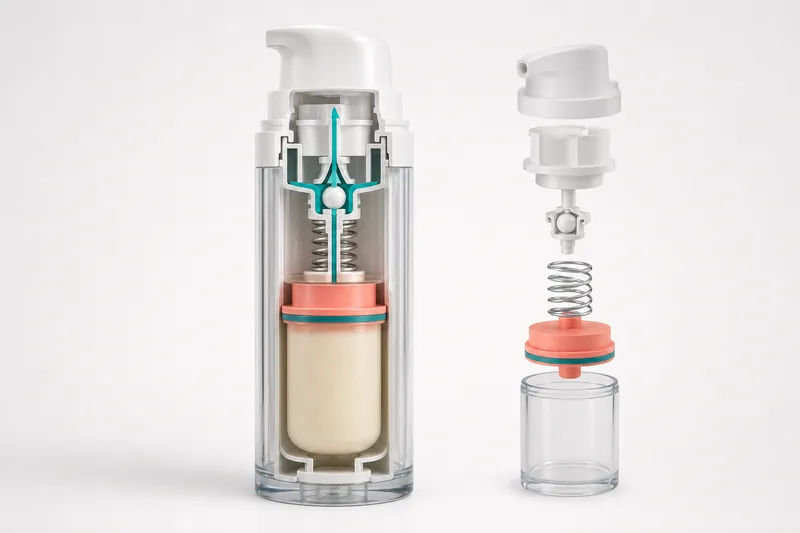
 English
  Español de Argentina
  Русский
  Italiano
  日本語
日本語  한국어
한국어  العربية
  Français
  Deutsch