

Direct answer: plastic bottle paneling occurs when pressure outside a sealed shampoo or lotion bottle becomes greater than pressure inside it, and the bottle’s sidewall is not stiff enough to resist the difference. The pressure loss can develop when a warm-filled pack cools, headspace gas is consumed or absorbed, water or volatile ingredients permeate through the package, or the pack moves to a different temperature or atmospheric pressure. Conveyor compression and poor wall distribution can create or localise the dent, but they are not the only causes.
The correct fix depends on when the paneling begins. A bottle that caves in within minutes of capping has a different investigation path from one that changes after six weeks or only after air shipment. Preserve affected samples, record the timeline, compare filled mass and dimensions with retained controls, and test the actual production bottle, closure and formula before changing bottle weight, fill temperature, headspace or ventilation.
This guide is for cosmetic brands, packaging engineers, quality teams, fillers and bottle suppliers. “Paneling” and “panelling” refer to the same inward sidewall collapse. There is no universal safe fill temperature, bottle weight, wall thickness or vacuum limit for every PET, HDPE, PP or PCR bottle.
What is plastic bottle paneling?
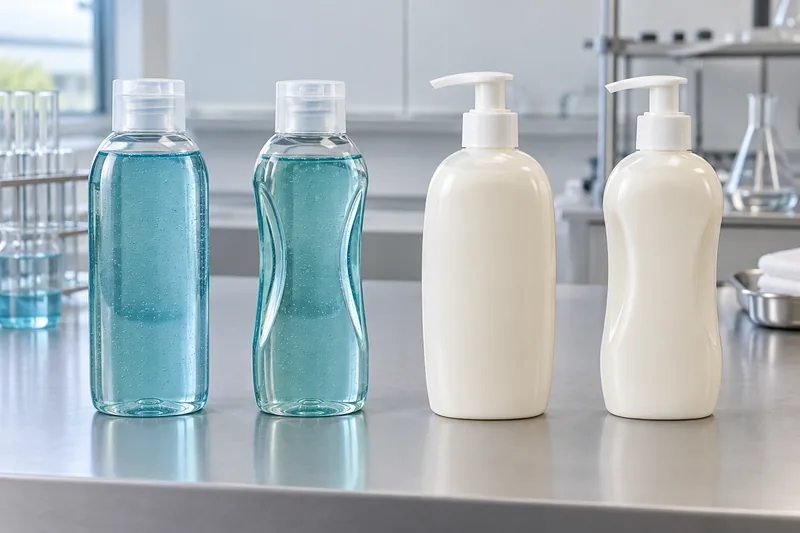
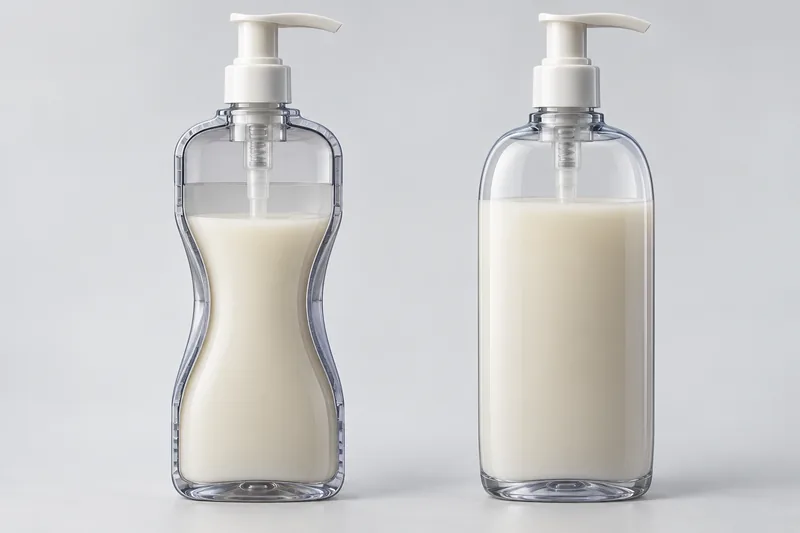
Paneling is the permanent or temporary inward deflection of one or more bottle walls. It is most visible on broad, relatively flat panels, but it can also appear as an hourglass waist, a single concave patch or several dents around a round bottle. The governing condition is simple: external pressure exceeds internal pressure by enough to buckle the available structure.
The pressure difference is the driver; wall stiffness and geometry determine how the package responds. A lightweight bottle may show the problem first, but merely adding resin can mask rather than remove an ongoing gas-loss, thermal or permeation mechanism. Conversely, a well-designed light bottle may outperform a heavier bottle with a large unsupported label panel or uneven wall distribution.
Paneling is not every kind of bottle deformation
| Observation | What it may indicate | Why the distinction matters |
|---|---|---|
| Sidewall caves inward after sealing | Paneling from negative internal pressure or applied compression | Investigate pressure history, gas loss and structural resistance. |
| Bottle bulges outward or base rocks | Positive internal pressure, gas generation, thermal expansion or inadequate heat resistance | This is the opposite pressure direction and requires a different safety assessment. |
| Identical dent exists before filling | Moulding, cooling, ejection, packing or transport damage | A retained empty-bottle control can separate bottle production from filled-pack effects. |
| White lines, crazing or cracks appear | Stress concentration or environmental stress cracking | Structural collapse and chemical stress cracking can coexist, but they are not synonymous. |
| A flexible tube stays flattened after dispensing | Poor air return, blocked orifice or tube-recovery issue | Tube behaviour should not be diagnosed with a rigid-bottle paneling rule. |
First inspect unfilled retained bottles from the same lot. If the empty control already carries the feature, start with blow moulding, cooling and pack-out. If it appears only after the production pack is filled and sealed, treat the bottle, formula, closure, fill process and environment as one system.
The fastest diagnostic tool: when did the bottle cave in?
The elapsed time between filling and visible deformation is often more useful than the resin name. Build a timeline from line video, production records, warehouse checks, shipment data and retained samples. “It arrived dented” is not enough; determine the earliest point at which a known-good unit became abnormal.
| When paneling first appears | Priorities to investigate | Useful evidence |
|---|---|---|
| Before filling | Wall distribution, mould cooling, ejection, empty-bottle packing and stacking | Cavity map, bottle mass, section weights, dimensions and empty controls |
| During handling or capping | Guide rails, star wheels, grippers, capping-head pressure and unsupported flat panels | Slow-motion video, contact marks, deformation orientation and line-position correlation |
| Minutes to hours after warm filling and sealing | Product and headspace cooling, closure timing, fill-temperature variation and bottle heat softening | Actual product temperature at fill/closure, cooling curve and cap-on time |
| Days or weeks, with measurable mass loss | Leakage, water/solvent permeation, volatile loss, closure transmission or formula absorption into plastic | Unit-by-unit mass trend, seal inspection, reference container and controlled storage |
| Days or weeks, little measured mass loss | Oxygen consumption, gas dissolution/absorption, slow thermal effects, structural creep or a gas leak too small for the mass method | Headspace/oxygen study, chemistry controls, dimensional trend and closure integrity |
| Only after transport or a climate transition | Altitude/barometric history, temperature cycling, stacking, vibration or closure movement | Route profile, data logger, pack-out condition and distribution simulation |
Why shampoo and lotion bottles panel: six root-cause families
1. Warm product is sealed, then cools
If a bottle is closed while its contents and headspace are warmer than the later storage condition, cooling can reduce internal pressure. The bottle wall may also be softer while warm, so it can deform before the system fully stabilises. The exact result depends on product temperature, headspace, liquid thermal contraction, bottle-volume change, closure timing, seal behaviour and bottle stiffness.
For the gas portion alone, the ideal-gas relationship gives a useful direction: at constant gas amount and volume, absolute pressure changes approximately in proportion to absolute temperature, P₂ ≈ P₁ × T₂/T₁. A real filled bottle is not a fixed-volume gas flask: liquid and bottle volumes change, gas can dissolve or permeate, and the closure may leak. Use the equation to understand direction, not to predict a pass/fail pressure.
2. The formula consumes or absorbs headspace gas
Oxidation or another formulation reaction can consume oxygen in the headspace. Gas can also dissolve in or be absorbed by the product. If replacement gas does not enter through the package at the same rate, internal pressure falls. Antioxidants, botanical systems, oils, fragrances, colourants and other ingredients can change oxygen demand, but the risk cannot be inferred reliably from an ingredient name alone. Compare the final formula against a suitable reference and, where justified, measure headspace composition.
A formulation-driven mechanism can be slow and lot-dependent. Changes to fragrance, antioxidant system, raw-material history, mixing aeration or fill temperature may alter the behaviour even when the bottle is unchanged.
3. Water, solvent or another component leaves through the package
A sealed plastic pack is not automatically an absolute barrier. Molecules can permeate through the bottle wall, closure, liner, pump, dip tube or interfaces. Formula components may also partition into a polymer. Loss of liquid or vapour can lower the internal pressure and reduce product mass. The rate depends on the complete material system, surface area, wall distribution, concentration gradient, seal, temperature and humidity.
ASTM D2684/D2684M addresses permeability of thermoplastic containers to packaged products under specified conditions and expresses results for many container designs as a rate of weight loss or gain. That principle is useful for cosmetics, but the standard does not turn one short accelerated result into a universal shelf-life prediction. The actual formula and intended conditions must be used, and extrapolation beyond the evidence requires caution.
4. Atmospheric pressure or temperature changes during distribution
A pack filled, sealed and equilibrated at one location can see a different barometric pressure at a higher or lower elevation. Air shipment, mountain routes and destination altitude may create pressure differentials. ASTM D6653/D6653M is specifically designed to evaluate effects of high-altitude pressure differential on packaging systems by vacuum method; its published scope notes feeder-aircraft exposure up to 5,791 m (19,000 ft) and describes results as qualitative. It does not prescribe one cosmetic-bottle pass limit.
Temperature and altitude can interact. A pack may cool in an aircraft hold, warm in a container or experience warehouse cycles. Distribution testing should reflect the route sequence, not test each hazard in isolation and assume the combined result.
5. The filling line mechanically compresses the bottle
Guide rails, star wheels, feed screws, grippers and capping heads can push on an unsupported panel. If the closure seals while the wall is compressed, the bottle can remain deformed when the load is released because the sealed system resists recovery. A repeated dent at the same height and orientation is a strong clue. This cause may be called paneling in everyday production language even though the initiating force is mechanical.
Run marked bottles through individual stations and inspect before and after each contact. For line-related risks such as rail position, base stability and capping-head alignment, your filler’s documented line trial is the controlling evidence. A hand-filled sample does not prove that the bottle will pass rails, transfer points, capper loads and accumulation on an automatic line.
6. Bottle structure cannot tolerate the applied differential
Large flat panels, sharp transitions, locally thin areas, asymmetric wall distribution and inadequate support near shoulders or bases can buckle first. Resin grade, orientation, crystallinity, moulding history, bottle temperature and long-term creep also influence stiffness. Repeated deformation may reduce resistance; a bottle that has already paneled should not automatically be treated as a representative unused test specimen.
This structural factor is often an amplifier. If a formula continuously removes gas or a warm-filled pack develops a strong vacuum, a more rigid bottle may delay visible damage without correcting the underlying pressure imbalance.
Does bottle material cause paneling?
Material matters, but resin family alone does not determine success. Compare resin grade, manufacturing process, wall distribution, shape, bottle mass, temperature and the formula-package interaction. The following tendencies are selection considerations, not compatibility approvals.
| Material/system | Typical packaging behaviour | Paneling checks |
|---|---|---|
| PET | Clear, glossy and relatively rigid; commonly stretch-blow moulded with oriented walls. | Preform/design wall distribution, panel geometry, fill temperature and formula/barrier performance. |
| HDPE | Tough, usually opaque/translucent and often squeeze-friendly; commonly extrusion-blow moulded. | Parison programming, corner/shoulder thickness, panel recovery, permeation and formula sorption. |
| LDPE or flexible PE-rich system | Soft and easy to squeeze. | Low stiffness can make pressure or air-return effects more visible; validate closure venting and recovery in actual use. |
| PP bottle | Good chemical resistance in many systems and used for some bottles, airless packs and many closures. | Grade/process, wall design, heat history, formula and complete dispensing system. |
| PCR-containing PET/HDPE/PP | PCR identifies recycled feedstock within a polymer family; it is not a separate polymer. | Control grade, source, percentage, contamination/odour, colour, mechanical variability and processing. Do not assume PCR content alone caused the failure. |
For a fuller resin comparison, see Boyu’s guide to plastics used for shampoo bottles. Buyers can then compare production formats in the plastic cosmetic bottle range, shampoo bottle category and lotion bottle category. Category selection is a starting point; production-equivalent filled-pack testing is still required.
Will a thicker or heavier bottle fix it?
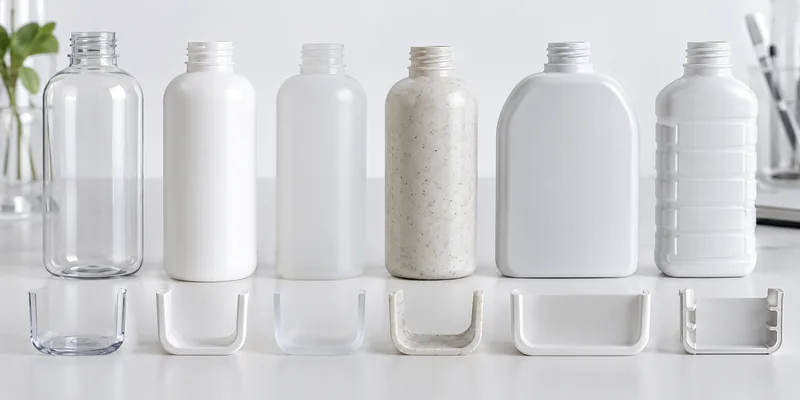
It may increase resistance, but it is not a guaranteed root-cause correction. Compare minimum wall distribution in critical zones, not just average mass. A few grams added to an already thick base will not strengthen a thin central panel. Request a section-weight study, critical-wall map, cavity data and controlled vacuum or filled-pack comparison. Also confirm that added stiffness does not harm squeezing, dispensing, recyclability goals, line handling or cost.
Does PCR make bottles more likely to panel?
Not inherently. A qualified PCR grade processed within a controlled design can perform acceptably. Risk rises when feedstock properties, contamination, degradation, blend ratio or process control create mechanical variation. Treat PCR percentage, source/grade and change control as specification variables, then qualify the finished pack. Boyu’s PCR cosmetic packaging guide explains why recycled content must be evaluated within its base polymer and end use.
How shampoo and lotion formulas affect paneling
A formula can affect the pack mechanically, chemically and through mass transfer. “Water based” does not prove compatibility. Shampoo may contain surfactants, salts, fragrance, conditioning polymers, silicones, botanical extracts, acids or alkalis. Lotion may contain water, oils, emulsifiers, fragrance, active ingredients, humectants and gases incorporated during mixing. Each can alter oxygen demand, gas solubility, sorption, permeation, stress-crack risk, viscosity or the required fill process.
- Viscosity is not the direct pressure cause. A thick lotion does not automatically panel a bottle. It may, however, require warm filling, retain aeration or affect how temperature equilibrates.
- Surfactants are not a universal paneling trigger. They can affect stress cracking and interfacial behaviour in some polymers, while paneling still requires pressure/compression plus insufficient structural resistance.
- Fragrance and solvent content matter beyond odour. Components may be absorbed by plastics, permeate, alter a liner or change mass-loss behaviour.
- Aeration complicates the baseline. Foam or entrained air can collapse after filling, changing fill level and headspace interpretation even when the bottle itself remains sealed.
- Formula oxidation can change headspace. Confirm it with controls or analytical evidence; do not diagnose oxygen consumption only from a dent.
Run cosmetic packaging compatibility testing with the final fragrance, colour, preservative, active system, resin, colourant, closure and decoration. A base formula in an undecorated bottle cannot clear every risk in the marketed pack.
How temperature, humidity, altitude and storage affect bottle collapse
Temperature changes gas pressure, liquid volume, polymer stiffness, creep, permeation rate and reaction rate. Record the actual product temperature at the filler, the temperature at closure application and the later conditioning profile. Room setpoint is not a substitute for product temperature inside the bottle.
Humidity can change the driving force for water transmission and affect labels or cartons, while low humidity and heat may accelerate water loss from some package systems. Its importance depends on formula and barrier path.
Altitude and barometric pressure change external pressure. Use the actual fill site, warehouse, transport modes and destination to define a pressure profile. A bottle that passes at sea level is not thereby qualified for every mountain route or unpressurised feeder-aircraft exposure.
Storage orientation and secondary packaging change contact and mechanical loads. Upright, side and inverted specimens can reveal different seal, permeation and formula-contact behaviours. Corrugated dividers, shrink film or pallet compression can constrain bottle recovery or create repeatable dents.
A practical root-cause investigation
- Quarantine and preserve evidence. Separate affected and unaffected units by lot, cavity, shift, line, formula batch and location. Do not open all samples.
- Define the defect. Photograph every face with a scale, record dent depth or critical dimensions, and note whether the closure, base or label also moved.
- Build the timeline. Identify the earliest good and first bad checkpoint. Recover product temperature, closure time, cooling, warehouse and shipment data.
- Compare controls. Include empty bottles, the same formula in a suitable reference container, known-good production packs and, if useful, alternate bottle materials/designs.
- Measure unit-by-unit mass. Clean exteriors and weigh the same units at baseline and planned intervals on a suitable calibrated balance. A downward trend supports leakage, permeation or volatile loss but does not locate the path.
- Map bottle structure. Record total mass, section weights, minimum critical wall, dimensions, cavity and resin/colour/PCR lot. Destructive sectioning may be necessary.
- Check closure integrity. Inspect sealing land, liner/gasket, threads or snap, pump collar and application setting. Gas exchange can occur without a visible puddle.
- Reproduce one factor at a time. Compare closure timing, temperature profile, formula, bottle design, line pressure or distribution condition while holding the rest constant.
Mass-change calculation
Change for one pack = conditioned filled-pack mass − its own baseline mass. Report the sign, elapsed time, condition and balance resolution. Correct interpretation requires matched controls because residue, label moisture, handling and instrument drift can influence small changes.
A cosmetic bottle leak-testing method can investigate seal paths, while a permeability/mass-loss study addresses slow package transmission. These are related but not interchangeable. A passed liquid-leak screen does not exclude gas transfer through a small path or permeation through a wall.
How to fix plastic bottle paneling
Select a correction only after the mechanism is supported by evidence. Changing several variables at once may make a trial pass without revealing which control must be maintained in production.
If cooling after closure creates the vacuum
- Reduce or better control fill temperature where product safety, viscosity and process requirements allow.
- Optimise the time and temperature at closure application through a documented line trial.
- Evaluate a bottle/resin/process designed for the real fill-temperature window.
- Review headspace and fill-volume specifications as a system; do not copy a universal percentage.
Why no universal headspace rule? Gas volume, liquid contraction/expansion, bottle compliance, closure behaviour, aeration and fill accuracy all interact. Increasing or decreasing fill can also create underfill, overflow, leakage or pump-dip-tube issues. Validate a defined fill range rather than using “more headspace” or “less headspace” as a slogan.
If formula chemistry or gas absorption drives the pressure loss
- Confirm the mechanism with formulation controls and headspace or chemical analysis where justified.
- Review antioxidant, fragrance, raw-material and process changes with the formulator.
- Evaluate a compatible package with sufficient structural or barrier performance.
- Consider inert-gas management only through a controlled filling study; gas dosing can create its own pressure, safety and process risks.
If permeation or volatile loss is responsible
- Locate whether the dominant path is bottle wall, closure, liner, pump or interface.
- Compare compatible resin grades, wall distributions, barrier structures or closures under the same conditioning protocol.
- Measure product mass, formula condition and package function through the claimed life.
- Perform regulatory and recyclability review before adopting coatings, multilayers or surface treatments.
If line pressure initiates the dent
- Reposition guide rails and contact points away from unsupported panels.
- Reduce unnecessary gripper, star-wheel or capping-head load within validated equipment limits.
- Add container handling or pucks where justified, and confirm the change does not reduce throughput or stability.
- Redesign the contact zone, base or sidewall if the process cannot safely avoid it.
If bottle structure is the limiting factor
- Improve wall distribution through preform, parison or blow-process control rather than adding mass blindly.
- Reduce broad unsupported flat areas or add subtle ribs, beads, curvature or engineered vacuum panels where the brand design permits.
- Use finite-element analysis and prototypes as development tools, then confirm with production-moulded bottles.
- Set cavity-specific dimensional and section-weight controls so a good average does not hide a weak cavity.
How to fill, close, store and use the bottle correctly
A qualified bottle can still panel when production operates outside the approved window. Convert development results into line settings, warehouse rules and change controls that operators can actually follow.
- Condition empty components as specified. Bottles stored very cold or hot can behave differently on the line. Keep them clean, covered and protected from prolonged loads that pre-dent broad panels.
- Control the product—not just the tank setpoint. Measure representative formula temperature at the filling nozzle and at closure application. Define actions for values outside the validated range.
- Hold fill and headspace within specification. Verify fill by a validated mass or volume method that accounts for formula density. Do not manually “top up” units beyond the approved fill range.
- Avoid squeezing a bottle before it is sealed. Rails, hands and grippers should not compress the panel while the cap or pump is applied. Confirm capper load and alignment during changeover.
- Apply the approved closure setting. An overtightened closure can damage a seal or neck; an undertightened one can create gas or liquid paths. Torque is one control variable, not proof of sealing by itself.
- Allow the defined cooling and conditioning time. Do not case-pack warm, soft bottles under heavy compression unless that condition was validated.
- Use the approved shipper, orientation and route. Protect the panels from divider or shrink-film loads and keep warehouse temperatures within the product/package specification.
- Do not “repair” consumer packs by puncturing or loosening closures. If paneling is observed in market stock, quarantine and assess the batch according to the company’s complaint and product-safety procedure.
Consumer instructions should reflect the product rather than the defect: store within the labelled temperature range, close the pack after use and do not transfer the formula to an unqualified container. For pump bottles, repeated normal actuation changes headspace and must be represented during development if it could affect shape or dispensing.
How to validate a bottle against paneling
A useful programme connects the suspected cause to a measurable challenge. There is no universal “paneling test” that clears all cosmetic bottles. The IoPP/PDI technical paper provides a useful vacuum-resistance concept for plastic drums, but its apparatus and values must not be copied as a cosmetic-bottle standard. Develop a bottle-specific method with calibrated equipment and documented acceptance criteria.
- Freeze the test article. Record resin grade/source, PCR percentage, colourant, mould and cavity, bottle mass/critical walls, finish, closure/pump, liner or gasket, decoration, formula batch and fill process.
- Establish baseline measurements. Photograph all sides; record filled mass, fill level, critical dimensions, closure application, product temperature and time from fill to seal.
- Use replicates and controls. Include more than one production unit, multiple relevant cavities/lots, empty controls and a suitable formula reference. Sample count should follow risk and variability, not a generic online number.
- Run realistic storage. Cover normal and justified stressed temperatures, relevant humidity, upright/side/inverted orientation and partially used packs if consumer use changes headspace.
- Challenge distribution. Reproduce pressure/altitude, thermal cycles, vibration, compression and drop hazards relevant to the final pack-out and route.
- Measure at planned intervals. Track mass, deformation depth/dimensions, formula appearance/odour/viscosity where relevant, leakage, torque and dispensing.
- Define pass/fail in advance. Examples may include no permanent unacceptable paneling, no leakage, dimensions within line/label limits, mass change within a justified limit and acceptable pump function. Numeric limits must be product-specific.
- Retest meaningful changes. Formula, fragrance, resin grade/source, PCR percentage, colour, bottle weight, mould/cavity, closure, fill settings, plant or route changes can invalidate prior evidence.
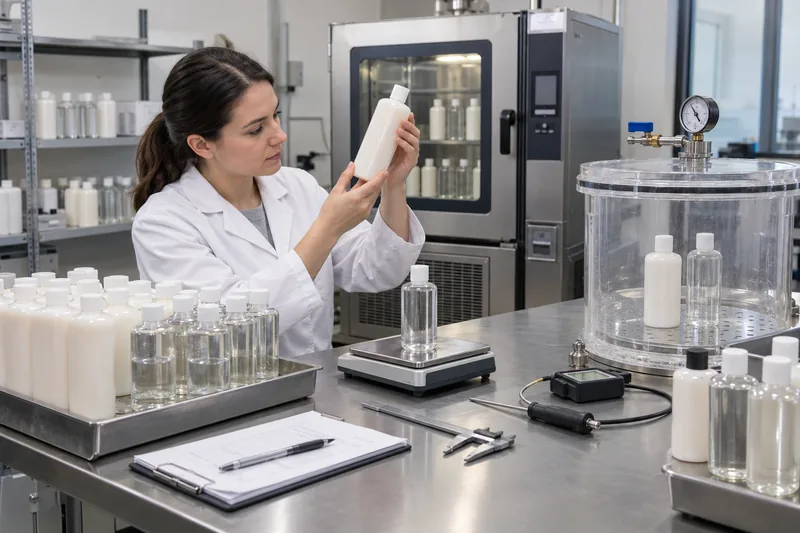
For the wider qualification programme—dimensions, leakage, compatibility, dispensing, drop and distribution—use the cosmetic bottle testing checklist. Paneling approval should sit inside that system, not replace it.
Plastic bottle paneling troubleshooting matrix
| Pattern | Most useful first checks | Potential direction after confirmation | Common wrong response |
|---|---|---|---|
| Panels within an hour of capping | Fill/closure temperature, cooling curve, cap-on timing, line compression | Control thermal/closure sequence; qualify suitable package structure | Changing resin without recording temperature |
| Slow paneling plus mass loss | Unit mass trend, seal path, volatility, material/closure comparison | Improve verified barrier or seal path; reconsider compatible materials | Calling it oxidation based only on appearance |
| Slow paneling without clear mass loss | Formula/reference controls, headspace, gas leakage sensitivity, temperature history | Address gas consumption/absorption or package path after confirmation | Assuming a stable scale reading proves no gas movement |
| Same-side dent on most bottles | Guide rail, star wheel, gripper, capping head and carton contact | Correct contact load/position or reinforce local geometry | Adding bottle weight before checking the line |
| One cavity or mould position fails | Cavity ID, section weights, wall map, cooling and process records | Correct tooling/process and tighten cavity controls | Blending failed and good cavities in one average |
| Only one formula panels the same bottle | Final formula, mass trend, headspace, fill temperature and reference pack | Adjust formula/process or select compatible barrier/structure | Using water as proof of compatibility |
| Only shipment samples fail | Route altitude/temperature, pack-out compression, vibration and closure movement | Validate final shipper and route-relevant sequence | Passing a static warehouse test and stopping |
What to put in the RFQ, quality agreement and control plan
- Final product category, relevant ingredients, viscosity range, density, volatility concerns, fill temperature range and aeration/foaming behaviour.
- Nominal fill, brimful capacity, permitted fill range, headspace method and filling/closure sequence.
- Bottle polymer, exact grade/source, PCR percentage/source where used, colourant/additives, bottle mass and critical wall/section-weight specification.
- Mould/cavity identification, critical dimensions, panel geometry, base stability, neck finish and approved drawing revision.
- Closure or pump model, liner/gasket, application setting, seal interface, dip tube and transport lock.
- Filling-line contacts and speeds, capper method, cooling/conditioning, secondary packaging and pallet configuration.
- Markets, fill and destination elevations, distribution modes, storage range and shelf-life target.
- Paneling inspection method, reference/boundary samples, measurement points, test conditions, intervals, sample plan and acceptance limits.
- Change-notification and reapproval requirements for formula, resin, PCR, colourant, mould/cavity, weight, closure, process, plant and route.
For supplier comparison, ask for production-representative samples and the data needed to reproduce the test—not a generic promise that a bottle is “anti-paneling.” If your team is selecting a format, Boyu Packaging can review shampoo bottle options and lotion bottle systems against the formula, fill process and route before formal qualification.
Frequently asked questions
Can a paneled bottle return to its original shape?
It may partially recover after pressure equalisation or warming, especially if deformation remained elastic. Permanent buckling, creep, heat history or stress can prevent full recovery. Do not rework a commercial lot merely by opening or reshaping bottles without investigating seal integrity, product safety, appearance and recurrence.
Does a vacuum pump test prove the bottle is suitable?
Only for the defined specimen, conditioning, ramp, hold and acceptance criterion. It can compare structural resistance, but it does not by itself prove formula compatibility, permeation, line handling, shelf life or distribution performance. The induced pressure difference must be justified for the real risk.
Is PET or HDPE better for preventing paneling?
Neither polymer is a universal winner. PET is often stiffer and clearer; HDPE is often tougher and more squeezable. Grade, shape, wall distribution, bottle mass, temperature, formula, closure and barrier needs determine performance. Compare production-intent packs with the same formula and process.
Can I puncture the liner or loosen the cap to relieve vacuum?
Not as an uncontrolled fix. It can create leakage, contamination, evaporation, oxidation and inconsistent opening torque. Any venting concept must be engineered and validated as part of the package, including microbiological and transport risks.
Why does only one side of the bottle cave in?
That side may be structurally weakest because of geometry or wall distribution, or it may contact a rail, gripper, carton or adjacent bottle. Mark orientation through the filling and packing line, map cavity and wall data, and compare the dent location across units.
Is bottle paneling only a cosmetic defect?
Not necessarily. It can make a label wrinkle, destabilise the pack, affect fill-level appearance, change pump dip-tube position or signal formula/package gas transfer. The product team must assess function, seal, stability, safety and consumer acceptability; appearance grading alone is insufficient.
Develop the bottle, formula and fill process as one system
To troubleshoot an existing failure or qualify a new shampoo or lotion pack, provide the formula category, bottle and closure specification, fill/closure temperatures, defect timing, photos, mass trend and distribution route. Boyu Packaging can help narrow production-intent samples and define the packaging questions your brand or test laboratory must verify.
Contact Boyu Packaging for a bottle and filled-pack review →
Sources
Standards and technical references were checked on 3 October 2026. Always confirm the current edition and purchase/use the full standard where required.
- ASTM D6653/D6653M-13(2021) — Effects of High Altitude on Packaging Systems by Vacuum Method
- ASTM D2684/D2684M-24 — Permeability of Thermoplastic Containers to Packaged Products
- ASTM D2561-17(2023) — Environmental Stress-Crack Resistance of Blow-Molded Polyethylene Containers
- Plastic Drum Institute / IoPP — Paneling White Paper
- Berlin Packaging — Overcoming Paneling With Plastic Bottles
- TricorBraun — Panelling of Plastic Bottles
- Container & Packaging Supply — What Is Paneling?

 English
  Español de Argentina
  Русский
  Italiano
  日本語
日本語  한국어
한국어  العربية
  Français
  Deutsch